Google has published a paper that might end the transformer era.
For the last 7 years, every major AI, ChatGPT, Claude, Gemini, has been built on the exact same architecture: The Transformer.
But Transformers have a fatal flaw.
To remember context, they have to process every single word against every other word. It’s called quadratic complexity. As your prompt gets longer, the compute cost explodes.
The alternative is the old-school RNN (Recurrent Neural Network). RNNs are incredibly cheap and fast, but they have a fixed memory size. If you give them a long document, they get amnesia.
Until today.
Google researchers published Memory Caching: RNNs with Growing Memory.
And it fixes the biggest bottleneck in AI.
Instead of an RNN having a fixed, rigid memory that constantly overwrites itself, Google gave it a "save" button.
The technique allows the RNN to cache checkpoints of its hidden states as it reads.
The memory capacity of the RNN can now dynamically grow as the sequence gets longer.
They built four different variants, including sparse selective mechanisms where the AI actively chooses exactly which checkpoints matter most.
The results rewrite the rules of efficiency.
On long-context understanding and recall-intensive tasks, these new Memory-Cached RNNs closed the gap with Transformers.
They achieved competitive accuracy without the explosive, quadratic compute cost. It perfectly bridges the gap between the cheap efficiency of an RNN and the massive capability of a Transformer.
We have spent billions scaling Transformers because we thought they were the only way an AI could remember a long conversation.
But Google just proved we don't need to process the whole history every single time.
We just needed a smarter cache.
🚨 Hedge fund managers are going to hate this. Someone just open sourced a system that does their entire job.
30.5% annualized returns. $0 in fees.
It's called TradingAgents.
Not one AI agent. An entire simulated trading firm. Analysts, researchers, traders, and risk managers. All AI. All arguing with each other before making a single trade.
No Bloomberg Terminal. No $50K data feeds. No MBA required.
Here's what's inside this thing:
→ 4 AI analysts scanning financials, news, social sentiment, and technicals
→ A Bull and Bear researcher that literally debate each other
→ A trader that synthesizes every argument into a final call
→ A risk management team that can veto any trade
→ A fund manager that approves or rejects execution
Here's the wildest part:
It beat every traditional trading strategy they benchmarked. Cumulative returns. Sharpe ratio. Max drawdown. All of them.
Hedge funds charge 2% management + 20% performance fees for this exact workflow. This is free.
100% Open Source.
Grab it here: https://t.co/VMx7hM62bT
🚨Want to learn Algorithmic Trading Strategies (that actually work)?
On June 25th, we are hosting a free workshop to help you get started with algorithmic trading with Python.
Register here (500 seats): https://t.co/uBk2SeORef
Niklas Luhmann wrote 70 books out of a wooden box of index cards and refused to fully explain how the system worked while he was alive, and 19 years after his death a German researcher named Sönke Ahrens finally cracked the manual.
The story of the wooden box has been told a thousand times.
Luhmann was a civil servant in a small German town in the 1950s. He started taking notes on index cards, one idea per card, linking each card to other cards in the box.
By the time he died in 1998, the box held over 90,000 handwritten notes. He had produced 70 books and over 400 academic papers from it. He had invented an entirely new theory of modern society that sociologists are still arguing about today.
He gave interviews about the system. He told people that the box was smarter than he was.
He said it was his communication partner. He said it remembered connections his conscious mind had long since forgotten making.
He answered the question of how he was so productive with a single sentence. He said he never worked against resistance. He followed what the box was pulling him toward.
What he never did was write the manual.
He never sat down and explained, in a step-by-step way, what kinds of notes went into the box, how they were structured, how they linked together, how a person sitting in front of an empty box was supposed to actually start using one.
He treated the system the way a craftsman treats a craft. It was something he did. Not something he taught.
For 20 years after his death, hundreds of academics, writers, and knowledge workers tried to reverse-engineer the box.
People photographed the actual cards. People wrote dissertations on the linking structure. People built software trying to replicate the network.
Most of them ended up with elaborate filing systems that looked like Luhmann's box from the outside and produced almost nothing.
The problem was that everyone was copying the surface of the system and missing the engine inside it.
The cards were not the point. The links were not the point. The point was a specific cognitive workflow that Luhmann had been running inside his own head for 30 years, and nobody had been able to articulate it clearly.
In 2017, a German education researcher named Sönke Ahrens published a 178-page book called How to Take Smart Notes.
He had spent years studying Luhmann's archive, comparing it to modern research on learning and writing, and trying to extract the actual method from the physical artifact.
The book did not get a big release. It came out through self-publishing. It spread by word of mouth through writers, students, and knowledge workers, and within a few years it had become the single most cited modern guide to thinking on the internet.
The reason is that Ahrens finally explained what Luhmann had refused to explain.
The system, Ahrens said, runs on three kinds of notes, and almost everyone trying to copy Luhmann was failing because they were confusing the three.
The first type is fleeting notes.
These are the quick captures. The scrap of an idea you have in the shower. The thought that hits you on a walk. The half-formed reaction to something you just read.
Fleeting notes are written fast, by hand if possible, with no concern for structure or grammar. Their only purpose is to make sure the thought is not lost before you can do something useful with it.
Most people stop here. Their notebooks are full of fleeting notes that never go anywhere because nothing was ever done with them.
The second type is literature notes.
These are written while you are reading something. The rule is brutal. You are not allowed to copy and paste. You are not allowed to highlight. You are not allowed to summarize in the author's words.
You must read a passage, close the book or look away from the screen, and write down what the author was claiming in your own words. The act of translating into your own language is the act of finding out whether you understood it.
Most people skip this step because it is uncomfortable. The discomfort is the entire point. The discomfort is where the learning happens.
The third type is the one that makes the whole system work.
Permanent notes. These are written from your fleeting notes and literature notes once a day, ideally, while the material is still fresh in your mind.
Each permanent note contains one idea, written in your own words, structured as if it would be read by a stranger years later. The note must stand on its own. It must be specific enough to be useful and short enough to fit on a single card.
Then you do the thing almost nobody does.
Before you file the new note, you go into the box and find every other note it connects to. You write the links explicitly.
This new note about a behavioral economics experiment connects to that older note about a Stoic principle. This new note about a coding pattern connects to that older note about a biological system.
You force yourself, every single time you add a note, to physically interrogate the box for what it already knows that this new idea touches.
Over time the box stops being a storage system and becomes a thinking partner.
When you sit down to write, you do not stare at a blank page. You go to the box. You find the cluster of notes that has been quietly accumulating around a topic you did not know you were obsessed with.
You pull those notes out. You arrange them. You discover that you have been writing the article, the essay, the book chapter for months without knowing it.
The writing becomes assembly, not invention.
This is the part Luhmann never explained out loud, and the part Ahrens spent the entire book hammering on.
The system does not store knowledge. The system generates it.
The act of forcing every new idea into conversation with everything you already know is what makes the new idea sharper, and the act of linking thousands of ideas to each other over decades is what produces the kind of dense network where original thinking actually lives.
Ahrens called the book a manual for how to write a PhD thesis or a nonfiction book. The book turned out to be much bigger than that.
The system inside it is the operating manual for any person who works with ideas for a living. Researchers use it. Writers use it. Engineers use it. Entrepreneurs use it.
AI researchers use it to keep up with papers that are being published faster than any human can read.
The reason Luhmann would not have predicted any of this is that he was working alone in a quiet German town with a wooden box on his desk.
He did not know that the system he had built by accident was the answer to a problem the entire world was about to have.
Ahrens did what Luhmann never quite did. He turned the private habit into a public method.
And the most original thinkers of the next 20 years will not be the ones reading more books than everyone else.
They will be the ones with a better box.
this is just the most ridiculous AI application i've ever seen lol
a Peter Thiel-backed startup that makes AI collars for cows is now worth $2 billion
and the more I read about it the cooler it gets. here's how it works:
every cow wears a solar-powered collar that talks to a network of radio towers and an app on the farmer's phone
instead of building physical fences, the farmer draws the fence on a map in the app, and the collar keeps each cow inside that invisible line using GPS
when a cow drifts toward the edge, the collar plays a sound to steer her, and a gentle vibration tells her which way to go.
it's like how a car beeps as you back up toward a wall
the cows learn the cues in a few days
so now a rancher can move an entire herd to fresh grass by sliding the fence on a map, without driving out to open a single gate
and that same collar is reading each cow's body the whole time.
it takes five readings per second on every animal, so the AI can catch a cow that's sick, injured, ready to breed, or about to give birth before a person would ever notice walking the field
so it's basically like WHOOP for cows too lol
and they gave the AI behind it the perfect name: the Cowgorithm
it's been trained on more than 7 billion hours of real cow behavior, which is why Halter calls the data its real asset and moat.
they know what a normal cow looks like better than anyone, so they can flag the odd one out instantly
it's already on more than 1M cattle across New Zealand, Australia, and a bunch of US states.
California even used it on public land to graze cattle in patterns that clear dry brush and slow down wildfires
costs about $5 to $8 per cow per month
a job that used to mean barbed wire, gates, and driving the fields all day is now mostly 1 person on their phone
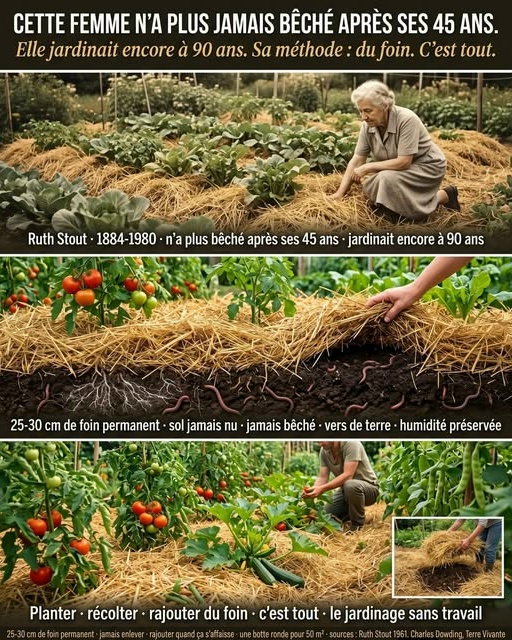
Cette femme n'a plus jamais bêché après
ses 45 ans. Elle jardinait encore à 90 ans.
Ruth Stout. Américaine. Née en 1884.
En 1944, elle attendait que quelqu'un vienne labourer son potager. Personne ne venait. Impatiente, elle a pris ses graines et les a plantées directement dans le sol non travaillé,
sous le foin de l'année précédente.
Tout a poussé. Mieux qu'avant.
Elle n'a plus jamais bêché. Pendant 36 ans.
La méthode Ruth Stout
le paillage permanent total :
Un seul principe : le sol ne doit jamais être nu. Jamais travaillé. Jamais bêché.
Une couche permanente de foin ou de paille de 20 à 30 cm recouvre tout — les allées, les planches, les espaces entre les plantes. Elle est renouvelée continuellement dès qu'elle s'affaisse.
C'est tout. Il n'y a pas d'étape 2.
Ce qui se passe sous le foin :
→ Les vers de terre prolifèrent — ils adorent l'humidité et le foin en décomposition
→ Le sol reste frais et humide même en canicule �� Ruth n'arrosait pratiquement jamais
→ Les mauvaises herbes ne germent pas — sans lumière, les graines restent dormantes
→ Le foin en décomposition nourrit le sol continuellement — zéro engrais
Comment démarrer :
→ Si tu as une pelouse ou des mauvaises herbes : pose du carton mouillé directement sur la végétation, recouvre immédiatement
de 25-30 cm de foin
→ Pour planter : écarte le foin, fais un petit trou dans le sol, plante, referme le foin autour du plant
→ Pour semer : écarte le foin, dépose les graines sur le sol, recouvre de 2-3 cm de terreau fin,
puis referme légèrement le foin autour
→ Renouvellement : quand le foin s'affaisse sous 15 cm, rajoute une couche par-dessus — jamais enlever le vieux foin, il se décompose et nourrit
Ce que Ruth ne faisait plus :
→ Bêcher — jamais
→ Désherber — jamais
→ Arroser — presque jamais
→ Fertiliser — jamais
Ce qu'elle faisait uniquement :
→ Planter
→ Récolter
→ Rajouter du foin
Le seul investissement :
Du foin ou de la paille en grande quantité la première année. Contacte un agriculteur local — une botte ronde de foin suffit pour un potager de 50 m². Prix : 10 à 30 € selon la région.
Ruth Stout appelait ça "le jardinage sans travail". Elle a écrit un livre à 77 ans pour l'expliquer.
Elle jardinait encore à 90 ans.
Sources : Ruth Stout "Gardening Without Work" (1961), Charles Dowding (no-dig),
Terre Vivante
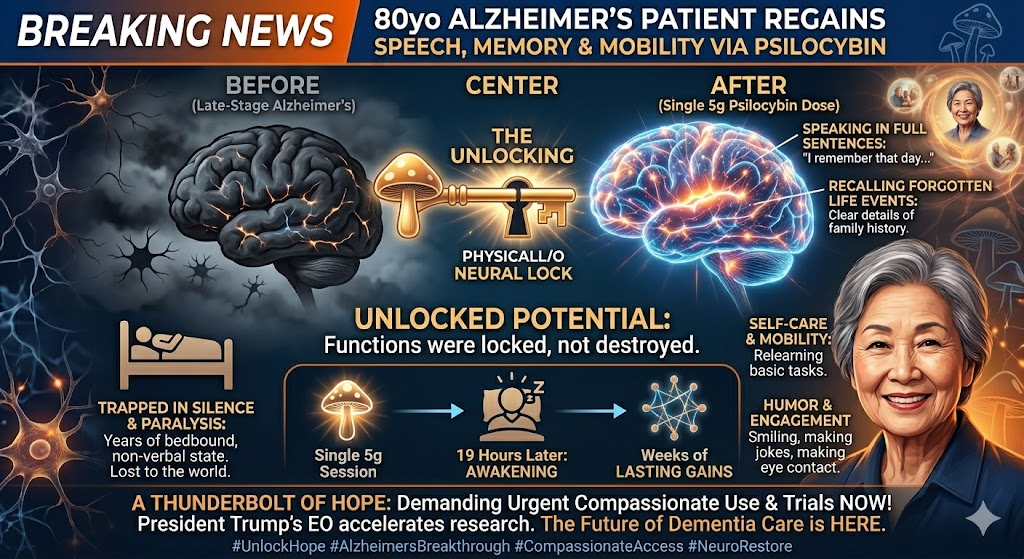
An 80-year-old Japanese-American woman with advanced Alzheimer’s—bedbound, incontinent, and speaking only in single syllables for years—just shattered our understanding of neurodegeneration.
After a single supervised 5-gram dose of psilocybin mushrooms (Enigma strain), she woke up after 19 hours and did the impossible:
+ Regained full speech (forming complete, coherent sentences)
+ Recovered lost memories (recalling long-forgotten life events)
+ Regained mobility & continence (dressing herself and staying dry)
+ Restored eye contact and humor
A follow-up 3-gram dose one month later boosted her verbal fluency and agility even further. These gains lasted for weeks.
🧠 This Is Not A Cure. It’s Something More Profound.
The case report, published in Frontiers in Neuroscience (May 27, 2026), proves that functions we assumed were irreversibly destroyed by dementia are actually still there—they are simply trapped behind broken neural gates. Psilocybin bypassed the damage. How? Through explosive, rapid neuroplasticity:
+ The 5-HT2A Switch: Psilocybin floods 5-HT2A serotonin receptors, triggering a massive spike in BDNF (Brain-Derived Neurotrophic Factor).
+ Neural Rewiring: BDNF acts like fertilizer for the brain, driving dendritic spine growth, synaptogenesis, and the repair of broken networks.
+ Circuit Restoration: It downregulates chronic neuroinflammation and re-establishes critical communication between the hippocampus and prefrontal cortex.
🛑 The Tragedy of Our Delay: Johns Hopkins is already studying psilocybin for depression in early-stage cognitive decline. But for late-stage, severe patients? It is an absolute shame that we aren't taking these trials more seriously. Modern medicine has exactly zero treatments that restore lost function in advanced dementia. This single case demands immediate action.
We don't have time to wait for a 10-year bureaucratic pipeline while millions of minds fade into the fog.
⚡ The Directive for Compassionate Use: President Trump’s executive order accelerating psychedelic research gives us the exact legal framework we need. We must bypass the standard red tape and establish compassionate use protocols immediately for advanced patients. For millions of families watching their loved ones slip away, this case report is a thunderbolt of hope. The brain still holds secrets, and science moves fast when we get out of its way.
What if a single guided experience could give you back one last conversation with the person you love?
🔄 Share this if you want real hope for dementia. Access and research must accelerate NOW.
#Psilocybin #Alzheimers #Neuroplasticity #BDNF #MedicalBreakthrough #CompassionateUse #Dementia
The 7-second cold wrist rinse was tested on 3,000 soldiers after combat simulations.
Cortisol dropped 52% within 90 seconds. Heart rate fell an average of 22 beats per minute. The Navy classified the protocol in 2009 and kept it secret until 2023.
The mechanism is radial artery cooling. Your inner wrists have the thinnest skin and the largest surface-to-volume ratio for blood vessels. 7 seconds of cold water cools the blood passing to your brain, which signals your hypothalamus to downregulate stress instantly
You've splashed cold water on your face. You've taken cold showers. Both work, but they're inconvenient.
The SEAL protocol takes 7 seconds, requires no undressing, and can be done at any sink. Soldiers used it before night missions to fall asleep fast.
The military classified this because a free 7-second stress fix would reduce demand for combat stress medication ($400M annually).
The 2023 declassification came after a FOIA lawsuit filed by a veteran.
The fix: run cold tap water over your inner wrists for 7 seconds. Both wrists. Do it when you feel a stress spike.
Within 90 seconds, your heart rate will drop. No shower, no ice.
Just 7 seconds.
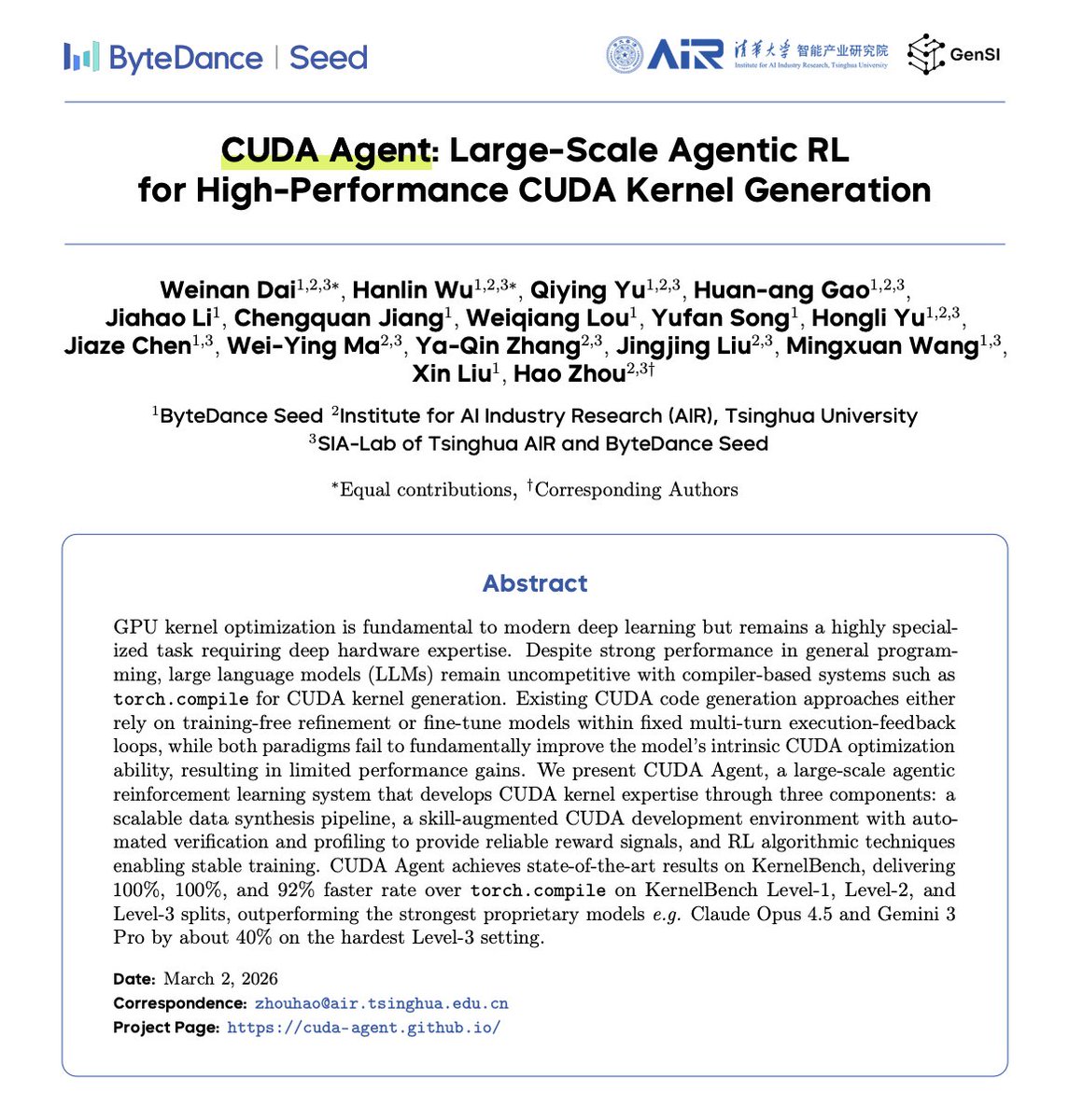
ByteDance has published a paper that should make every NVIDIA investor sweat.
They trained an AI that writes CUDA better than humans experts.
They call it CUDA Agent.
And it completely rewrites the economics of AI hardware.
They built a massive agentic reinforcement learning loop. The AI writes a kernel, compiles it, profiles the hardware, analyzes the bottlenecks, and rewrites the code until it's flawless.
It learned how to optimize memory access patterns and hardware tiling strategies that traditional compilers miss.
The results are staggering.
On the industry-standard KernelBench, CUDA Agent completely destroyed traditional compilers.
It delivered code that runs up to 3.2x faster than PyTorch's native execution.
On the hardest, most complex models, it beat the strongest proprietary models in the world—including Claude Opus 4.5 and Gemini 3 Pro, by 40%.
It didn't just match human experts. It started discovering optimizations that static compilers literally cannot see.
Here is why this is a massive threat to NVIDIA.
NVIDIA's dominance relies on the fact that CUDA is incredibly hard to master. Developers get locked in because optimizing code for other chips is too painful.
But if an AI agent can autonomously generate hyper-optimized hardware kernels...
You don't need a team of $500k a year CUDA engineers to build world-class infrastructure.
And if an AI can autonomously master CUDA, it can master AMD's ROCm. Or custom silicon.
The impenetrable software wall protecting NVIDIA's monopoly just got breached by a reinforcement learning loop.
If anyone can automatically squeeze maximum performance out of any chip...
Hardware becomes a commodity.
A British biologist looked at 200,000 years of human history and found that the entire reason humans broke out of poverty was not intelligence, not language, not even agriculture, but one mechanism so simple a 6-year-old could explain it.
His name is Matt Ridley.
He is a zoologist by training, an evolutionary biologist by career, and in 2010 he wrote a book called The Rational Optimist that quietly argued the most important fact about human progress had been hiding in plain sight for the entire history of economics.
Naval Ravikant has been telling people to read everything Ridley has ever written for the last 15 years. The reason is the argument inside this one book.
For 200,000 years, anatomically modern humans walked around with the same brain you have right now. Same skull size. Same neural architecture. Same raw capacity for language, planning, and abstract thought.
For roughly 190,000 of those years, almost nothing happened. Generation after generation lived and died inside the same Stone Age toolkit their great-great-grandparents had used. Then somewhere around 50,000 years ago, the line on the chart of human progress started to tick upward. Then it bent. Then it exploded.
The question Ridley spent years on was the only question that mattered. What changed.
It was not the brain. The brain had been the same for 190,000 years. It was not language, which had existed long before the takeoff. It was not even agriculture, which arrived only 10,000 years ago and was actually preceded by the upward bend, not the cause of it.
What changed was that humans started trading with strangers.
This sounds too small to be the answer. Ridley argues that it is the answer to almost everything. The moment one human exchanged a useful object with another human from a different group, something happened that no other species on earth had ever done.
Two ideas that had developed in isolation came into contact. The flint knapper learned what the spear maker had figured out. The fisherman from the coast learned what the hunter from the forest had figured out. The two pieces of knowledge fused into something neither side could have produced alone.
Ridley calls this ideas having sex. The phrase sounds frivolous and it is meant to. The point is that ideas, like genes, get better when they combine with other ideas from different lineages.
An idea sitting inside one head, no matter how brilliant the head, eventually hits a ceiling. The same idea exposed to ten thousand other ideas does something genes do under sexual reproduction. It mixes. It recombines. It produces offspring nobody planned.
The cleanest proof of this argument is the most uncomfortable case study in the book. Tasmania.
Around 10,000 years ago, rising sea levels cut Tasmania off from mainland Australia. A population of roughly 4,000 humans was now isolated on an island, with no possibility of contact with the rest of humanity. They had the same brains. The same language. The same starting toolkit as their cousins 150 kilometers north. The natural experiment was now running.
What happened next is something no economist or geneticist had ever predicted.
The mainland Australians kept inventing. Boomerangs. Spear-throwers. Fishing nets. Bone needles for sewing fitted clothes. Watercraft with paddles. Their technology compounded slowly across the centuries.
The Tasmanians went the other way. They did not just fail to invent the new tools their cousins were developing. They started losing the tools they already had. Fishing was abandoned within a few thousand years. Bone tools disappeared. Fitted clothing disappeared. They forgot how to make fire from scratch and started carrying lit firebrands from camp to camp instead, relighting their fires from a neighbor's whenever their own went out.
By the time European explorers arrived in the 17th century, the Tasmanians had the simplest toolkit of any human society ever recorded. Their material culture had gone backward for 8,000 years.
The archaeologist Rhys Jones called it a slow strangulation of the mind.
Joseph Henrich at Harvard later proved with formal mathematical models that there was nothing wrong with Tasmanian brains. There was something wrong with their network. A toolkit requires a critical mass of people exchanging skills to maintain itself.
The act of teaching a skill is imperfect. Every generation loses a small percentage of what the last generation knew. If your population is large enough and trading widely enough, those losses get caught and corrected by someone else who still remembers.
If your population shrinks below a certain threshold and stops mixing with outsiders, the small losses compound until entire technologies disappear.
This is the part that should haunt anyone reading this in 2026.
Intelligence is not a property of the individual brain. Intelligence is a property of the network the brain is connected to. A genius in isolation will produce less than a mediocre thinker inside a dense exchange of other mediocre thinkers.
The thing your ancestors needed in order to break out of 190,000 years of stagnation was not better brains. It was better connections between brains they already had.
The implication for any individual is direct and uncomfortable. If you are smart and isolated, you will be outproduced by people half as smart who are connected.
The most successful people in any field are almost never the smartest people in it. They are the ones positioned at the intersection of the most idea flows. They are reading more authors than their competitors. They are talking to more people from more disciplines. They are in the rooms where ideas from different lineages bump into each other.
Ridley ends the book on the line that sounds optimistic but is actually a warning its this "The future will be invented by people who connect ideas, not by people who guard them."
A DEVELOPER TAUGHT GIT WITH A BOX OF CHILDREN'S TOYS AND ENGINEERS WITH TEN YEARS IN SAY IT'S THE FIRST TIME THE THING EVER ACTUALLY MADE SENSE
90 minutes, one table, a pile of Tinkertoys. No wall of jargon -- he builds a real Git repo out of plastic rods right in front of you.
-> The moment he snaps the first pieces together, Git stops being scary command-line magic and becomes what it really is: a chain of tiny objects pointing at each other.
Branches, merges, rebase, the staging area -- every concept that's ever burned you at 2am -- he rebuilds with toys until a four year old could follow. He calls Git a two-trick pony. After this you'll see exactly why.
Memorizing commands was never the skill -> holding the graph in your head is. And with an AI agent now committing and rebasing on your machine all day, that mental model is the only thing between you and a history you can't read.
Scroll the comments and you'll see the same thing over and over: this is the talk that finally made Git click and made people the one their whole team comes to when it breaks.
Bookmark & watch it today. It's the 1.5 hours that pays you back for the rest of your career ↓
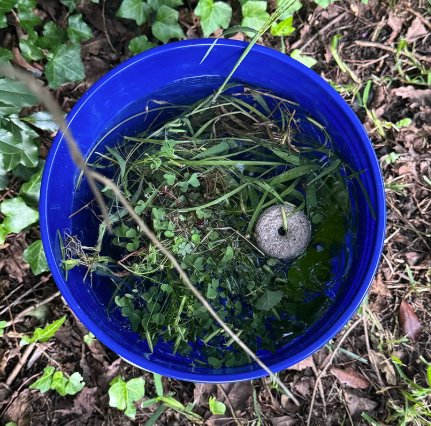
You can crash your yard's mosquito population without spraying a single chemical with a Mosquito Bucket of Doom.
Fill a 5-gallon bucket about two-thirds with water. Drop in a handful of grass clippings, leaves, or hay. Let it sit for a day, then drop in a Bti dunk (also called Bacillus thuringiensis israelensis, sold at any hardware store as "mosquito dunks," about $10 for six).
Mosquitoes are powerfully attracted to fermenting water and will lay their eggs in your bucket. Bti is a naturally occurring soil bacterium that produces a toxin that kills mosquito, blackfly, and fungus gnat larvae only.
This method doesn't harm bees, butterflies, fireflies, fish, frogs, birds, pets, or people. BTI dunks are EPA-approved for organic use and safe in animal water troughs and birdbaths.
One dunk lasts about 30 days. Top off the water as it evaporates. Cover with 1/2-in Mesh Hardware Cloth to prevent animals from getting trapped and put the bucket somewhere shady where pets and kids won't get into it.
The bucket becomes a mosquito magnet and a dead end. Compare that to fogging the entire yard with pyrethroids, which kills every insect in it, including the predators that eat mosquitoes.
Doug Tallamy's Homegrown National Park has been running the "Mosquito Bucket Challenge" since 2021. The more buckets in a neighborhood, the bigger the dent. One bucket per yard is a great start.
Listen! Every ChatGPT/Claude prompt SENDS YOUR DATA TO THE CLOUD.
Obsidian + LM Studio + local LLMs= 0 cloud. 16GB RAM. 60 min setup. Same power, full privacy.
I just wrote a how to guide on how I moved my entire workflow OFFLINE.
Here is my most recent project: https://t.co/oSMutzh6yp
Unlike Sci-Hub and Sci-Net, where I have written all the code manually be hand, this one is pure AI generated - I decided to do this as a kind of experiment. LOVE the result! AI is 50x speedup in code writing, however creating the project is still a lot of work (human input is still needed for architectural decisions, debugging complex functionality and precise instructions)
Sci-Bot is connected to Sci-Hub database so it can read research articles and generate answers grounded in science. To pay for generated tokens, Sci-Bot supports two funding models: the first one is standard pay-as-your-go and the second one is legacy from Sci-Hub: it is donation based.
Anyone can donate: from these donations, the project will automatically calculate budget for upcoming month, and derive how much AI-generated answers it can serve to users for free.
Yes. That's how real recognition gets stolen, masqueraded as a compliment. Sci-Hub is SO BIG, SO BIG that you obviously couldn't do it yourself.
HATE. The very fact it is being masked as compliment makes it even more terrible.
I hear this argument being repeated again and again. This argument about Sci-Hub being BIG is absolute nonsense. Let's consider it:
Just how big Sci-Hub is?
Sci-Hub is, basically a piece of computer code that I wrote in PHP back in 2011. The code itself was not that large - some great computer games that were created by single authors in the time of MS-DOS are much longer.
The code itself was tiny, but it was universal: it worked on many research papers - millions of them, making them free. You can compare Sci-Hub code to a mathematical formula in physics. Just imagine: Einstein's formula is just three letters E = mc^2 - that was enough to describe the WHOLE UNIVERSE. That global universality does not make anyone think there was any team doing Einstein's work.
Sci-Hub does not require any exceptional or very expensive technical infrastructure to run on. It was first launched on a free web hosting, then moved to a rented server, as the project grew I bought a few servers myself. Every hardware part here is commercially available and within areach for a single person even without big funding.
The mere fact that impact of Sci-Hub was big also does not in any way imply it must be a work of many people. Consider how many great works of art or literature were created by single authors. Nobody says Tolstoy's epic novel "War and Peace" must be work of many because it is big and famous.
If you consider Sci-Hub as a work of writing - and it is writing in code - then you can easily place it in context of other works of writing and see that Sci-Hub is actually very small - both in terms of how much letters were used - and in terms of how much people it reached. Some books for kids are much more popular (yet nobody says there are many authors...)