@unusual_whales This is a train that can’t be stopped because of global competition. If the US pauses AI growth, China for example will surpass the US in ai tech
I sometimes use session probability maps for discretionary trading
The biggest issue is that the buckets are almost always either too broad to trade precisely or too narrow to show up often enough
For example, say price opens between the London high and the London session midpoint and the data says there is an 80% chance of tagging the London high.
That sounds good and all, but it does not mean every setup inside that bucket is equal.
An open 2 points below London high and an open near the London midpoint may both fall into the same bucket, even though they are completely different trades. The first one barely has to move to “work.” The second one may need a much larger move, more time, and a different market condition.
So the stat can be true and still be misleading if you treat it too literally.
This is why I think probability maps are best used as context and not signals. The broad bucket tells you what has generally happened in similar conditions.
The live chart still has to answer the practical questions: distance to target, risk, structure, speed, and whether the setup actually makes sense.
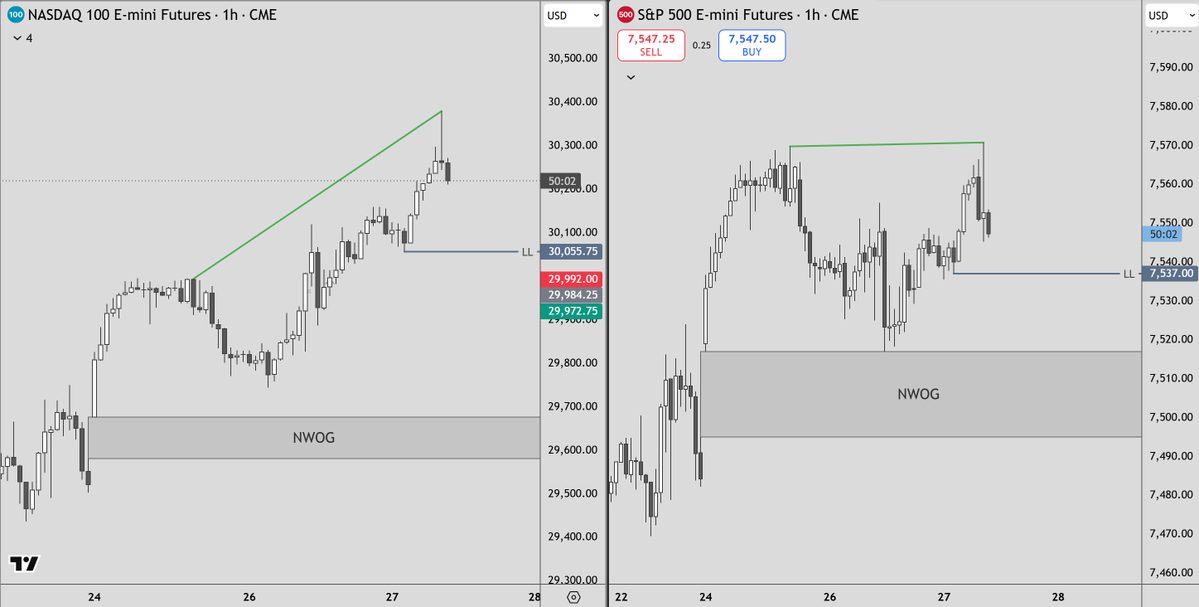
@dhesi_trades Yep i would draw it like this. take a high and what are the previous highs it took out.
take a low, what is the previous lows it took out.
extend forward.
very possible if we displace through lows
Approximately 100k jobs were lost directly due to Ai over the past 2 years
The undisclosed amount is likely much higher
The potential for white collar job growth has certainly diminished
Finally someone put facts behind my main theory on how all this plays out. Paper only proves it at the firm level but same logic scales up and no country can stop either or they get outpriced
Two economists just published a mathematical proof that AI will destroy the economy.
Not might. Not could. Will — if nothing changes.
The paper is called "The AI Layoff Trap." Published March 2, 2026. Wharton School, University of Pennsylvania. Boston University. Peer reviewed. Mathematically modeled.
The conclusion is one sentence.
"At the limit, firms automate their way to boundless productivity and zero demand."
An economy that produces everything. And sells it to nobody.
Here is how you get there.
A company fires 500 workers and replaces them with AI. A competitor fires 700 to keep up. Another fires 1,000. Every company is behaving rationally. Every company is following the incentives correctly. And every company is building a trap for itself.
Because the workers who were fired were also customers.
When they lose their jobs faster than the economy can absorb them, they stop spending. Consumer demand falls. Companies respond by cutting costs — which means automating more workers — which means less spending — which means more falling demand — which means more automation.
The loop has no natural exit.
The researchers tested every proposed solution. Universal basic income. Capital income taxes. Worker equity participation. Upskilling programs. Corporate coordination agreements.
Every single one failed in the model.
The only intervention that worked: a Pigouvian automation tax — a per-task levy charged every time a company replaces a human with AI, forcing them to price in the demand they are destroying before they pull the trigger.
No government has implemented this. No major economy is seriously discussing it.
Meanwhile the numbers are already tracking the curve. 100,000 tech workers laid off in 2025. 92,000 more in the first months of 2026. Jack Dorsey fired half of Block's workforce and said publicly: "Within the next year, the majority of companies will reach the same conclusion."
Nobody is doing anything wrong. Companies are following their incentives perfectly. That is exactly the problem.
Rational behavior. At scale. Simultaneously. With no mechanism to stop it.
Two economists built the math. The math leads to one place.
Source: Falk & Tsoukalas · Wharton School + Boston University ·
@jackcoder0 Finally someone put facts behind my main theory to how all this would go down. Paper only proves it at the firm level but same logic scales up and no country can stop either or they get outpriced
People preparing for NY session open on Sunday afternoon are sweats
I used to do this but I didn’t trade better
This was before I had systems and a proven discretionary strategy
I’ll log on at 9am on Monday, review my data and trade
Simplicity = Profits
Patience + Execution = Profits
Discretionary ✅
Orb Breakout ✅
NMR - B/E
F5D - No trade
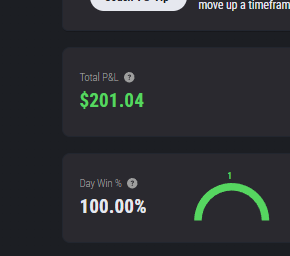
+$460 across acounts
Did you get trapped in shorts today or are you long only right now?
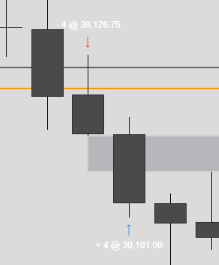
This is a bearish NY open for me
NQ packed its bag, boarded the flight but realized it forgot its bag at home so now it has to turn around to go get it
This is a bearish NY open for me
NQ packed its bag, boarded the flight but realized it forgot its bag at home so now it has to turn around to go get it
These “ai one-click dashboard” strategies that run a million different parameter optimizations that people are trying to sell are comical
0 drawdown? 3+ Profit Factor? 70% winrate? 2:1 rr?
If you run thousands of parameter optimizations you will find one that looks amazing
If it looks too good to be true then it likely is
There’s someone reading this who only needs ONE more green day…
Maybe $150. Maybe $200.
Just enough to request their payout.
And they’re about to overleverage tonight or tomorrow while US markets are closed trying to force it.
Congrats.
You proved you couldn’t wait ONE more day to get paid.