Measure C has sent $53 million to Alameda County, California child care providers serving more than 15,000 children. The investments include funding for family child care providers as well as more than $10 million in relief and materials grants for Family, Friend, and Neighbor (FFN) caregivers.
The funds have been distributed to child care providers to help pay staff, expand subsidized child care slots, upgrade facilities, and strengthen the child care infrastructure in the county.
When communities invest in home-based child care, they strengthen the providers that families already trust and help to meet the diverse needs of children and families.
Alameda County’s experience shows what’s possible when public investment reaches providers where they are. Read more about how Measure C is supporting child care across the county: https://t.co/Qeac2lRDGW
On Kauaʻi, just 10–14 home-based infant care slots have historically been available for roughly 700 babies born each year.
With so few options, many parents are forced to leave the workforce, piece together care, or consider moving away. Across Hawaiʻi, more than half of parents report leaving their jobs due to child care challenges, according to a 2025 survey by the Chamber of Commerce Hawaiʻi.
The severe shortage of infant care on Kauaʻi highlights a crisis felt in communities across the country. At Home Grown, we believe stabilizing child care supply requires two key policy shifts:
🔸 Resource home-based providers with child care subsidy rates that cover the true cost of care.
🔸 Expand publicly funded options to include trusted Family, Friend, and Neighbor (FFN) caregivers who deliver culturally competent care.
Read the article to learn more about how families and providers on Kauaʻi are navigating this challenge: https://t.co/QnSJOv2EJG
Home-based child care providers are often among the first people outside a child’s family to shape their relationship with food. They plan meals, stretch food budgets, navigate nutrition programs, and care for children during some of the most formative years of development.
Yet they have rarely been recognized as food system actors or included in food policy conversations.
Providers who understand the daily realities of feeding young children are best positioned to explain what programs like WIC and CACFP look like in practice, where barriers show up, and what solutions would actually work for families.
“As a home-based child care provider, I see firsthand how deeply connected food access and child care truly are. Programs and policies like CACFP directly impact the children and families we care for every day.” – Marina Navarro, Family Friend and Neighbor provider
Read more about how home-based child care providers, advocates, and partners in Los Angeles are working to advance early childhood nutrition and strengthen food equity efforts: https://t.co/ZW0wywRVDs
@First5LA
Over the past four years, Home Grown's Thriving Providers Project (TPP) has delivered direct payments to 350 home-based child care providers through eight pilot sites.
Join us on Tuesday, September 8th for a conversation with researchers, providers, and policy leaders closest to this work.
The live event will cover:
🔸 The cross-site report: Key findings from a new report bringing together data and implementation insights from four pilot sites
🔸 The provider experience: A firsthand perspective on how this project impacts providers' lives and care work
🔸 Policy breakthroughs: How findings are already reshaping policy in pilot communities
🔸 The work ahead: What it will take to sustain this momentum for child care providers
Register here: https://t.co/jFBU4ARhtX
The rising cost of food and inadequate CACFP reimbursements don't just affect home-based child care providers' businesses—they affect their own families.
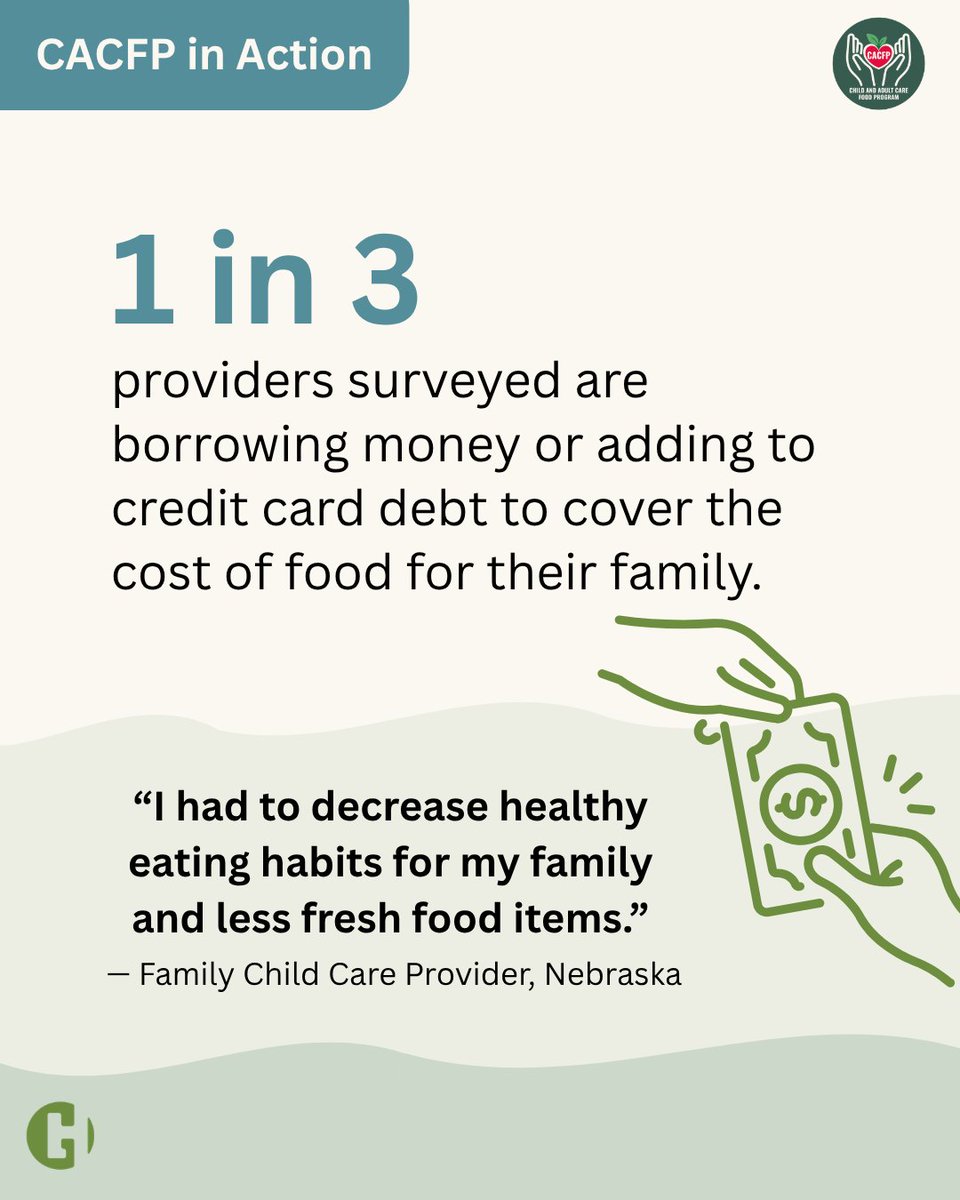
Home Grown's June 2026 survey found that 1 in 3 providers surveyed are borrowing money or adding to credit card debt to cover the cost of food for their family.
One family child care provider in Nebraska shared: “I had to decrease healthy eating habits for my family and less fresh food items.”
Home-based child care providers not only need to feed their own families, but also must stretch CACFP reimbursements to provide nutritious meals and snacks to the children in their care. They are doubly impacted by the pressures of rising food prices.
Providers should not have to sacrifice their own financial security or their family's access to healthy food to continue feeding the children they care for.
CACFP reimbursement rates must reflect the full cost of providing healthy meals—including the food providers purchase and the time and labor required to plan, shop for, prepare, and serve them.
Read our latest blog to learn more: https://t.co/qImMPSbqQe
Introducing Home Grown’s Nourishing Care Community of Practice!
At a critical moment, with food and basic needs costs on the rise just as federal food and child care benefits are simultaneously reduced, Home Grown is bringing together state policy advocates working across care, food, and economic stability issue areas.
Beginning this month, eight teams with members from 20 child care and food justice organizations will spend eight months learning about the intersection of food justice and care and exploring innovative models to bolster food access for home-based child care providers and the children they serve.
Through the Community of Practice, teams will map their CACFP and CCDBG systems and child care landscapes, identify challenges and gaps, develop policy changes, and create actionable roadmaps for advancing change in their states and regions. Teams will also have opportunities to learn from one another, share effective strategies, and explore solutions to common policy and administrative challenges.
The Nourishing Care Community of Practice is part of Home Grown’s multi-year Nourishing Care initiative.
Read our latest blog to learn more: https://t.co/YnmwAgsoaB
Home-based child care providers are stretching CACFP reimbursements further and further to continue serving nutritious food to the children in their care.
Last year, providers surveyed by Home Grown reported that CACFP covered 50–75% of their food costs. In our June 2026 survey, the majority of providers reported that reimbursements now cover just 25% or less.
Providers are often making up the difference themselves.
“Bulk purchasing is out of reach as I don’t have time to travel that distance — besides the price of gas. I purchase foods at Walmart and our local supermarket. I have not made any changes to what I serve, but I have had to take less in salary.” – Family Child Care Provider, Maine
Providers should not have to sacrifice their own financial security to ensure the children in their care have nutritious food.
CACFP must reflect the true cost of feeding children—including both the cost of food and the labor providers contribute every day to plan, shop for, prepare, and serve meals and snacks.
Read our latest blog to learn more: https://t.co/qImMPSbqQe
Family, Friend and Neighbor Appreciation Week (September 13–18, 2026) is an opportunity to recognize and celebrate the more than 5 million FFN caregivers who care for 11.5 million children each year.
Each day of FFN Appreciation Week has a theme highlighting a different aspect of FFN care and the important role these caregivers play in supporting children, families, and communities.
We invite you to help us raise awareness and show gratitude for the invaluable contributions of FFN caregivers to our communities and society.
Learn more and view our social media toolkit: https://t.co/Np8A2kmYPt
And join us for a live webinar, Celebrating Progress and Building Futures with FFN Caregivers, on Wednesday, September 16 at 3 p.m. ET/12 p.m. PT. Together, we’ll recognize policy progress supporting FFN care and imagine a shared future that lifts up the caregivers at the heart of our communities. Register here: https://t.co/6QpnGYBi7i
4 more cents for breakfast. 9 more cents for lunch. 2 more cents for a snack.
That's what the new CACFP reimbursement rates mean for a Tier I home-based child care provider serving a child this program year.
Meanwhile, providers are telling us that the cost of feeding children is forcing them to make difficult decisions:
“I cannot provide afternoon snack, and soon I will remove dinner from my program plans.” – Family Child Care provider, New York
Home-based child care providers are committed to serving nutritious meals that help children grow, play, and learn. But these small increases in reimbursement rates are not enough to keep pace with the actual cost of providing that food.
CACFP reimbursement rates should reflect what it actually costs providers to purchase, prepare, and serve healthy meals and snacks—not force providers to choose between absorbing the costs themselves or making changes to what they can provide.
Read our latest blog to learn more: https://t.co/qImMPSbqQe
The Child and Adult Care Food Program (CACFP) plays a critical role in helping home-based child care providers serve nutritious meals and snacks to the children in their care.
That support is especially important as families face reduced access to SNAP. As SNAP benefit cuts take hold, families may have fewer resources to meet their nutritional needs at home, while providers continue to feed and care for children throughout the day.
“Asking parents to send food doesn’t always suffice; the children always want to eat something extra beyond what is sent.” – FFN caregiver, Texas
CACFP is designed to help providers meet this need, but current reimbursement rates are already falling short of the true cost of feeding children.
As SNAP access shrinks, CACFP will become even more important. We need to ensure the program is adequately resourced to meet the needs of home-based child care providers and the children and families who rely on them.
Join us: What four years of the Thriving Providers Project has taught us
In 2022, Home Grown launched the Thriving Providers Project (TPP), an innovative pilot that delivers direct payments to home-based child care providers. Over the past four years, the project has included eight pilot sites and 350 providers.
Earlier this summer we shared findings from the Thriving Providers Project's first cross-site report, bringing together data and insights from four pilot sites to understand how direct cash payments affect home-based child care providers well-being and work. Now you're invited to hear directly from researchers, providers, and policy leaders closest to this work.
Register here to join us for a live conversation on September 8, 2026 (1 p.m. ET / 10 a.m. PT):
https://t.co/CviS3xWoRK
In July, the U.S. Department of Agriculture published the annual reimbursement updates for the Child and Adult Care Food Program (CACFP). For home-based child care providers participating in CACFP, the new rates amount to a 2.74% increase.
While the increases are welcomed, they are not enough to meet the needs of growing children or compensate hard-working child care providers.
The shortfall created by inadequate CACFP payment rate policies means hardship for child care providers, reduced access to healthy food for young children, and strains on family budgets.
We need CACFP to reimburse providers for the full cost of food and their labor and effort. This means increasing the base reimbursement rate, transitioning to the Food Away From Home CPI for annual adjustments, and reimbursing providers for all healthy meals and snacks served during the workday.
Read our latest blog to learn more: https://t.co/qImMPSbqQe
Read our latest blog to learn more: https://t.co/qImMPSbqQe
Home-based child care providers work every day to make sure the children in their care have enough nutritious food to eat—but many are already turning to additional resources for help.
RAPID found that nearly 1 in 2 child care providers surveyed (48%) reported using a food pantry one or more times during the previous year to access food or other items for children in their care. Yet among providers who used food pantries, 44% said they did not improve their ability to provide nutritious meals.
Food pantries can provide important support, but they cannot replace reliable access to food assistance. As fewer families and providers are able to access SNAP, already-strained home-based child care providers may face even greater pressure to fill the gaps.
Consistent access to nutritious food supports the healthy development of children and the well-being of families and caregivers. This #SNAPWeekofAction, we’re calling attention to the need to ensure families and providers can continue accessing the resources they rely on to put food on the table.
Learn more: https://t.co/b1piMVklpn
Home-based child care providers spend their days making sure children are cared for, nurtured, and fed. But many providers are struggling to afford food themselves.
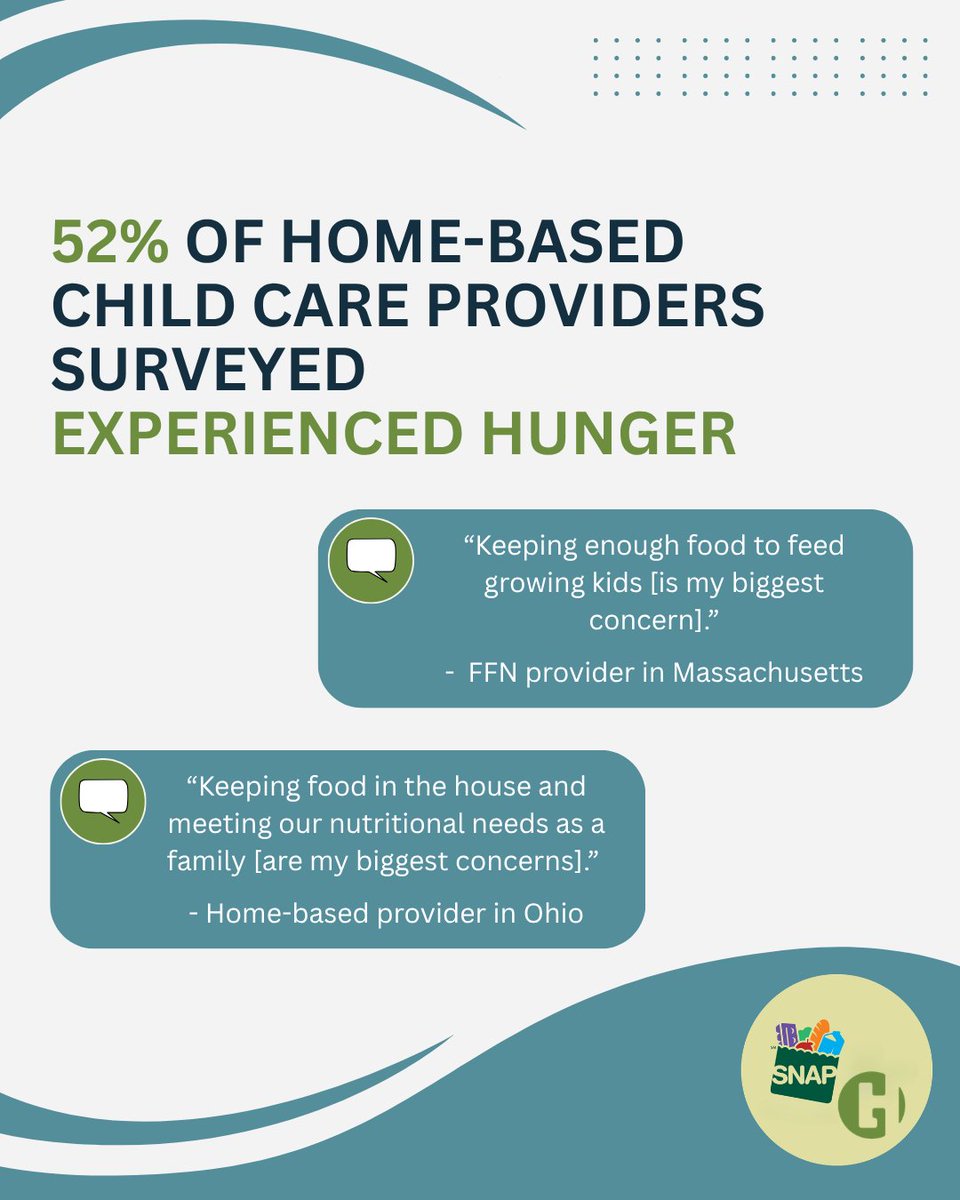
In June 2025, 52% of home-based child care providers surveyed by RAPID experienced hunger. Some providers also shared that rising grocery costs have led them to skip meals or eat less so the children in their care have enough food.
With 43% of the early care and education workforce relying on programs like SNAP to make ends meet, declining access to SNAP could deepen food insecurity and financial strain for providers.
These economic pressures can contribute to higher provider turnover and program instability, disrupting the continuity of care that young children and families rely on.
Read the article to learn more: https://t.co/kVx0JRGMXW
Millions of people across the country are losing access to SNAP, a critical program that helps families afford food.
Recent policy changes, including stricter eligibility requirements and increased administrative paperwork, are making it harder for families to maintain or qualify for benefits.
As fewer families are able to access SNAP, more children may arrive at child care without consistent access to the nutritious food they need at home—putting additional pressure on the providers who care for and feed them.
Children need reliable access to nutritious food throughout their days. This #SNAPWeekofAction, we’re calling attention to what reduced access to SNAP means for young children, their families, and the home-based child care providers who support them.
Learn more: https://t.co/KcNr44o6lT
This #SNAPWeekofAction, we’re joining advocates across the country in calling attention to the importance of protecting access to nutritious food for children, families, and the people who care for them.
Children need access to nutritious food both at home and while they are in child care. As access to SNAP shrinks, home-based child care providers may increasingly be caring for children whose families are struggling to afford food—while many providers are experiencing food hardship themselves.
Throughout SNAP Week of Action, we’ll highlight how food insecurity impacts young children and home-based child care providers, and the need to ensure children have access to nutritious food wherever they spend their day.
When extreme heat changes a provider's day, it changes children's days, too.
Research shows that spending time outdoors benefits both caregivers and young children. But extreme heat is reducing opportunities for both to enjoy those benefits.
Home-based child care providers are constantly adjusting routines, activities, and schedules to keep children safe while continuing to provide high-quality care.
Their flexibility and dedication help children continue learning and growing—even when the weather doesn't cooperate.
https://t.co/xzIlSaEjEo
Extreme weather affects more than daily routines—it affects families' peace of mind.
A national RAPID Survey found that 64% of parents of young children experienced at least one extreme weather event in the past two years.
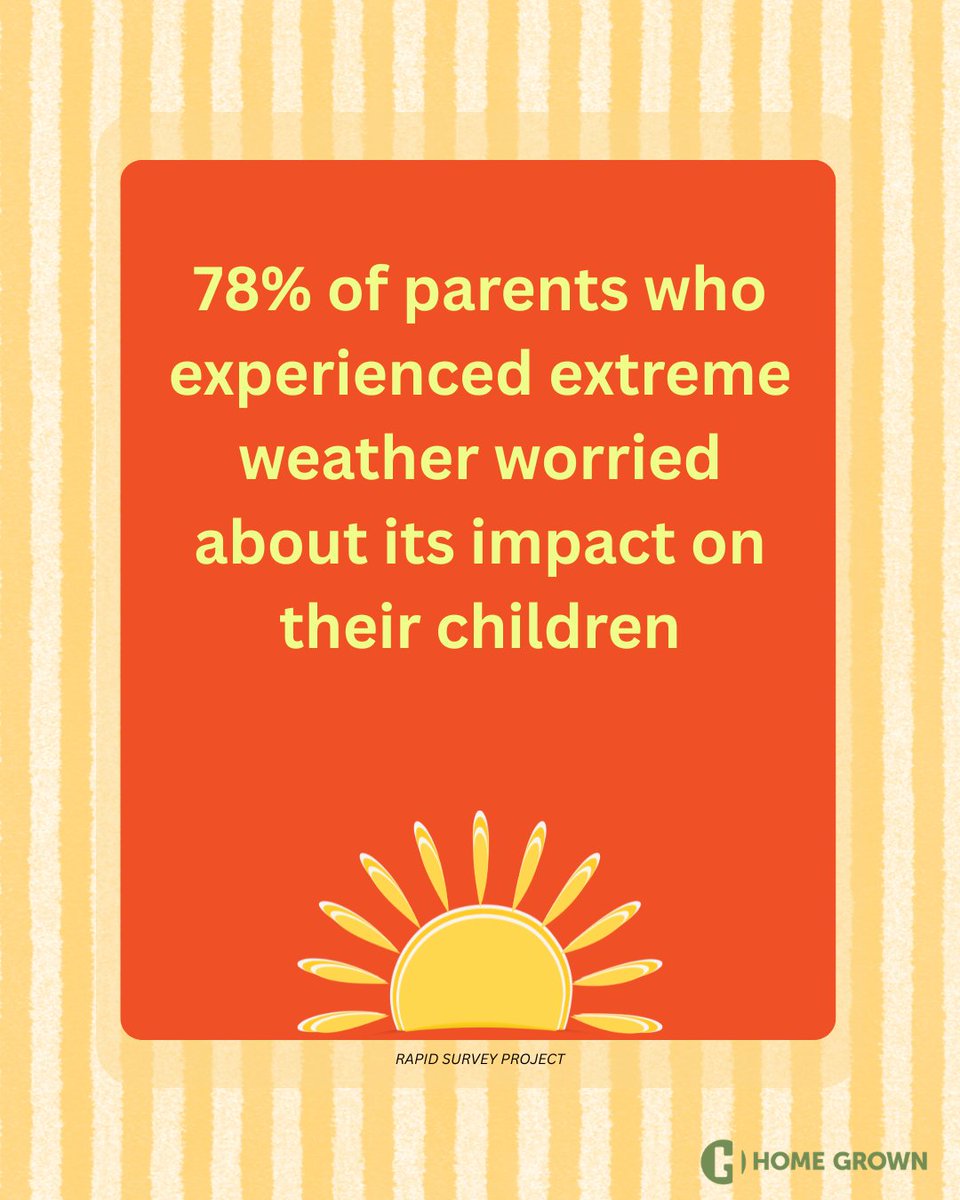
Among those parents, 78% worried about how those events affected their children.
Extreme weather can disrupt child care, limit time outdoors, increase utility costs, and create concerns about children's health and well-being. Home-based child care providers help families navigate these challenges by creating safe, nurturing environments where children can continue to learn and thrive.
https://t.co/bzGgXcn19i
Keeping children safe during extreme heat comes with added costs.
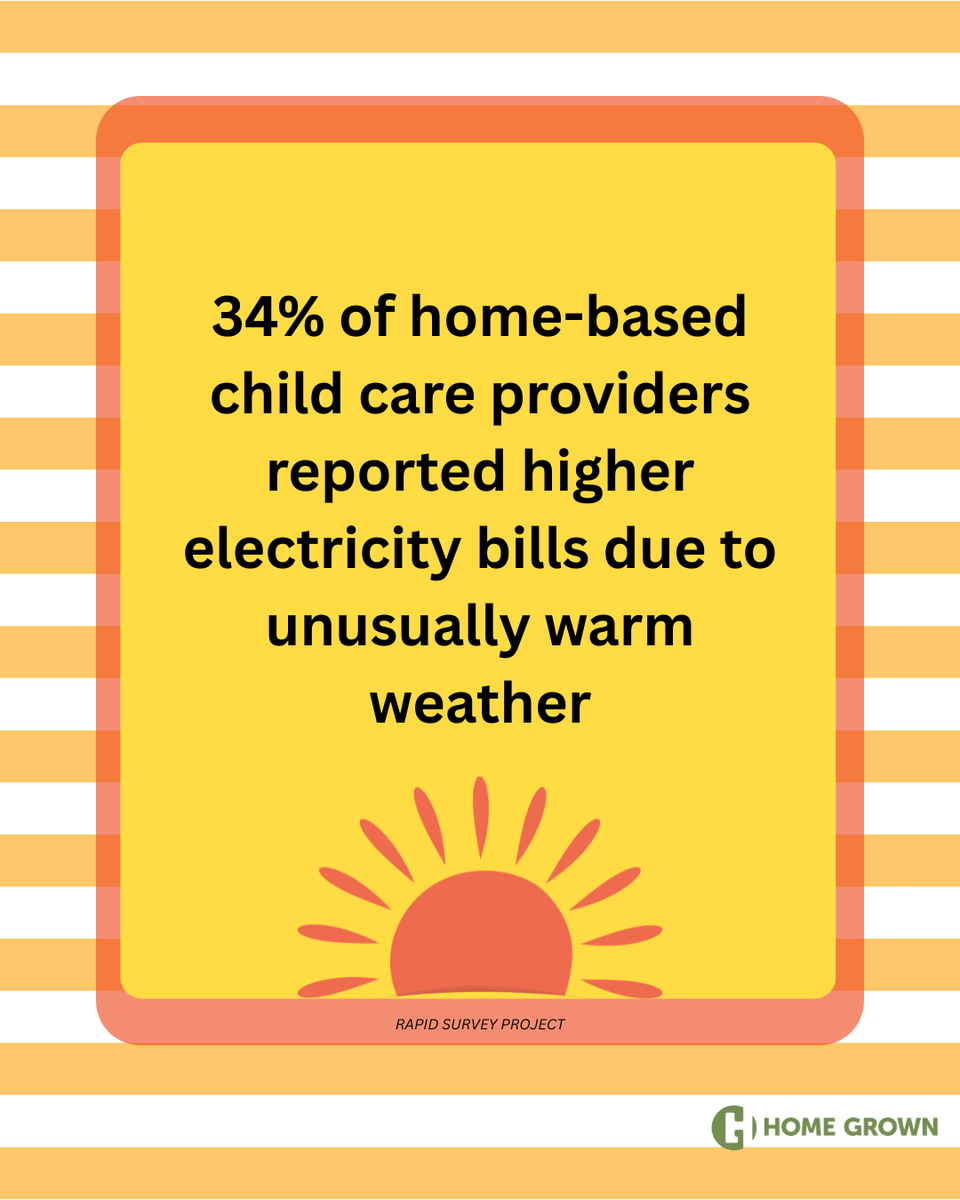
One in three home-based child care providers (34%) reported higher electricity bills as unusually warm weather increases the need for cooling.
Because many providers operate child care programs from their homes, rising utility costs directly affect both their businesses and their families.
Learn more: https://t.co/xzIlSaEjEo