Dartmoor's hill ponies have grazed those commons for longer than there has been a country called England. Fewer than a thousand are left, down from six thousand a generation ago. The United Nations listed them as endangered in 2023. So, naturally, the body charged with protecting nature has decided to get rid of nine in ten of the survivors.
There is a process, obviously.
Natural England's new grazing contracts now count the ponies in the same bucket as the cattle and sheep. A commoner with a fixed quota has a choice: keep a semi-wild pony worth nothing at market, or use the slot for a lamb he can sell. Guess which one survives the spreadsheet. The rest are gathered in the autumn drifts, and with nowhere to put thousands of unhandled moorland ponies, the next stop is the abattoir.
Natural England would like it noted that it has not ordered a cull. It has merely built a machine whose only output is a cull, switched it on, and handed the bolt gun to a farmer so the fingerprints land elsewhere. Very tidy.
And now the funny part. The pony is the best tool on the entire moor for eating Molinia, the coarse purple grass strangling Dartmoor into a brown monoculture. Cattle and sheep won't touch it. The ponies hoover it down and clear the ground for the orchids, the wildflowers and the insects behind them. Remove the ponies and the moor chokes into precisely the lifeless scrubland the contract was meant to prevent.
So the conservation strategy, in full: protect the habitat by deleting the animal that maintains the habitat. A masterclass.
Better still, Natural England's own Fursdon review looked at this exact question and told them, in plain English, not to lump ponies in with cattle and not to cut pony numbers. They read it, praised it, said they fully supported it, then did the precise opposite.
Four thousand years these animals have run Dartmoor with no committee and no contract. They could be gone within one, and the people who did it will write it up as a win for nature.
📢 Our 2026 #BrokenPlate report shows the poorest families with children would need to spend 𝟴𝟱% of their income to afford the government-recommended healthy diet.
This should act as a wake-up call for policymakers to ensure everyone has access to good food.
https://t.co/ShIBMZMR4A
@NuffieldFound
Hedgehog Conservation Ireland and researchers at University of Galway and Oxford are calling on people to take part in the inaugural Great Big All-Ireland Hedgehog Count
https://t.co/UGpclcHXrV
Israeli soldiers subjected activists from the latest Gaza aid flotilla to sexual, psychological and physical abuse after intercepting their boats and taking them to Israel, according to numerous accounts from participants.
https://t.co/l0a6ujQL3h
There was a time when every adult in Britain owned at least one woollen jumper that had been knitted by a relative.
An Aran in cream báinín, smelling faintly of lanolin because the wool had never been scoured. A Fair Isle in eight muted colours from the dyer in Lerwick. A Guernsey in tight navy worsted from a port on the Channel. The yarn came off sheep grazing the same hillsides a great-grandfather had grazed sheep on. It was carded, spun, and knitted by a woman who had been doing it since she was nine.
The jumper lasted twenty years. It was warm when wet. It was naturally flame-retardant and did not melt onto your skin if a spark from the galley stove landed on it, which was not a hypothetical concern on a fishing boat.
The mill towns of Yorkshire and the Borders ran on this. Bradford alone had seventy-three worsted mills by 1836 and considerably more by 1900. Hebden Bridge, Halifax, Hawick, Galashiels, every river valley a chimney, every chimney a wage packet for the village around it.
Most of them are flats now. Or coffee shops. Or empty.
The decline started in the 1950s. By 1995 the British Wool Marketing Board had ninety-one thousand registered producers. By 2015 it had forty-six thousand. A British sheep fleece in 2026 is, in many cases, worth less than the cost of paying the shearer to remove it. Some farmers compost the wool. Some pay to have it taken away as agricultural waste. The same fleece their grandfathers had clothed the country with is being treated as a disposal problem.
The jumper in your wardrobe is now polyester, manufactured in Bangladesh from petroleum, shedding microplastic fibres into the washing machine on every cycle, most of them ending up in the ocean and staying there for the next three hundred years.
The sheep is still on the hillside. Still growing the fleece. Still needing the shear.
Waiting for someone to remember what it was for.
Dr Margaret Connolly, the sister of President Catherine Connolly, is among a number of Irish citizens detained by Israeli forces after a Gaza-bound aid flotilla was intercepted in the Mediterranean this morning, organisers have said.
https://t.co/c1flAadDDw
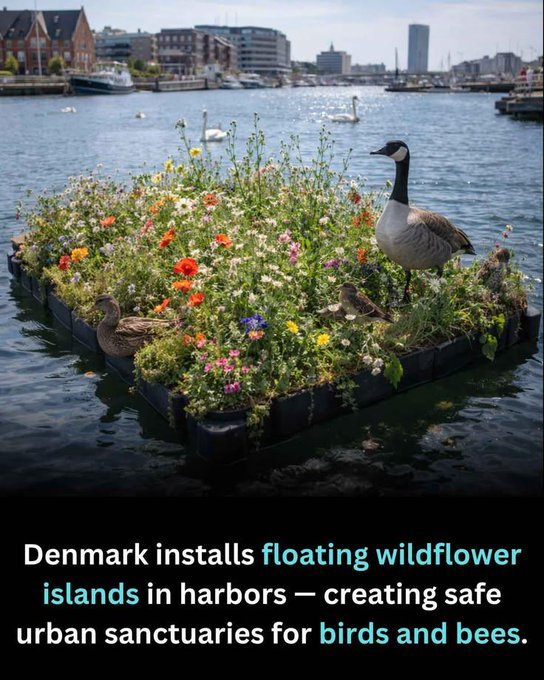
Denmark, particularly in Copenhagen, has installed floating platforms/islands planted with wildflowers and native vegetation in its harbors and canals.
These create safe urban habitats and sanctuaries for birds, bees, pollinators, insects, and even some aquatic life.
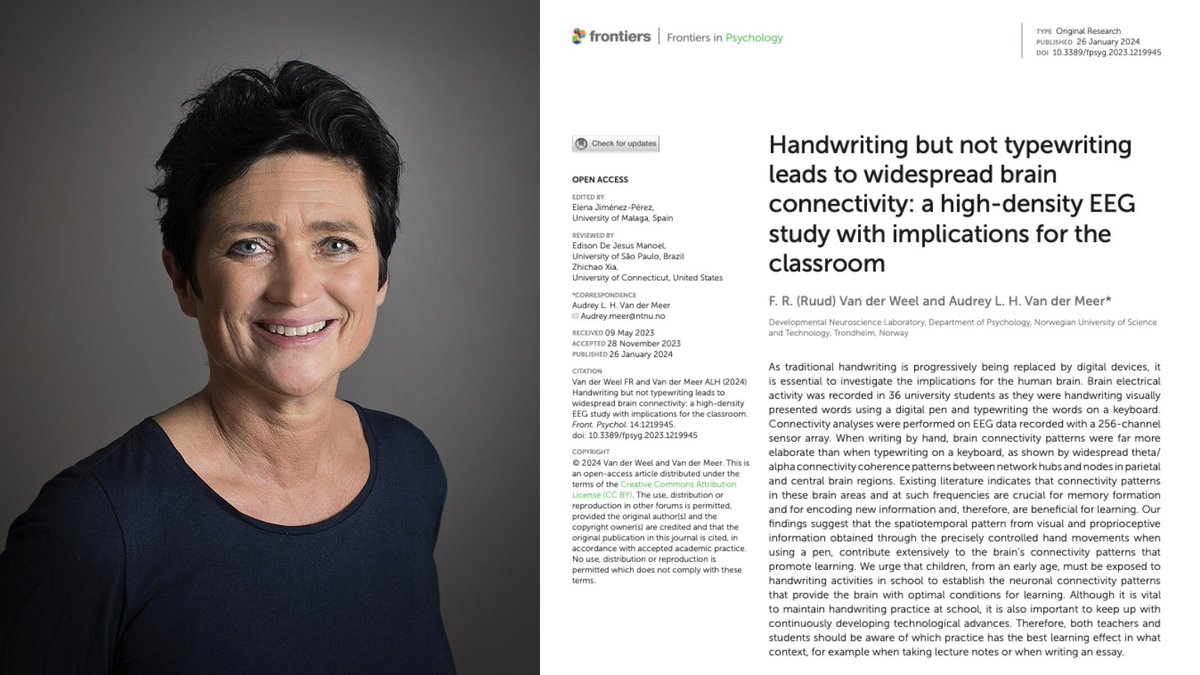
A Norwegian neuroscientist spent 20 years proving that the act of writing by hand changes the human brain in ways typing physically cannot, and almost nobody outside her field has read the paper.
Her name is Audrey van der Meer.
She runs a brain research lab in Trondheim, and the paper that closed the argument was published in 2024 in a journal called Frontiers in Psychology. The finding is brutal enough that it should have changed every classroom on Earth.
The experiment was simple. She recruited 36 university students and put each one in a cap with 256 sensors pressed against their scalp to record brain activity. Words flashed on a screen one at a time.
Sometimes the students wrote the word by hand on a touchscreen using a digital pen, and sometimes they typed the same word on a keyboard. Every neural response was recorded for the full five seconds the word stayed on screen.
Then her team looked at the part of the data most researchers had ignored for years, which is how different parts of the brain were communicating with each other during the task.
When the students wrote by hand, the brain lit up everywhere at once.
The regions responsible for memory, sensory integration, and the encoding of new information were all firing together in a coordinated pattern that spread across the entire cortex. The whole network was awake and connected.
When the same students typed the same word, that pattern collapsed almost completely.
Most of the brain went quiet, and the connections between regions that had been alive seconds earlier were nowhere to be found on the EEG.
Same word, same brain, same person, and two completely different neurological events.
The reason turned out to be something nobody had really paid attention to before her work. Writing by hand is not one motion but a sequence of thousands of tiny micro-movements coordinated with your eyes in real time, where each letter is a different shape that requires the brain to solve a slightly different spatial problem.
Your fingers, wrist, vision, and the parts of your brain that track position in space are all working together to produce one letter, then the next, then the next.
Typing throws all of that away. Every key on a keyboard requires the exact same finger motion regardless of which letter you are pressing, which means the brain has almost nothing to integrate and almost no problem to solve.
Van der Meer said it plainly in her interviews.
Pressing the same key with the same finger over and over does not stimulate the brain in any meaningful way, and she pointed out something that should scare every parent who handed their kid an iPad.
Children who learn to read and write on tablets often cannot tell letters like b and d apart, because they have never physically felt with their bodies what it takes to actually produce those letters on a page.
A decade before her, two researchers at Princeton ran the same fight using a completely different method and ended up at the same answer. Pam Mueller and Daniel Oppenheimer tested 327 students across three experiments, where half took notes on laptops with the internet disabled and half took notes by hand, before testing everyone on what they actually understood from the lectures they had watched.
The handwriting group won by a wide margin on every question that required real understanding rather than surface recall.
The reason was hiding in the transcripts of what the two groups had actually written down.
The laptop students typed almost word for word, capturing more total content but processing almost none of it as they went, while the handwriting students physically could not write fast enough to transcribe a lecture in real time, which forced them to listen carefully, decide what actually mattered, and put it in their own words on the page.
That single act of choosing what to keep was the learning itself, and the keyboard had quietly skipped the choosing and skipped the learning along with it.
Two studies. Two countries. Same answer.
Handwriting makes the brain work. Typing lets it coast.
Every note you have ever typed instead of written went into your brain through a thinner pipe. Every meeting, every book highlight, every idea you captured on your phone instead of on paper was processed at half depth.
You did not forget those things because your memory is bad. You forgot them because typing never woke the part of the brain that would have made them stick.
The fix is the thing your grandmother already knew.
Pick up a pen. Write the thing down. The slower road is the faster one.
Britain has lost around half its hedgerows since the Second World War. The wildlife that depended on them has followed a similar trajectory. 🌿
The old field boundary — a strip of blackthorn, hawthorn, dog rose, and elder two to five metres wide between cultivated ground — was not wasted agricultural space. It was a functioning ecological system that maintained pollinators, pest predators, and farmland birds across centuries of working land.
Each hedgerow is a nesting corridor for grey partridge and skylark, a foraging habitat for brown hares and hedgehogs, a site for solitary bee colonies, and a windbreak for the crops alongside it.
The field cultivated to its very edge gives the maximum return this season. It removes the populations of beneficial insects, farmland birds, and small mammals on which stable long-term production depended.
The field with a hedgerow yields a few percent less per cultivated hectare — but remains productive across decades without compensatory chemical inputs. The documented declines in grey partridge, lapwing, and skylark across the British agricultural landscape since the 1970s are directly linked to field consolidation and hedgerow removal.
Practical equivalents for the garden or smallholding:
- A strip of wildflower meadow at least one metre wide at the plot boundary
- A clump of nettles in a shaded corner as a habitat base for red admiral, small tortoiseshell, and peacock butterflies
- A native mixed hedge of blackthorn and hawthorn in place of post-and-wire fencing
- A section of uncut grass between rows of fruit trees
#HedgerowHabitat #FarmlandWildlife #NativeHedge #GardenWildlife
Final chance to feed into the Project BASELINE EIP Farmer Survey on Regenerative Agriculture.
Check out https://t.co/OwqA2U8wdZ for the survey link and have your voice heard.
Deadline is Sunday May 17th at 9pm!
@ProBASELINE@BaseIreland@agriculture_ie
This is what a regenerative Irish woodland looks like! I planted every tree on this 3 acre rushy, boggy land. I’m past hearing excuses for not planting deciduous trees in Ireland!
A wildlife rescue centre in Kildare is calling for the creation of a nationwide service, with multi-annual funding to enhance the country's biodiversity.
https://t.co/OULH8GkxNI
By 2050 the global population is projected to reach nearly 10 billion, with food demand rising significantly. @WorldBankGroup@IFC_org continue to support large-scale livestock production as a solution, but growing evidence links industrial livestock systems to environmental degradation, public health risks, and of course huge animal welfare concerns 🐷🐔
Can we live with factory farming?
#stopfinancingfactoryfarming
Ireland needs to invest hundreds of millions every year to restore nature and to support farmers, fishers and foresters to protect the environment according to a report from the Independent Advisory Committee on Nature Restoration
https://t.co/OvOKnS5WOF
When poison designed for rodents is turning up in birds of prey and mammals across the country, it shows the scale of environmental damage we're causing.
We need action to monitor, regulate and phase out these harmful substances before the damage goes further.
#Wildlife
Cancer experts have warned that over 80% of Ireland's radiotherapy machines need immediate or imminent replacement, with little or no active planning to do so
https://t.co/J4hXV3PUZF
The Government would be well advised to reinstate the Multi-Species Sward and Red Clover Silage measures to support Irish farmers (and the environment) during this challenging time. Excellent value for money schemes. https://t.co/gpyFcSTTQf