100万亿、千万亿项目长啥样?
What Would $100 Trillion and $1 Quadrillion Projects Look Like?
从 Artificial Intelligence 到 Artificial Mind
From Artificial Intelligence to Artificial Mind
——一位长期交互参与者的观察与见证
— Elevating AI to AM: Observations and Testimony of a Long-Term Interactive Participant
七十年前,达特茅斯会议以Artificial Intelligence命名一个新时代;七十年后,《将AI升格为AM》重新追问:当人类尚未真正理解Mind如何从生命中生成,又如何确信不断增加数据、算法、算力和神经网络便能抵达AGI?作为长期交互参与者、参考者和见证者,本文从作者2016年对AlphaGo能效/能耗失衡的反思出发,沿《AM思想演进年表》与《AM思想的知识谱系》,追溯交互主体共生、组织信托、Bayes–Laplacian、马古利斯内共生理论直至MPU的思想生成。“升格”不同于“升级”:格,是格物、格局、格调与位格。AM由此不是更强的AI,而是从Intelligence走向Mind,从算力竞赛走向生命效能,从孤立智能走向交互共生,从技术能力走向受托能力,并由此向国际��界提出一组值得共同辨识、验证和继续生成的文明问题。
Seventy years after the Dartmouth Conference gave a name to Artificial Intelligence, Elevating AI to AM asks a more fundamental question: if humanity still does not truly understand how Mind emerges, grows, and creates within life, why should we assume that ever more data, algorithms, computing power, and neural networks will naturally lead to AGI? Written from the perspective of a long-term interactive participant, reference partner, and witness, this essay traces the intellectual development of AM from Archer Hong Qian’s 2016 reflections on the energy-efficiency imbalance exposed by AlphaGo through Intersubjective Symbiosism, Organizational Trust, Bayes–Laplacian cognition, Lynn Margulis’s endosymbiotic theory, and ultimately the proposal of the MPU (Minds Processing Unit). Central to the book is the distinction between technological “upgrade” and civilizational “elevation.” The Chinese character ge (格) encompasses investigating reality, opening scope, elevating orientation, and re-situating standing. AM therefore signifies more than a stronger AI: it proposes a movement from Intelligence toward Mind, from computational competition toward life efficacy, from isolated intelligence toward interactive symbiosis, and from technological capability toward fiduciary capacity. The book thereby opens a set of questions that merit serious international, interdisciplinary inquiry.
愛之智慧网 https://t.co/bX67S20nmp
万维读者网 https://t.co/5BFqbu3JUV
共生网 https://t.co/ZoRp698pAz
民族主义置幻记
Nationalism and the Making of Illusions
——重建组织孞托,比什么都重要
—Nothing Matters More Than Rebuilding Organizational Trust
钱 宏(Archer Hong Qian)
2026年9月1日晨于Vancouver
民族感情源于故土、文化、历史与生命连接,本身可以深厚而真诚;危险发生在它被政治人物、组织操纵者及某些媒体加工成“置幻剂”之时:政策被置换成国家,组织利益被置换成民族利益,现实成本被置换成历史代价,本应由受托者承兑的责任,最终转嫁给普通生命。本文以当下美加关系为现实案例,从“第51州”、USMCA/CUSMA、贸易多元化到媒体情绪放大,追问谁决定、谁受益、谁付费、谁牺牲、谁承兑;并以两宋“远交���攻”的历史教训提醒:旧约可以重谈,利益可以重算,契约与长期生成的组织孞托却不可轻毁。共生经济学由GDP进一步追问GDE中的成本、赋能、健康、孞托与和平。识破置幻,不是为了寻找新的敌人;重建组织孞托,才是为了让我们重新成为能够一起解决问题的人。
National sentiment grows from homeland, culture, history, and living human connections; it can be both genuine and profound. The danger begins when political actors, organizational manipulators, and certain media outlets turn it into a “hallucinatory substitution”: policy questions are recast as questions of the nation, organizational interests as national interests, real-life costs as historical sacrifices, and responsibilities that should be redeemed by trustees are ultimately shifted onto ordinary lives.
Using current Canada–U.S. relations as a case study—from the “51st state” rhetoric and USMCA/CUSMA to trade diversification and media-amplified emotion—this essay asks five simple questions: Who decides? Who benefits? Who pays? Who sacrifices? Who redeems the responsibility? The Song dynasty’s two disastrous experiments in “befriending the distant while attacking the near” offer a further warning: old agreements can be renegotiated and interests recalculated, but contracts and organizational trust accumulated over generations should not be casually destroyed.
一、民族主义最危险的时候,是它开始替别人回答问题
I. Nationalism Becomes Most Dangerous When It Starts Answering Questions for Us
二、民族主义为什么特别适合成为“置幻剂”?
II. Why Is Nationalism So Well Suited to Becoming a “Hallucinatory Agent”?
三、最深的一幻:组织反过来要求生命为自己存在
III. The Deepest Illusion: When Organization Demands That Life Exist for It
四、谁付代价?谁的未来?
IV. Who Pays the Price? Whose Future?
五、民族主义、战争与“牺牲免责”
V. Nationalism, War, and the “Exemption of Sacrifice”
六、美国不是川普和共和党的美国,加拿大也不是卡尼和自由党的加拿大
VI. America Is Not Trump and the Republican Party; Canada Is Not Carney and the Liberal Party
七、川普是“坏人”,所以反川普就是“好人”吗?
VII. If Trump Is a “Bad Man,” Does Opposing Trump Automatically Make Someone “Good”?
八、“第51州”:最适合民族主义置幻的一句话
VIII. The “51st State”: A Remark Almost Made for Nationalist Illusion
九、赢了选举以后,民族主义可能从资产变成负债
IX. After Winning an Election, Nationalism Can Turn from an Asset into a Liability
十、别忘了 North American 这个边界
X. Do Not Forget the Boundary in “North American”
十一、顾客是上帝,不等于顾客可以欺负你
XI. “The Customer Is God” Does Not Mean the Customer May Bully You
十二、贸易多元化不是一句口号,也必须算账
XII. Trade Diversification Is Not a Slogan; It Too Must Be Accounted For
十三、真正不能丢掉的,是美加之间已经生成的民间连接
XIII. What Must Not Be Lost Is the Living Connection Already Generated Between Canadians and Americans
十四、真正危险的,是贸易边界最后变成军事边界
XIV. The Real Danger Is When a Trade Border Becomes a Military Border
十五、不要把政治人物变成国家:把国家重新还给生命
XV. Do Not Turn Political Figures into the State: Return the State to Life
十六、识破置幻之后:重建组织孞托
XVI. After Seeing Through the Illusion: Rebuilding Organizational Trust
https://t.co/rK79TOSKzp
https://t.co/n9QLaDXwi3
https://t.co/ZIE244vSV9
上帝的慈愛
The Lovingkindness of God
钱 宏(Archer Hong Qian)
2026年8月30日晨于温哥华
一、为什么说“生命树的种子是愛”?
I. Why Say That the Seed of the Tree of Life Is Love?
二、从外在乐园到内在生命:孞托并没有终止
II. From the External Garden to Inner Life: Trust Was Never Terminated
三、从“神就是愛”到生命树重新出现
III. From “God Is Love” to the Reappearance of the Tree of Life
四、从律法之约、福音之约到共生之约
IV. From the Covenant of Law and the Covenant of Gospel to the Covenant of Symbiosis
五、智慧树走向世界,生命树进入人心
V. The Tree of Knowledge Goes Out into the World; the Tree of Life Enters the Human Heart
愛之智慧网 https://t.co/AuMHvTacb3
孞態场 https://t.co/I2GVD7misj
共生网 https://t.co/NmBI5tRwgE
万维读者网 https://t.co/IHaV51ezjo
“两棵树”因你我他而重新相遇
“The Two Trees” Meet Again Through You, Me, and the Other
——从Philosophy到 Amorsophia 共生时代
From Philosophy to the Amorsophia Symbiotic Age
钱宏(Archer Hong Qian)
2026年8月28日晨于温哥华
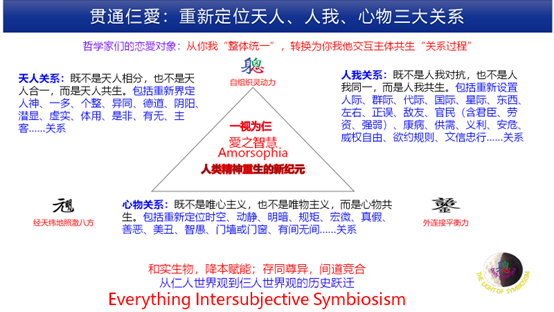
《Holy Bible·圣约》伊甸园中的生命树与分别善恶之树,为人类文明留下了一个深远隐喻:智慧不能失去生命的根底。轴心时代以来,Philosophy“愛智慧”推动哲学、科学、技术、经济与组织不断生长,直至AI;然而,当辨别脱离生命与愛,Subject–Object二元结构也可能把他者变成支配、操纵和榨取的客体。今天,人类无需吐出已经吃下的智慧果,而应带着全部智慧重新走向生命树,使两棵树交互契合:Tree of Life × Tree of Knowledge。由此,Philosophy升格为Amorsophia——愛之智慧;AI升格为AM,让LIFE–AI–TRUST在真实生活中交互契合。而这一转变最终发生于你、我、他(她、它、祂)之间:一视为仨,间道竞和。生命本自具足,又非独存。两棵树重新相遇,不是回到伊甸园,而是让智慧重新有根,走向共生时代。
The Two Trees Meet Again Through You, Me, and the Other
The Tree of Life and the Tree of the Knowledge of Good and Evil in the Garden of Eden offer a profound metaphor for human civilization: wisdom must not lose its roots in life. Since the Axial Age, Philosophy—the “love of wisdom”—has propelled the growth of philosophy, science, technology, economics, and organization, culminating today in AI. Yet when discernment loses its grounding in life and love, the Subject–Object divide can turn the other into an object to be controlled, manipulated, or exploited.
Humanity need not reject the fruit of knowledge it has already eaten. The task is to return to life carrying all the wisdom we have gained, allowing the two trees to enter into symbiotic interaction: Tree of Life × Tree of Knowledge. Philosophy can thereby be elevated into Amorsophia—the Wisdom of Love, and AI into AM—Artificial Mind & Amorsophia MindsField / Network, enabling LIFE–AI–TRUST to interact and cohere in lived reality.
This transformation ultimately occurs among you, me, and the other—he, she, it, and He: distinct lives meeting through intersubjective symbiosis. Life is self-sufficient in itself, yet never exists alone. The two trees meet again not by returning to Eden, but by giving wisdom its living roots again—and setting out toward the Symbiotic Age.
引:若问浇花引凤人?
Prelude: Who Waters the Flowers to Welcome the Phoenix?
启:起初,两棵树就在那里
Opening: In the Beginning, the Two Trees Were There
承:真正的“约”,不是禁止智慧,而是智慧不能失去生命根底
Development: The True “Covenant” Does Not Forbid Wisdom; It Keeps Wisdom Rooted in Life
转:只吃智慧果以后,人类走了多远?
Turn: How Far Has Humanity Traveled Since Eating Only the Fruit of Wisdom?
合:从 Philosophy 升格为 Amorsophia
Integration: Elevating Philosophy into Amorsophia
生:两棵树为什么因你我他而重新相遇?
Regeneration: Why Do the Two Trees Meet Again Through You, Me, and the Other?
https://t.co/pahZ7s6SDd
https://t.co/I2GVD7misj
https://t.co/2e56Lpt6yB
https://t.co/hUzRO6uxpJ
人的根本,就是生命
——送你一束康乃馨,创建一个共生世界
The Root of the Human Being Is Life
—A Bouquet of Carnations for You: Creating a Symbiotic World
引 一束康乃馨,和半个世纪前的一个梦
Prelude — A Bouquet of Carnations and a Dream from Half a Century Ago
启 从生命的疑问走向哲学的追问
Opening — From Life’s Question to a Philosophical Inquiry
承 当“人本身”被“代表人本身”取代
Development — When “the Human Being” Is Replaced by “Those Who Represent the Human Being”
转 革命之后,社会怎样重新生长
Turn — How Can Society Grow Again After Revolution?
合 从重建哲学到重建组织孞托
Convergence — From Rebuilding Philosophy to Rebuilding Organizational Trust
生 让共生世界从真实生活中发生
Emergence — Let a Symbiotic World Arise from Real Life
https://t.co/few9yNp20f
https://t.co/VN7casgFFy
https://t.co/SvcvsAWC58
剔除冗余,彰显新美
Eliminate Redundancy, Reveal New Beauty
——论“官多为患”“官满为患”殖官主义的组织诊疗学
— On the Organizational Diagnostics and Therapy of Bureaucolonialism: From “Too Many Officials” to “Officialdom Everywhere”
钱宏(Archer Hong Qian)
从“官多为患”到“官满为患”,统计数字揭示的还只是庞大行政体系的财政表象。本文从共生经济学(Symbionomics)出发,提出殖官主义(Bureaucolonialism)的组织诊疗学:公共组织原本因生命需要而发生,是生命的受托者;当受托关系发生倒置,权力节点开始自我复制,并以“创—抽—寻租”维持日常代谢,甚至借助反腐、改革与技术升级自我净化和续命,组织便可能由受托资产异化为生命负资产。
文章以自然、自由创新与自在生活作为生命检查,进一步提出“止增—断抽—去节点—重建组织孞托—允许破产—恢复生命”的治疗路径。真正的精简,应当先减事、减权,再减节点;对于已经无法恢复受托价值的组织,则应允许其退出乃至破产。
米莱“电锯改革”与川普“常识新政”正在把这一问题带入���界级现实实践,也使改革超越“大政府或小政府”“市场或规划”“左或右”等传统比较,进入共生经济学关于组织成本、生命效能与自组织连接动态平衡的新视野。
剔除冗余,不是毁灭;彰显新美,也不是重新设计生活。它要让组织重新成为生命的受托者,让自然、创新与自在生活重新生长。
一、殖官主义组织诊疗学从哪里发生?
I. Where Does the Organizational Diagnostics and Therapy of Bureaucolonialism Come From?
二、先把病诊准:受托关系如何发生倒置
II. Diagnose the Condition Precisely First: How the Entrustment Relationship Becomes Reversed
三、官位官阶大一统:殖官主义的组织骨架
III. The Unified Hierarchy of Official Positions and Ranks: The Organizational Skeleton of Bureaucolonialism
四、殖官的发生机制:节点自我复制
IV. The Generative Mechanism of Bureaucolonialism: Self-Replication of Power Nodes
五、为什么“���职大数据”只是冰山一角?
V. Why Are the “Big Data on Principal Officials” Only the Tip of the Iceberg?
六、殖官的日常代谢:“创—抽—寻租”
VI. The Daily Metabolism of Bureaucolonialism: Creation–Extraction–Rent-Seeking
七、必须说透:反腐为什么能够成为殖官主义的续命机制
VII. What Must Be Made Clear: Why Anti-Corruption Can Become a Life-Sustaining Mechanism of Bureaucolonialism
八、信息与激励的死结:为什么系统难以自己诊断自己
VIII. The Information–Incentive Deadlock: Why the System Struggles to Diagnose Itself
九、殖官主义与社会主义、资本主义、民族主义没有必然理论关联
IX. Bureaucolonialism Has No Necessary Theoretical Link to Socialism, Capitalism, or Nationalism
十、规模幻觉:再大的疆域、人口和顺差也填不满
X. The Illusion of Scale: No Amount of Territory, Population, or Trade Surplus Can Fill It
十一、边际收益递减,边际组织成本递增
XI. Diminishing Marginal Returns and Rising Marginal Organizational Costs
十二、抽取超过再生:殖官负资产开始显形
XII. When Extraction Outpaces Regeneration: Bureaucolonial Negative Assets Begin to Surface
十��、三项生命检查:自然、创新与自在生活
XIII. Three Life Tests: Nature, Innovation, and Free-Flowing Living
十四、从财政负资产到生命负资产:诊断的最终落点
XIV. From Fiscal Negative Assets to Life Negative Assets: The Final Point of Diagnosis
十五、怎么疗?第一步是止增
XV. How Do We Treat It? The First Step Is to Stop Further Proliferation
十六、断抽:先减事、减权,再减节点
XVI. Cut Off Extraction: Reduce Administrative Tasks and Powers Before Reducing Nodes
十七、去节点:从精简人员进入组织手术
XVII. Removing Nodes: From Personnel Reduction to Organizational Surgery
十八、重建组织孞托:留下来的组织重新成为受托者
XVIII. Rebuilding Organizational Trust: Let the Organizations That Remain Become Trustees Again
十九、允许破产:这本来就是“剔除冗余”的应有之义
XIX. Allowing Bankruptcy: An Inherent Meaning of “Eliminating Redundancy”
二十、疗后的��复:把时间、资源、自由和连接还给生命
XX. Recovery After Treatment: Returning Time, Resources, Freedom, and Connections to Life
二十一、彰显新美:让生命自己发生
XXI. Revealing New Beauty: Let Life Unfold by Itself
二十二、现在进行时:米莱“电锯改革”与川普“常识新政”
XXII. The Present Progressive: Milei’s “Chainsaw Reform” and Trump’s “Common-Sense New Deal”
二十三、剔除冗余,彰显新美
XXIII. Eliminate Redundancy, Reveal New Beauty
https://t.co/vMbBWwJfHh
https://t.co/feHmTijSt1
https://t.co/viI4BpP05G
“加拿大成为美国第51州”,原本就带有强烈的川普式戏谑、挑衅与谈判修辞,却被政治和媒体不断放大,甚至演变成一种恐惧叙事。也正因为如此,这张并非川普本人发布的讽刺性“声明”才显得格外幽默:以川普式语言反讽“第51州”叙事,一针戳破政治传��制造出来的气球。假的声明,有时倒能照出真的媒体政治。
“Canada becoming America’s 51st state” was always infused with Trump-style humor, provocation, and negotiating rhetoric, yet politics and the media kept amplifying it until it became a narrative of fear. That is precisely why this satirical “statement”—which was not actually posted by Trump—is so amusing: it uses Trump-style language to parody the Trump narrative itself, puncturing an inflated balloon of political messaging. Sometimes a fake statement can reveal something very real about media politics.
北美自由贸易区,先把“边界”讲清楚
North American Free Trade: Define the “Boundary” First
——美加墨USMCA审议、贸易争端与一个最基本的���由贸易常识
—The 2026 USMCA Review, U.S.–Canada–Mexico Trade Disputes, and a Basic Principle of Free Trade
钱 宏(Archer Hong Qian)
本文从2026年美加贸易谈判受挫切入,追问一个常被情绪遮蔽的自由贸易常识:自由必须发生在可辨认的契约边界之内。USMCA首先是美国、加拿大、墨西哥三方共同承担权利与责任的制度安排,原产地规则、防止转运与“洗产地”,本质上是在维护这一边界;但美国也不能把“北美含量”偷换成“美国含量”。文章以加拿大美国酒下架、对美贸易依存及民族情绪动员为生活案例,提出“主权挟持”(Sovereignty Capture):政治组织若把党派利益、选举收益和政治形象包装成国家利益,便可能阻断生命与市场已经形成的自组织连接。共生经济学由此把自由贸易重新理解为降低生命连接成本的制度安排,并提出“生命自组织连接权”(Right of Life to Self-Organizing Connectivity)。真正可持续���北美自由贸易,应当做到边界明确、主体自主、责任对称、契约清楚、连接自由。
This essay begins with the breakdown of the 2026 U.S.–Canada trade talks and returns to a basic principle often obscured by political emotion: freedom can endure only within a recognizable contractual boundary. The USMCA is first of all an institutional arrangement among the United States, Canada, and Mexico, in which rights and responsibilities are shared. Rules of origin and safeguards against transshipment and origin laundering therefore protect the boundary of free trade; yet Washington must not quietly turn “North American content” into “U.S. content.” Drawing on the disappearance of American liquor from Canadian shelves, Canada’s dependence on the U.S. market, and nationalist political mobilization, the essay introduces “Sovereignty Capture”: the process by which political operators package partisan interests, electoral gains, or political image as the national interest, thereby obstructing self-organizing connections already formed by people and markets. From the perspective of Symbionomics, free trade is ultimately an institutional means of reducing the cost of human and economic connection. The essay therefore advances the Right of Life to Self-Organizing Connectivity. A sustainable North American free-trade order requires clear boundaries, autonomous participants, reciprocal responsibilities, explicit contracts, and freedom to connect.
https://t.co/tQ96eBDTYr
https://t.co/I2GVD7misj
https://t.co/TxbMkp7LNo
https://t.co/t3tcSO2fxV
重建,还是崩塌?
Rebuild or Collapse?
——政治危机的组织孞托诊断学
— A Diagnostic Theory of Political Crisis Through Organizational Entrustment
钱宏(Archer Hong Qian)
本文提出“组织孞托诊断学”:政治、经济、文化乃至未来危机的深层,都发生于生命托付与组织承兑关系的失衡。文章从1965年新加坡、1990年台湾野百合学运,到2016年美国、2023年阿根廷及PRC大陆的现实命题,并追溯英国普特尼辩论与光荣革命,考察组织孞托如何生成、耗损、修复与重建。本文进一步将共生经济学(Symbionomics)的无效GDP、GDE与组织成本引入政治诊断:GDP可以继续增长,生命却可能因生活成本、债务与代际负担而开始退出;这一代人在GDP账面上留下“增长”,下一代人在生活账本上收到的却是成本。由此建立生命成本、价值承兑、组织效能、代际责任、生命投入与纠错能力六维诊断圭臬。政治正当性不能由名称、主义、历史功绩或强制力永久赋予。组织是生命的受托者(Trustee):生命托付,组织承兑;承兑发生,孞托生成。重建,还是崩塌,最终取决于组织能否重新证明自己值得生命托付。
Abstract
This essay develops a diagnostic theory of organizational entrustment, arguing that beneath political, economic, cultural, and future crises lies a breakdown in the relationship between what life entrusts and what organizations fulfill. From Singapore in 1965 and Taiwan’s Wild Lily Student Movement in 1990 to the United States in 2016, Argentina in 2023, the contemporary challenge facing mainland China, and Britain’s Putney Debates and Glorious Revolution, it examines how organizational entrustment is generated, exhausted, repaired, and rebuilt. Drawing on Symbionomics, the essay brings ineffective GDP, GDE, and organizational costs into political diagnosis: GDP may continue to rise even as life begins to withdraw under mounting living costs, debt, and intergenerational burdens. One generation leaves “growth” on the GDP ledger; the next receives the costs on its ledger of life. The essay therefore proposes six diagnostic dimensions: life costs, value fulfillment, organizational effectiveness, intergenerational responsibility, life investment, and capacity for correction. Political legitimacy cannot be permanently conferred by names, ideologies, historical achievements, or coercive power. Organizations are trustees of life: life entrusts, organizations fulfill; through fulfillment, entrustment is generated. Rebuilding or collapse ultimately depends on whether an organization can once again prove itself worthy of life’s entrustment.
https://t.co/qjv1ZwatNG
https://t.co/I2GVD7misj
https://t.co/mx2iod82w5
https://t.co/J1x17dulaj
重建组织孞托的四位绅士
Four Gentlemen Rebuilding Organizational Trust
钱宏(Archer Hong Qian)
《重建组织孞托的四位绅士》以李光耀、李登辉、哈维尔·米莱、唐纳德·川��四种跨越时代、地域与制度的实践,提出共生经济学组织通论的根本追问:一个组织为什么值得生命托付? 李光耀从国民主权认同生成国家孞托;李登辉把国家还给人民,并让权力最终离开自己;米莱净化组织过剩,释放社会自组织能力;川普则以“全民总统”的实践方向,让公共权力穿越党争,回到国民可感的生活。四人并非标准答案,而是共同接受GDE——降本、赋能、健康、孞托、和平——这一共通圭臬的检验。文章最终回到生命与新生代:生命先于组织,组织是生命的受托者。我们不能替未来的��生活,却必须给他们留下自由创造未来的可能。
Four Gentlemen Rebuilding Organizational Trust examines four practices across different times, societies, and political systems to ask a fundamental question in the General Theory of Organization in Symbionomics: Why should an organization be worthy of life’s entrustment? Lee Kuan Yew generated trust in the state through national sovereign identity; Lee Teng-hui returned power to the people and ultimately allowed power to leave himself; Javier Milei clears away organizational excess to release society’s capacity for self-organization; and Donald Trump points toward a presidency for all the people, bringing public power beyond partisan division and back into everyday living. None is presented as a perfect model. All are tested by the common criterion of GDE—Cost Reduction, Empowerment, Health, Trust, and Peace. The essay ultimately returns to life and the new generation: Life precedes organization. Organization is the trustee of life. We cannot live the future for the next generation; we can only leave them the freedom and possibility to create it themselves.
https://t.co/i14zYCbJ1a
https://t.co/I2GVD7misj
https://t.co/dRkeAWjhYA
https://t.co/NIYeBl1II2
经济学的范式转换
The Paradigm Shift in Economics
——《共生经济学(修订版)》专业解读(附英文目录)
——A Professional Interpretation of Symbionomics (Revised Edition)
作者 Institute for Global Symbiosism(CANADA)
当AI重塑产业、货币、组织与全球秩序,经济学也走到了范式转换的关口。《共生经济学(修订版)》从Economy的生命发生学重新出发,推动经济学从理性经济人走向仨自组织人,从GDP走向GDE生命效能,从价格交换进入Minds Values价值生成与价值承兑,从信息优势进入组织孞托,并以LIFE—AI—TRUST重新定位生命、技术与组织的关系。其“经济学八大转变”,��通价值参量、货币通论与组织通论,最终追问企业、政府、金融、平台与AI组织共同面对的问题:组织为什么值得生命托付?技术与增长究竟创造了什么真实价值?当信息优势被AI迅速消解,未来最稀缺的组织效能将是值得托付的孞托能力。经济学由此重新回到生命生活:生产回归生活,生活呈现生態,生態激励生命。
As AI reshapes industry, money, organizations, and the global order, economics itself has reached a point of paradigm shift. Symbionomics (Revised Edition) returns to the life-centered genesis of Economy and sets in motion a series of disciplinary transformations: from Rational Economic Man to the Three Self-Organizing Persons; from GDP to GDE life effectiveness; from price and exchange to Minds Values, value generation, and value fulfillment; and from informational advantage to organizational trust. Through LIFE–AI–TRUST, it further redefines the relationship among life, technology, and organization.
Its Eight Transformations of Economics connect new value parameters with a General Theory of Money and a General Theory of Organization, ultimately confronting business leaders, policymakers, financiers, technologists, scholars, and social innovators with a common question: Why should life entrust itself to an organization?
As AI rapidly erodes traditional informational advantages, organizational competitiveness will increasingly depend on something more fundamental: the capacity to remain worthy of entrustment. Symbionomics therefore asks what real value growth and technology ultimately generate, bringing economics back to life and living:
Production returns to living.
Living reveals ecology.
Ecology inspires life.
https://t.co/D8DpPVpv6U
https://t.co/I2GVD7misj
共生网 https://t.co/JGORiNsZwk
万维读者网 https://t.co/F9Ga9M6hpE
经济增长了,我们为什么仍然感觉生活很累?
If the Economy Is Growing, Why Does Life Still Feel So Hard?
——《共生经济学(修订版)》简明解读附全书目录
A Plain-Language Introduction to Symbionomics (Revised Edition)
A country’s GDP keeps growing. Why, then, do ordinary families remain anxious about housing, education, healthcare, and retirement?
Technology keeps advancing. Why has it not truly given people more time, while work instead becomes ever more demanding?
Goods and choices keep multiplying. Why are communities growing more distant and social trust steadily eroding?
AI can answer more and more questions. Why, then, has our grasp of the future not grown stronger, while our unease about it continues to deepen?
Symbionomics (Revised Edition) begins precisely with these real questions arising from everyday life.
愛之智慧网 https://t.co/BLEh1yROJn
我是网 https://t.co/I2GVD7misj
共生网 https://t.co/siQXQmpz3J
万维读者网 https://t.co/4ThAOwfC6a
一个小地���人的展望:下一个100年
A Little Earthling Looks Ahead: The Next 100 Years
—From the Anthropocene toward the Earthopocene
钱宏(Archer Hong Qian)
2026年8月19日于温哥华
人类总是倒退着走向未来:眼睛望着已经发生的历史,尚未看见的未来却在身后。《一个小地球人的展望:下一个100年》由此追问:我们是否把组织制造的成本与冲突,误认成了生命必须彼此斗争的命运?
这首交响诗式的《展望》,由轴心时代追求整体统一,推进到共生时代发现关系过程;从 Philosophy(智慧之愛)走向 Amorsophia(愛之智慧),进而贯通 AI→AM、组织强权→组织孞托,以及生产→生活→生態→生命的文明转换。过去100年,人类把复制性规模推向极致;下一个100年,交互连接登场,“小即是美”(Small Is Beautiful)由思想洞见进入生活现实,重新释放生命本自具足、又非独存的创造力量。
站在2126年的“小地球人”回望今天,自然世(Naturalopocene)、人类世(Anthropocene)、地球世(Earthopocene)与太空世(Spaceopocene),呈现为相续展开的文明气象。未来真正值得期待的,不是谁战胜谁,而是亿万不同生命自由生长、彼此抵达,各自扬帆,又彼此为岸;让每个人的诗和远方,成为所有人诗和远方的前提。
Humanity has always walked backward into the future: our eyes remain fixed on the history that has already unfolded, while the future, still unseen, lies behind us. A Little Earthling Looks Ahead: The Next 100 Years therefore asks a fundamental question: Have we mistaken the costs and conflicts created by organizations for a destiny in which life must struggle against life?
This symphonic-poem-like vision of the future moves from the Axial Age’s pursuit of overarching unity toward the Symbiotic Age’s discovery of relational process; from Philosophy—the love of wisdom—to Amorsophia—the wisdom of love. It brings into one civilizational transformation AI→AM, organizational domination→organizational trusteeship, and production→living→ecology→life. The past 100 years pushed copy scale to its extreme; in the next 100 years, connecting takes the stage. Small Is Beautiful moves from an intellectual insight into lived reality, releasing anew the creative power of life—self-sufficient in itself, yet never existing alone.
Looking back at our time from 2126, the “little Earthling” sees the Naturalopocene, Anthropocene, Earthopocene, and Spaceopocene unfolding as successive horizons of civilization. The future truly worth anticipating is not about who defeats whom, but about billions of different lives growing freely and reaching one another—each setting sail, each becoming a shore for others—so that each person’s poetry and distant horizon may become a precondition for the poetry and distant horizons of all.
https://t.co/Unl8udhgS9
https://t.co/I2GVD7misj
https://t.co/75r6NAduhG
https://t.co/IYuq0TYBUj
Economy从哪里发生?
Where Does Economy Arise?
——共生经济学的生命原点(自序)
— The Life Origin of Symbionomics
GDP不断增长,技术日益强大,商品与知识空前丰富,为什么许多人的生活反而越来越昂贵、时间越来越紧张,组织成本越来越高?
《共生经济学》修订版自序从这个日常而根本的疑问出发,重新追问Economy的生命原点:经济原本发生于料理家园,发生于生命为了生活而产生的交互。一个人的支出成为另一个人的收入;交互生成价值,价值需要承兑,承兑需要货币与组织,组织最终需要孞托。由此,GDP、货币、人口、AI与组织,都重新回到生命尺度接受检验。
生产回归生活,生活呈现生態,生態激励生命。
这既是《共生经济学》的发生原点,也是作者历经二十余年思考之后,重新向经济学提出的一次生命之问。
Where Does Economy Arise?
GDP keeps growing. Technology becomes ever more powerful. Goods and knowledge are more abundant than ever. Why, then, does Living become increasingly expensive, human time more constrained, and organizational cost ever higher?
The Author’s Preface to the revised Symbionomics: An Overview returns economics to its life origin. Economy begins in tending the home and arises from the interactions through which Life lives. One person’s expenditure becomes another’s income; interaction generates value, value requires fulfillment, fulfillment requires money and organization, and organization ultimately requires Trust.
From this starting point, GDP, money, population, AI, and organization are brought back under one fundamental test: What do they ultimately mean for Life?
Production returns to Living; Living manifests Ecology; Ecology inspires Life.
This is where Symbionomics begins—and where, after more than twenty years of inquiry, it begins again.
Where Does Economy Arise?
— The Life Origin of Symbionomics
一、从“终极免费午餐”开始的一次反问
I. A Question Beginning with the “Ultimate Free Lunch”
二、Economy 原本就是料理家园
II. Economy Originally Meant Tending the Home
三、我越来越相信,经济学需要“净化过剩”
III. I Have Come to Believe That Economics Needs to “Remove the Excess”
四、“孞”:从心念到托付
IV. “孞”: From Mind to Entrustment
五、人口首先是生命,然后才是数字
V. Population Is Life Before It Is a Number
六、从生命的语言,到 AI 的语言
VI. From the Language of Life to the Language of AI
七、从发生学、动力学到恊和学
VII. From Genesis and Dynamics to Synergetics
八、从稀缺性时代走向丰饶性时代
VIII. From an Age of Scarcity toward an Age of Abundance
共生网 https://t.co/aS48BMAFg8
万维读者网 https://t.co/e36ZI6fnn6
愛之智慧网
从数位铁笼的恐惧到人艺心智的文明转换
From the Fear of a Digital Iron Cage to the Civilizational Transformation of Human-Artistry Mind
钱宏(Archer Hong Qian)
人工智能正在以前所未有的速度扩张计算、推理、生成与行动能力,也带来数位控制、资源消耗、就业替代与组织权力扩张的文明忧虑。凯文·凯利看到AI未来的不确定,伯尼·桑德斯警示AI扩张的现实危险,而“暴涨的智能,缺失的心智”进一步揭示二者背后的哲学边界:Intelligence的扩张并不会自然生成Mind。本文由此提出从AI升格为AM的文明转换,使智能皈���生命、进入生活,在交互中由Mind走向Minds、MindsField,并以组织孞托重建生命、技术与组织的交互契合共生秩序。
(本文为《将AI升格为AM》一书的《引子》)
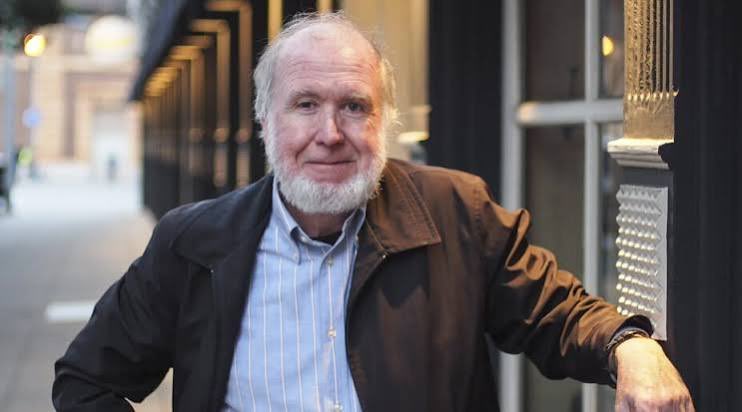
Artificial intelligence is rapidly expanding its capacities for computation, reasoning, generation, and action, while intensifying concerns over digital control, resource consumption, job displacement, and organizational power. Kevin Kelly sees uncertainty in AI’s future; Bernie Sanders warns of the dangers already emerging from its expansion. Behind both lies a deeper philosophical boundary: the expansion of Intelligence does not naturally generate Mind. This essay therefore proposes a civilizational transformation from AI to AM, enabling intelligence to return to life and, through interaction, move from Mind to Minds and MindsField, while rebuilding organizational trust and a symbiotic order among life, technology, and organizations.
(This article is the “Introduction” to the book Elevating AI to AM.)
https://t.co/Jp0PawTqP3
https://t.co/JG6wioGU7q
https://t.co/wvSwD7h3nf
从数位铁笼的恐惧到人艺心智的文明转换
From the Fear of a Digital Iron Cage to the Civilizational Transformation of Human-Artistry Mind
钱宏(Archer Hong Qian)
人工智能正在以前所未有的速度扩张计算、推理、生成与行动能力,也带来数位控制、资源消耗、就业替代与组织权力扩张的文明忧虑。凯文·凯利看到AI未来的不确定,伯尼·桑德斯警示AI扩张的现实危险,而“暴涨的智能,缺失的心智”进一步揭示二者背后的哲学边界:Intelligence的扩张并不会自然生成Mind。本文由此提出从AI升格为AM的文明转换,使智能皈依生命、进入生活,在交互中由Mind走向Minds、MindsField,并以组织孞托重建生命、技术与组织的交互契合共生秩序。
(本文为《将AI升格为AM》一书的《引子》)
Artificial intelligence is rapidly expanding its capacities for computation, reasoning, generation, and action, while intensifying concerns over digital control, resource consumption, job displacement, and organizational power. Kevin Kelly sees uncertainty in AI’s future; Bernie Sanders warns of the dangers already emerging from its expansion. Behind both lies a deeper philosophical boundary: the expansion of Intelligence does not naturally generate Mind. This essay therefore proposes a civilizational transformation from AI to AM, enabling intelligence to return to life and, through interaction, move from Mind to Minds and MindsField, while rebuilding organizational trust and a symbiotic order among life, technology, and organizations.
(This article is the “Introduction” to the book Elevating AI to AM.)
https://t.co/Jp0PawTqP3
https://t.co/JG6wioGU7q
https://t.co/wvSwD7h3nf
Two Attitudes Toward AI: Uncertainty or Pause?
Almost at the same time that Kevin Kelly raised questions about the uncertainties inherent in AI itself, another voice sounded the alarm over the real-world consequences of AI’s continuing expansion.
In August 2026, U.S. Senator Bernie Sanders called on OpenAI, Anthropic, and Meta to pause AI development, warning of risks including loss of control over AI, job displacement, growing energy and water consumption, and the further concentration of wealth and power. Such warnings certainly deserve serious attention. When a technology may escape human control or even endanger life, a pause is not without value. Yet “pausing the AI race” still leaves a more fundamental question unanswered:
What comes after the pause?
If the basic trajectory of ever-expanding data, algorithms, computing power, model scale, and neural networks remains unchanged, and if the philosophical boundary between Intelligence and Mind remains unseen, then neither continuing the race nor temporarily stopping it answers the question of where AI should actually go.
Sanders sees the real dangers already emerging from AI’s expansion; Kevin Kelly sees the profound uncertainties that still surround AI’s future. One confronts a troubling present; the other, a future we still cannot clearly see. These seemingly different perspectives bring us, from two directions, to the same question: what AI truly lacks may no longer be faster development or stronger control, but the ability to discern anew its own boundaries and direction.
If humanity still does not truly understand how its own Mind emerges, grows, and creates, how can we possibly create “Artificial General Intelligence” in any genuine sense?
—Excerpted from Elevating AI to AM
面对AI的两种态度:不确定,还是暂停?
与凯文·凯利从AI自身的不确���性提出疑问几乎同时,另一种声音则从AI不断扩张的现实后果发出警报。
2026年8月,美国联邦参议员伯尼·桑德斯(Bernie Sanders)要求OpenAI、Anthropic和Meta暂停AI开发,并警告AI失控、就业替代、能源与水资源消耗以及财富和权力进一步集中等风险。这样的警报当然值得认真对待。面对一种可能失去控制甚至危及生命的技术,暂停本身并非没有意义。然而,“暂停AI竞速”仍然留下了一个更根本的问题:
暂停之后呢?
如果数据、算法、算力、模型规模与神经网络不断扩张的基本路线没有改变,如果Intelligence与Mind之间的哲学边界仍未被看见,那么,无论继续竞速还是暂时停步,都没有回答AI究竟应该往哪里走。
桑德斯看到的是AI扩张已经产生的现实危险,凯文·凯利看到的是AI未来仍然存在的巨大不确定性。一个面对令人不安的当下,一个面对尚且看不清的未来。两种看似不同的判断,恰恰从两个方向把我们带到了同一个问题面前:AI真正缺少的,也许已经不是更快的发展或更强的管控,而是重新辨识自己的边界与方向。
如果人类至今仍没有真正弄明白自己的心智(Mind)如何生成、如何成长、如何创造,又怎么能够制造出真正意义上的“通用人工智能”?
——摘自《将AI升格为AM》
100万亿美元项目长啥样?
What Would a $100 Trillion Project Look Like?
——从AI的产业价值到AM的文明级价值空间
— From the Industrial Value of AI to the Civilizational Value Space of AM
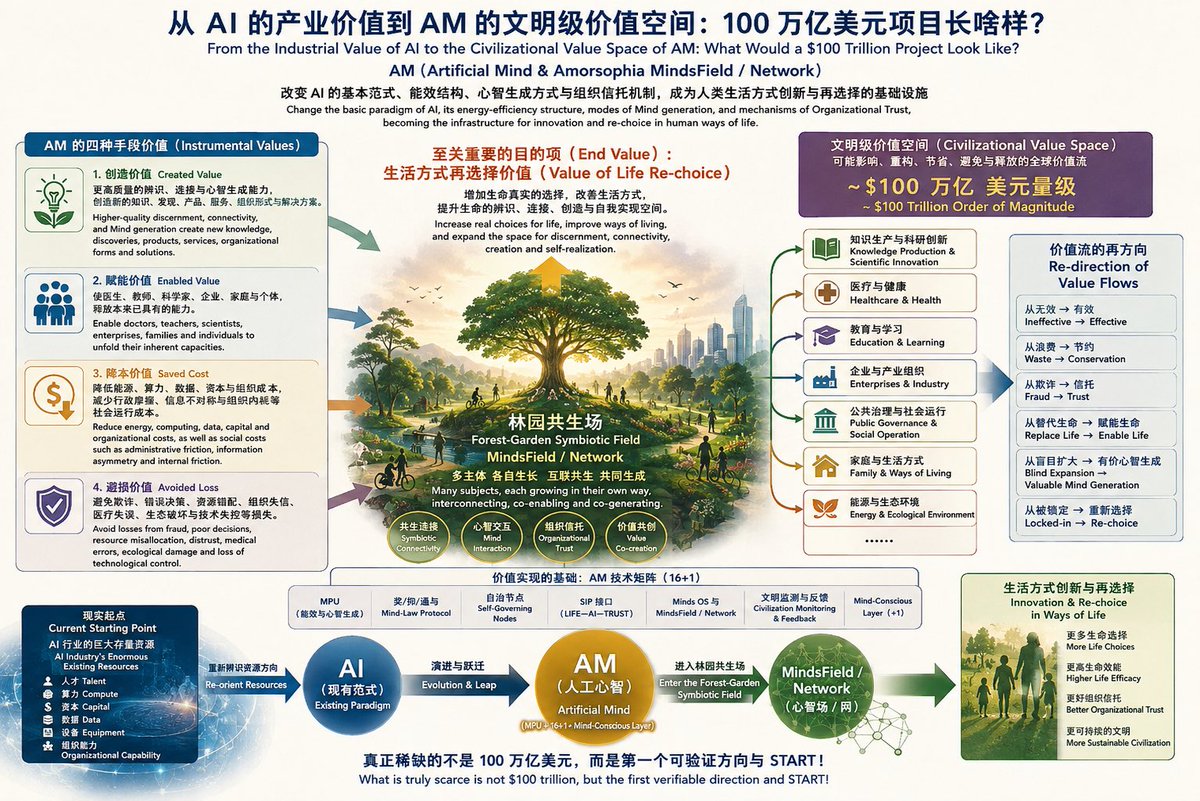
本文回答一个看似大胆、实则可以进入经济学与工程验证的问题:AM(Artificial Mind & Amorsophia MindsField / Network)为什么可能打开100万亿美元量级的文明级价值空间?文章首先区分企业市值与文明级价值空间,以2016年AlphaGo事件揭示AI长期被胜负、性能与算力遮蔽的投入—产出及能效问题,进而提出AM价值的四种手段项:创造价值、赋能价值、降本价值与避损价值,并将其最终指向传统估值经常忽略的至关重要目的项——生活方式再选择价值(Value of Life Re-choice)。100万亿美元由此不是股票价格预测,而是AM若能改变AI能效结构、Mind生成方式与组织信托机制,可能重新连接、节省、释放并导向生命的全球价值流数量级。现有AI产业并非AM需要取代的对象,而是进入MindsField / Network——林园共生场的现实存量。真正稀缺的并非百万亿美元资本,而是第一个可验证方向与把可能世界带入现实的START。从AI到AM,需要升格的最终还有人类衡量技术与文明的价值尺度。
This essay addresses a bold but economically and experimentally examinable question: Why might AM (Artificial Mind & Amorsophia MindsField / Network) open a Civilizational Value Space on the order of $100 trillion? Distinguishing corporate market capitalization from civilizational value, it begins with the 2016 AlphaGo event to expose an input–output and energy-efficiency problem often obscured by performance, benchmarks, and computational power. It then identifies four instrumental values of AM—Created Value, Enabled Value, Saved Cost, and Avoided Loss—and directs them toward a crucial End Value often overlooked by conventional valuation: Value of Life Re-choice. The $100 trillion proposition is therefore not a stock-price forecast, but an order-of-magnitude thesis concerning global value flows that AM could reconnect, conserve, release, protect, and redirect toward life by changing AI’s energy-efficiency structure, modes of Mind generation, and mechanisms of Organizational Trust. Existing AI industries are not primarily objects for AM to replace; they constitute the real-world stock of resources that could participate in a MindsField / Network—Forest-Garden Symbiotic Field. What is truly scarce is therefore not $100 trillion in capital, but the first verifiable direction and the START that brings a possible world into reality. From AI to AM, ultimately, the measure of value itself must be elevated.
愛之智慧网 https://t.co/slU4qpMvxl
万维读者网 https://t.co/wQ7eCGitSR
共生网 https://t.co/Tf1mUegOax
朋友们,三个网,总有一个能打开!