“Islamists arrive and are given permission to give vent to their ancient loathing by anarcho-socialists, and their naive campus enablers, who love Palestine but hate Canada, and despise Jews most of all.”
https://t.co/rtw0nkp3X6
This is far longer than my typical post, but it tells an important story of what appears to be an attempt by leadership at Massey College to censor a major conference on antisemitism, leading to the resignation of one of its senior fellows.
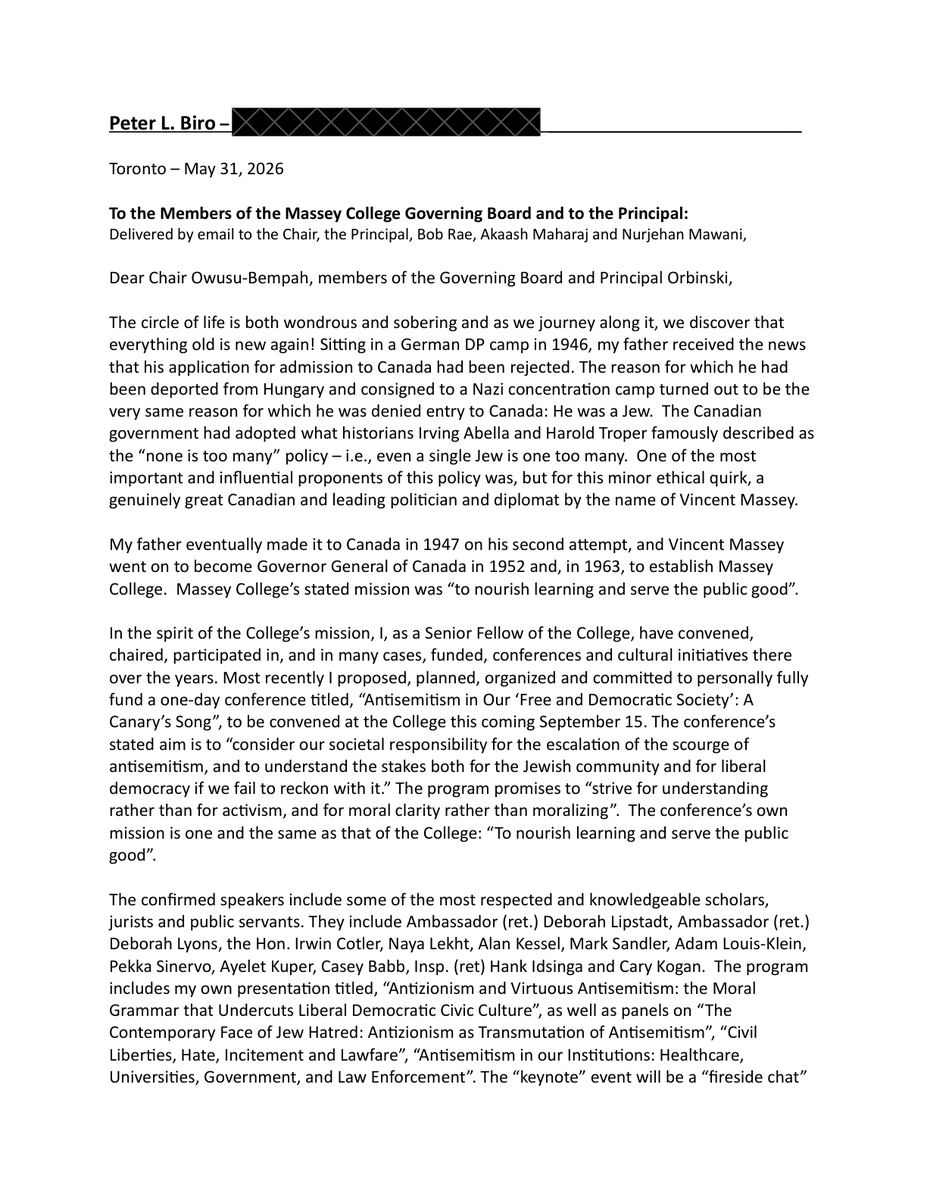
The disappointment that greeted Mark Carney’s antisemitism speech this week is partly a function of a Jewish community that has been facing real threats for months, with fears that our governments and institutions have been unwilling to confront them directly and honestly. Hours before the Carney speech, I received a note from Peter Biro, a Toronto lawyer and longtime senior fellow at the University of Toronto’s Massey College, that provided a tangible example of the harm. Biro, facing what appears to have been an attempt by Massey College leadership to censor a major antisemitism conference planned for this fall, resigned his fellowship rather than succumb to it.
Biro proposed, organized, and committed to personally fund a one-day conference, “Antisemitism in Our ‘Free and Democratic Society’: A Canary’s Song,” co-presented with the Raoul Wallenberg Centre for Human Rights and featuring Deborah Lipstadt, Deborah Lyons, and Irwin Cotler, among others. According to his resignation letter, which I am sharing here with his permission, the College told him it had never approved the event and insisted on appointing an advisory committee to review, curate, and approve a version of the program that fit the College’s “mission and approach.” When he asked who had raised concerns and whether such a committee had any precedent, he says he received no answer.
Biro calls the stated objection false and a pretext. The real concern, he argues, is the substance: how antisemitism would be examined, by whom, and whether a human rights centre founded by a Jewish and Zionist lawyer was an acceptable partner. That objection makes little sense, since the College itself partnered with the very same centre only months ago. In Biro’s words, the committee “looks and feels less like prudent corporate governance and more like antisemitism.” Read the letter and judge for yourself.
Here is the part that should worry everyone. An academic institution responded to a conference on antisemitism, organized by one of its own fellows and featuring some of the world’s most notable antisemitism scholars, by insisting that an oversight committee was needed to decide whether the subject was being handled appropriately. I’ve organized many conferences and never had university leadership intervene in this manner. Massey College, much like Mark Carney, had a chance to lead, but both failed to meet the moment. The conference will go on in Toronto on September 15. The stain on Massey College will not come off as easily.
Let's hope so. To be meaningful, the prime minister will have to set out in concrete terms what the government will do using existing laws and what Criminal Code & other legal reforms it plans to table.
I have a feeling that @MarkCarney's Monday speech about antisemitism - from within a Toronto synagogue - is going to be quite important, and an implicit acknowledgment of the government's many missteps on the issue. @CIJAinfo@bnaibrithcanada
In @the_lineca today, an essay adapted from part of a lecture I gave at @cardusca earlier this month. The full lecture will be published soon, but this part mostly stands on its own:
The Case for a "Loose Confederation"
https://t.co/z6wZ3XYFDp
The "right direction" is a relative concept. A man who has dug himself into a hole 20 feet deep begins moving in the right direction once he puts down the shovel. But whether people are optimistic that he can actually climb out is another matter altogether.
“A pessimistic electorate narrows minds. People look for relief. They punish governments.”
“But an optimistic electorate listens longer.”
New long read on the return of Canadian optimism and what it means for politics, advocacy, and leadership in Canada.
https://t.co/8rwABQEgO0
@nspector4 The House increase - which is the one I referred to as prompt - is technically a constitutional amendment but could be passed with an ordinary parliamentary majority - and several such amendments have already been passed.
One way to achieve rep-by-pop more promptly would be to meaningfully increase the number of MPs. This could also have the salutary benefit of making MPs more independent.
The other needed reform is amending the constitutional allocation of senators. The west is chronically underrepresented due to a population distribution more than a century out of date.
My own (admittedly anecdotal) sense is that many Albertans are neither staunch federalists nor staunch separatists. Any federalist strategy must be aimed at convincing these people that their voices are being heard and that the federation can work for Alberta. If ordinary Albertans perceive central Canada to be dismissive, it will only push them toward the separatist camp.
Uh oh. The Prime Minister is playing with fire.
The last thing Alberta separatists need to hear is a Liberal prime minister calling a referendum, "stupid".
@MatthewProtti I did not say that new states require a previous incarnation. I said that one cannot assume this "new state" would look like the former province.
Howard is correct. I say this as someone who's long been an advocate of provincial autonomy and who sympathizes with Alberta's grievances. Alberta's very existence is a function of Crown sovereignty and legislation. Its boundaries were literally delineated by an Act of Parliament that forms a part of the Canadian Constitution. Unlike BREXIT, there is no status quo ante to which Alberta can return.
So it's crucial for separatists and skeptics alike to remember that there is no principle by which the province can separate while also insisting on some right to retain its current form. If Alberta can be reconstituted outside the Crown, then all bets are off as to what this new entity looks like and what parts of the current province remain with Canada.
Democracy also requires that all Canadians have a say when a fraction of the electorate in one part of the country tries to break Confederation.
And democracy requires that in the event of an actual attempted separation, the parts of the province that don’t want to leave Canada, such as, oh, say, the cities of Calgary and Edmonton, remain part of Canada. If Canada is divisible, then Alberta is divisible.
But none of this is about democracy. Democracy is not a free floating concept. It operates within existing institutions and social constructs. Separatists aren’t engaged in a democratic project, they are proposing a revolutionary act of constituent power.
Democracy is the wrong lens through which to view attempts to break up a country in the absence of genuinely inhumane conditions or systemic oppression. And as much as I agree enthusiastically with many separatists’ grievances with Ottawa (and other provincial governments), this is not that.