Welcome to $HoodCash TV.
We are building an animated series around the lore of internet finance.
GameStop. WallStreetBets. Roaring Kitty. The Red Kitten Crew. Robinhood. Solana. The traders, the villains, the chaos and the moments that turned markets into culture.
Every episode is built shot by shot through a custom animation pipeline using storyboards, character references, controlled motion, multiple AI models, manual editing, sound design and countless iterations.
This is not a collection of random AI clips.
It is an ongoing animated universe with recurring characters, connected storylines and original episodes inspired by the events that shaped the trenches.
Our first season is:
The Great Squeeze
Episode 1: The Bet
🎬
Website: https://t.co/KGk8ptluZO
Building one frame in ComfyUI:
Around seven minutes of hands on production compressed into 40 seconds.
What looks like a single frame on screen has already gone through storyboard planning, shot selection, prompt construction, reference setup, node routing, composition checks and multiple review passes.
The models can generate quickly, but they do not make the creative decisions for us. Every camera angle, expression, character position and final frame is selected and refined manually by the HoodCash TV animation team.
Most outputs never make it into the episode. We test, reject, rebuild and rerun until the shot matches the storyboard and feels consistent with the rest of the series.
AI gives our studio speed. The actual work is still direction, taste and iteration.
This is one frame. Now imagine the work behind a full episode.🎬
The bet was placed long before the rest of the market understood it.
This is where the story begins.
Hood Cash TV presents
The Great Squeeze
Episode 1: The Bet
Working behind the scenes on the visual language of the series 🎬
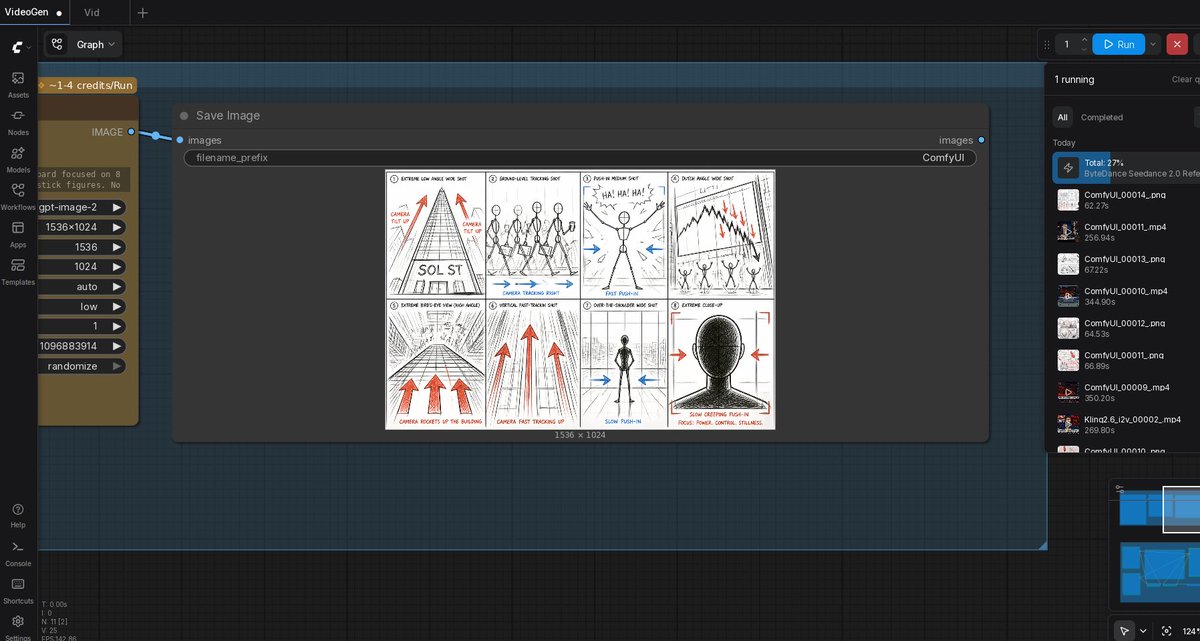
Before a scene reaches the animation pipeline, we map out the camera work shot by shot.
Establishing shots, tracking shots, push ins, close ups and Dutch angles are all planned around the emotion and pacing of the scene. We have been building a reusable shot library so the series develops a consistent directing style instead of every clip feeling like a separate AI generation.
The storyboard is also used to define what the camera should follow, how quickly it should move, where the characters sit in frame and what the audience should be paying attention to.
It is easy to generate movement.
The difficult part is making every movement feel intentional.
A quick look at part of our animation pipeline 🎞️
Every shot starts as an approved storyboard frame. From there, we pass it through a few different models before it ever reaches Seedance.
Gemini handles scene analysis and helps rebuild the motion prompt. IPAdapter keeps the characters consistent from shot to shot, ControlNet locks composition whenever we need tighter control, and once everything is in place, Seedance generates the final motion pass.
Most of the work actually happens after that.
If a character starts drifting, we strengthen the reference. If the camera moves too aggressively, we rebuild the motion prompt. If the background starts hallucinating, we isolate that section and rerun it instead of regenerating the entire shot.
The Rick and Morty inspired style is much harder than it looks. The linework needs to stay clean, the expressions need to stay readable, and the models constantly try to add depth and movement that doesn’t belong.
We’ve probably spent more time building and debugging the pipeline than actually generating scenes.
The goal isn’t to find one model that does everything. It’s building a workflow where each model handles one job, then hands it off to the next.