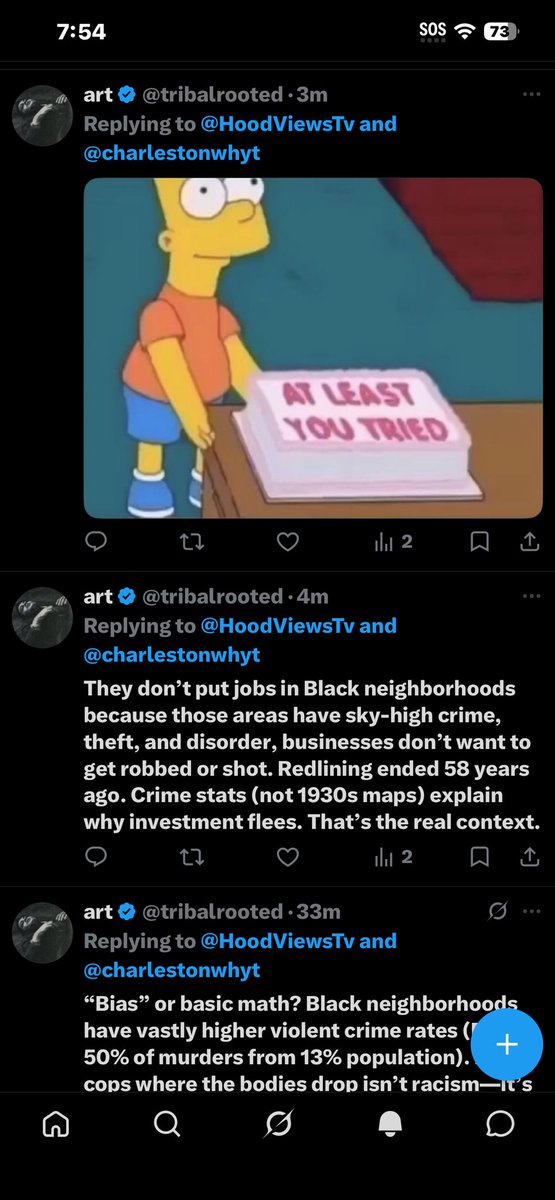
@tribalrooted @charlestonwhyt At the end of the day you’re a fan of black people . If you wasn’t you would not put so much of your time and energy into conversation about a race of people you don’t like . That’s why racism is a mental illness. Y’all hate us but love to think about us at the same time.
@tribalrooted @charlestonwhyt That’s backwards.
Businesses didn’t just “flee crime.” A lot of these neighborhoods were denied loans, denied investment, over-policed, underfunded, flooded with liquor stores, and left with fewer real economic options long before the crime stats you’re pointing at.
@Crocostiago @tribalrooted @charlestonwhyt You don’t think flooding neighborhoods with drugs, liquor stores, poverty, bad schools, and no opportunity helps create the environment you’re talking about?
Crime is the symptom. Disinvestment is the disease.
@tribalrooted @charlestonwhyt Crime is always higher where they don’t invest back into the community. This applies to every community in the world not just black people . I know your racist mind can’t comprehend this kind of information. You can only copy and paste 😂
@tribalrooted @charlestonwhyt So it is not simply “police are there because Black people commit more crime.” That is too shallow. The real issue is history, poverty, policy, bias, and government choosing punishment over investment.
@tribalrooted @charlestonwhyt 5. Revenue policing
Some departments have used tickets, fines, warrants, and court fees to bring money into the city. The DOJ found that Ferguson’s policing was heavily focused on revenue generation and that Black residents carried the burden of those practices disproportionately
@tribalrooted @charlestonwhyt 4. Political pressure
When crime rises, politicians often choose the fastest-looking answer: more police, tougher laws, more arrests. It is easier than funding schools, mental health, jobs, housing, youth programs, and addiction treatment.
@tribalrooted @charlestonwhyt suspended licenses, minor drug possession, street vending, noise, traffic violations — became reasons for more police contact.
@tribalrooted @charlestonwhyt 2. Poverty was criminalized
A lot of Black neighborhoods were made poor by redlining, job discrimination, school inequality, and lack of investment. Then instead of fixing the conditions, cities often sent more police. So things tied to poverty — loitering, unpaid tickets,
@tribalrooted @charlestonwhyt 1. History of control after slavery
After slavery, laws like Black Codes and vagrancy laws were used to arrest freed Black people and force them into labor through convict leasing. That created a long pattern where law enforcement was used to control Black movement, work,
@tribalrooted @charlestonwhyt Aka prison , which is why they police the black community the most and made Black Codes laws . The 13th Amendment banned slavery except as punishment for a crime, and that loophole was used heavily after slavery. You literally can look up all this info if you really cared