🚨BREAKING: Claude can now analyze the stock market and build your trading strategy in hours not weeks.
Here are 16 powerful prompts that act like a Wall Street hedge fund manager (for free).
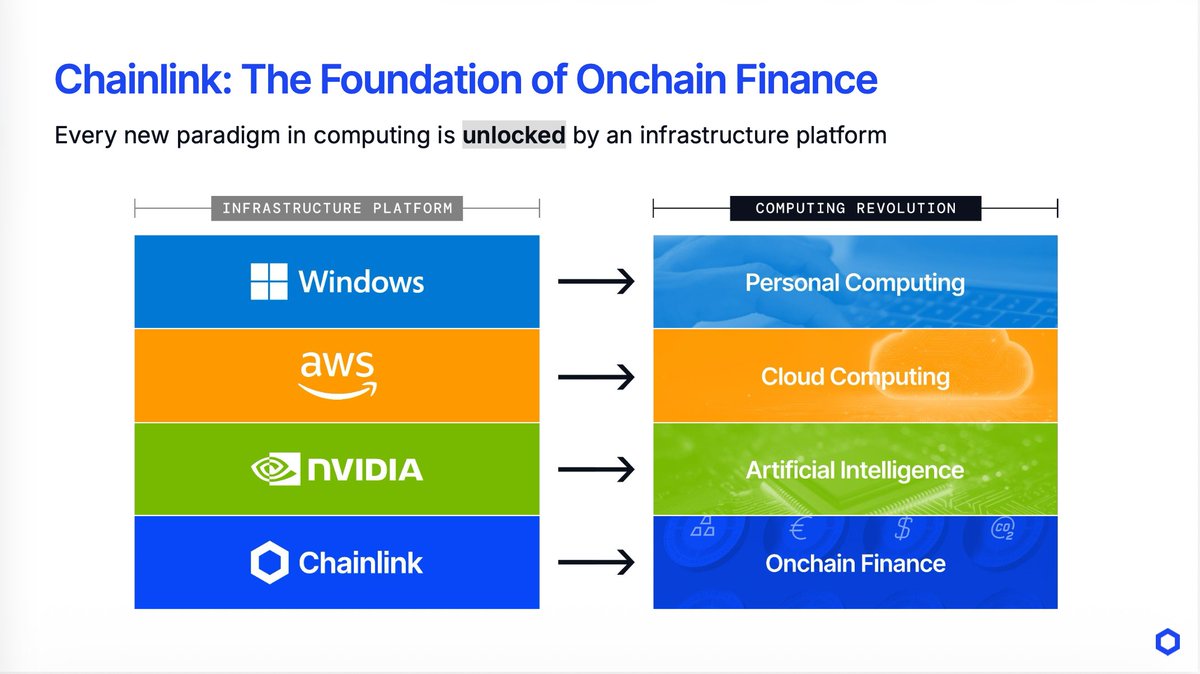
What does @chainlink have in common with @nvidia? They have evolved from products into standards through network effects.
When people hear “network effects,” they often think of social networks or marketplaces, where value increases as more users join. In the case of NVIDIA and Chainlink, the dynamic is subtler but more powerful. Each has built a technology platform around which an ecosystem of developers, tools, integrations, and institutional practices has formed.
As more organizations build products and workflows on NVIDIA’s hardware and software stack, it becomes easier and safer for others to do the same. Expertise accumulates, tooling improves, and operational risk declines. Over time, choosing NVIDIA stopped being a bet on superior specifications and became the only decision for teams that needed reliability at scale. NVIDIA did not just supply GPUs; it became the standard foundation for AI development.
In many ways, Chainlink is similar. As more data providers, applications, and financial institutions integrate with the network, its reliability and security improve. That reliability and security, in turn, attract the largest DeFi protocols and traditional finance institutions that are adopting onchain infrastructure. Integration with Chainlink reduces coordination and trust costs, making it the global standard for serious applications rather than merely a competitive option.
The platform wins because it minimizes risk, aligns incentives across a broad ecosystem, and answers a critical question for decision-makers: What do the best teams in onchain finance already rely on? Chainlink.
TOP 10 STOCK PICKS FOR 2026 🧵
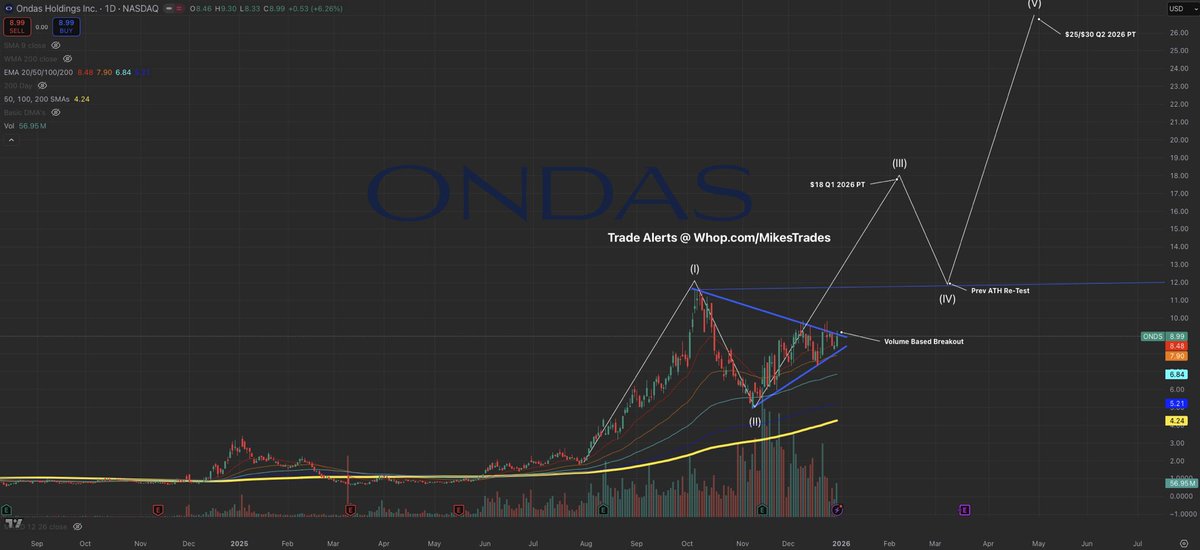
1: Ondas Holdings ~ $ONDS
The drone industry is an expanding market, and Ondas is directly involved with autonomous drones and private wireless networks.
ONDS has a 580% YoY revenue growth with many new contracts.
Price target ~ $30+ (+233%)
NEW‼️: The Telegraph reports that Stanford University research shows mRNA Covid vaccines, like Pfizer and Moderna, can trigger heart inflammation by prompting immune cells to attack the vaccines’ foreign RNA, potentially damaging heart tissue.
Over 2,000 Britons developed myocarditis or pericarditis post-vaccination, with young men most affected.
The vaccines induce protective immune memory but can cause acute cytokine surges leading to rare myocarditis, marked by symptoms like chest pain and fever within days; recovery is typically swift, though hospitalization or death occurs seldom.
Rates stand at one per 140,000 after the first dose and one per 32,000 after the second, peaking at one per 16,750 in males under 30—higher short-term than Covid infection but lower long-term, making vaccination safer overall.
Blood analysis revealed elevated signaling proteins in affected patients; experiments found soy-derived genistein mitigated vaccine-induced damage in cells and animals.
The study, published in Science Translational Medicine, highlights mRNA vaccines’ adaptability for new threats while suggesting ways to curb cytokine risks.
🔥 WHY THIS IS MASSIVELY BULLISH FOR $LINK 🚨
THE SHORT VERSION:
@The_DTCC , the organization that settles $2 QUADRILLION per year, just received regulatory clearance to tokenize U.S. securities on blockchains.
This requires:
✅ Oracles
They need trusted, real-time data feeds to ensure tokenized assets stay synchronized with the underlying securities.
✅ Cross-chain messaging
They explicitly want the ability for participants to register wallets across any blockchain (public or private).
If you support “any chain,” you need a secure interoperability protocol.
✅ Compliance-aware smart contracts & reversibility
They require compliance-aware tokens like ERC-3643, a standard maintained by Chainlink partner Tokeny, built with Chainlink-based controls at its core.
✅ A root-of-trust layer
DTCC must be able to enforce reversibility, freeze, burn, and reassign tokenized assets.
You CANNOT do this safely across multiple chains without a cryptographically-verifiable middleware layer.
There is only one network that already solves all three at institutional grade: Chainlink.
DTCC already worked with Chainlink in past pilots (e.g., Smart NAV, Funds Service).
DTCC initiated the SWIFT/Chainlink interoperability proof-of-concept that succeeded with 12+ major banks.
DTCC’s “blockchain-agnostic” requirement is literally CCIP’s design philosophy.
This letter is the regulatory door opening for exactly the type of tokenized financial system Chainlink has been building for 7 years.
🔥 THE LONG VERSION 🚨
THE REAL BULLISH SIGNALS FOR CHAINLINK
1. DTCC tokenization is now officially allowed by the SEC, this is the biggest gateway to RWA adoption in history
DTCC is the final settlement layer for nearly all U.S. equities.
If they are now legally permitted to tokenize securities:
Stocks
Treasuries
ETFs
…then Chainlink’s infrastructure becomes inevitable, because institutions need:
- deterministic cross-chain transfers
- verified real-world data
- compliance automation
- settlement guarantees
DTCC cannot run the entire financial system on brittle bridges or speculative chains.
They need institutional middleware, and they want Chainlink.
2. They require a cross-chain system that supports any blockchain, which is exactly CCIP
The letter states:
“The DTCC Tokenization Services would not prescribe a particular blockchain… DTC would support the broadest range of blockchains.”
This means interoperability is mandatory.
DTCC needs to:
- mint on chain A
- transfer between any participant wallets
- burn and remint on chain B
- track everything in real time
That is literally the architecture Chainlink designed CCIP for.
No other interoperability protocol:
- has bank-grade security
- has decentralized risk management
- has an active standard for “blockchain-agnostic messaging”
This is CCIP’s perfect market.
3. They require “compliance-aware tokens” — this is Tokeny + Chainlink
The approved token standard?
ERC-3643, Tokeny’s compliance framework.
Tokeny is:
a Chainlink ecosystem partner
using Chainlink for identity, permissions, and access control in enterprise tokens
The letter emphasizes:
“Distribution control”
“Transaction reversibility”
“Only transferable to registered wallets”
This is exactly what Tokeny + Chainlink infrastructure provides.
So DTCC’s required token model aligns with Chainlink’s RWA stack.
4. LedgerScan must observe all transfers across all chains → requires oracles
They need real-time, cryptographically verified state:
“DTC must have the ability to observe all transfers… including privacy-preserving chains.”
This is impossible without:
- trust-minimized external data feeds
- scalable cross-chain state reporting
- a global decentralized oracle network
This requirement screams Chainlink State Proofs + CCIP + DECO.
5. DTCC requires reversibility, override keys, and auditability → this aligns with Chainlink’s compliance stack (CCID + ACE)
DTCC must be able to:
- freeze
- burn
- reverse
- correct errors
- enforce corporate actions
- maintain AML/KYC controls
Chainlink’s emerging compliance suite is the only solution designed for:
- KYC’ed wallet networks
- role-based permissions
- regulated institutions
- onchain audits
- identity binding
- policy-enforced transfers
DTCC needs a full trust-minimized compliance layer.
Chainlink has already built one.
6. This confirms the U.S. is preparing to move securities onto public blockchains
This is THE step that unlocks:
- onchain treasuries
- tokenized ETFs
- tokenized equities
- cross-border settlement
- intraday collateral mobility
Every major institution (BlackRock, Citi, JP Morgan, BNP Paribas, etc.) has already expressed intent to tokenize trillions.
DTCC is the final gatekeeper.
Now they have approval.
Chainlink is the interoperability + data layer for all of that.
7. The “Digital Omnibus Account” matches Chainlink’s vision of an offchain master ledger synced by CCIP
The design is familiar:
- Real securities stay custodied at DTCC
- Token balances represent entitlement
- Transfers occur cross-chain
- DTCC tracks state using an external system (LedgerScan)
This directly mirrors:
- Chainlink’s Cross-Chain Synchronization
- Chainlink Proof of Reserve model
- Chainlink CCIP Omnichain Token frameworks
This is the exact architecture @SergeyNazarov has been describing on stage for two years.
8. DTCC openly acknowledges the need for an external trust layer to unify all chains
They say:
“Objective, neutral, publicly available requirements… ensuring Tokens are maintained on blockchains that are reliable.”
They cannot rely on any single L1.
They need a network-neutral trust layer.
That is Chainlink’s core thesis.
🔥 THE META: WHY THIS IS THE BIGGEST “GREEN LIGHT” FOR CHAINLINK SO FAR
Most crypto “news” doesn’t matter.
This does.
Because:
✔ DTCC is the core of U.S. financial infrastructure
✔ They settle more value annually than every blockchain combined
✔ They needed regulatory permission before launching tokenization
✔ Now they have it
✔ And the system they plan to build requires:
- cross-chain messaging
- secure oracles
- compliance automation
Chainlink is the only production-ready provider of all three.
This isn’t hype.
It’s the literal onboarding of global finance into Chainlink’s domain.
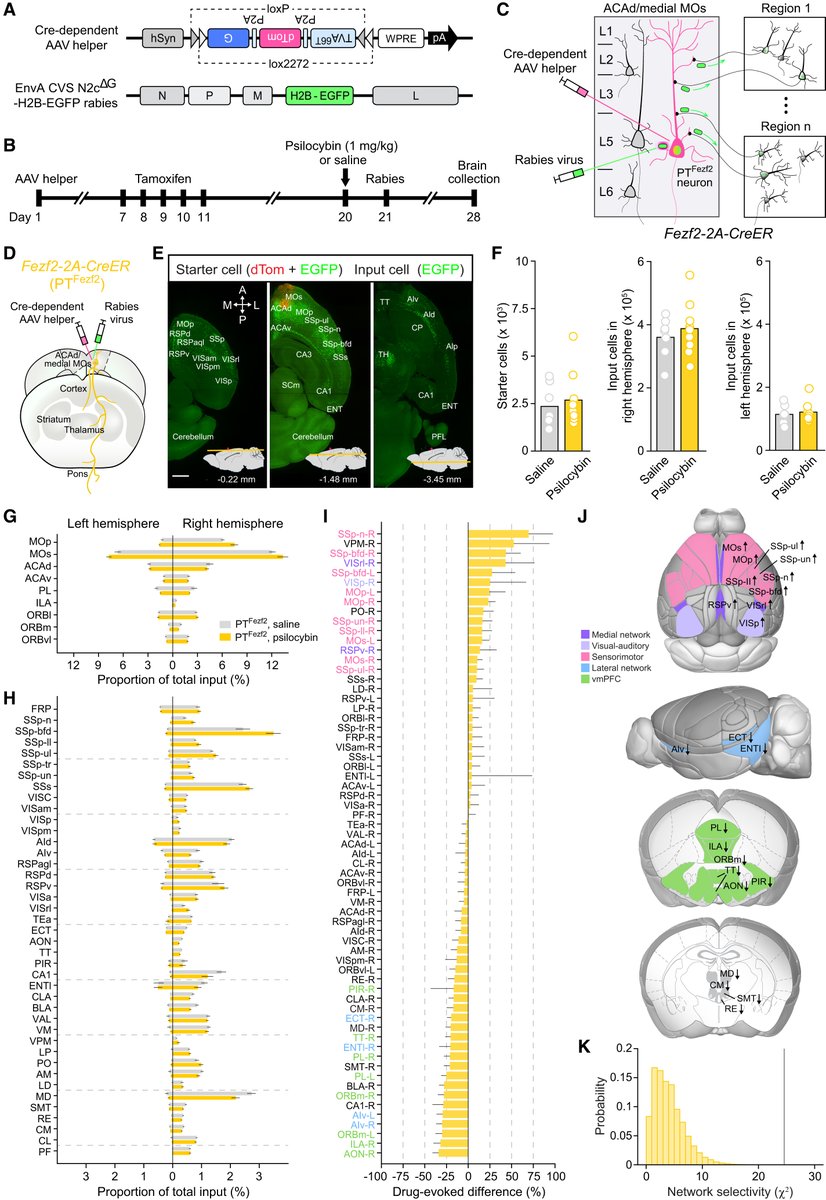
That question just got answered by a team at Cornell.
They needed a way to trace connections backward through the brain - to light up every neuron sending signals into a specific area.
The solution?
𝗔 𝗺𝗼𝗱𝗶𝗳𝗶𝗲𝗱 𝗿𝗮𝗯𝗶𝗲𝘀 𝘃𝗶𝗿𝘂𝘀.
$Link I asked Chat gpt to play out the Chainlink token value in the scenario that Chainlink is data layer for all of this by 2030....
Worst case- $500 token
Best case- $25,000 token
Yea... I'll wait this out a bit longer.
Below is the TLDR full breakdown:
If the $3 quadrillion tokenization scenario in that Water Tower Research report actually plays out — and if Chainlink becomes the interoperability & data layer powering a meaningful share of that infrastructure — then the value of LINK would not resemble anything close to today’s framework.
But we need to break it down realistically, not with moonboy hype.
Below is the cleanest, most grounded way to think about LINK valuation in that world.
---
🔵 1. The Key Variable Isn’t the $3 Quadrillion — It’s LINK’s Fee Capture Share
Chainlink does not get priced by “market cap of tokenized assets,” but by:
value secured × fee extraction × token sinks × velocity
In a world where:
Banks, custodians, and capital markets use CCIP
Tokenized assets across chains require oracles for pricing, settlement, and auditability
SWIFT-style flows run through standardized interoperability layers
…then LINK becomes a monopoly-like middleware asset that captures fees every time:
tokenized assets settle
prices are delivered
messages are validated
cross-chain movements are executed
This is recurring revenue.
---
🔵 2. Reasonable-fee models produce very large numbers
Let’s run three valuation tiers, using conservative-to-aggressive assumptions.
🟦 Scenario A: LINK captures only 0.01% of infrastructure fees
Tokenized settlement flows: $3 quadrillion (annual)
Fee rate extracted by oracle/interoperability layers: ~0.5–2 bps (typical in B2B financial plumbing)
Link share of that oracle/messaging layer: ~5–10%.
This produces roughly:
➤ LINK revenue: $3B–$10B per year
If staking rewards + burn mechanics + node operator costs stabilize token velocity:
LINK price range: $500–$1,200
This is a low-end structural adoption case.
---
🔵 3. Mid-case scenario (likely if CCIP becomes standard):
Here LINK is treated like:
The settlement gas
The security staking collateral
The message routing payment asset
The oracle validation asset
Assume LINK captures 0.05%–0.1% of global settlement value.
➤ Annualized value flowing through LINK: $20B–$50B
With velocity and burn-integration:
LINK price range: $2,000–$5,000
This is where many institutional models tend to fall once tokenized U.S. Treasuries, funds, collateral rails, and interbank settlement move on-chain.
---
🔵 4. High-end scenario (LINK as the global middleware standard)
This is if:
CCIP = the TCP/IP of tokenized finance
Banks, custodians, and sovereigns run CCIP routers
All tokenized assets require Chainlink reference data + settlement verification
Interbank messaging systems integrate directly with Chainlink
Here LINK captures 0.25%–0.5% of infrastructure fees across trillions in annual settlement.
➤ LINK revenue: $100B–$200B/year
With heavy token sinks from staking + inflation already zero:
LINK could trade between: $10,000–$25,000+
This is not hopium — these numbers come from traditional market infrastructure valuation math, not retail
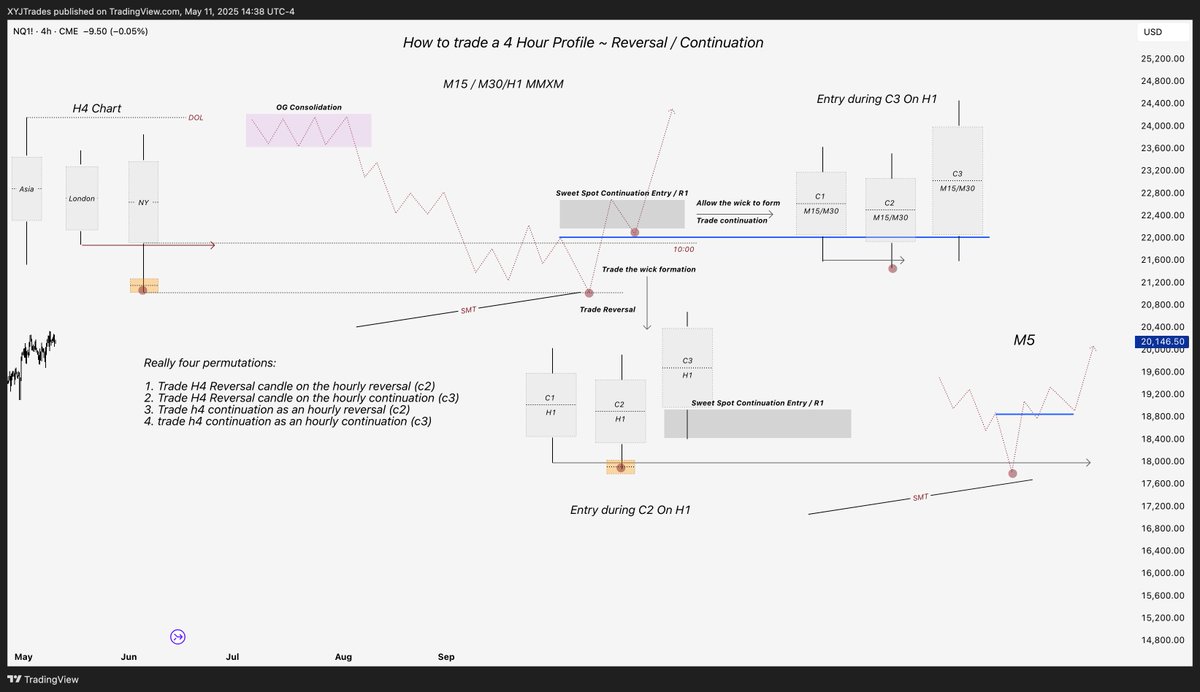
How I approach Top Down Analysis:
Step 1: Which H4 candle has reversed the daily range?
(confirm with m15/m30 CISD)
1. Asia (6pm or 10pm)
2. London (2am)
3. NY (6am or 10am)
Step 2: Determine if you are trading within the H4 reversal or a subsequent H4 continuation candle.
1. If trading within the H4 reversal you need
M30 CISD preceded by SMT + key level first....
Logic: Allow the reversal to form, this confirms the wick of that H4 candle and allows you to trade intra-candle continuations with lower time frame alignments (H1/M30)
2. If trading H4 continuation you need
H1/M30 fractal with associated m5/m3 CISD
You can trade either the reversal (c2) or continuations (c3) here on the LTF.
To trade a LTF Reversal (C2 before closure) consider:
1. Into a Key Level (FVG)
2. Small Opposing run
3. Need SMT at the C1 low
4. Trading the redistributions not LRE (think propulsion block, OB off an FVG, and not the original CISD)
3. Pair this with drivers
ask…. is the driver creating the h4 reversal candle?
or
is the driver after the h4 candle has already reversed?
If we have LOD / HOD established drivers should expand away from these levels / create protected swings
if we do not have LOD/HOD established drivers can create LOD/HOD
Trading decoupled markets is harder than waiting for asset resynchronization.
It is still possible however, and should be thought of as trading the protraction / manipulation phase of an entire triad, as opposed to just one market / HTF candle.
When we observe a decoupled market move, typically
YM / NQ opposing direction expansion
The following is always true:
1. One market is expanding as a function of manipulation (protraction) and the formation of a PSP -> leading asset
2. The other market is distributing in the true direction the triad will resync in (foreseen distribution); also the formation of a PSP, typically -> lagging asset
We can trade either this manipulation, with a target of a “manipulation trigger” which will resync the markets (an old higher time frame high or gap)
Or we can trade the manipulating asset / leading asset after we observe a strength switch at the manipulation / reversal area of interest.
How can we confirm the assets will resync?
1. The lagging asset forms a new phase of price (consolidation / retracement) with higher time frame draws still in tact
2. The leading asset becomes weaker / stronger upon reversal
I will teach you these exact signatures in the coming weeks.
I hope his provides some solid foundational framework.
My last YouTube video discusses these topics at a high level.
If you think you know @chainlink, think again. 🤔
It secures $93B+ across 60+ blockchains.
Powers 68% of all #DeFi.
Connects Web3 to JPMorgan, Mastercard, SWIFT, and more.
Here’s how it became the orchestration layer for the blockchain economy 🧵 ⬇️
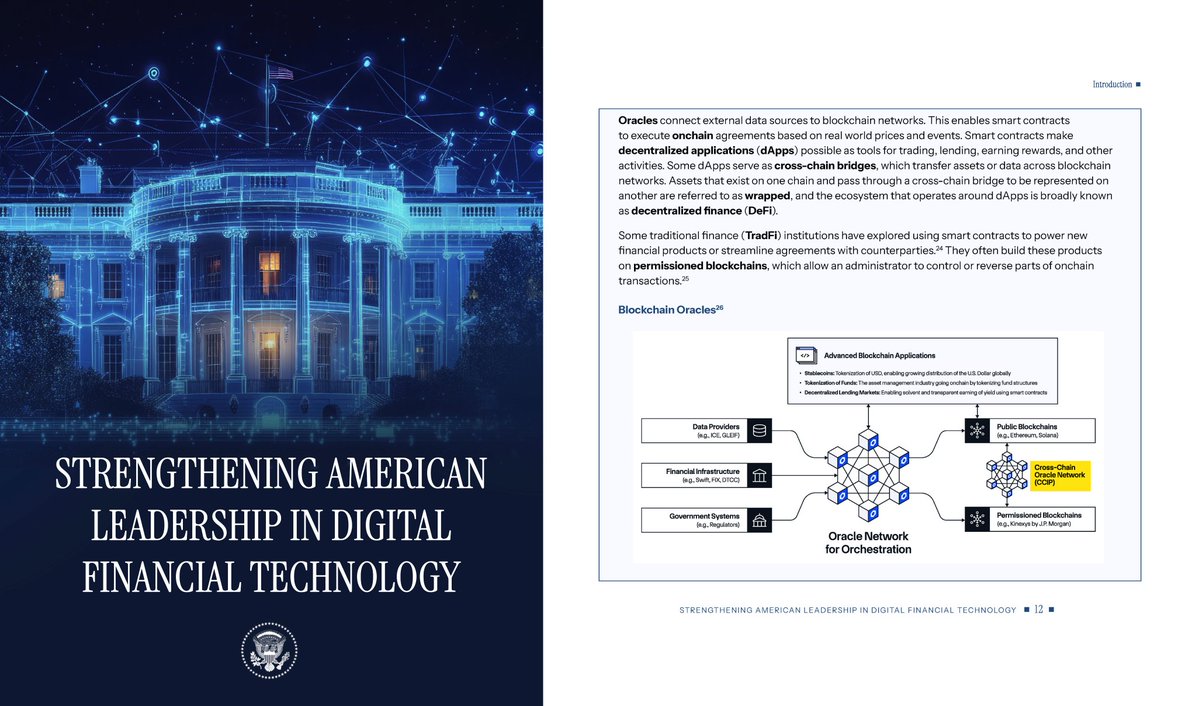
TODAY: The White House has featured oracles as a key technology in its new Digital Asset Report, highlighting how Chainlink is critical infrastructure for powering stablecoins, tokenized funds, & the onchain economy.
https://t.co/EaEchQ33UD
We and our entire industry are immensely grateful to President Trump (@realDonaldTrump), @SecScottBessent, @DavidSacks, @BoHines, and the President‘s Working Group on Digital Asset Markets for their leadership in advancing bipartisan digital asset innovation in the United States. The Trump Administration's thoughtful approach to our industry’s adoption and growth has created a new era for both our industry and the United States financial future.
The @WhiteHouse report outlines the U.S. government’s approach to digital assets, proposing a clear regulatory framework for their issuance by addressing market structure, oversight, and consumer protection.
This landmark policy initiative underscores a growing global consensus that oracle infrastructure is critical for secure, interoperable, and compliance-ready digital assets, which are key for the blockchain industry to reach its full potential. In addition to the Chainlink team’s many ongoing meetings in D.C., this report clearly affirms the significant policy momentum Chainlink has strategically worked to support for years, both in D.C. and globally.
In a single platform, Chainlink enables governments, financial institutions, and Web3 developers to overcome the three most critical challenges in deploying institutional-grade blockchain applications in a regulated environment:
1. Delivering verifiable data onchain enables the creation of hyper-reliable government and institutional-grade blockchain applications by ensuring the accuracy, integrity, and transparency of critical data.
2. Connecting public chains, private chains, and legacy systems into a unified network unlocks next-generation financial markets and streamlines digital asset operations.
3. Enabling regulatory requirements and policy controls to be embedded directly into smart contracts allows for programmatic compliance with regulations, such as KYC/AML, jurisdictional restrictions, and transaction limits, all while preserving user privacy.
By establishing the foundational standards needed for secure and compliant digital asset infrastructure, Chainlink is accelerating digital asset adoption in America and powering the future of U.S. financial leadership.
Post 1: The Realities of $XRP vs. $LINK — A Factual Comparison for Investors
This thread isn’t meant to be biased or anti-XRP for the sake of it.
My goal is simply to lay out a clear, fact-based comparison between what XRP has long been believed to deliver — and what has actually happened in the market — especially when compared to Chainlink’s progress in the same areas.
If you read this thread all the way through, you may arrive at the same conclusion I have. And even if you don’t, I hope the research here helps you think more critically about where and why you invest.
Disclaimer: This thread is comprehensive — but when you're considering putting real capital into a project for the long term, thorough research like this is not just helpful... it's necessary.
Here’s what my research and close following of industry news, announcements, and adoption data has led me to.
That XRP is not what it was promised to be — and Chainlink is doing many of the things XRP once claimed it would do.
The goal of this thread is to walk through the key claims surrounding XRP — especially the idea that it would become the infrastructure for global banking — and compare them to what has actually been delivered in the market.
At the same time, we’ll look at Chainlink’s progress, especially in the areas where it has succeeded in building real infrastructure that aligns with many of XRP’s original ambitions.
This thread is not for traders looking to scalp price action. It’s for long-term holders who have been led to believe that XRP is “inevitable,” “partnered with all the banks,” or “replacing SWIFT.” If you hold XRP based on those beliefs, this thread is for you.
Every post will present:
What the original claim was
Why it would be significant if true
What has been delivered
Whether Chainlink has achieved it instead
Verified public sources that actually support the point being made
I am not a Chainlink maxi. I am a researcher and builder in the crypto space. I’ve followed XRP and Chainlink closely for years. My only goal is to present the truth, backed by data — and hopefully help some people preserve the capital they’ve invested in this space before reality catches up to the hype.
Let’s begin.
Major thesis unfold. Grab your coffee ☕️
President Trump 🇺🇸 recently made a 10yr $1.4T deal with the UAE🇦🇪. At the same time, we see that the UAE is rapidly advancing tokenized asset markets and doing so working hand in hand with @chainlink. This relationship spans multiple levels, ranging from regulations and capital markets to technological innovation across blockchains and AI.
Let’s consider the implications for the US economy in terms of this deal and why this deal was made with the UAE specifically.
The largest historical purchasers and holders of UST were China, Japan and the UK. Over the last few years, China and Japan have begun unwinding those positions and signaled intentions to sell more.
The US is currently sitting on a staggering $36T debt load. The interest on US treasuries alone is just under $1T in 2025! Since we bring in far less than we owe, this is a catastrophic disaster for the global economy just waiting to happen. Believe it, if the US implodes, much of the world goes down with us due to modern markets and economies being so intertwined and inter dependent.
The US Gov is rapidly advancing the GENIUS stable coin bill in both houses
of Congress with bipartisan support. The take away from the bill, as it currently stands is that all stable coins must be UST backed, dollar for dollar, employ proof of reserves (PoR) and be multi chain interoperable (CCIP).
Simply put, stable coins are a back door approach to monetize the liability side of the governments balance sheet. If every tokenized dollar banks transacted across blockchains had to be backed by federal law with an equal amount of treasuries, the USgov just spiked treasury sales in a very meaningful way.
In terms of the technology, there’s truly only one company in the world that can enable such a feat at scale with top tier security, that is trusted across every major financial market infrastructure (FMI) provider in the world— Chainlink. $LINK
So, if all US approved stable coins will de-facto be riding the Chainlink protocol stack and be backed by treasuries, Chainlink has then become tethered (pun intended) to the economic health and future of the American economy! Perhaps that’s why they’re the only company to have done a fireside chat with the US Treasury and be integrated into every layer of the US financial system top to bottom.
The disastrous policies of the Biden administration lost us the Petro dollar— the most important economic driver for greenback dominance since coming off the gold standard.
What is happening today between the stable coin bill and what I believe are the current administration’s attempts to proliferate treasury backed stable coins across the MENA Region (Middle East + Northern Africa) is very much akin to what William Simon pulled off with the Saudi’s in the 1970’s in the creation of the Petro dollar.
One hand washes the other…
If I am correct, then we are in for one hell of a ride as stable coins, RWA’s and tokenized assets usher in a new era of prosperity in America. More so, it would mean a more democratized and less corruptible market place, leveling the playing field, removing barriers to liquidity and opening access to once considered fringe assets.
https://t.co/18VUsx1TFr
Stablecoin regulation in the US will kick off a wave of new stablecoins in the US and all over the world. They will all need proof of reserves and cross-chain connectivity to be used as a source of payment for the growing digital asset economy and tokenized funds.
Chainlink is the only platform that provides proof of reserves and cross-chain connectivity in one system.
This is before we look at the need for on chain identity and the ability to use stablecoins as a form of payment with minimal friction when fulfilling compliance requirements. Chainlink will then be the only platform to provide proof of reserves, cross-chain connectivity and on-chain identity/compliance in a single system.
As the complexity of blockchain transactions grows with more data, connectivity, compliance and other requirements, Chainlink will be being built as the only platform that can fulfill all those requirements in a single unified system of transactional standards.
All of these Chainlink capabilities can then be easily configured, deployed and managed in one piece of workflow code on CRE. So you're getting all the services you need to prove reserves, connect across chains, solve compliance/identity issues and manage all this complexity with a single piece of code, in one system.
You won't learn more in a single 5 minute video anywhere else....
When it comes to identifying reversals... this is all you need.
Use this logic to trade
1. HTF reversals (True reversals)
2. LTF Reversals (HTF continuations)
https://t.co/FFK4vQtlu4