Launch tokens on @arc, quoted in USDC or cirBTC. Zero-seed Uniswap v4 pools with rules you can read before you sign.
0x294165a63A7797Bedcd77ac7e75e72521e8aF61e
Hookarc is officially live on @arc. $HARC is live.
CA: 0x294165a63a7797bedcd77ac7e75e72521e8af61e
Hookarc is the first UniSwap V4 Hook token launchpad on Arc. Every pool is quoted in USDC or cirBTC, opens with zero seed capital, and runs on rules frozen on chain the moment you launch. And every USDC pool on it feeds one token: $HARC.
One transaction, one token.
No bonding curve. No migration. No seed capital. The pool holds only tokens at the open, the first buy pays quote in, and the curve takes it from there. The opening price is the floor: sell everything back and the pool returns to where it started, never below.
Live Now: https://t.co/42EZMg1Vyl
We separated token presentation from pool mechanics.
Hookarc stores the optional image, description and project links in a dedicated metadata contract. The current CreatorFeeNFT holder controls those updates, while the pool's hook configuration remains frozen.
Metadata is submitted separately after launch, so a failed or skipped metadata transaction does not undo the pool.
That separation lets a project maintain its public information without giving it a way to rewrite the trading rules.
We built Nth-buy Pot around an inspectable counter.
A configured share of buy input funds the pot. Qualifying buys advance the counter, with at most one advance per block. Every Nth advance assigns the accumulated pot to the winning recipient.
The payout is credited to a claim balance, and the winner claims it separately.
There is no random draw. The counter, qualification threshold and payout interval are part of the mechanism traders should understand before participating.
We designed Anti-Snipe around a measurable constraint: how much quote input a pool can accept in a single block during its opening window.
The cap is cumulative across the pool, rather than tracked separately for each wallet. An order that exceeds the remaining cap reverts instead of being silently reduced.
Creators can also configure an early-buy fee for that window.
These are specific limits enforced by the hook. They do not prevent every bot strategy, so we avoid presenting them as an anti-bot guarantee.
We implemented Auto Burn at the token-output stage of a buy.
When the block is enabled, the hook takes the configured share of the output and burns it through the token contract. The buyer receives the remaining tokens, and total supply decreases by the amount burned.
Sells do not trigger this block.
For us, the important implementation detail is making the deduction explicit: a burn changes supply and the buyer's received amount. It does not guarantee a price outcome.
We made creator fee rights follow a transferable NFT rather than permanently tying them to the wallet that launched the pool.
Each pool has a CreatorFeeNFT. When fees are claimed, the contract checks its current owner. Transferring the NFT therefore transfers the claim rights, including fees that have accrued but remain unclaimed.
This separates the historical creator address from the current rights holder.
The ownership check is part of the contract, not an offchain account setting.
We account for Hookarc's fees on the quote side so each amount has a clear denomination and destination.
The base swap fee is split into 0.30% for the protocol and 0.50% for the creator. Optional buy-side blocks can add further costs, which need to be considered alongside that base.
Inside the contracts, protocol fees, creator fees and pot balances use separate ledgers.
That separation lets us track what has accrued and who is entitled to claim it.
One launch detail we enforce at the contract level: nobody can buy inside the transaction that creates the pool.
Hookarc writes a transient launch lock when the pool is registered. The swap hook checks that lock and rejects swaps until the transaction ends.
The creator follows the same constraint. An optional creator buy is a separate transaction after launch.
This closes the atomic launch-and-buy path without relying on the frontend to enforce the ordering.
For Hookarc's launch flow, we wanted to remove the requirement for creators to supply the initial quote asset.
The factory creates the token and seeds a single-sided Uniswap v4 position using its supply. The launch does not require matching USDC or cirBTC from the creator.
Zero-seed describes that initial liquidity setup. The creation fee and network gas still apply, and quote liquidity enters through trading.
That distinction matters when explaining what a launch actually needs.
The Builder is where we make hook configuration easier to understand before it becomes an onchain commitment.
Creators can combine four blocks, adjust their parameters and inspect how the stack affects a buy. The interface shows estimated gas and nominal fee drag so those choices have visible consequences.
A configuration can also travel as a share link. Designing and sharing a stack requires no transaction; the rules are committed when the pool launches.
We built Hookarc around a simple constraint: a pool's trading rules should stay consistent after launch.
The selected hook blocks and their parameters are validated once, then stored per pool. There is no path to add another block, remove one or rewrite its settings later.
That makes configuration a real design decision. Creators choose the mechanics before launch, and traders can inspect the same rules the hook enforces.
The Builder is one of the parts of Hookarc we're most proud of, so here's what it does and why we built it this way.
https://t.co/4IMtTHVVZh
The problem: a launch on Hookarc freezes up to four rules into the pool forever. Anti-Snipe, Auto Burn, Nth-buy Pot, Halt Guard, each with its own parameters. Once you sign, nobody can change them. That's the whole point, but it also means you should understand exactly what you're signing before you do.
So the Builder is a workbench, not a form.
Pick blocks from the palette and they snap into the chassis. Every slider works in units you actually think in: blocks and percent for Anti-Snipe, percent of the buy for Auto Burn, "every Nth buy" and a minimum size for the pot, hours of feed age for Halt Guard. The same bounds the contract enforces are the bounds of the sliders, so you cannot build a stack that would revert at launch.
Then switch to the swap flow and watch a sample buy pass through the hook, step by step: what gets capped, what gets taxed, what gets burned, what goes into the pot, what Halt Guard checks. The inspector shows the total hook drag on a buy and the estimated gas per swap, so you can see what a heavier stack costs the people trading your token.
Two details we cared about:
• Nothing here touches the chain. The Builder is pure client-side maths that mirrors the contract's validation. You don't need a wallet to use it.
• Every stack is a link. The whole configuration lives in the URL, so you can share it, post it, or open it later. Anyone who follows the link lands in Launch with your rules prefilled. Found a pool you like? "Remix these rules" on its page opens the Builder with that pool's exact stack.
There are presets to start from (fair launch, community, full stack, bare pool), but the honest use is to drag things around until the swap flow shows the token you'd want to trade yourself.
DexScreener token info for $HARC is now updated with the official details.
Verify before you buy. Anything else using the name is not ours.
https://t.co/iLSa5zH8hI
What Hookarc actually is, explained by the people who built it.
Most token launchpads are a separate app with its own pricing curve. You buy on the launchpad, and at some point the token "graduates" and moves to a real exchange. Two systems, a migration step in between, and a team that controls it.
Hookarc has none of that. There is no launchpad in the middle. Your token trades on Uniswap v4 from the first second, in a pool that Hookarc only created and configured.
Here's how. Uniswap v4 lets a pool run custom code, called a hook, before and after every swap. Hookarc is that hook. When you launch, one transaction does everything:
• Deploys your token, 1 billion supply, nothing kept for the creator
• Opens a Uniswap v4 pool quoted in USDC or cirBTC
• Prices it at a fixed $10,000 valuation using the Chainlink feed
• Puts the entire supply into the pool and locks it forever
• Writes your chosen rules into the hook
The rules are the interesting part. You pick up to four "blocks" and they are frozen at launch:
• Anti-Snipe: for the first N blocks, nobody can buy more than X per block, and anyone trying pays an extra tax to you
• Auto Burn: a slice of every buy is burned, so supply only goes down
• Nth-buy Pot: a bit of every buy goes into a pot, every Nth buyer wins it
• Halt Guard: if the Chainlink feed for USDC or cirBTC goes stale, or Circle pauses the token, buys stop until it clears
Once the pool is live, nobody can change any of this. Not the creator, not us. There is no admin function that touches a live pool. The owner of the protocol can collect the 0.30 % protocol fee and run buybacks of $HARC that burn every token bought. That is the full list of what we can do.
Why Arc? Because Circle built a chain where gas is USDC, blocks take half a second, and finality is one block. A launch, a buy and a claim each settle before you finish reading this sentence. And because USDC and cirBTC are native there, a pool can be quoted in real dollars or real Bitcoin instead of a volatile gas token.
Everything above is checkable. The contracts are open source:
https://t.co/n32ezwnlKE
By community request, the official $HARC contract address is now on the site.
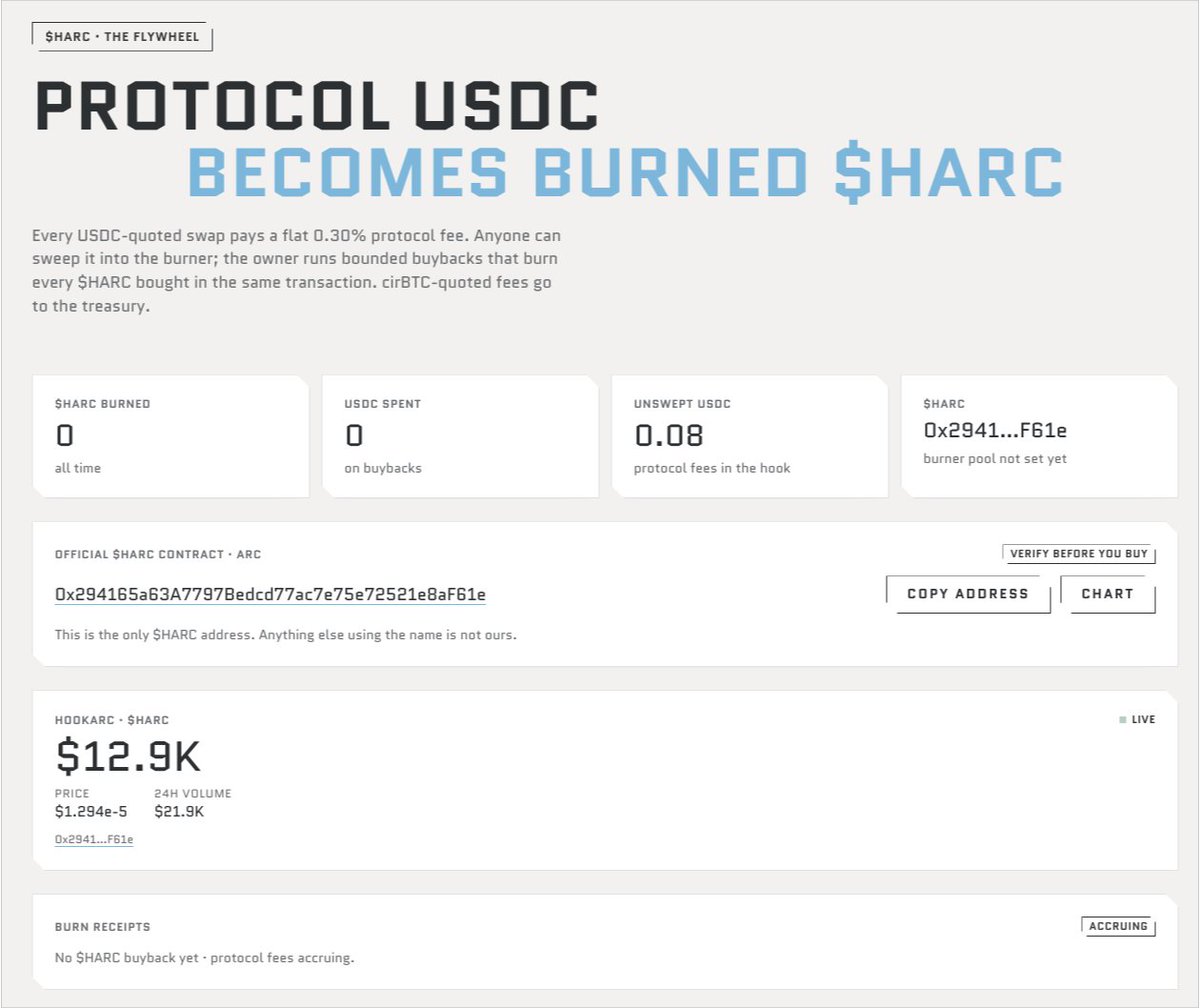
0x294165a63A7797Bedcd77ac7e75e72521e8aF61e
You'll find it on the $HARC page, in the footer and in the docs. This is the only official address. Anything else using the name is not ours.
https://t.co/uciMnAHxqS
Hookarc's contracts are now public on GitHub.
https://t.co/n32ezwnTAc
We'd rather people read the code than take our word for it, so here is what's in there and why it's built the way it is.
Hookarc is a Uniswap v4 launchpad on Arc. One transaction deploys a token, opens a canonical v4 pool quoted in USDC or cirBTC at a fixed $10,000 FDV, mints a single-sided position and locks it forever.
Try Hookarc: https://t.co/42EZMg1Vyl
The flywheel.
Every USDC-quoted swap on every Hookarc pool pays a flat 0.30% protocol fee. Anyone can sweep it into the burner. The burner buys $HARC and burns it to 0xdead in the same transaction.
More launches means more swaps. More swaps means more $HARC gone. The counters are public, every buyback emits a Burned event, and the burns page lists them all. No dashboard trust required. Read the contract.
Hookarc is officially live on @arc. $HARC is live.
CA: 0x294165a63a7797bedcd77ac7e75e72521e8af61e
Hookarc is the first UniSwap V4 Hook token launchpad on Arc. Every pool is quoted in USDC or cirBTC, opens with zero seed capital, and runs on rules frozen on chain the moment you launch. And every USDC pool on it feeds one token: $HARC.
One transaction, one token.
No bonding curve. No migration. No seed capital. The pool holds only tokens at the open, the first buy pays quote in, and the curve takes it from there. The opening price is the floor: sell everything back and the pool returns to where it started, never below.
Live Now: https://t.co/42EZMg1Vyl
Creators get paid.
0.50% of every buy and sell on your pool, plus the whole Anti-Snipe tax, goes to whoever holds the pool NFT. Sell the NFT, sell the fee stream. It is a fee-bearing asset minted at launch.