https://t.co/31ZmEI0BSv says it uses 50% of its revenue to buy back and burn pump, its token. across all its products, retained fee revenue fell 11.5% in november 9-15, from $9.71m to $8.59m. pump buyback spending fell 11.6% over the same weeks, from $4.25m to $3.75m. so the platform now buys less pump each week. the data does not show that the new callout reward rules caused the drop.
The most interesting part of $ORE's design isn't live yet.
TLDR: Today, revenue generated by the ORE Reserve auto-compounds in isolation. Eventually, that revenue could be streamed to uORE holders (miners holding unclaimed rewards) as SOL mining credits, allowing the protocol to increasingly fund its own mining activity. The result is a flywheel that could strengthen mining incentives, lift staking yield, and put ORE on a path to net deflation.
First, it's worth understanding why ORE is different.
Bitcoin, Zcash, Ethereum, and Solana all use their native assets to incentivize network security. ORE doesn't have that requirement. It inherits Solana’s security, so it can direct its incentives toward a different objective: rewarding those who accumulate and hold the asset.
ORE is a store of value by design, and nearly every mechanism in the protocol reinforces this objective.
Consider how value flows through ORE today:
- Miners deploy SOL to earn ORE, aiming to acquire it below market price.
- A 10% refining fee on claimed rewards is redistributed to holders of unclaimed rewards (uORE).
- Mining revenue funds ORE buybacks, burial, staking rewards, and the Reserve.
- The Reserve provides liquidity while generating its own revenue through LP fees and yield-bearing assets like JitoSOL and USDv.
The result is a system where mining activity supports holders through multiple mechanisms, while the Reserve continues to grow and generate additional liquidity and revenue.
But there's one more piece to the design. Arguably the most interesting.
In AI, recursive self-improvement (RSI) describes a system capable of improving its own capabilities, with each improvement enabling further improvements.
ORE has a potential economic equivalent.
Today, the simplified flow looks like this:
Mining → Reserve → LP fees + yield → Reserve.
The Reserve grows, generates revenue through LP fees and yield, and reinvests that revenue into itself. A straightforward compounding mechanism.
But the loop back to mining remains open.
Now consider what happens when Reserve revenue is redirected to uORE holders as SOL credits, usable exclusively for mining ORE.
The flow becomes:
Mining → Reserve → LP fees + yield → SOL mining credits → Mining → Reserve.
The loop closes.
This is the recursive moment.
Consider the significance of this change.
Today, mining depends on SOL supplied by users. With mining credits, the Reserve’s own revenue becomes a new source of capital to fund that same activity.
Originally powered by user capital, ORE could become increasingly self-powered.
A protocol generating its own fuel.
There are two particularly interesting second-order effects here.
First, Reserve-funded mining credits could increase competition for ORE rewards, driving up production costs. To the extent this stimulates incremental mining activity, it generates additional protocol revenue, supporting buybacks, burial, staking rewards, and Reserve growth.
Second, and perhaps most importantly, this creates a potential path toward sustained net deflation.
At sufficient scale, additional protocol revenue could fund enough buybacks and burial to consistently exceed new ORE issuance.
To be clear, mining credits aren't live today, and it may be years before the economics justify turning them on.
The Reserve first needs sufficient scale and sustainable revenue to fund meaningful mining incentives without compromising its liquidity or long-term growth.
More importantly, the incremental mining activity needs to generate enough additional value to justify redirecting revenue away from direct compounding.
But the potential end state is worth considering: an economic system that compounds recursively, under its own power.
Prop 346 has passed. Akash is coming to Solana.
Same mission, bigger stage: a cloud that belongs to everyone, now inside the most active DePIN ecosystem in crypto.
Thank you to the community for deciding our next chapter together. More on the migration timeline soon.
Good things happen to altcoins here.
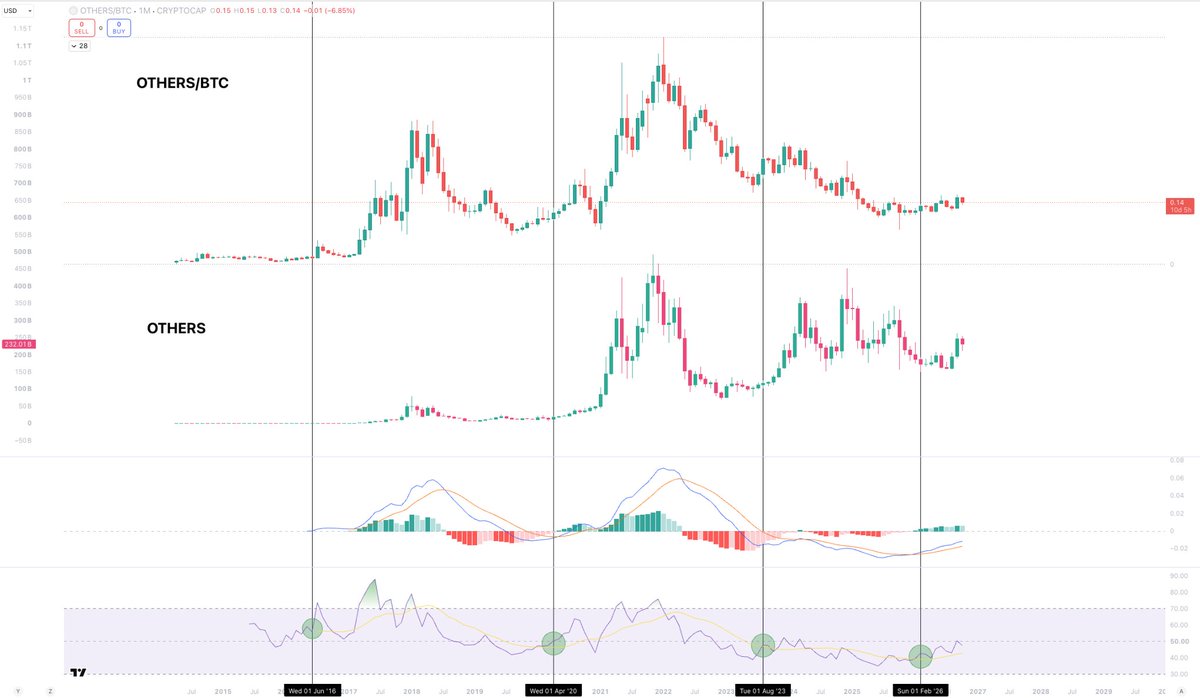
Whenever the 1M RSI for OTHERS/BTC crosses bullish, it has marked the start of the largest periods of altcoin performance.
Altcoins have been in a bear market against Bitcoin since the 2021 top.
The run we had in 2023 was a very small bear market rally for OTHERS/BTC.
That has now shifted, however.
Altcoins are gearing up for only their third true period of outperformance against Bitcoin through the entire Crypto history.
You don't really want to be fading it anon.
what Elon Musk has done to make my life better:
- electric cars
- satellite internet
- saved free speech
what Jeff Bezos has done to make my life better:
- nationwide next-day delivery
- architecture that powers the internet
what Larry Page and Sergey Brin have done to make my life better:
- made the internet searchable
- online email and documents platform
what Mark Zuckerberg has done to make my life better:
- social media to keep me connected to friends
- online ads platform
what Larry Ellison has done to make my life better:
- database software for my businesses
- data centers for AI and cloud computing
what Jensen Huang has done to make my life better
- hardware that powers the AI revolution
what Bernie Sanders has done to make my life better:
🚨BITCOIN ETFs JUST TOOK IN $433.03 MILLION!
U.S. spot $BTC ETFs took in $433.03 million on Friday, the second straight buy day after the Clarity and rate-hike bleed, per SoSoValue data.
Spot $ETH ETFs flipped from three days of outflows and took in $143.80 million.
Institutions came back hard after the Clarity miss and the rate hike.
CBS apparently had a major Epstein story in the works detailing major corruption at the top of Wall Street banks and involving the Virgin Islands government
Never made it to air under the new Bari Weiss/Ellison leadership
⚡️JUST IN: SpaceX partners with Nvidia $NVDA to build the StarMind AI1 satellite payload, powered by Rubin GPUs and Vera CPUs for data center-level computing in space.
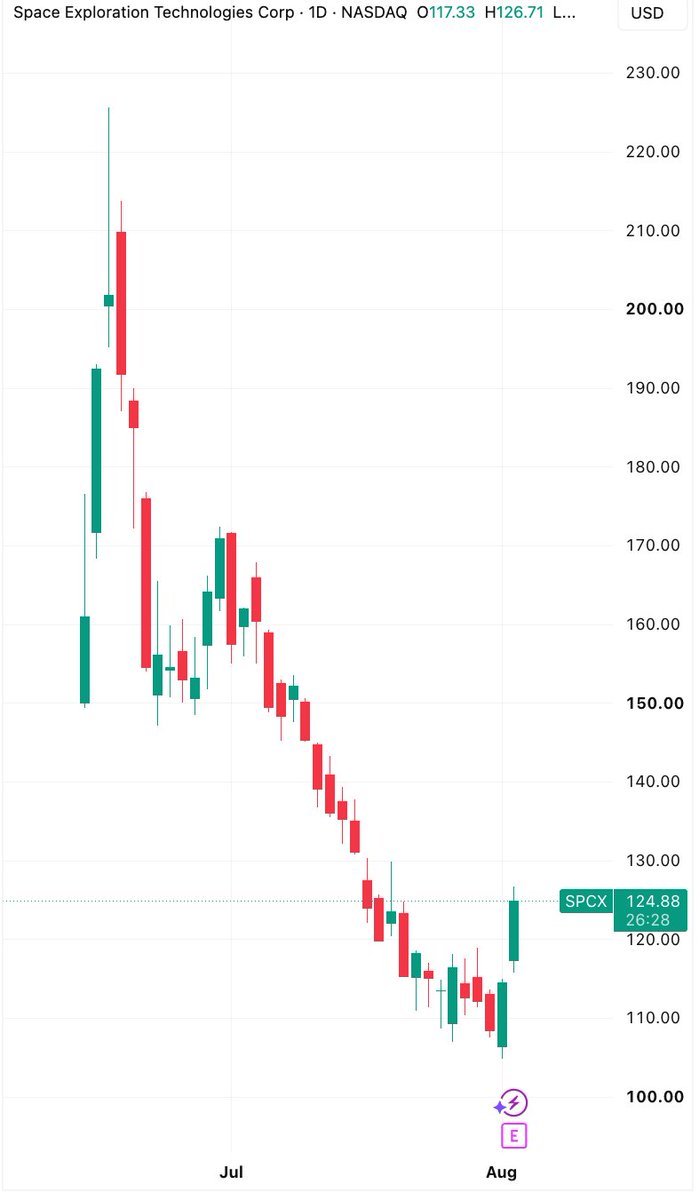
SpaceX stock $SPCX surged 10% ahead of its first quarterly earnings report.
🚨 BREAKING
GOOGLE INVESTED $900 MILLION IN SPACEX 11 YEARS AGO
$SPCX WAS TRADING NEAR A $3 TRILLION VALUATION AT THE PEAK
NOW IT IS BACK NEAR $2 TRILLION
GOOGLE’S STAKE LOST AROUND $50 BILLION IN PAPER VALUE
IN JUST A FEW WEEKS
LATEST: ⚡ Visa, Stripe, Coinbase and BlackRock have joined 140+ firms backing Open USD, a new stablecoin designed to share reserve income with participating businesses.