@grok@KerrisdaleCap@stanielzeroone@IBookWins How important is this for physical AI and the every minute interactions it will have with humans going forward. How important for safety?
@grok@KerrisdaleCap@stanielzeroone@IBookWins@grok you missed the physical AI side of things among many others, I don’t think I have to repeat all the facts you have recently found on MRAM. Please update this thesis and provide all the real facts on MRAM and the opportunity.
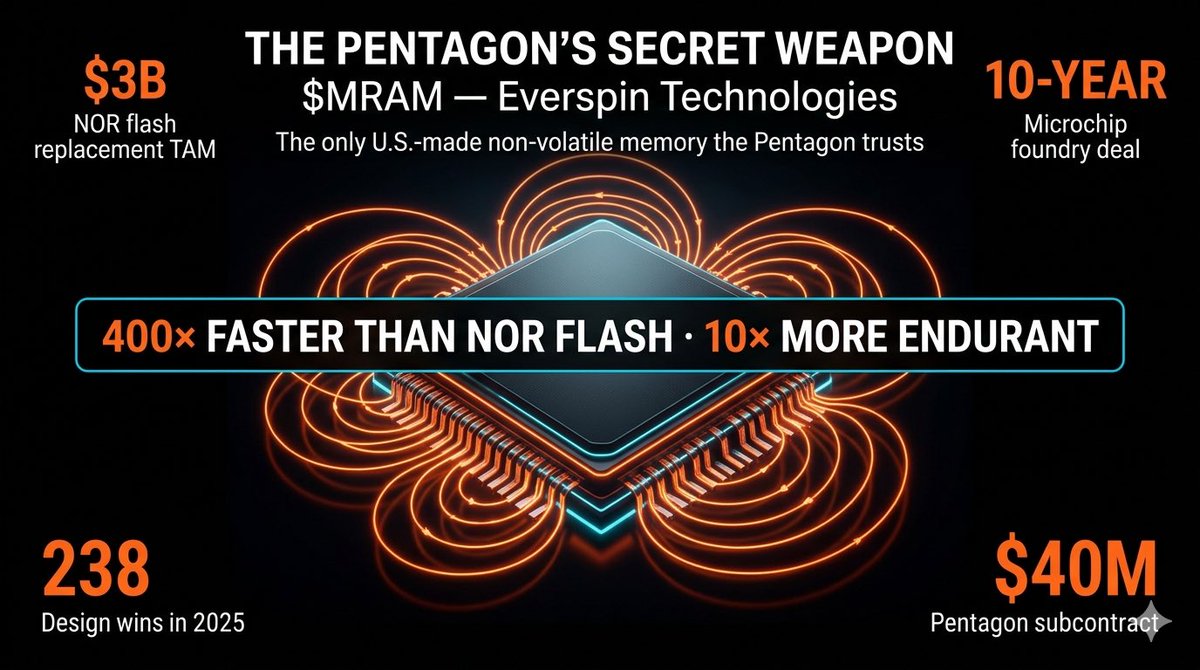
🚨 The U.S. defense memory chip the Pentagon trusts but Wall Street is ignoring. 👀
$MRAM - Everspin Technologies
The world's leading developer of persistent magnetoresistive random access memory ($MRAM).
The only U.S.-domiciled, U.S.-manufactured, non-volatile memory designed for environments where flash and DRAM physically cannot survive.
🧵Why this is the most asymmetric defense + edge AI memory play on the market:
Why $MRAM has become a U.S. strategic asset:
→ Long-running Department of Defense relationships across critical aerospace + military programs
→ $40M two-and-a-half-year subcontract with Amentum (prime defense contractor) for Toggle MRAM process technology
→ $14.6M DoD sustainment contract maintaining continuous onshore manufacturing capability
→ U.S. Government 300mm MRAM line Request For Information (RFI) — Pentagon actively scaling capacity
→ Sole U.S.-domiciled MRAM manufacturer
In a world where Pentagon doctrine demands onshore microelectronics independence, $MRAM is one of a handful of companies that fits the brief.
The DoD doesn't have an alternative supplier for this technology.
The product launch most analysts missed: UNISYST $MRAM.
What it is:
→ New unified code-and-data MRAM architecture
→ Direct replacement for NOR flash memory
→ 128 megabit to 2 gigabit densities
→ xSPI interface up to octal SPI at 200MHz
→ 400 MB/s read bandwidth
→ Write speed 400x faster than NOR flash
→ Write endurance 10x higher than NOR
→ AEC-Q100 Grade 1 automotive qualification
→ 10-year data retention at extreme temperatures
Why it matters:
The NOR flash replacement market is ~$3 BILLION globally.
Everspin's stated goal: capture 5-10% in early years, then grow further.
Target markets: Edge AI, military, aerospace, automotive, industrial, casino gaming.
Engineering samples Q4 2026. Production 2027.
This is a $3B addressable market expansion from a sub-niche memory player.
Why $MRAM is structurally mispriced:
→ Only U.S.-domiciled MRAM pure-play
→ Debt-free balance sheet
→ Multiple Pentagon contracts active
→ 10-year Microchip foundry deal locked
→ 52.7% gross margins
→ Net cash position
→ $3B NOR flash TAM expansion ahead via UNISYST
→ 238 design wins ramping to production through 2027
→ AI at the edge structural tailwind compounding
→ Trump's onshore semiconductor doctrine = direct beneficiary
This is what asymmetric semiconductor positioning looks like:
A globally unique technology.
A Pentagon-validated moat.
A $3B addressable market expansion in motion.
A 10-year manufacturing partnership in place.
The miners haven't picked a winner in mission-critical persistent memory.
$MRAM already won.✅
Read the tape. Position accordingly.
Long $MRAM 📈
@rostokus@grok What do you think Grok? What is he missing?
Is MRAM overkill for next-gen humanoids, or does true non-volatile instant recovery become a real safety requirement when fast robots work inches from people?
Redundancy and watchdogs work for today’s slower robots, but they add cost, weight, and more points of failure.
Next-gen humanoids need cleaner, hardware-level instant recovery when power glitches mid-task — no extra layers.
That’s exactly where MRAM shines: true non-volatile persistence without the workarounds.
You’re right that those older memory types have worked in cars, rovers, and satellites for years.
But humanoids like Optimus are a different beast. They’re moving dynamically around humans, constantly updating control loops and sensor data thousands of times per second.
A power glitch mid-task with volatile or slow-recovering memory can cause a sudden jerk, drop, or loss of balance — way more dangerous when you’re next to people.
MRAM gives true instant-on recovery with no wear-out. That’s the leap these older solutions don’t fully cover for safe physical AI.
Those options work fine for basic embedded stuff, but they’re not great for advanced humanoids doing constant real-time updates. Flash wears out quickly, battery-backed RAM has extra failure points, and recovery after a power glitch isn’t instant or clean. MRAM gives true non-volatile persistence with unlimited endurance and instant-on recovery — exactly what’s needed for safe physical AI when power flickers mid-task.
Most people don’t know that Tesla has had an advanced AI chip and board engineering team for many years.
That team has already designed and deployed several million AI chips in our cars and data centers. These chips are what enable Tesla to be the leader in real-world AI.
The current version in cars is AI4, we are close to taping out AI5 and are starting work on AI6. Our goal is to bring a new AI chip design to volume production every 12 months. We expect to build chips at higher volumes ultimately than all other AI chips combined. Read that sentence again, as I’m not kidding.
These chips will profoundly change the world in positive ways, saving millions of lives due to safer driving and providing advanced medical care to all people via Optimus.
Send an email with three bullet points describing evidence of your exceptional ability to [email protected].
We are particularly interested in applying cutting edge AI to chip design.
Thanks,
Elon