@AndyBurnham in your significant expansion of mental health and care services, is there going to be any provision for adult amputees to access running and activity prosthetic limbs? 1/6
With your support of health and care services and the link between exercise and health, will your government ending this structural inequality faced by amputee adults? 6/6
@kieraroche@MarieTidball
@AndyBurnham in your significant expansion of mental health and care services, is there going to be any provision for adult amputees to access running and activity prosthetic limbs? 1/6
Sports prostheses provides access to sport; with access to sport/exercise aiding with social inclusion and mental and physical health. These are objective facts, yet there is no mention in Burnham plan of fixing this structural inaccessibility amputee adults in England face. 5/6
🔥Last year, the Royal College of Psychiatrists doubled down on opposition to the assisted suicide Bill.
“WE COULD NOT SUPPORT THE BILL”.
RCPsych wants nothing to do with it, even though they're supposed to be on the death panels!
These same concerns remain with the new Bill.
No professional bodies or organisations back Lauren Edwards’ assisted dying Bill.
None.
Even those that are neutral on the principle: don’t back this Bill.
Think about it…
Government’s own impact assessment on #assisteddying shows disproportionate impact of this ill thought out sloppy bill on Black, Asian and minority ethnic people - as some of us have been saying all along
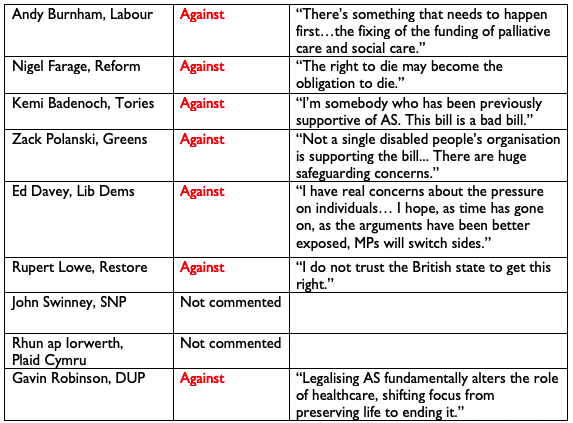
Yet more reason why I will be voting AGAINST when this returns before MPs
Ten MPs who switched from voting for the assisted dying bill (at 2nd reading) to voting no (at 3rd):
1. Brian Mathew (Lib Dem).
“I do not think it is right that we introduce the choice for assisted death into a society where many are going without basic end-of-life care.”
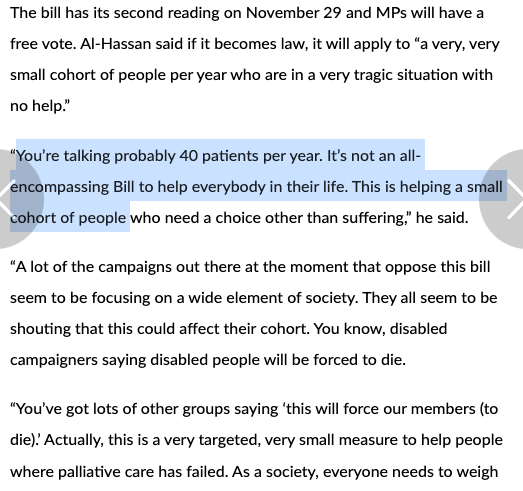
Before the first assisted dying vote, supporters (here Sadik Al-Hassan MP) were saying this kind of thing. “40 patients per year.”
Today the government revised its upper estimate for applications per year, to 10,428.
Time and again, the bill has been misunderstood and mis-sold.
NEW: Govt's updated impact assessment on assisted dying bill has just QUADRUPLED the estimated number of people who would apply to die
New 160-page official report has upper estimate for applicants (in first year of implementation) rocketing from:
- 1,078 under the old Leadbeater bill
- to 4,610 under the new Lauren Edwards bill
Updates are largely down to adjusted methodology based on fresh international data
Means lots of new info for MPs to chew over as bill gets 2nd reading on 11 Sept...
Report here: https://t.co/J9K8CWQFPe
Not a single Disabled People's Organisation (organisations run by and for Disabled people) publicly supports the Assisted Dying Bill.
That tells you everything you need to know.
Write to your MP, telling them to vote against the bill on 11th September 👇https://t.co/wmS1dnVThv
On the day that Lauren Edwards MP reintroduced the Terminally Ill Adults (End of Life) Bill, a reminder that none of these problems have been addressed 👇
David Alton, Chair of the Joint Committee on Human Rights, on the Assisted Dying Parliament Act Plan: "This is dangerously short-sighted. Reflect for a moment on how a future Government — with different priorities — might utilise this dangerous constitutional precedent once it is set.
Weaponising the Parliament Acts on such a divisive issue may deliver “victory” for campaigners, but at what cost? It would be foolhardy, petulant and dangerous — both for the vulnerable people who will inevitably die as a result of the legislation, and for the state of our politics.
The assisted suicide Bill would remain unsuitable and fundamentally flawed regardless of whether proponents seek to ram it through under the Parliament Acts. Lawmakers must consider whether that cost is justified."
Julian Smith MP: "to reintroduce an identical assisted dying bill, and use the Parliament Acts to force it through, would be both dangerous and divisive.
As Government Chief Whip between 2017 and 2019, I sat at the centre of the most turbulent parliamentary period in living memory. I know how legislation can fail under the weight of insufficient preparation. I saw what happens when Parliament moves faster than the evidence, and when the consequences of getting things wrong are treated as a secondary concern. On the Terminally Ill Adults (End of Life) Bill, the process failed completely."