God Won’t Give up on Us, Jeremiah 3-5. Head to https://t.co/Yrg5F0E7Fx for the reading guide and to catch up on previous posts from the Bible in One Year series.
Happy Studying! #BibleinOneYear#Biblestudy
God of Wrath and Grace, Hosea 9-11. Dive into the Bible in One year series at https://t.co/Yrg5F0E7Fx for the reading guide and to catch up on previous posts. #BibleInOneYear#BibleStudy
Seeking the Unlovable, Hosea 5-8. Head to https://t.co/Yrg5F0EFv5 for the reading guide and to catch up on previous posts from the Bible in One Year series.
Happy Studying! #BibleinOneYear#Biblestudy
The Transfiguration of Jesus is humming with Old Testament language, themes, and imagery.
It begins with the setting. In Matthew 17:1–8, the phrase “after six days” echoes Moses waiting six days on Sinai before God spoke from the cloud (Exod. 24:16).
The “high mountain” recalls Sinai, Moriah, Nebo, and other sacred peaks where God revealed himself. It also evokes Isaiah 40:9: “Go on up to a high mountain…[and proclaim] “Behold your God!”
From the outset, the scene invites us to read this theophany—indeed, the entire New Testament!—with Hebrew glasses on.
As the event unfolds, those connections broaden and deepen. Jesus’ face shines, recalling Moses’ radiant face after encountering God (Exod. 34:29), but here the glory in Jesus is not reflected; it is intrinsic to him. The imagery also resonates with Ezekiel’s vision of the radiant man on God’s throne (Ezek. 1:26–28).
Then Moses and Elijah appear, representing the Law and the Prophets, the whole witness of Israel’s Scriptures. They speak with Jesus about his coming “exodus” (Luke 9:31), a word crowded with meaning, pointing to the new and greater act of redemption.
Peter responds by suggesting three tabernacles. Though Luke notes he didn’t know what he was saying, his impulse echoes both the wilderness tabernacle and the Feast of Booths, when Israel dwelt in tents to remember their years in the wilderness with God.
While Peter is still speaking, a cloud overshadows them, the familiar sign of God’s presence from the Exodus (13:21-22; 40:34-38). Then comes the divine voice: “This is my beloved Son, with whom I am well pleased; listen to him” (Matt. 17:5). In that single sentence, God weaves together threads from Psalm 2:7, Genesis 22:2, Isaiah 42:1, and Deuteronomy 18:15. The Father gathers the Scriptures into one declaration and directs all attention to his Son.
Everything converges in the Transfiguration. The Law, the Prophets, the exodus, the mountain, the cloud, all find their fulfillment in Jesus.
Look to him and him alone for the full revelation of God.
______
For more on this topic, see my book, The Christ Key: Unlocking the Centrality of Christ in the Old Testament, https://t.co/AbNV4FCcZ5
Deliver Us From Evil, 2 Kings 19-21. Head to https://t.co/Yrg5F0EFv5 for the reading guide and to catch up on previous posts from the Bible in One Year series.
Happy Studying! #BibleinOneYear#Biblestudy
It would be hard to out-sin Manasseh, who seems to have had a PhD in iniquity creation.
He stands as one of the clearest reminders that “like father, like son” is not always the case. His father, Hezekiah, was a reformer who tore down idols and called Judah back to the Lord.
His son, Manasseh, did the opposite. If Hezekiah was a reformer, Manasseh was the anti-reformer.
He reigned from 687–642 BC, the longest tenure of any king of Judah, and during that time, he plunged the nation into the toilet bowl of idolatry.
He rebuilt the high places his father had destroyed. He erected altars for Baal and Asherah. He set up altars in the house of the Lord itself, turning the temple into a shrine for the sun, moon, and stars.
It was spiritual adultery of the most grotesque kind, akin to an unfaithful wife covering the walls of the master bedroom with lurid images of her former and current lovers.
And Manasseh did not stop there. Oh no. He burned his own son as an offering. He turned to fortune-tellers, mediums, and necromancers. He sampled and slurped down every flavor of sin, licking his lips and demanding more.
Even his name carries a tragic irony. The Hebrew name “Manasseh,” first given to Joseph’s son, is formed from the verb “to forget.” This king lived out that meaning in the worst way, leading God’s people into exile because they forgot the Lord who saved them.
Yet what is most remarkable is not the swamp of his sin, but the ocean of God’s mercy to him.
In 2 Chronicles 33:12-13, we read that Manasseh prayed and humbled himself before the Lord. And the Lord forgave him, restored him, and welcomed him back. Yes, even him!
This is the scandal of grace, isn’t it? Even sinners like Manasseh, even sinners like us, are not beyond the reach of divine mercy. The Lord who pursued him still pursues us, calling us home, ready to forgive, ready to heal us in Christ.
This lady is driving down a stretch of road on St. Louis St. in Springfield, Missouri.
She is driving exactly 30
Mph and as she does so the rumble strips create the melody of “America The Beautiful”. This just opened up recently.
The song was chosen as a tribute to America’s open road, the spirit of Route 66 and the upcoming celebration of the country’s 250th anniversary. ❤️🇺🇸
I think that is too cool. Love when towns and cities are patriotic. 💯
Never knew this existed or was a thing. I’ve heard there are other roads in our beautiful country that have other songs as well.
Did you know this existed? Have you ever driven on a road where the rumble strips play a song before? Isn’t that cool?
The Orthodox theologian, Fr. Thomas Hopko, once composed 55 maxims to guide us in our Christian life. Although all of them are helpful, here are three of my favorites.
1. Have no expectations except to be fiercely tempted to your last breath.
2. Have a short prayer that you constantly repeat when your mind is not occupied with other things.
3. Endure the trial of yourself and your own faults and sins peacefully, serenely, because you know that God’s mercy is greater than your brokenness.
Elisha's Vivifying Bones, 2 Kings 13. Dive into the Bible in One year series at https://t.co/Yrg5F0E7Fx for the reading guide and to catch up on previous posts. #BibleInOneYear#BibleStudy
Here’s a simple tip for reading and studying the Bible: pay attention to how often the biblical authors place two narratives side by side so you can compare and contrast them.
A great example appears in Matthew 14, one of the chapters we read today in Bible in One Year. There, you have a striking contrast between Herod, who orders the beheading of John the Baptist, and Jesus, who feeds the five thousand.
Herod is a ruler, but how does he act? On his birthday, when the daughter of Herodias dances before him, he rashly vows to give her whatever she asks. Prompted by her mother, she asked for John the Baptist to be decapitated. Because of the oath and his guests, Herod had John beheaded in prison, and his head was brought on a platter.
Herod, the ruler, is all about Herod. He even takes the life of an innocent man.
Then you have Jesus. He is compassionate, merciful, and selfless. When he sees the crowds, he has compassion on them, heals their sick, and refuses to send them away hungry. Instead, he provides for them abundantly.
Jesus, the ruler, is all about others, even willing to die as an innocent man for us, the guilty.
So which ruler is truly powerful? Herod or Jesus?
Jesus, the Son of God, is the truly powerful one. Yet he exercises his power not through domination or cruelty, but through mercy toward those in need.
These are two very different kinds of rulers, two very different ways of relating to people.
In the kingdom of God, what kind of ruler do we have in Jesus?
We have the one who looks upon us with compassion. The one who sees our need and desires to meet it. The one who acts toward us with grace and love, welcoming us into his kingdom to give us everything he desires us to have.
Spiritual Pride, Matthew 12. Head to https://t.co/Yrg5F0E7Fx for the reading guide and to catch up on previous posts from the Bible in One Year series.
Happy Studying! #BibleinOneYear#Biblestudy
There certainly have been moments in history when the Lord manifested himself to people in earth-shaking, awe-inspiring ways. When no eye or ear could miss that they stood on holy ground.
God appeared to Israel when they were camped at Mount Sinai. “There were thunders and lightning and a thick cloud on the mountain and a very loud trumpet blast, so that all the people in the camp trembled” (Exod. 19:16). Sinai was “wrapped in smoke because the LORD had descended on it in fire” (v. 18).
These divine pyrotechnics made Israel, and even Moses, cower in fear. This was unmistakably sacred space.
God appeared to Isaiah when he was worshiping in Jerusalem. He saw Yahweh “sitting upon a throne, high and lifted up; and the train of his robe filled the temple” (Isa. 6:1). Six-winged seraphim flew about him, chanting, “Holy, holy, holy is the LORD of hosts; the whole earth is full of his glory!” (v. 3).
As the temple shook and the house filled with smoke, Isaiah cried out that he was a dead man. He was unclean yet had laid eyes on the King. Only after an angel purified his lips with a coal from the altar did the prophet regain some composure. Here, too, was clearly holy ground.
These theophanies, or “God-appearances,” and others like them in the Old Testament all exhibit a common trait: they left no skeptics, agnostics, or atheists quibbling about what just happened. God crashed humanity’s party in a big way. It was a fact as incontrovertible as the sun blazing in the sky.
People saw God in his Godness. It was incredible and terrifying. And it was rare.
But the OT appearance that unveils more about God than any other is the one with the smallest wow factor. It too happens at Sinai, but this time Elijah alone is privy to the scene. First, three natural phenomena, all seemingly electrified with divinity, roar past the prophet: a great and strong wind tears mountains apart and breaks rocks in pieces, an earthquake shakes the mount, and tongues of fire lick the earth.
Yahweh is rummaging through the loudest costumes in nature’s closet. But one by one he leaves them on the hanger. We hear this litany: “But the LORD was not in the wind . . . but the LORD was not in the earthquake . . . but the LORD was not in the fire” (1 Kings 19:11–12).
Then where was he? “After the fire the sound of a low whisper” (v. 12).
The sound of a low whisper. Or “a still small voice,” as the King James Version renders it. The Hebrew for “low” or “small” (dakah) is used to describe objects that are thin, like the gaunt cows in Pharaoh’s dream (Gen. 41:3) or the wafer-like manna (Exod. 16:14). This was not a massive, bellowing sound that reverberated through the wilderness. It was God whispering something under his breath, almost inaudible, easily missed.
The Lord’s clothing doesn’t fit him. His favorite shirts and pairs of pants are three sizes too small. The flowing wind would have hugged his frame nicely. The earthquake was tailored to his dimensions. The robe of fire was voluminous enough to wrap around his presence.
But the voice was all wrong. Too tight. Too confining. It was unbecoming for such a towering divinity to squeeze himself into such a tiny space as a whispering voice.
But he does. That’s the point of God’s subdued appearance to Elijah. He eschews bigness for littleness. We can walk right past God and never see him, never hear him, never even know he’s there. The bells and whistles of Sinai will be absent. We won’t spy six-winged seraphim swooshing through the air around us.
The space God inhabits will look small and undivine. A whispering place. It may even look like the last place in the world where you’d expect to take your shoes off because you’re treading on sacred soil.
It might look like the blood-soaked soil beneath a Roman cross, where the voice of dying man says, "It is finished."
_____
-Adapted from my book, Your God Is Too Glorious, https://t.co/gWwxTKKYPu
Here’s a fascinating example of why it’s not only helpful to study the Hebrew Old Testament but also the Greek translation of the Old Testament, the Septuagint.
The Septuagint heavily influenced New Testament writers, and at times they chose their Greek in such a way as to echo what was happening in the Old Testament. That echo becomes clear when you compare the Greek of the Old Testament with the Greek of the New Testament.
Here’s the example. In Luke 7, Jesus raises the widow’s son at Nain. Afterward, we are told that “he gave him to his mother [ἔδωκεν αὐτὸν τῇ μητρὶ αὐτοῦ]" (Luke 7:15).
Initially, that seems an odd detail, right? His mother is right there, so why would Luke add that Jesus "gave him to his mother"?
The answer is found in the Septuagint in 1 Kings 17:23, which we read today in Bible in One Year. After Elijah raises a dead boy to life again, the prophet “brought him down from the upper room into the house and gave him to his mother [ἔδωκεν αὐτὸν τῇ μητρὶ αὐτοῦ]."
If you are reading both the Old Testament and the New Testament in Greek, the connection is unmistakable. Luke is intentionally echoing Elijah’s miracle.
The further confirmation of the overlap between the miracle by Elijah and the miracle by Jesus is that the crowds respond, “A great prophet [!] has arisen among us!” (Luke 7:16).
They saw the similarities between what was done, even as we, the readers of the text, see *and* hear the similarities.
What Luke is doing, then, is alerting us that Jesus has performed an Elijah-like miracle. But more than that, he is showing that Jesus is the new and greater Elijah. The ministry of Elijah becomes a kind of pattern or foreshadowing of what Jesus will do.
Jesus is indeed a prophet, but he is more than a prophet. By echoing Elijah in this way, Luke helps us see both the continuity and the escalation: what God once did through his servant, he now does more fully and finally in his Son.
_______
Join us for Bible in One Year at any time! https://t.co/XxNvEtNH7e
Forgiveness and More, Matthew 8. Head to https://t.co/Yrg5F0E7Fx for the reading guide and to catch up on previous posts from the Bible in One Year series.
Happy Studying! #BibleinOneYear#Biblestudy
Is there a place in the church for sermons that don’t make Christ and his work the central message?
Yes. That place is the trash can.
Preach Christ and his work or sit down and shut up till you are ready to do so.
Who Can Forgive Sins But God Alone? 1 Kings 8-9. Dive into the Bible in One year series at https://t.co/Yrg5F0EFv5 for the reading guide and to catch up on previous posts. #BibleInOneYear#BibleStudy
A Wise King In Need Of Grace, 1 Kings 3-5. Dive into the Bible in One year series at https://t.co/Yrg5F0E7Fx for the reading guide and to catch up on previous posts. #BibleInOneYear#BibleStudy
The chief problem for Israel is the same one we face in the church today. It’s not scandals among the leadership, apathy in the pews, or people deconstructing their faith. Though all of those are significant, they are symptoms of a deeper problem.
To mistake them for the ultimate issue is like patching cracks in your drywall and repainting the walls, all the while ignoring the foundation that is slowly sinking beneath the house. You can fix the surface again and again, but until the foundation is addressed, the damage will keep returning.
Our foundational problem is and will always be this: unbelief. An unbelief caused and fostered by stopping up our ears to the word of God.
Israel's sins began in their ears. So do ours.
What does Paul say? “Faith comes from hearing, and hearing through the word of Christ” (Rom. 10:17). If the word of Christ is not heard—or, to say it more precisely, if sinners stick their fingers in their ears and refuse to hear, faith is not present.
Faith burns apart from God’s word about as long as a log removed from the flames.
This means we should learn something from young Solomon, whom we read about today in Bible in One Year. When he took over the kingdom after the death of his father, David, the Lord God offered to give Solomon whatever he asked for. Wisely, the king did not ask for riches or long life.
Instead, he asked for a lev shomea (לֵב שֹׁמֵעַ), which has been translated as “discerning heart” (NIV), "understanding mind" (ESV), "receptive heart" (CSB; 1 Kings 3:9).
I prefer a more literal translation: a “hearing heart” or “listening heart.” Lev means "heart" and shomea is from the verb shama "to hear."
I picture a lev shomea as a heart that has sprouted two large ears, open and eager to hear whatever words proceed from the mouth of God.
Heavenly Father, give us a heart with two oversized ears, listening to you, listening for you, as you speak to us in your Word.
____
Join us for Bible in One Year at https://t.co/XxNvEtNH7e
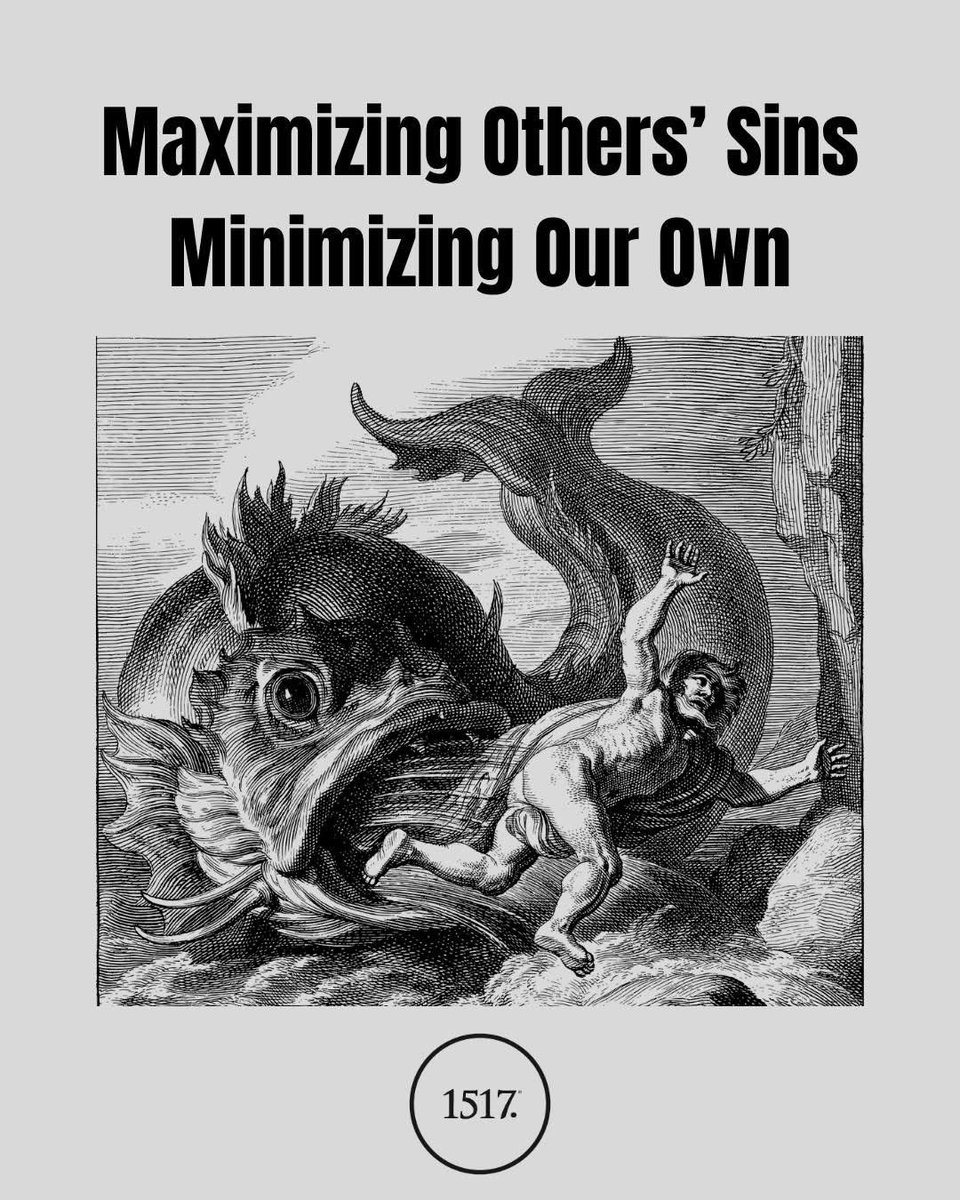
Jonah embodies one of our favorite pastimes: maximizing the sins of others while minimizing our own.
He was utterly blind to the Nineveh in his own soul.
The laws of God are given as a mirror, to reflect our own flaws and constant need of repentance, not a window by which to spy on the sins of others.
Lord grant us:
•a humble heart
•a contrite spirit
•a mouth to confess
•faith to believe
Let us pray, over and over, hour by hour, till our final breath, “Lord Jesus Christ, Son of God, have mercy on me, a sinner.”
______
We read Jonah today in Bible in One Year. Join us any time at https://t.co/XxNvEtNH7e
John the Baptist is uncivilized. With locust legs in his teeth, uncut hair, and a camel-hair wardrobe, he will never be hired by a Fortune 500 company or make the cover of GQ. Mamas don’t want their babies to grow up and be John the Baptists.
He makes us uncomfortable, doesn't he? Not simply because of his appearance or diet, but because he refuses the life we call normal. He lives outside the civilized structures we trust. No home, no polished identity, no white-picket fence and two-car garage.
The wilderness is his dwelling, the Jordan his altar, and repentance his message.
When asked who he is, John refuses all titles. Not the Christ. Not Elijah. Not the Prophet. He is only a voice: “Make straight the way of the Lord.” He exists for one purpose, a singular, consuming focus on the coming Messiah. Everything about him draws attention away from himself and toward another.
And so he calls us out, away from our civilizing of sin. Away from the illusion that our job, family, possessions, or comfort are of ultimate importance. Away from the lie that sin can be managed.
In the wilderness, those illusions collapse. There, stripped of distractions, we see the truth of our condition. The law exposes us. Pride withers. Excuses fall silent. We sit in the dust and remember what we are: from dust, and to dust.
This is why we resist John. The old Adam recoils at being unmasked. His words scrape against us like sandpaper. He will not soften the law or offer a pleasant version of repentance. He calls us to turn, because wrath is real and sin is deadly.
John calls us out into the wilderness, where the only life is where there is water. There stands Jesus in the Jordan. John points: “Behold, the Lamb of God, who takes away the sin of the world.”
In that water, Christ gives us his life. What the law exposes, he heals. What sin has parched, he refreshes. Here conscience finds peace, hearts find rest, and sinners find forgiveness.
The wilderness of repentance becomes the place of salvation, because there Christ meets us in the baptismal water into which he has placed himself for us.


![birdchadlouis's tweet photo. The Transfiguration of Jesus is humming with Old Testament language, themes, and imagery.
It begins with the setting. In Matthew 17:1–8, the phrase “after six days” echoes Moses waiting six days on Sinai before God spoke from the cloud (Exod. 24:16).
The “high mountain” recalls Sinai, Moriah, Nebo, and other sacred peaks where God revealed himself. It also evokes Isaiah 40:9: “Go on up to a high mountain…[and proclaim] “Behold your God!”
From the outset, the scene invites us to read this theophany—indeed, the entire New Testament!—with Hebrew glasses on.
As the event unfolds, those connections broaden and deepen. Jesus’ face shines, recalling Moses’ radiant face after encountering God (Exod. 34:29), but here the glory in Jesus is not reflected; it is intrinsic to him. The imagery also resonates with Ezekiel’s vision of the radiant man on God’s throne (Ezek. 1:26–28).
Then Moses and Elijah appear, representing the Law and the Prophets, the whole witness of Israel’s Scriptures. They speak with Jesus about his coming “exodus” (Luke 9:31), a word crowded with meaning, pointing to the new and greater act of redemption.
Peter responds by suggesting three tabernacles. Though Luke notes he didn’t know what he was saying, his impulse echoes both the wilderness tabernacle and the Feast of Booths, when Israel dwelt in tents to remember their years in the wilderness with God.
While Peter is still speaking, a cloud overshadows them, the familiar sign of God’s presence from the Exodus (13:21-22; 40:34-38). Then comes the divine voice: “This is my beloved Son, with whom I am well pleased; listen to him” (Matt. 17:5). In that single sentence, God weaves together threads from Psalm 2:7, Genesis 22:2, Isaiah 42:1, and Deuteronomy 18:15. The Father gathers the Scriptures into one declaration and directs all attention to his Son.
Everything converges in the Transfiguration. The Law, the Prophets, the exodus, the mountain, the cloud, all find their fulfillment in Jesus.
Look to him and him alone for the full revelation of God.
______
For more on this topic, see my book, The Christ Key: Unlocking the Centrality of Christ in the Old Testament, https://t.co/AbNV4FCcZ5](https://pbs.twimg.com/media/HJpRZgfb0AAxks4.jpg)



![birdchadlouis's tweet photo. Here’s a fascinating example of why it’s not only helpful to study the Hebrew Old Testament but also the Greek translation of the Old Testament, the Septuagint.
The Septuagint heavily influenced New Testament writers, and at times they chose their Greek in such a way as to echo what was happening in the Old Testament. That echo becomes clear when you compare the Greek of the Old Testament with the Greek of the New Testament.
Here’s the example. In Luke 7, Jesus raises the widow’s son at Nain. Afterward, we are told that “he gave him to his mother [ἔδωκεν αὐτὸν τῇ μητρὶ αὐτοῦ]" (Luke 7:15).
Initially, that seems an odd detail, right? His mother is right there, so why would Luke add that Jesus "gave him to his mother"?
The answer is found in the Septuagint in 1 Kings 17:23, which we read today in Bible in One Year. After Elijah raises a dead boy to life again, the prophet “brought him down from the upper room into the house and gave him to his mother [ἔδωκεν αὐτὸν τῇ μητρὶ αὐτοῦ]."
If you are reading both the Old Testament and the New Testament in Greek, the connection is unmistakable. Luke is intentionally echoing Elijah’s miracle.
The further confirmation of the overlap between the miracle by Elijah and the miracle by Jesus is that the crowds respond, “A great prophet [!] has arisen among us!” (Luke 7:16).
They saw the similarities between what was done, even as we, the readers of the text, see *and* hear the similarities.
What Luke is doing, then, is alerting us that Jesus has performed an Elijah-like miracle. But more than that, he is showing that Jesus is the new and greater Elijah. The ministry of Elijah becomes a kind of pattern or foreshadowing of what Jesus will do.
Jesus is indeed a prophet, but he is more than a prophet. By echoing Elijah in this way, Luke helps us see both the continuity and the escalation: what God once did through his servant, he now does more fully and finally in his Son.
_______
Join us for Bible in One Year at any time! https://t.co/XxNvEtNH7e](https://pbs.twimg.com/media/HIrA7KsXsAAMsYn.jpg)