Quick test: what is a third of an hour? 20 minutes. A quarter? 15. Clean. Now a third of 100 minutes? 33.33 and on forever. 60 makes sharing time easy. ⏱️
What is a fifth of an hour?
#Horology#Babylon#Time
Nobody knows for sure why they chose 60. But it is easy to divide: it splits evenly by 1, 2, 3, 4, 5, 6, 10, 12, 15, 20, 30 and 60. Twelve clean divisions. 🧮
#Horology#Babylon#Time
The Sumerians of Mesopotamia used a base-60 counting system around 2000 BCE. The Babylonians inherited it and used it for astronomy. Their maths became the root of our minutes. 🧱
#Horology#Babylon#WatchHistory
That explains 24. But where does 60 come from? A different story, from a different place: Babylon. Any guesses? 🤔
Tomorrow: the number 60.
#Horology#Babylon#WatchHistory
Equal hours began as a tool for astronomers' calculations. Everyday life kept using hours that stretched and shrank with the seasons. Science and daily life ran on different clocks. 🌍
#Horology#AncientGreece#WatchHistory
The fix came from Greece. In the 2nd century BCE, the astronomer Hipparchus proposed a day of 24 equal hours, based on the 12 hours of light and 12 hours of dark on equinox days. ⚖️
#Horology#AncientGreece#Astronomy
But those hours were still not equal. A winter daytime hour was short, a summer one was long. Imagine your watch changing the length of an hour every season. 😅
Would you wear it?
#Horology#WatchHistory#Sundial
12 hours of day plus 12 hours of night. That is the 24-hour day. It was born in Egypt, with sundials by day and stars by night. No clock, just the sky. 🌓
#Horology#AncientEgypt#WatchHistory
One explanation for 12 night hours: about 18 decans were visible at night, but twilight at each end used up 3 of them, leaving 12 for the dark. One star rising, one hour passing. ⭐
#Horology#AncientEgypt#Astronomy
The oldest evidence of dividing the night into hours is written inside Egyptian coffin lids from about 2000 BCE. Star tables with 12 rows, one row for each hour of the night. 🏺
Tomorrow: why 12?
#Horology#AncientEgypt#History
Each decan marked a stretch of about 10 days. 36 decans × 10 days = 360 days, plus 5 extra days, and you get the 365-day year. Maths hidden in the sky. 🧮
#Horology#AncientEgypt#Astronomy
Sundials fail at night. So Egyptian astronomers watched the stars. They tracked 36 groups of stars called decans, which rose above the horizon one after another. 🌌
#Horology#AncientEgypt#Astronomy
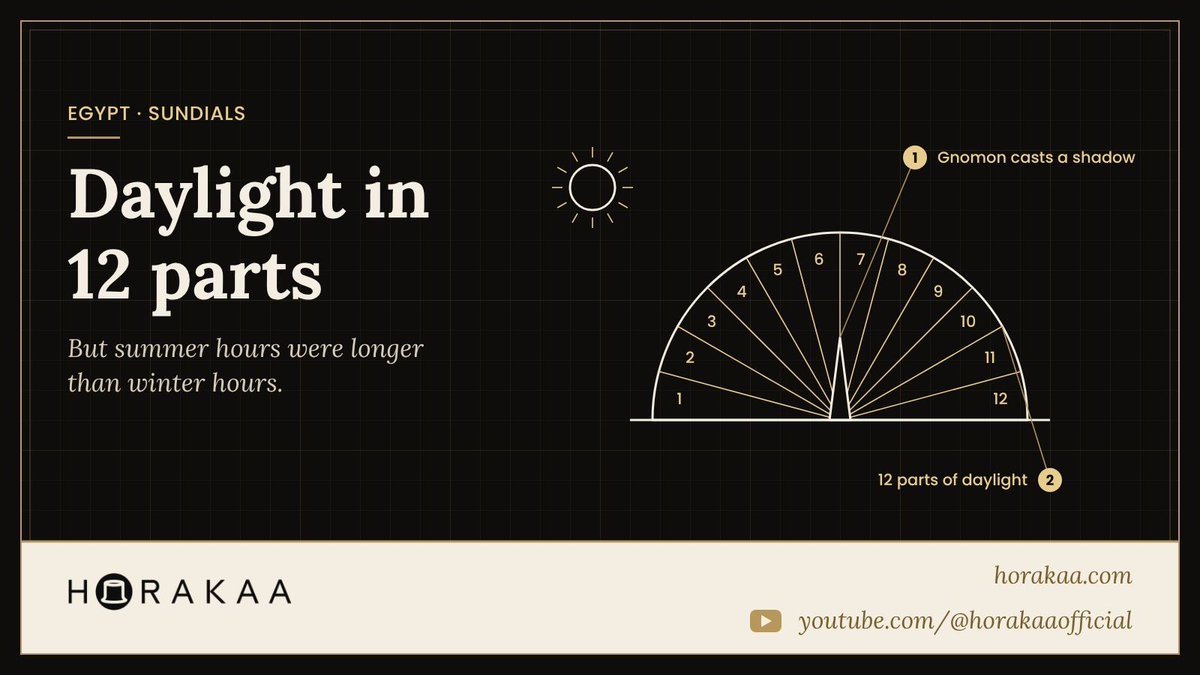
The Egyptians split daylight into 12 parts using sundials. But the hours were lopsided: summer hours were much longer than winter hours. Same 12 parts, different lengths. ☀️
#Horology#Sundial#AncientEgypt
Try this: use your thumb to count the three segments of each finger on one hand. You reach 12. Some historians think this is why the ancients loved counting in 12s. 🖐️
Did you get 12?
#Horology#WatchHistory#AncientEgypt
Why is a day 24 hours and an hour 60 minutes? We count in tens, yet our clocks run on 12s and 60s. The answer starts in ancient Egypt and Babylon. 🔢
This week: where 24 and 60 came from.
#Horology#WatchHistory#Time
Next week: why is a day 24 hours and an hour 60 minutes? The answer starts in ancient Egypt and Babylon, and it has nothing to do with the number 10. Follow along. 🔢
IG & YouTube: @horakaaofficial | https://t.co/B0sSBIHA8g
#Horology#WatchHistory#Time
Until mechanical clocks arrived in the 14th century, sundials and water clocks were the main ways to measure time. For well over a thousand years, water ruled the night. ⏳
#Horology#WatchHistory#History
Week two recap: Egypt's Karnak clock, Greek water thieves, timed speeches in court, Ctesibius and his floats, the Tower of the Winds, and copper bowls in India. 💧
Which story was your favourite?
#Horology#WatchHistory#WaterClock
At Nalanda, the great Buddhist university, a water clock like this marked time in four-hour intervals. Study there was timed by water. 📚
#Horology#Nalanda#AncientIndia
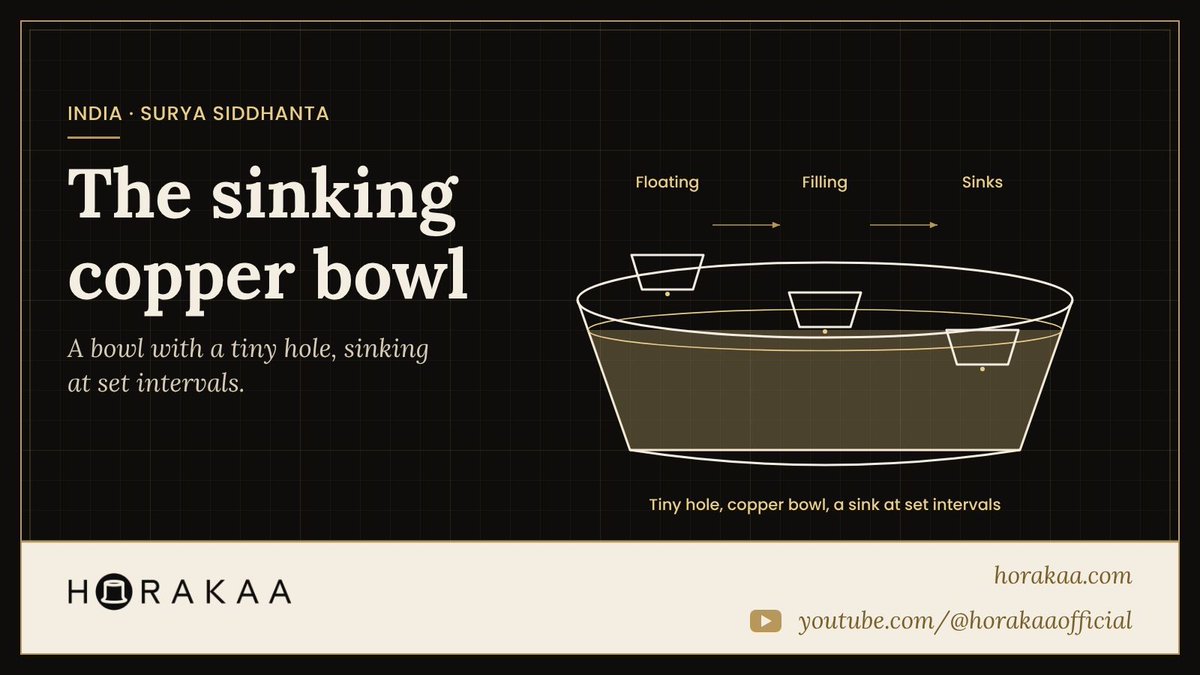
In India, a copper bowl with a tiny hole floated on water and sank at set intervals. The Surya Siddhanta, from around the 5th century CE, mentions one.
Have you heard of this? 🇮🇳
#Horology#AncientIndia#WaterClock