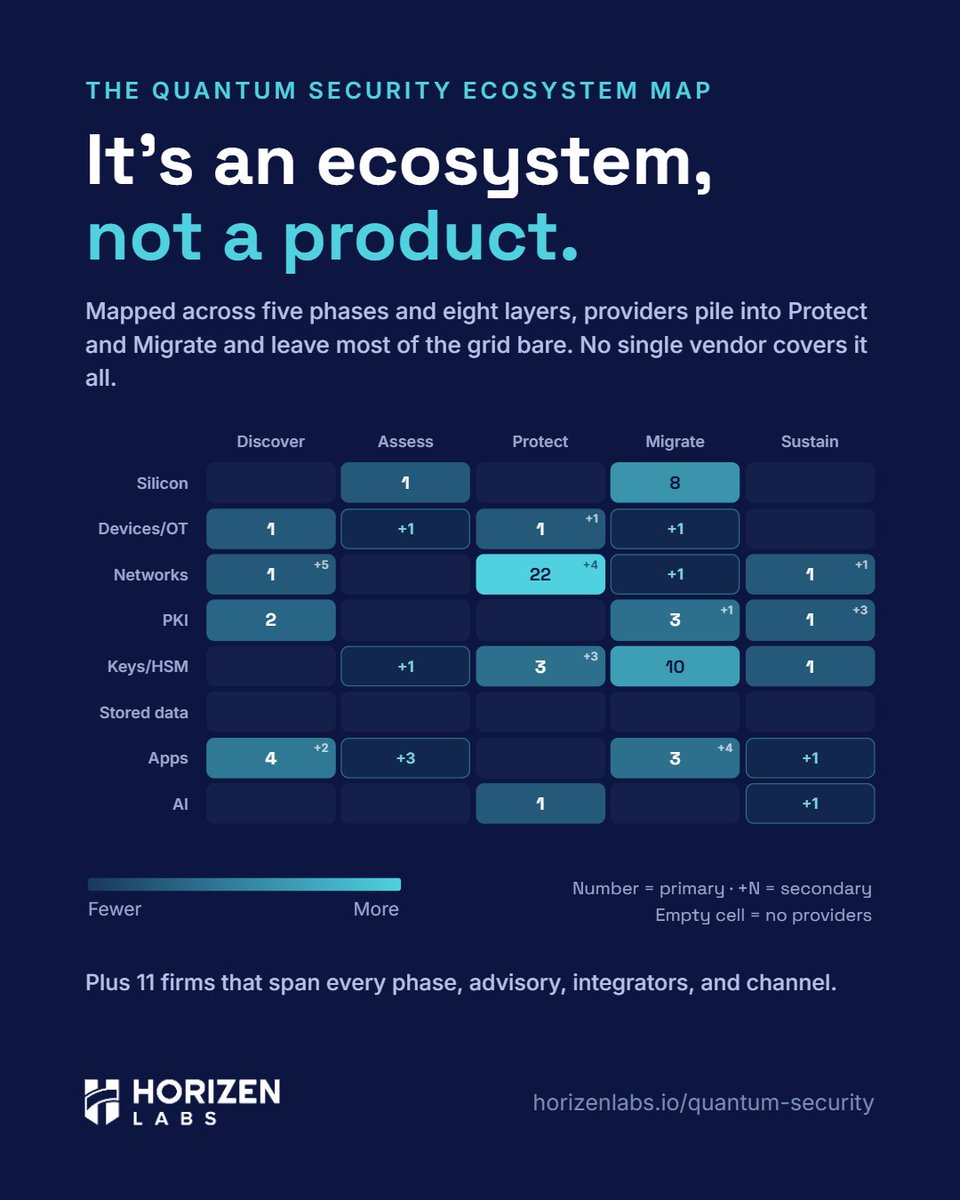
📣Today we’re launching the Quantum Security Ecosystem Map to help organizations migrate to quantum-resistant cryptography.
The map shows which providers support each phase of a quantum-resistant migration across every layer of the cryptographic estate, so security, risk, and compliance leaders can see who does what and where to start.
👉See the full announcement: https://t.co/gIfRolS0wz
On today's rails, no system resists quantum computers end to end.
So the ZenIP plan starts where it counts, with encryption built for the quantum era, and swaps in stronger proofs as the tech evolves ↴
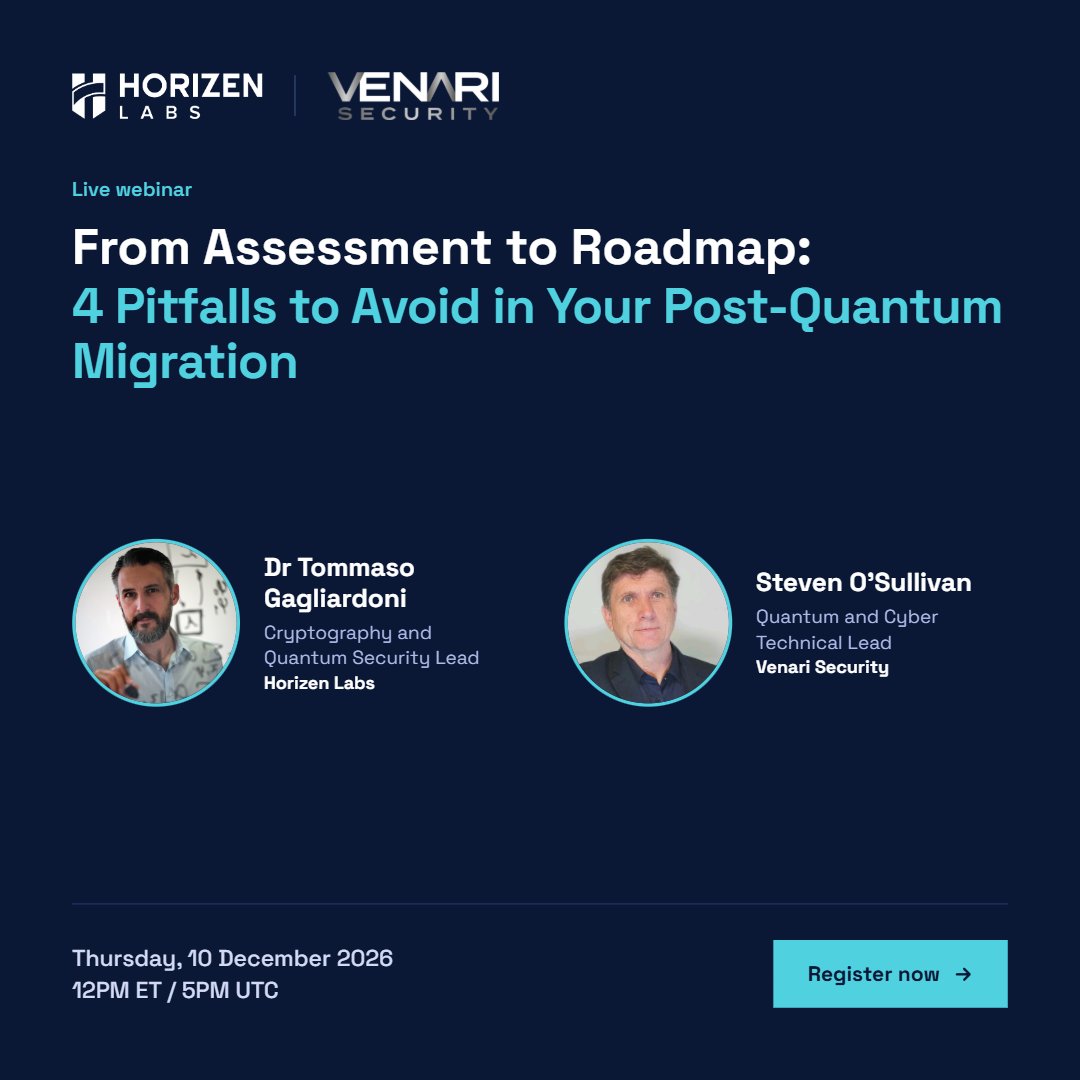
🟢Registration for the next live webinar is open🟢
Horizen Labs and @venarisecurity go live on the 4 decisions that go wrong in quantum-resistant migrations.
👉 Register now: https://t.co/Y6EY8gBToX
4/ Thousands of unranked findings and no obvious first move.
So teams freeze, work through the list in order, treat migration as a simple algorithm swap, or accept an AI-generated report as proof the job is done.
⚛️Quantum computers that can break today’s encryption don’t exist yet.
But data stolen now can be decrypted later, and migrating cryptography takes years.
📊So, honestly: Where is your organization on quantum-resistant migration today? 👇
A simple test for whether quantum risk is already a problem for your organization:
X = how long your data must stay confidential
Y = how long it takes to migrate your cryptography
Z = how long until a quantum computer can break it
If X + Y > Z, you’re already exposed.
Expert surveys put Z most likely in the 2030s.
Migration for a large organization can take well over a decade.
Most health, legal, and financial records must stay private longer than that.
Harvest now, decrypt later: attackers store encrypted data today to crack once quantum computers catch up.
Fixing it isn’t one purchase; it’s an ecosystem.
We mapped who covers each phase of quantum-resistant migration, and where the gaps are.
Check out: https://t.co/wbbURRH0Vn
📣Today we’re launching the Quantum Security Ecosystem Map to help organizations migrate to quantum-resistant cryptography.
The map shows which providers support each phase of a quantum-resistant migration across every layer of the cryptographic estate, so security, risk, and compliance leaders can see who does what and where to start.
👉See the full announcement: https://t.co/gIfRolS0wz
3/ Most organizations know a quantum security migration is coming.
The hard part is knowing who can help with which step, because no single vendor does it all.
The map starts from where you are and shows who covers that step.
We're partnering with @venarisecurity to help organizations prepare for the post-quantum migration.
Read the full partnership announcement: https://t.co/XD6fBigv1I
Almost everything your organization does online is protected by encryption: payments, customer records, internal email, and more.
Quantum computers, once they’re powerful enough, are expected to break much of the encryption in use today.
They aren’t there yet, but attackers aren’t waiting.
They’re already collecting encrypted data now so they can unlock it later.
Anything that needs to stay private for years, like health records, financial data, or intellectual property, is already at risk.
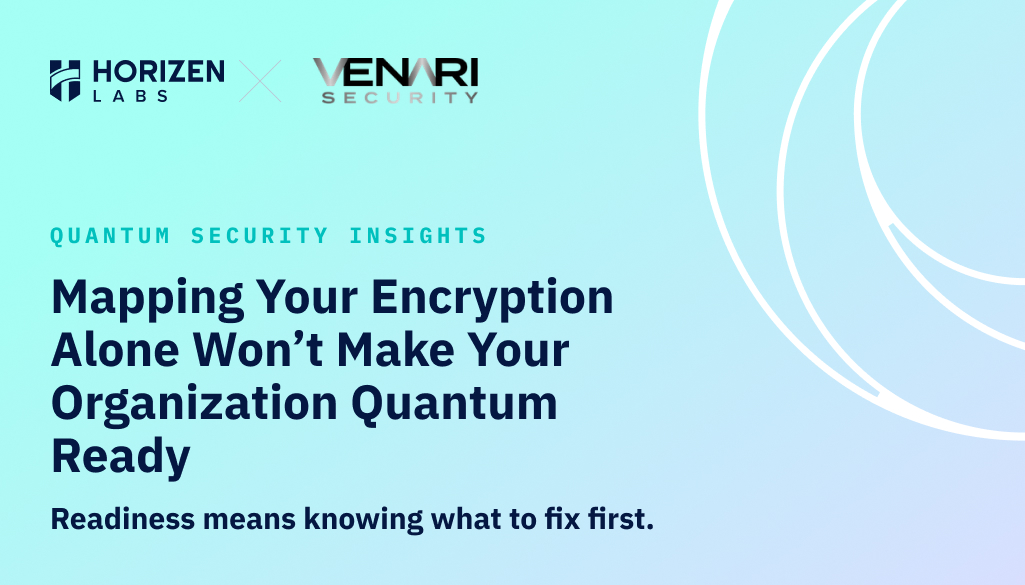
Most organizations respond by finding out what encryption they actually use. That’s the right first step, but it isn’t a plan.
A scan can produce a long, detailed list of every key and protocol in your systems. It can’t tell you which risks matter most to your business, or what your leadership should fix first.
Our CEO @RobViglione and @VenariSecurity CEO Tom Millar explain how to turn that list into clear decisions, and where to start this quarter.
Read the full article: https://t.co/7ED0wdPbCg
Unpopular opinion: crypto agility is a bit of a fantasy 🦄
It's becoming a real buzzword across the industry right now. But is it actually a smart move?
People don't build cryptography. They build applications, and the crypto has to fit whatever limits the app sets.
The cryptography team at @HorizenLabs explain👇
"We are a bit late. The cryptographic community has been raising the alarms for years."
Episode 6 of The Post-Quantum Experience is now live, with Tommaso Gagliardoni, founder of Lucumo Security and cryptography research team lead at @HorizenLabs.
From government deadlines and falling qubit estimates to forged signatures, Satoshi's coins and the biggest myths in quantum security, hear from a cryptographer who's been working on this since 2011.
Watch 👇
A question worth putting to your cyber risk committee this week:
What is the earliest external date that forces us to move to quantum-resistant encryption, and is it on our plan?
Most institutions can't answer it.
Not because the work is impossible, but because no one has been told to finish by when, and most don't have a map of where their encryption actually lives.
One financial regulator actually measured how ready its banks are for the shift to quantum-resistant encryption. Nearly three-quarters were not. That is a Swiss figure.
The more uncomfortable point: no US regulator measures this at all, so for the US banking system, the honest answer to "how ready are we" is that nobody knows, because nobody has been required to say.
This week's Quantum-Resistance Intelligence Newsletter breaks down:
❓ what that means for anyone who owns cryptographic risk at a financial institution.
❓ why the readiness question is unanswerable without a cryptographic inventory, and
❓what to ask before your next audit.
Read now👉 https://t.co/RF7uAnTN2u
In Part 2 of our quantum-resistant migration series, we lay out Horizen Labs' roadmap for migrating our infrastructure to quantum-resistant (QR) cryptography.
The industry consensus says harvest-now-decrypt-later is the urgent problem and signatures can wait. Horizen Labs' own infrastructure audit found close to the opposite.
Our Quantum Security and Cryptography Lead Tommaso Gagliardoni breaks down why: encryption is a configuration change, but quantum-resistant signatures for most of what a company signs (fund custody, code commits, contracts) do not exist yet in deployable form.
The result at Horizen Labs: SSH and TLS are already hybrid quantum-resistant. Signing is not, and it is the harder problem.
Read the full article 👉 https://t.co/H2XeicECvt