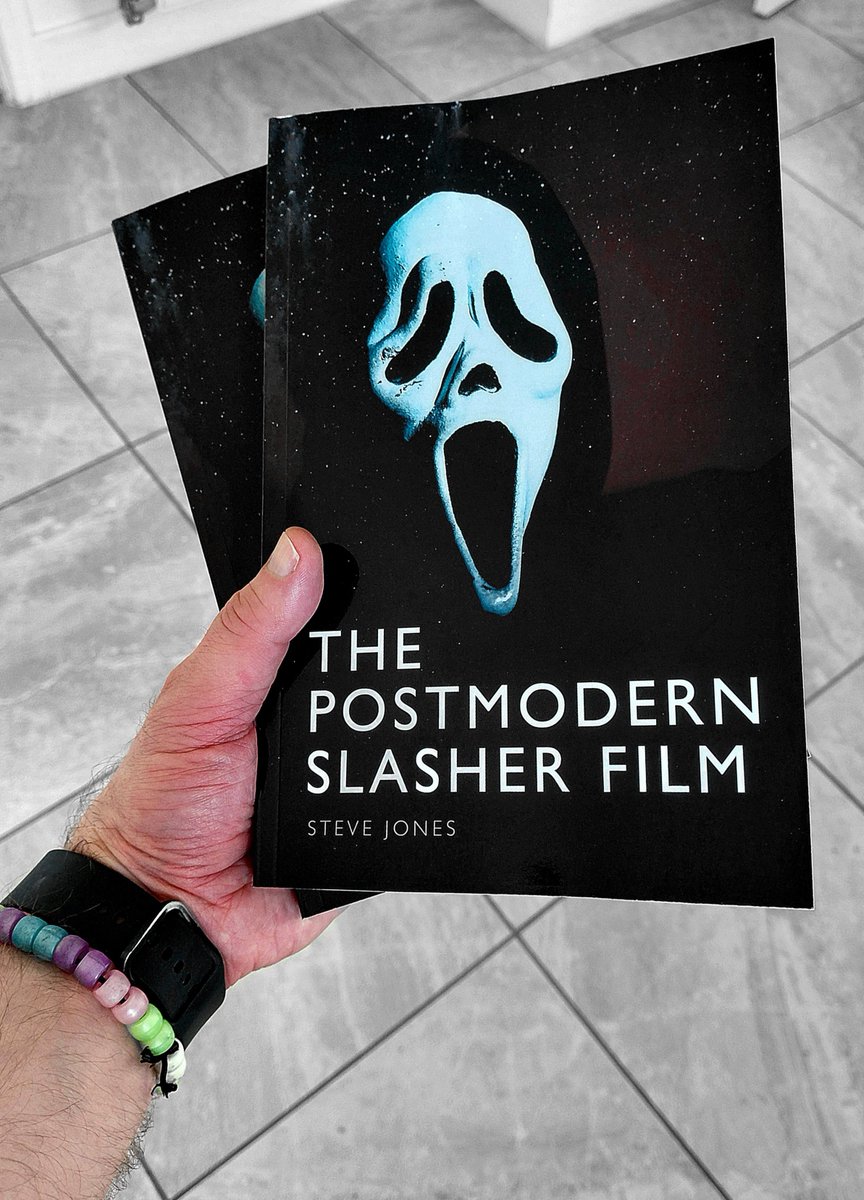
New video: Epistemic Doubt in the Postmodern Slasher Whodunit (Full series)
Parts 1-6 of @DrSteve_Jones on how the whodunit structure exposes the postmodern slasher's ironic, cynical and non-committal tone, now as one complete video
https://t.co/MmJ3ZacFre
#horrorNU
New video: Epistemic Doubt in the Postmodern Slasher Whodunit (Part 6)
In the concluding part of this series, @DrSteve_Jones shows that the whodunit structure exposes the postmodern slasher's ironic, cynical and non-committal tone
https://t.co/x9xwkpMwqs
#horrorNU
New video: Epistemic Doubt in the Postmodern Slasher Whodunit (Part 5)
In the fifth of this six part series, @DrSteve_Jones considers how filmmakers weaponise knowledge of the subgenre to wrongfoot slasher fans
https://t.co/DDZqkW5QTd
#horrorNU
New video: Epistemic Doubt in the Postmodern Slasher Whodunit (Part 4)
In the fourth of this six part series, @DrSteve_Jones examines how postmodern slashers use false information to actively mislead viewers
https://t.co/H1vOyEW4Q9
#horrorNU
New video: Epistemic Doubt in the Postmodern Slasher Whodunit (Part 3)
In the third of this six part series, @DrSteve_Jones focuses on the ways that information is withheld from viewers in postmodern slasher films
https://t.co/44xeSbA8WF
#horrorNU
New video: Epistemic Doubt in the Postmodern Slasher Whodunit (Part 2)
In the second of this six part series, @DrSteve_Jones examines how postmodern slashers embed an invitation to play in their whodunit narratives
https://t.co/csK3YdSkJj
#horrorNU
New Video: Epistemic Doubt in the Postmodern Slasher Whodunit (Part 1)
In the first of a six-part series, @DrSteve_Jones argues that the common murder-mystery structure illuminates the postmodern slasher's distinctive tonal features.
https://t.co/RUqMx4Dvhw
#horrorNU
New video: Intertextuality in Urban Legend
@DrSteve_Jones argues that Urban Legend offers a more sophisticated take on intertextuality than most other slasher films of the period
https://t.co/im7H5nhnPI
#horrorNU
Last week, Northumbria University's Horror Studies Research Group held our annual international conference, Horror Studies Now.
For anyone who missed it, here is our annual highlight reel: https://t.co/0OiTd2LvVW
Did you attend the Horror Studies Now conference last week?
There's still time to check out our #Horror Studies reading list, which brings together our bestselling titles from across #HorrorStudies,
https://t.co/E1zg3CZHbK
Jeon provides a consideration of the director’s entire career and themes of his works. Insightful and engaging, Jeon offers an up-to-date analysis of the genre-bending international director.
Browse our virtual exhibit here: https://t.co/VcW5y3I6Yb
@HorrorStudies@IllinoisPress
The Horror Theory Reader is indispensable for scholars and will be of interest to anyone curious about our paradoxical enjoyment of appalling and fearsome things
Browse the MNG Horror Studies virtual exhibit: https://t.co/zQNqBX7Rum
#Horrorstudies@HorrorStudies@UMinnPress
Offers fresh insights into an important body of work, contributes to current studies of the evolution of horror aesthetics, and maps borders between exploitation, independent, and mainstream film
Browse our virtual exhibit: https://t.co/WyW0MAnONK
#Horrorstudies@HorrorStudies
Examines female monstrosity as it appears in horror films and considers specific political, scientific, and historical contexts to better understand how we construct and reconstruct monstrosity
Virtual Exhibit: https://t.co/iUvOI0tTbf
@HorrorStudies@RutgersUPress#Horrorstudies
Heading to the @HorrorStudies Now conference next week?
Drop by the MUP stand to meet @houston_ml, browse our #HorrorStudies books, and find out more about our brand new *Foundations of Horror Studies* series
https://t.co/E1zg3CZHbK