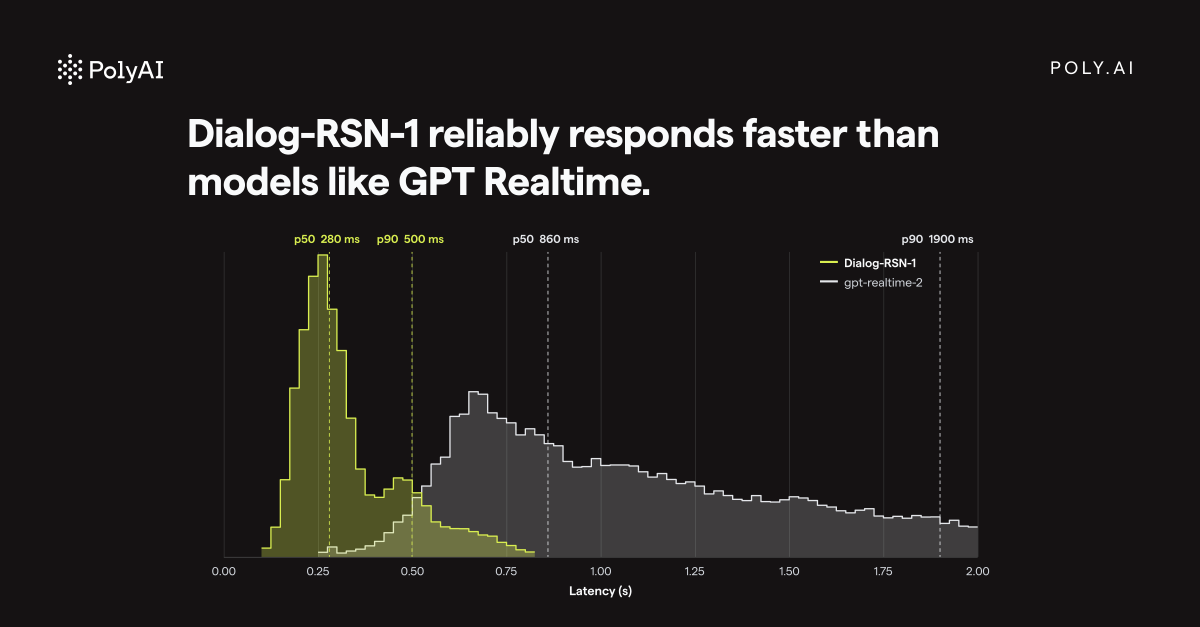
About half a second. That's how long it takes on a live call before the silence gets awkward and customers lose trust that you're handling things right.
Dialog-RSN-1, our new model, is the solution to answering within that window without losing the audio information you need or the control over your voice output you want.
And as @nikola_mrksic shared with @Ronanchamberss & @lukeknight on @etnshow, it does so faster and at a higher quality than any other real-time-capable model.
A reply in 280ms keeps a phone call feeling human. Two seconds of silence? That gets you "hello? are you there?" and a prompt hang up.
Today @polyaivoice launched a model built around that fact. Meet Dialog-RSN-1.
Instead of reading a transcript of what you said, Dialog-RSN-1 listens to the call itself. It reasons through its answer and starts speaking faster than GPT Realtime can begin a reply, and it's already carrying real customer calls in production.
Most AI agents running in contact centers today are built on general-purpose models with defaults designed for long-form text and screen-based interactions.
On a live customer call, that means responses that are too long, phrased for a reader, and delivered at a pace that makes callers wonder if anyone's listening.
Raven is how we solved it. A model built specifically for customer service, trained on millions of real conversations, and designed for how people actually talk.
In our upcoming session, Matt Henderson and Jak Katterfield will walk through why we train Raven in-house, how we do it, and what it delivers on a live call.
Join us July 1st at 12 PM ET: https://t.co/u1LKGvsB0O
🇨🇦 PolyAI is coming to Toronto!
Toronto has one of the deepest concentrations of AI talent anywhere in the world, and our North American customers are growing fast. Being on the ground means we can move with them and recruit the teams who will define the next phase of our platform.
Our team there will be focused on agent design, deployment engineering, and business development.
Read about where we're headed next: https://t.co/CI2nbTlFpU
Starting today, we're opening our Agentic Dialog Platform to every enterprise builder.
Our dialog agents have resolved 1 billion+ customer conversations for clients like FedEx, Unicredit, PG&E, Marriott, Foot Locker, and many more.
These aren't easy conversations. They solve problems like:
> A patient booking medical transport who needs insurance verified on the spot.
> A homeowner calling their utility company about a gas leak.
> A cardholder figuring out why their must-have purchase was declined.
Standard conversational AI was never built for this. It was designed for chat, adapted for voice later. It generates responses, but can't do what dialog requires: hold context under pressure, navigate ambiguity in real time, and actually resolve problems.
So we built a better model.
Our proprietary model Raven was built from the ground up specifically for dialog. Agent harness in the weights, not bolted on through prompts that drift under pressure. And in our platform, you can deploy Raven as your default or bring in GPT-5, Claude, Gemini, whatever model fits your use case or regulatory requirement.
Now that the Agentic Dialog Platform is open, any team can create, test, and deploy dialog agents on the same model and infrastructure the world’s top brands trust on their hardest days. This opens up the pool of builders across your entire enterprise. The person who knows customers best, who runs operations, who owns the customer journey: they're all builders now.
Two ways to build:
> Poly Agent Builder: Describe your use case in natural language, and it configures your agent, knowledge base, and conversation flows automatically. Production-ready in ten minutes.
> Agent Development Kit (ADK): Developers use this to build dialog agents the same way they build everything else. Use your own IDE, a coding assistant like Claude, version with Git, deploy from your terminal.
Get started now: https://t.co/ifZOy1uEBz
Just in: the @FinancialTimes has ranked PolyAI the #1 fastest-growing AI company in Europe!
As we continue to expand globally, it’s especially meaningful to see this recognition coming out of our home base.
Enterprises don’t trust just anyone with their customer conversations. We’ve earned their trust by delivering better business outcomes across tens of millions of real interactions.
Out of the @FT 1000 companies, PolyAI ranked #32 overall, and #1 among enterprise AI providers. Get the full story here: https://t.co/3Rz3xf0tNv
When people talk about AI in healthcare, they jump straight to replacing roles. But right now, the most interesting work is simply about listening.
Some companies are already building voice AI that tracks speech patterns over time to detect changes linked to diabetes, mental health conditions, and even insomnia.
Nikola Mrkšić sat down with Alexandra Brown to talk about where AI is actually making an impact in healthcare today, and it's a lot closer than most people think.
Watch the full episode: https://t.co/SY1D5WUFWs
Hear how The Melting Pot is creating the perfect night out.
Dan Mullins, Manager of Technology at The Melting Pot Restaurants, shares how they generated $300k from after-hours bookings with their always-available PolyAI agent.
Check out their story below ⬇️
I’ve never seen a customer agent being used in therapy centers.
But the way this AI handled the call is impressive
Voice shaky. Long pauses. Sentences trailing off. AI didn't rush or fill the silence.
That's something most humans can't even do well.
We keep talking about AI getting smarter. Better at code, images, reasoning. Nobody's talking about it getting emotionally intelligent.
Not "detecting sentiment" in a dashboard. Actually knowing when to shut up. Knowing that "Great!" is the wrong response when someone's having a rough day.
Most companies already deliver worse experiences with real agents who are overworked and burned out.
AI isn't competing with the best human on their best day. It's competing with the average Tuesday afternoon call. And it's winning.
The company that's closest to nailing this is @polyaivoice. They built the whole thing for phone calls from day one.
They already handle calls for Marriott, Gordon Ramsay's restaurants, and every major casino in Vegas.
This call is what made it click for me:
I quit Apple because I knew Siri would never make an actual dent in the world.
Not because the tech was bad.
But because the entire concept had to be rethought.
General-purpose AI assistants try to do everything, and end up doing nothing well.
When you optimize for breadth, you can't go deep enough to actually complete transactions.
Siri can tell you about restaurants but it can't book one, can't take payments, can't modify reservations, can't handle the messy back-and-forth that happens in real conversations.
It's a search interface, not a transaction engine.
When we started @polyaivoice, we made one decision: We only do customer service calls.
Yes! Just one single thing.
We wanted to answer your calls so your customers can talk to AI agents that actually know what they're doing.
And that focus is exactly why we handle 500M+ calls today.
This is what actually happens when you go narrow:
1️⃣ you can train on real data that matters.
We've trained on hundreds of millions of actual customer service calls across hospitality, banking, logistics, and healthcare.
And I'm not talking about web-scraped text, or synthetic conversations.
I'm talking about real calls with real edge cases, real accents, real background noise, real payment failures, and real angry customers.
Our model know what "I need to move my reservation" sounds like in 45 different languages because they've heard it millions of times.
2️⃣ you can integrate deeply into actual business systems.
PolyAI doesn't just talk; it pulls data from your CRM, checks availability in your booking system, processes payments through your payment gateway, updates your PMS, triggers workflows, and a lot more.
3️⃣ you can measure what actually matters to businesses.
We don't track "user engagement" or "daily active users".
We track containment rate, revenue per call, cost per contact, CSAT scores, after-hours bookings captured.
The Melting Pot generated $250K in six months from calls that would've gone to voicemail.
4️⃣ and this is the part that took me years to understand:
You can actually be held accountable.
When your AI is handling a business's main phone line, every failure is visible immediately.
A hallucination doesn't just annoy a user, it costs the business a customer.
So you build differently.
You build with guardrails, with fallbacks, with human handoff protocols, and with real-time monitoring.
You build like the business depends on it, because it does.
PolyAI Agent Studio will help every business have a customer service AI that works 24/7 and actually gets things done.
Excited to have it deployed across your business.
@polyaivoice I think we all have heard how AI sounds under perfect conditions but this really shows it can perform under the pressures the real world. And the Gordon cosign too? Sheeeesshh.