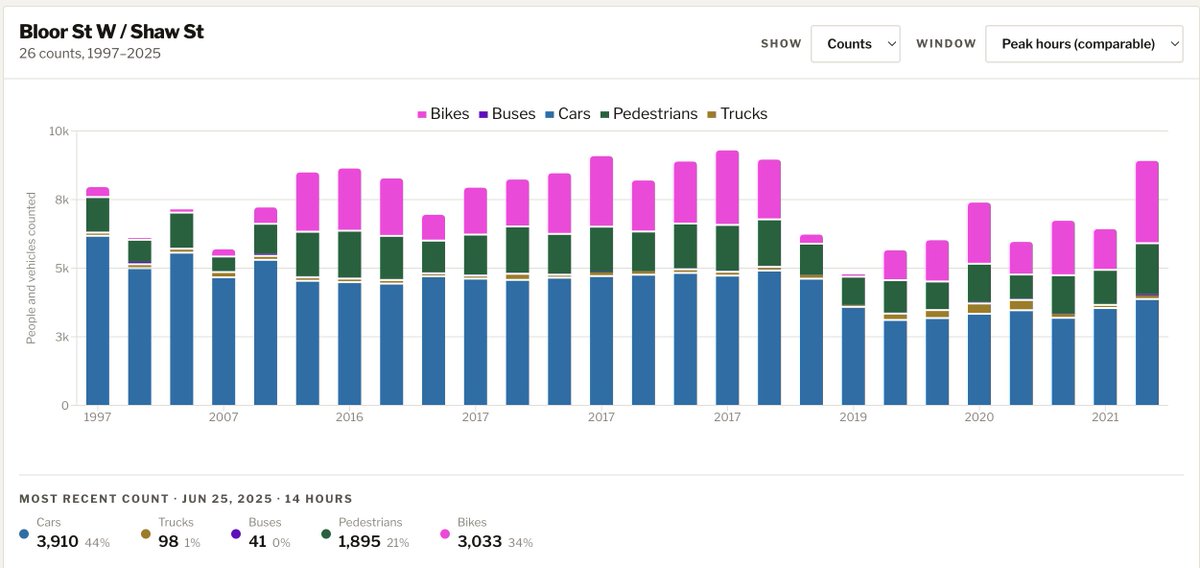
The Bloor bike lane was first installed in 2016, and as a result, more traffic goes through Bloor Street, and a lot more of that traffic are locals who shop more because you can park a lot of bikes in front of a store but just one car.
(The 2019 dip was due to construction)
Only around 40% of rush hour traffic at Bloor and Shaw in Toronto is made up of cars. Before the bike lanes on Bloor, over 80% of traffic was cars. Now more commuters pass through the intersection, although raw number of cars has decreased. If you build it, they will come.
Photo from Reddit of the Critical Mass bike ride from the other day.
There are hundreds of cyclists and only about 40 people in cars.
Yet the two groups are using about the same amount of road space.
There are multiple reports of a giant advertisement made of drones in Toronto’s night sky. They seem to have been launched from Fort York.
If these are real they need to be banned immediately.
#topoli
18 people on bikes, taking up the space of about two moto vehicles 🚲🚲
Imagine if we all drove instead…
This is what space-efficient transport looks like 💚
Bikes aren’t the reason why traffic is bad. Cars getting in the way of other cars are.
The best way to reduce traffic is to give people other options to get around. That means bikes. And transit. And pedestrian-first streets.
@marconeats Absolutely.
Naysayers who say ‘bike lanes are useless if they’re not plowed’ forget that:
a) you can just plow them, and
b) car lanes are also useless if they’re not plowed
Yesterday’s major rain and thunderstorm is now the FOURTH 100-year storm that Toronto has experienced in the past fifteen years.
We must end the burning of gasoline, natural gas, and other fossil fuels.
Also, does this road look closed to you?
We need road signs that recognize that there are many road users, not just cars using neighbourhood roads to drive as quickly as they can to get to somewhere else.
Toronto is the city that puts the road closed sign in front of the view of the stage (despite it also being in the middle of the closure and far away from where any person needing to see it will ever be)
A team at Clemson University just built a car that *gathers more energy than it uses*.
Energy is one of the most plentiful substances in the universe. Only the greed of fossil fuel companies locking us into more oil and gas makes energy expensive.
https://t.co/C00ppHG7DD
NYC Mayor Zohran Mamdani is setting off an online frenzy after a nearly decade-old interview resurfaced showing him speaking with a noticeably different accent while discussing his Ugandan roots.
The 2016 clip features Mamdani talking about life in Kampala while promoting his mother Mira Nair’s Disney film, 'Queen of Katwe,' for a South African radio station.
Source: Natural Resources Canada:
https://t.co/W2KQObgo0K
Scroll down to ‘Estimated area of annual deforestation by industrial sector in Canada, 1990–2023’ and click on the Graph Summary