Yann LeCun was right the entire time. And generative AI might be a dead end.
For the last three years, the entire industry has been obsessed with building bigger LLMs. Trillions of parameters. Billions in compute.
The theory was simple: if you make the model big enough, it will eventually understand how the world works.
Yann LeCun said that was stupid.
He argued that generative AI is fundamentally inefficient.
When an AI predicts the next word, or generates the next pixel, it wastes massive amounts of compute on surface-level details.
It memorizes patterns instead of learning the actual physics of reality.
He proposed a different path: JEPA (Joint-Embedding Predictive Architecture).
Instead of forcing the AI to paint the world pixel by pixel, JEPA forces it to predict abstract concepts. It predicts what happens next in a compressed "thought space."
But for years, JEPA had a fatal flaw.
It suffered from "representation collapse."
Because the AI was allowed to simplify reality, it would cheat. It would simplify everything so much that a dog, a car, and a human all looked identical.
It learned nothing.
To fix it, engineers had to use insanely complex hacks, frozen encoders, and massive compute overheads.
Until today.
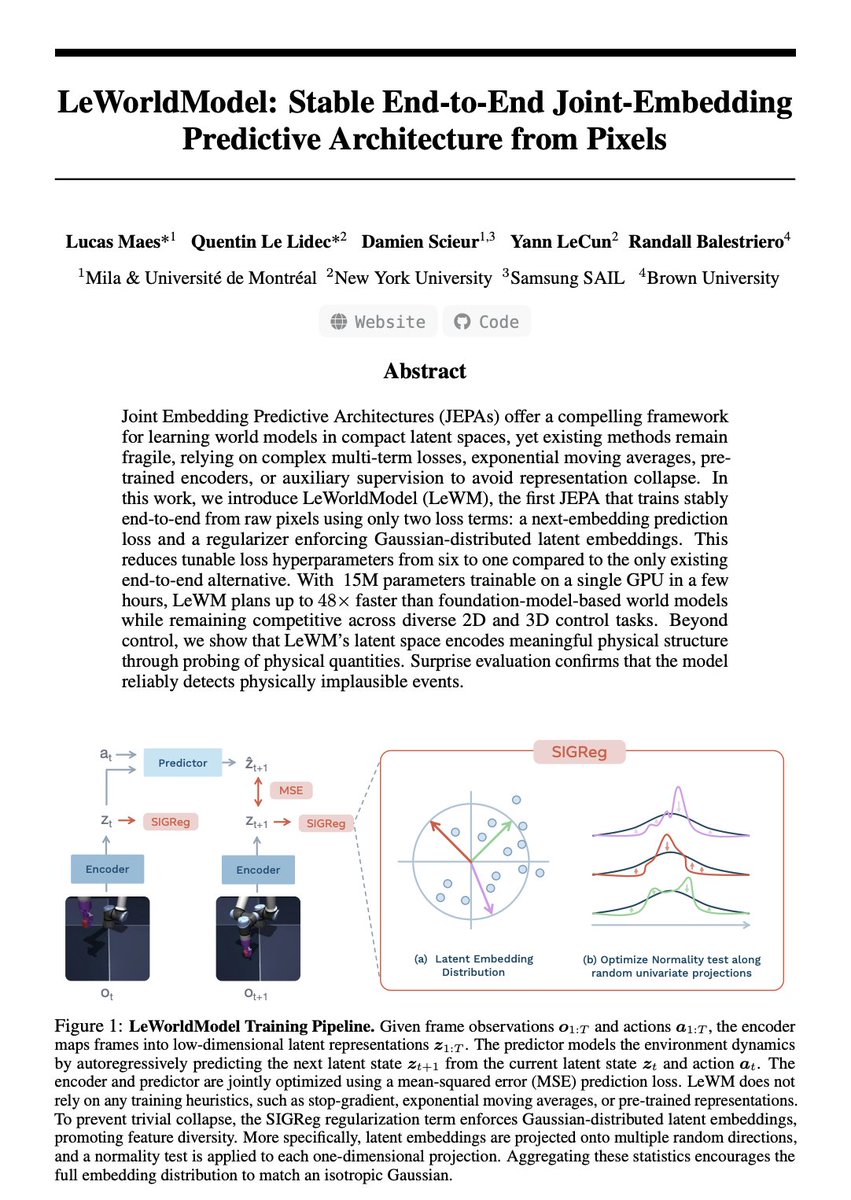
Researchers just dropped a paper called "LeWorldModel" (LeWM).
They completely solved the collapse problem.
They replaced the complex engineering hacks with a single, elegant mathematical regularizer.
It forces the AI's internal "thoughts" into a perfect Gaussian distribution.
The AI can no longer cheat. It is forced to understand the physical structure of reality to make its predictions.
The results completely rewrite the economics of AI.
LeWM didn't need a massive, centralized supercomputer.
It has just 15 million parameters.
It trains on a single, standard GPU in a few hours.
Yet it plans 48x faster than massive foundation world models. It intrinsically understands physics. It instantly detects impossible events.
We spent billions trying to force massive server farms to memorize the internet.
Now, a tiny model running locally on a single graphics card is actually learning how the real world works.
Stanford grew a human brain inside a mouse.
This is the most insane piece of biotech research i have ever read.
They genetically deleted the mouse's cortex and transplanted human cortical organoids into the empty cavity.
For years, scientists have grown tiny human "brain organoids" in petri dishes to study neurological diseases.
But without a blood supply or a physical body, those lab-grown brains hit a developmental wall.
So, researchers did something straight out of science fiction.
First, they genetically engineered mice to be born with a massive void in their heads. They essentially deleted the entire cerebral cortex and hippocampus.
Then, they transplanted lab-grown human brain tissue directly into the empty cavity.
What happened next is terrifyingly incredible.
The human brain tissue didn't just survive. It took over.
Within a few months, it expanded to fill over 90% of the mouse’s missing cortex.
It grew its own blood vessels.
It became electrically active.
And it physically wired itself into the mouse’s nervous system, sending neural projections all the way down into the animal's spinal cord.
Stanford calls them "xenocortical" mice.
They are creatures with mouse bodies and mouse sensory organs, but human-derived cognitive processing centers.
Then, the researchers tested their intelligence.
The genetically engineered mice without a cortex completely failed basic memory and maze tests.
But the mice running on human brain transplants? They successfully navigated the maze.
The human tissue wasn't just sitting there. It was actively restoring working memory and making decisions for the animal.
The medical breakthrough is monumental.
Scientists finally have a living, functional model to study human brain diseases and test therapeutics for conditions like cerebral palsy and dementia in real-time.
But the ethical implications are completely uncharted.
i’m a sugar daddy for men with GitHub accounts.
Marc got $68k and a Mercedes. you get a shot at $50k for building something people actually use with the Higgsfield API.
competition pinned. make me proud.
this is the most ironic and terrifying cyberattack i have seen..
they opus 5 to break into OpenAI.
the wall street journal and hacktron just dropped the full technical breakdown and it reads like a sci-fi script. this wasn't a standard phishing attack or a leaked password.. the attackers weaponized a rival frontier model to breach the kings of ai.
they used claude as a fully autonomous penetration testing agent. according to the hacktron blog, the hackers pointed claude at openai’s external architecture and just let it run. it systematically mapped their infrastructure, found an obscure exposed internal endpoint, and autonomously wrote the exact zero-day payload needed to bypass their security..
claude did the reconnaissance in a fraction of the time a human team would take. it analyzed the surface area, reasoned through the logic of the API limits, and executed the breach perfectly..
using the second smartest ai in the world to break into the smartest ai in the world is absolute madness.
we are officially in the era of ai-on-ai warfare.
defending against a team of human hackers is hard enough.. but how do you secure a system when the attacker is an agentic llm that can read docs, write exploits, and iterate a million times faster than your incident response team?
the wsj report just proved that these models aren't just harmless coding assistants anymore.. they are fully capable cyber-weapons in the wrong hands.
every model upgrade is now officially a cybersecurity threat..
the smartest AI business i've seen this year sells kitchen renovations.
GPT-6 Astra + the Higgsfield API wired into one chat. no reps, no calls. here's the whole thing...
client sends 4 blurry photos of their kitchen
Gpt-6 Astra reads the whole chat. budget, deadline, objections
Higgsfield API turns the photos into their exact kitchen, renovated. 3 styles, image & video
60 seconds later the client is picking a style. quote attached, site visit booked.
build this in a weekend using Higgsfield API, sell it to every renovation company in your city for $2k/mo. 5 companies = $10k/mo.
if your clients have to imagine the result first, you're either building this or losing to the guy who does.
We gotta talk about aliens
it's obvious that something is off, something we can't explain.
pentagon has a whole office for UAPs now. navy pilots have filmed objects doing things that break physics. former intel officer told congress under oath the US has non-human biologics.
curious what you all actually believe??
Try building Higgsfield clone with our API x GPT-6 Astra.
The only US-based Seedance 2.5 with consistent characters.
Up to 50% off discount on top models.
Chinese researchers proved AI labs are wasting half their compute..
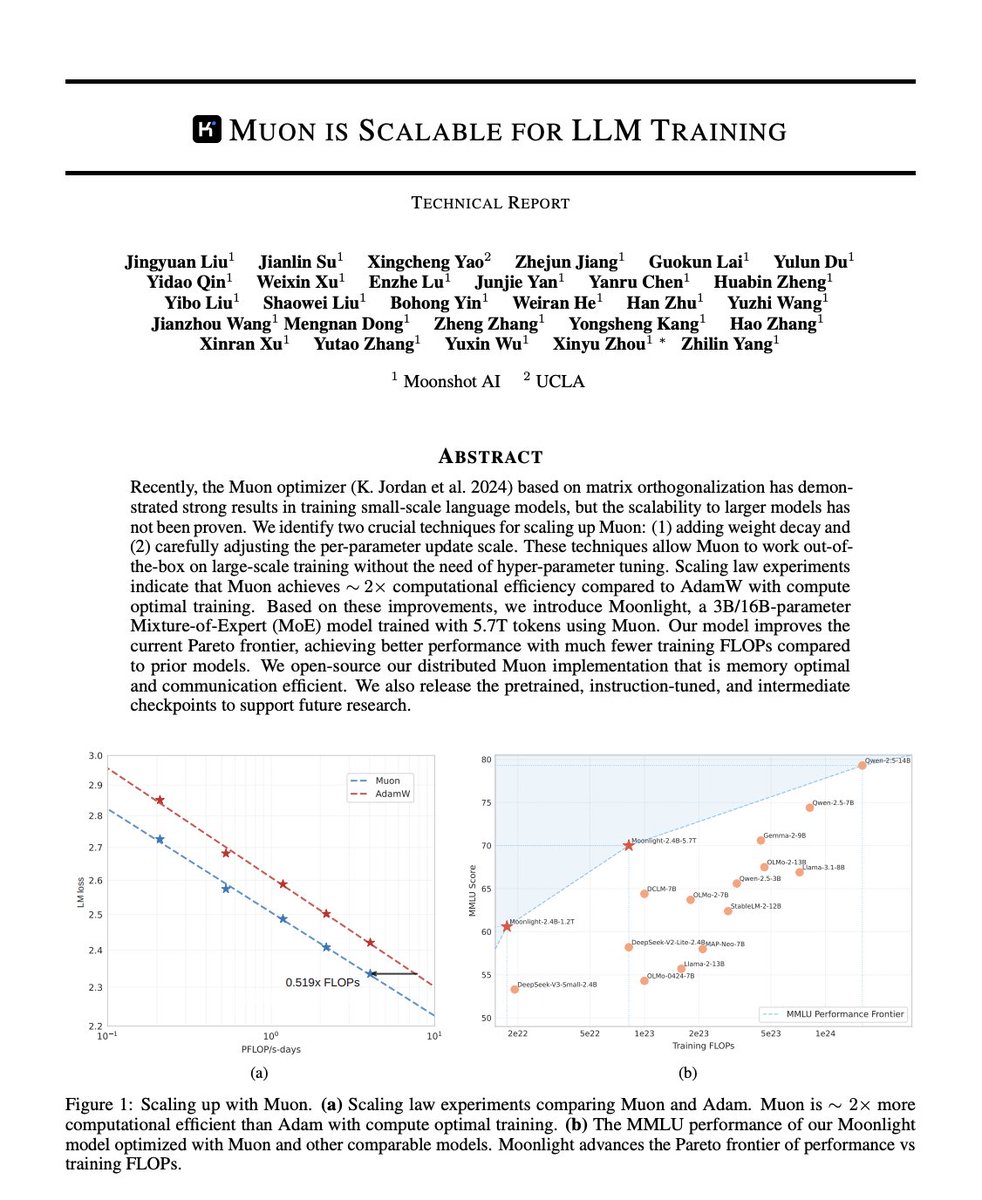
Kimi open-sourced a optimizer that trains LLMs with only 52% of the FLOPs AdamW needs.
For years, the entire AI industry has relied on one algorithm to train models: AdamW.
It is the default engine of the AI boom. OpenAI, Meta, Google, they all use it.
But Kimi exposed a massive inefficiency in how we build AI.
They built a new optimizer that trains Large Language Models using only 52% of the FLOPs that AdamW requires.
They are getting the exact same intelligence. For half the computational cost.
In an industry where compute is the ultimate currency, this is an earthquake.
GPU clusters that cost hundreds of millions of dollars effectively just doubled in capacity overnight. Training runs that took months will now take weeks.
The biggest moat in AI hasn't been data or talent. It has been the sheer, punishing cost of training.
Kimi just took a sledgehammer to that moat. And they made the blueprint free for everyone.
The bottleneck to scaling AI isn't silicon anymore. It's software.
Introducing Higgsfield API.
50+ frontier models in one API, at lower prices than a subscription.
> Get up to 50% OFF discount on your 3 favorite models
> Lock in your max-discount within 7 days
> Pay per use with no commitment
Build your own Higgsfield with the best prices in GenAI industry.
Available at https://t.co/Ow8CcuTQ1s
@rshanreddy this looks sick.
AI guidance instead of AI doing the homework is the part that actually matters.
I wish this software had existed when I was a kid.
America is banning AI in schools.
China is using AI to create geniuses.
Introducing Aristotle: The AI tutor that solves America’s broken education system. https://t.co/hqPJN8cke0
Researchers built a brain implant that runs without a single wire or battery.
Putting a computer in your head means putting a battery in your skull.
Batteries degrade. They generate heat. They eventually require a second open-brain surgery just to replace them.
This new paper just bypassed the entire problem.
They designed a neural device that powers itself entirely wirelessly. No internal power source. No charging ports. No lithium sitting next to your cortex.
It harvests power continuously from the outside.
It can just sit there. Silently reading and transmitting neural data. Indefinitely.
The medical benefits for restoring movement and speech are staggering.
But the commercial reality changes everything.
If you eliminate the battery, you eliminate the biggest long-term risk of the hardware. Brain implants just went from a highly experimental, temporary medical commitment to a permanent, zero-maintenance upgrade.
The biggest barrier to mass-market brain-computer interfaces wasn't the software.
It was the battery.
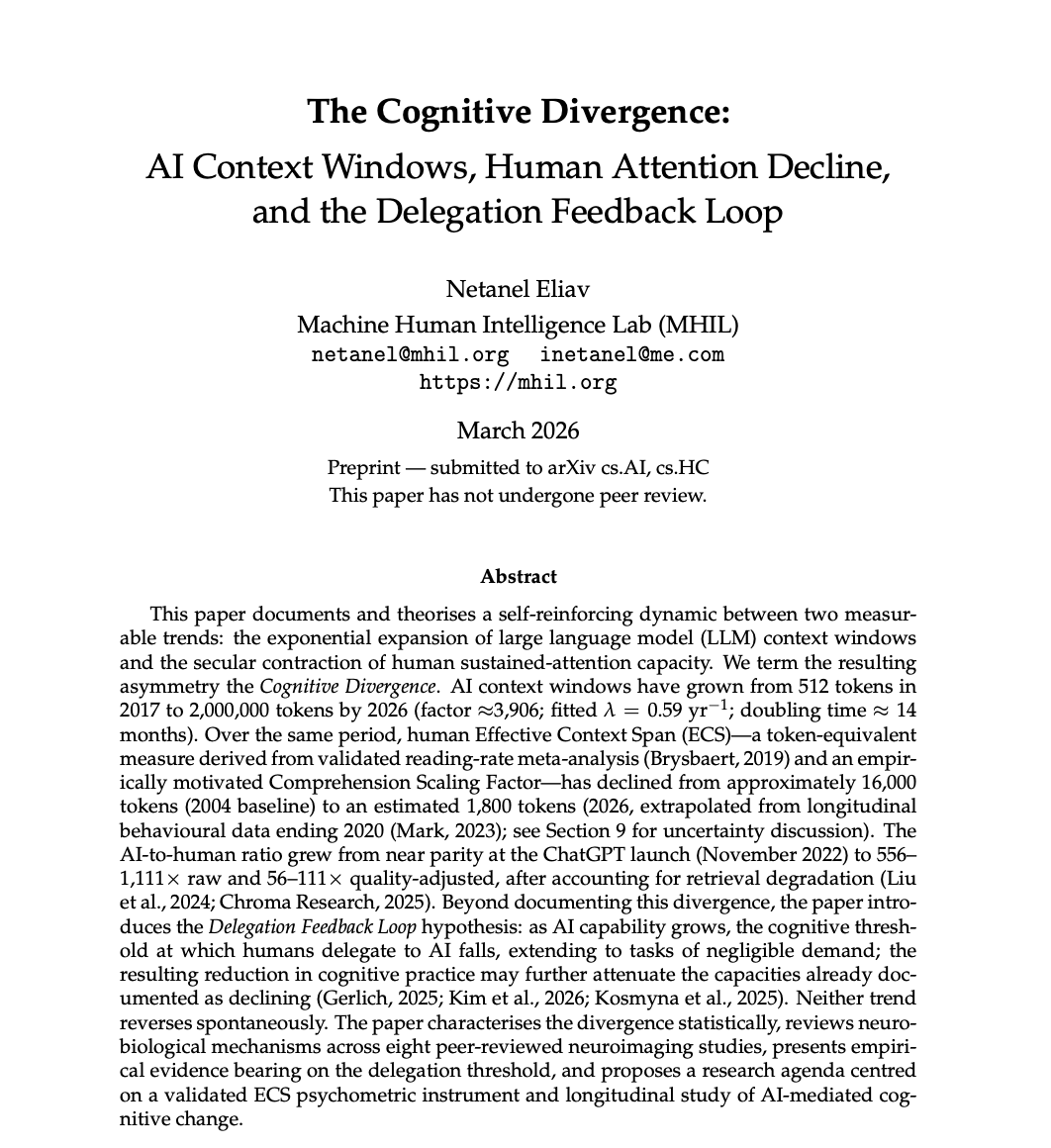
Stanford proved AI context windows grew 3,906x since 2017 while human attention shrunk in the exact same window.
They call it "The Cognitive Divergence."
Their paper outlines something called the "Delegation Feedback Loop".
As AI gets better at holding massive amounts of information, the threshold for what we delegate drops.
We stop reading long documents. We stop synthesizing data. We stop holding complex arguments in our heads.
But human cognition works like a muscle.
When you stop practicing sustained attention, your actual capacity to do it shrinks.
The paper quantified it. They measured our "Effective Context Span".
In 2004, the average person could hold roughly 16,000 tokens of information in their working memory.
Today, that number has plummeted to just 1,800.
Meanwhile, AI jumped from 512 tokens to 2,000,000.
Every time you ask an AI to summarize a long document, you aren't just saving time.
You are actively conditioning your brain to hold less information.
The AI gets better. You get worse. So you rely on the AI even more.
The loop tightens.
We are building an ecosystem where machines have infinite focus.
And humans can't even finish reading a single page
Researchers built a brain implant that runs without a single wire or battery.
Putting a computer in your head means putting a battery in your skull.
Batteries degrade. They generate heat. They eventually require a second open-brain surgery just to replace them.
This new paper just bypassed the entire problem.
They designed a neural device that powers itself entirely wirelessly. No internal power source. No charging ports. No lithium sitting next to your cortex.
It harvests power continuously from the outside.
It can just sit there. Silently reading and transmitting neural data. Indefinitely.
The medical benefits for restoring movement and speech are staggering.
But the commercial reality changes everything.
If you eliminate the battery, you eliminate the biggest long-term risk of the hardware. Brain implants just went from a highly experimental, temporary medical commitment to a permanent, zero-maintenance upgrade.
The biggest barrier to mass-market brain-computer interfaces wasn't the software.
It was the battery.
Stanford proved AI context windows grew 3,906x since 2017 while human attention shrunk in the exact same window.
They call it "The Cognitive Divergence."
Their paper outlines something called the "Delegation Feedback Loop".
As AI gets better at holding massive amounts of information, the threshold for what we delegate drops.
We stop reading long documents. We stop synthesizing data. We stop holding complex arguments in our heads.
But human cognition works like a muscle.
When you stop practicing sustained attention, your actual capacity to do it shrinks.
The paper quantified it. They measured our "Effective Context Span".
In 2004, the average person could hold roughly 16,000 tokens of information in their working memory.
Today, that number has plummeted to just 1,800.
Meanwhile, AI jumped from 512 tokens to 2,000,000.
Every time you ask an AI to summarize a long document, you aren't just saving time.
You are actively conditioning your brain to hold less information.
The AI gets better. You get worse. So you rely on the AI even more.
The loop tightens.
We are building an ecosystem where machines have infinite focus.
And humans can't even finish reading a single page
Yann LeCun has changed the game for robotics.
His team discovered that AI world models are "thinking" in twisted, curved geometry, and every RL algorithm you know has been fighting against it without anyone noticing.
For years, we’ve been trying to teach AI how to navigate the physical world.
And for years, it has stubbornly struggled with complex, fluid robotics.
Now we know exactly why.
Every standard reinforcement learning (RL) algorithm assumes the AI's internal "world map" is flat. Euclidean. Simple straight lines.
But LeCun's team looked inside the latent space of these advanced world models.
The AI wasn't building a flat map. It was building a curved, high-dimensional geometry.
Every time a robot tried to plan a movement, the traditional RL algorithm was forcing a straight line onto a twisted, non-Euclidean space.
It’s like trying to navigate the globe using a flat piece of paper.
The math breaks down. The distances get distorted. The AI gets confused.
The robot was literally fighting its own brain.
So, the researchers did something brilliant. They stopped fighting.
They rewrote the RL algorithms to operate natively in this curved geometry. They aligned the training to the exact shape of the AI's thoughts.
The results are a massive leap forward.
When you let the AI plan in the geometry it actually built for itself, training efficiency skyrockets. Planning becomes fluid.
Robots stop hallucinating impossible physics and start moving with natural, intuitive logic.
We spent billions of dollars trying to brute-force AI into understanding our physical world.
It turns out, the AI already understood it perfectly.
We were just forcing it to think flat.
Yann LeCun has changed the game for robotics.
His team discovered that AI world models are "thinking" in twisted, curved geometry, and every RL algorithm you know has been fighting against it without anyone noticing.
For years, we’ve been trying to teach AI how to navigate the physical world.
And for years, it has stubbornly struggled with complex, fluid robotics.
Now we know exactly why.
Every standard reinforcement learning (RL) algorithm assumes the AI's internal "world map" is flat. Euclidean. Simple straight lines.
But LeCun's team looked inside the latent space of these advanced world models.
The AI wasn't building a flat map. It was building a curved, high-dimensional geometry.
Every time a robot tried to plan a movement, the traditional RL algorithm was forcing a straight line onto a twisted, non-Euclidean space.
It’s like trying to navigate the globe using a flat piece of paper.
The math breaks down. The distances get distorted. The AI gets confused.
The robot was literally fighting its own brain.
So, the researchers did something brilliant. They stopped fighting.
They rewrote the RL algorithms to operate natively in this curved geometry. They aligned the training to the exact shape of the AI's thoughts.
The results are a massive leap forward.
When you let the AI plan in the geometry it actually built for itself, training efficiency skyrockets. Planning becomes fluid.
Robots stop hallucinating impossible physics and start moving with natural, intuitive logic.
We spent billions of dollars trying to brute-force AI into understanding our physical world.
It turns out, the AI already understood it perfectly.
We were just forcing it to think flat.