Simple Earn: Flexible or Locked?
Not every crypto strategy needs to be complicated.
Sometimes, the biggest decision is simply what you want to do with the assets you already hold: keep them available or lock them away for a while?
That’s where Simple Earn gets interesting.
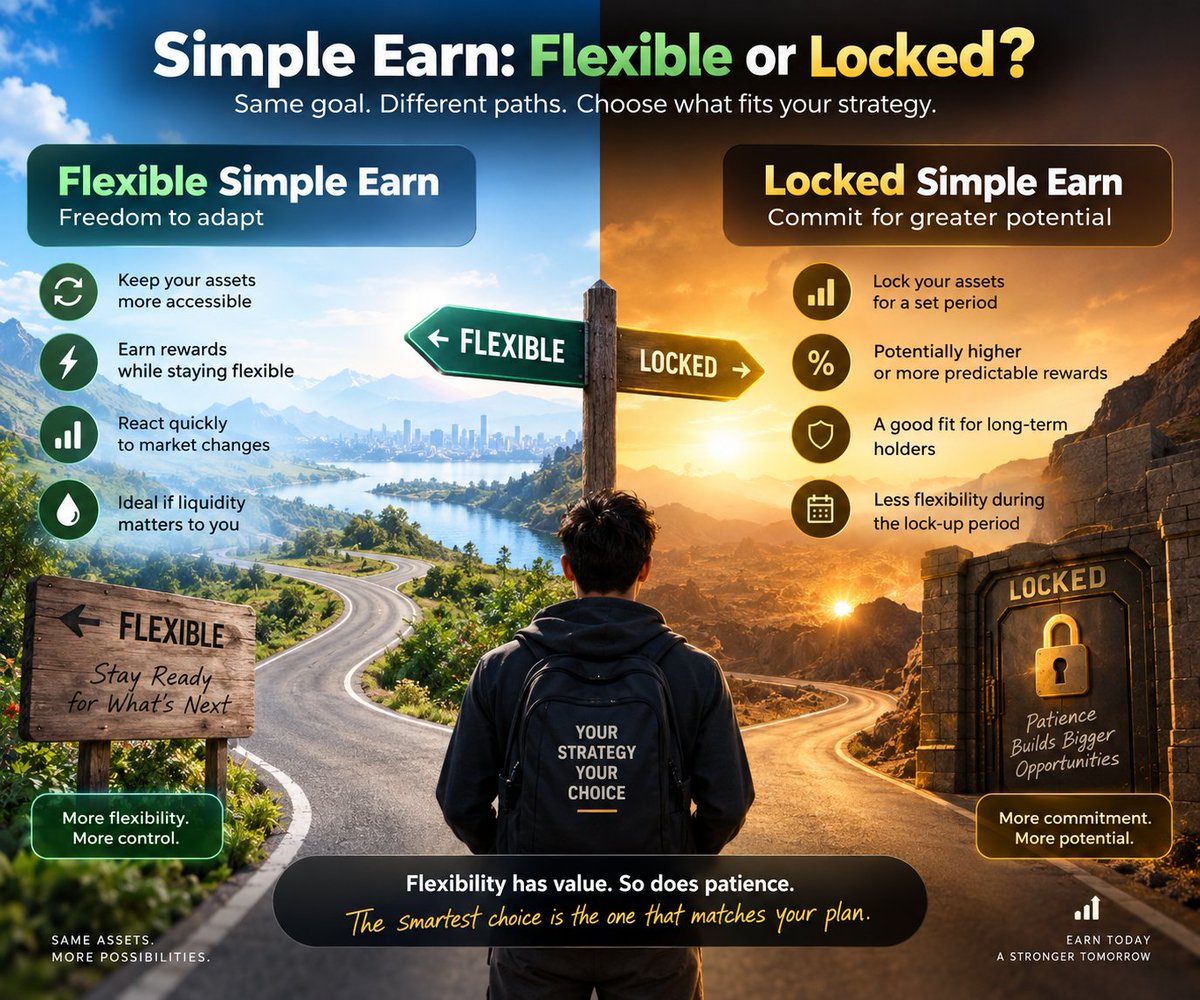
With Flexible, you’re choosing freedom. Your assets can continue earning rewards while giving you more flexibility to respond when the market changes. It’s the option that makes sense when liquidity matters and you don’t want to feel committed.
With Locked, you’re taking a more patient approach. You agree to keep your assets locked for a set period, potentially receiving a higher or more predictable reward in return.
Neither choice is automatically the “better” one.
If you like having access to your funds, Flexible may feel more natural.
If you’re holding for the longer term anyway and don’t mind committing your assets, Locked could be worth exploring.
The key is not chasing the biggest number on the screen. Look at the lock period, rewards, redemption conditions, and the risks involved before making a decision.
Flexibility has value. So does patience.https://t.co/50dwu8dIDU
The smartest choice is the one that matches your own plan—not someone else’s. 🔥
#Binance #BinanceAcademy
#LearnWithBinance
Binance Card: What Can You Actually Use Crypto For?
Crypto is becoming less about simply holding coins and more about finding ways to use them in real life.
That’s where the Binance Card gets interesting.
Instead of keeping crypto locked inside an exchange account, a crypto payment card can connect your digital assets to everyday spending. Depending on your location, eligibility, and the assets supported, you may be able to use it for things like shopping, dining, travel, online purchases, and subscriptions.
But there’s a catch.
“Pay with crypto” doesn’t necessarily mean a merchant is directly accepting Bitcoin or another cryptocurrency. The payment process can involve converting your crypto into a supported payment currency behind the scenes.
So the experience can feel like a normal card transaction, while the source of the funds is your crypto balance.
That creates an interesting bridge between two financial worlds.
For years, crypto adoption has been measured by prices, trading volume, wallets, and exchange users.
But perhaps a more meaningful question is much simpler:
Can people actually use their crypto when they buy something?
If crypto cards become easier to use, more widely available, and accepted across more everyday situations, the line between “crypto” and “money” could become increasingly difficult to see.
The technology may be complicated.
The goal is surprisingly simple:
Make digital assets useful beyond the chart.
Would you actually spend your crypto with a card—or would you rather keep it untouched as an investment?
#Binance #BinanceAcademy
#LearnWithBinance
Liquid Staking: ETH & SOL
Staking used to feel like putting your crypto in a box and waiting for it to come back.
Liquid staking changes that idea.
With ETH and SOL, you can stake your assets to help secure the network while receiving a liquid representation of your staked position. Instead of your capital simply sitting there, it can potentially remain useful across DeFi.
Think of it like this:
Your ETH/SOL works in the background, while its liquid representation keeps moving.
That opens the door to lending, liquidity pools, trading strategies, and other DeFi opportunities—without completely giving up the benefits of staking.
But liquid doesn't mean risk-free.
Smart-contract exploits, validator performance, liquidity issues, and the possibility of an LST trading below its underlying value are all risks worth understanding before chasing yield.
The interesting part is bigger than the yield itself.
Liquid staking is pushing crypto toward a world where network security, staking rewards, and DeFi liquidity can exist in the same financial system.
ETH and SOL are taking different paths, but the direction is fascinating:
Stake it. Keep it productive. Keep it liquid.https://t.co/50dwu8dIDU
That’s why liquid staking could become one of the most important building blocks of the next generation of DeFi. ⚡
#Binance #BinanceAcademy
#LearnWithBinance
The Moment Crypto Trading Starts to Make Sense
Your first crypto trade doesn’t have to feel like a leap into the unknown.
At first, the screen can look overwhelming—candlesticks moving up and down, numbers changing every second, and unfamiliar options like Market, Limit, and Convert.
But once you understand what each one actually does, the picture becomes much simpler.
Spot trading is essentially buying or selling cryptocurrency directly. You’re dealing with the asset itself rather than using leverage to speculate on a much larger position. That makes spot trading a useful starting point for learning how the crypto market behaves.
Then come the orders.
⚡ Market order: You prioritize execution. Your order attempts to fill at the best available prices at that moment. When crypto prices are moving quickly, the final execution price can vary.
🎯 Limit order: You prioritize your chosen price. You tell the market, “I’m willing to trade at this price,” and the order waits for suitable market conditions.
🔄 Convert: A simpler exchange experience where you can swap one supported asset for another without navigating the traditional spot trading screen.
The interesting part is that none of these tools can tell you where the market is going next.
That’s the lesson beginners often discover the hard way.
Crypto can move rapidly because sentiment, news, liquidity and market activity can change within minutes. A green chart doesn't guarantee another green candle. A sudden drop doesn't automatically mean a recovery is coming.
So instead of asking, “What should I buy?”
Start asking:
“Do I understand what I’m doing?”
Know the difference between buying an asset and trading a leveraged product. Understand how your chosen order works. Pay attention to fees and execution. Most importantly, never confuse a fast-moving market with an easy one.
The strongest first step in crypto trading isn't pressing the Buy button.https://t.co/3OUjurx0PY
It's knowing exactly what that button means.
#Binance #BinanceAcademy
#LearnWithBinance
The Smart Way to Move Crypto In and Out of an Exchange
Crypto transactions aren’t just about clicking Buy, Sell, Deposit, or Withdraw. The real skill is knowing what you’re doing before you confirm that final step.
With Binance P2P, the process can feel almost like a direct digital marketplace—one person buys, another sells, and the payment happens through an available method. But never let convenience replace caution. If you’re selling crypto, don’t release it because of a payment screenshot or a message saying “sent.” Open your payment account and verify the money yourself.
When making a crypto deposit, treat the wallet address and network like an exact destination. Check them carefully before sending. A familiar-looking address isn’t enough, and selecting the wrong network can create serious problems.
Withdrawals deserve the same attention. Before pressing confirm, check the recipient address, network, amount, and fees. Taking an extra minute to verify can save you from a mistake that may be impossible to reverse.
And remember: the payment options and available crypto services can differ depending on your region.
The best crypto habit isn’t moving faster.
https://t.co/Jhivu7X3vF
It’s knowing exactly where your money is going before you press confirm. 🔐⚡
#Binance #BinanceAcademy
#LearnWithBinance
Binance Account: Your First Step Into Crypto
Setting up a Binance Account doesn’t have to feel like a maze. For a beginner, the real goal isn’t simply creating an account—it’s understanding what happens at each stage and making sure everything is done correctly.
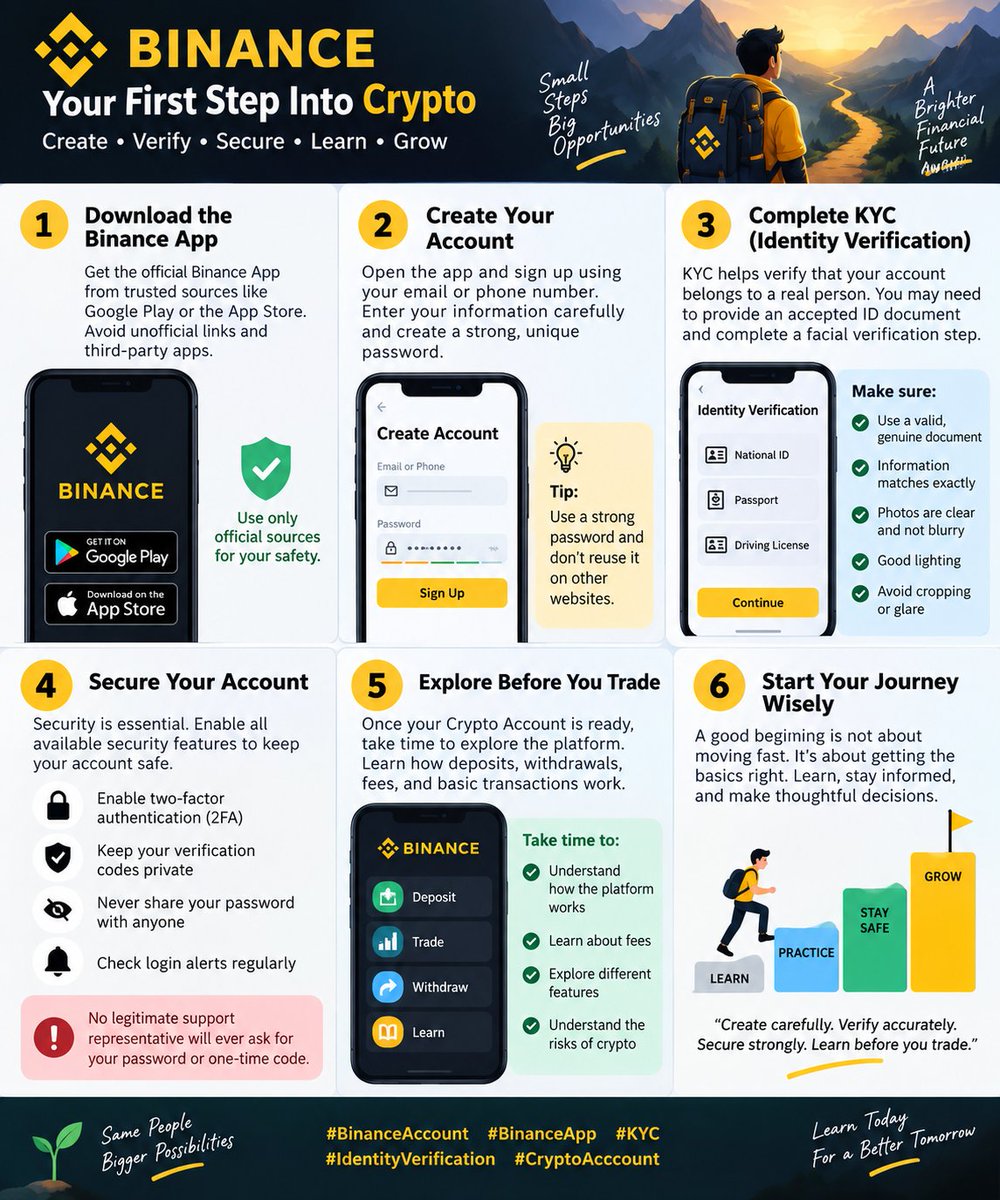
Start with the official Binance App, create your account, and take your time while entering your personal information. Accuracy matters, especially when you reach the KYC stage.
KYC (Identity Verification) is where the platform verifies your identity. You may need to provide an accepted identification document and complete additional verification steps. Use genuine, valid documents and make sure the information you provide matches them. Clear photos, good lighting, and avoiding cropped or blurry documents can help prevent unnecessary delays.
Then comes the part beginners sometimes overlook: security.
Use a strong password that you don’t reuse elsewhere. Turn on available two-factor authentication and keep your verification codes private. No legitimate support representative should need your password or one-time security code.
Most importantly, don’t rush into trading just because your Crypto Account is ready. Explore the platform first. Learn how deposits, withdrawals, fees, and basic crypto transactions work. Cryptocurrency involves real financial risk, so understanding what you’re doing is far more valuable than simply getting started quickly.
A good beginning is not about moving fast. It’s about getting the basics right.
https://t.co/8p9teqNLhB
Create carefully. Verify accurately. Secure strongly. Learn before you trade.
#Binance #BinanceAcademy
#LearnWithBinance
1/
TermMax is launching a Booster program on @BinanceWallet.
Complete five tasks or post on Binance Square to share 2,000,000 $TMX.
Aug 17 07:00 UTC to Aug 24 23:59 UTC
Your First Salary: What Do You Actually Do With It?
That first salary feeling is different.
You open your banking app, see the money sitting there, and for a few seconds you feel unstoppable. Then reality taps you on the shoulder: bills, family, savings, plans, wants, emergencies… suddenly “adulting” feels very real.
Before spending everything or jumping into investments because everyone online seems to be doing something, take a breath.
Your first salary is a chance to understand your money.
Where is it going?
How much do you need for essentials?
Can you keep something aside for emergencies?
What are you saving for?
And if you ever think about investing, do you actually understand the risks?
Saving and investing are not the same. A budget is not boring. An emergency fund is not “extra.” And risk is not something to ignore just because a trend looks exciting.
If crypto is something you’re curious about, start with learning first. Binance Academy can help you explore concepts like Bitcoin, blockchain, market risk, diversification, and DYOR in a simple educational way.
Your first salary should not disappear without a plan. Let it teach you how to earn, manage, save, learn, and make informed choices.
Educational only, not financial advice.
#Binance #BinanceAcademy #LearnWithBinance