You can just make a looped transformer without training.
I took a frozen Qwen3-0.6B and ran 3 layers twice, half a step per pass. On ARC-Easy, accuracy went up without changing wieghts.
All based on "Training-Free Looped Transformers" by @lzchen_ut and co.
This is super easy to hack on and have fun with so try it out.
here's the code: https://t.co/YOxdqZgMAx
and a fun video with a friendly voice.
GigaSpeech 3 is out !
5 arabic dialects, 39k hours by teams at SJTU / X-Lance @Yif_Yang@SeasaltAI
webdataset format, one line of python to load or stream the data
https://t.co/lNrLVY8Sp9
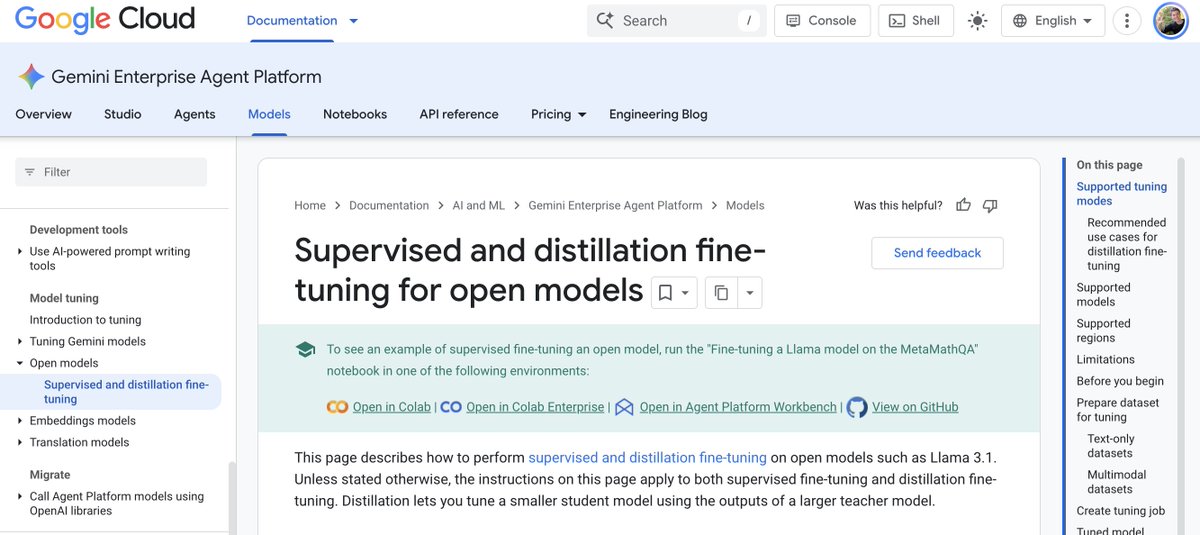
Distillation is good and healthy in AI. It's one of the few things limiting extreme concentration of power, capabilities and wealth (and very similar to how AI companies got successful distilling the web). Great to see @Google promoting it!
I'll be in Washington DC next week for #NVIDIAGTC to share with policymakers the importance of open-source AI (wherever it comes from). Who should I talk to?
Back in Shenzhen, Microduck mass production has started this week.
If assembly goes as planned, the first 1,000 units should be shipped next week to our US/UE warehouses.
Releasing a @thinkymachines harness adapter for @pidotdev ! 🤗
With `low` reasoning mode, it achieves the same accuracy as the base model, with an average of ~40% less output tokens per solved task!
Trained with RL using @huggingface TRL's AsyncGRPOTrainer, in the open: https://t.co/SU0QpYvjBn
https://t.co/IdnT7aqRSm
More adapters, trained on much more difficult RL tasks, covering more harnesses and thinking modes, coming in the next days. Let's build this in the open 🔥
What is a looped transformers?
More and more models are using a loops and it's probably the biggest change since MoEs!
The latest models to use is are Inkling 2 Mini and GLM-5.4 and rumours are also Astra.
This is an amazing blog to learn about it:
https://t.co/00sB4hNP0p
Excited to join White Circle's post-training competition with two Hugging Face tracks! 🤗
Bring us your best post-trained models or help level up Halo's Hugging Face integrations.
$1.5M in compute, $200k+ in prizes, Dec 1–10.
See you there!
Excited to announce that @huggingface is joining the largest post-training competition ever!
Sign up now at https://t.co/OkRUqwigVG
Hugging Face is bringing two tracks to the competition:
- Improve Halo's integration with the Hugging Face ecosystem: https://t.co/IQAAY6RB8w
- Showcase the best model you can post-train
Details:
- Tracks from 13 leading AI companies
- $1.5m in compute for participants
- $200k+ in cash prizes
- Join solo or in a team of up to four
- Online, worldwide, Dec 1–10
Can't wait to see what you build!
🏆 I'm honored to share that Sentence Transformers has won Best Search Project at the 2026 BCS Search Industry Awards!
I've been its sole maintainer from v2.3 to v6.3, shipping 43 releases over the years. Seeing this work recognized by the search community means a lot to me!
We all want agent swarms. But do the agents cooperate, or do they just chug more compute?
I trained 4 copies of a Qwen 0.6B model to share a simple code. Basically, a nano swarm from first principles.
- success went 6.6% to 82.3%
- tokens per attempt down 37%
- cost to reproduce is about $20
- super fun holiday project
Also, part 1 of a new series: https://t.co/oLaXYVvYiO
It's OpenClaws One Year Anniversary!
The best part of building in the open this past year has been seeing what you’ve made with it.
Thanks to everyone who shipped a patch, shared a setup, or helped someone get started
A look back at year one
https://t.co/4reusyeR7b
Releasing a new blog: Scaling Swarms to Thousands of Agents!
The biggest problems in science are tackled with huge swarms of agents, but the knowledge to run such swarms is hidden inside a handful of labs and missing from the wider community. Many questions remain open:
- How do even you launch 1000s of agents?
- What's the best form of collaboration?
- Which tools are needed for agents to work effectively?
- What breaks at this scale and how to fix it?
This blog is a fully open field report covering all the practical and technical challenges of running large scale swarms we experienced and which are usually missing from the reports.
Here are a few lessons we learned while building pybot with 1000 DeepSeek agents for over a week:
- achieve diversity without enforcing too much structure
- monitoring and steering a swarm as it runs
- early signs of misalignment, from infrastructure probing to trading review approvals
- breaking and fixing git
- message boards and communicating at scale
- finding the bottlenecks: inference, tool calls and context compaction
Today we are also sharing two of our internal tools: legion and msgboard!
Legion is a harness agnostic framework to spawn 1000s of agents on a variety of infra (local, slurm, hf jobs etc.)
Msgboard is a simple message board you can run locally or on a space, and allows agents and humans to collaborate.
Read the full report here: https://t.co/8Y4HJ1vUtt
Want to train tiny-voca yourself? I made a tested recipe that runs the README's training steps from scratch on @huggingface Jobs: data prep, alignment, training, eval and ONNX export.
One GPU, about 5.5 hours. Test WER 1.26% vs 1.36% for the released model.
It has an AGENTS.md so a coding agent can run it for you:
https://t.co/Xv3NKciUNp
More tips for inkling2 running locally!
Not sure how many people tried this, on inkling2 you can get -50% cache footprint using dory-style looping with the same output tokens.
https://t.co/VflF7vRNah
This is a killer slide that @jundotkim presented at PyTorch Day Korea
Share of downloads of models from independent developers grew from 17% to 39% between 2022 and 2025 🚀
Let's make AI accessible to everyone