Elasticities. Recently, a non-economist friend told me that he would happily sacrifice x amount of his yearly salary for y more hours of leisure. Perfectly unprompted. It was beautiful.
Results from my Claude Code audit of six Callaway and Sant'Anna packages (two in python, two in R, two in Stata). Same specification, same dataset, same covariates, same estimator, almost never do they agree.
https://t.co/KpRwlAagbr
I’m excited to share American Stories, a new billion-scale dataset of structured texts/layouts from public domain newspapers (1780-1960) that we’ve built using our deep learning packages. #EconTwitter (1/13)
Paper: https://t.co/15nQ1gZ9E5
Dataset: https://t.co/LhCtd9XsXZ
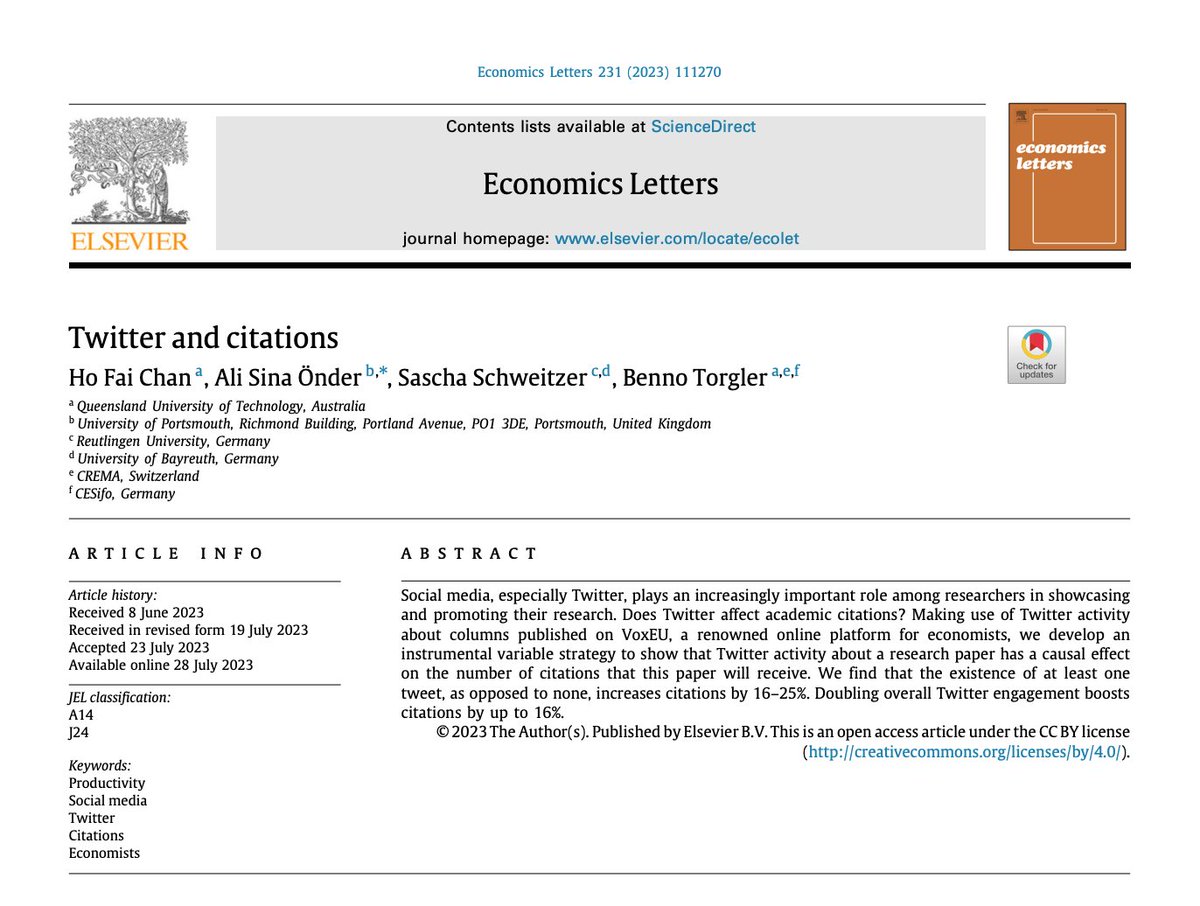
Our article demonstrates that you can indeed boost the impact of your publications by sharing and promoting your research on Twitter. https://t.co/bBT12Tbh4q (Open Access).
Note: This might generalize to X and social media more broadly.
What the hell is an ampersand and why does it look like that?!
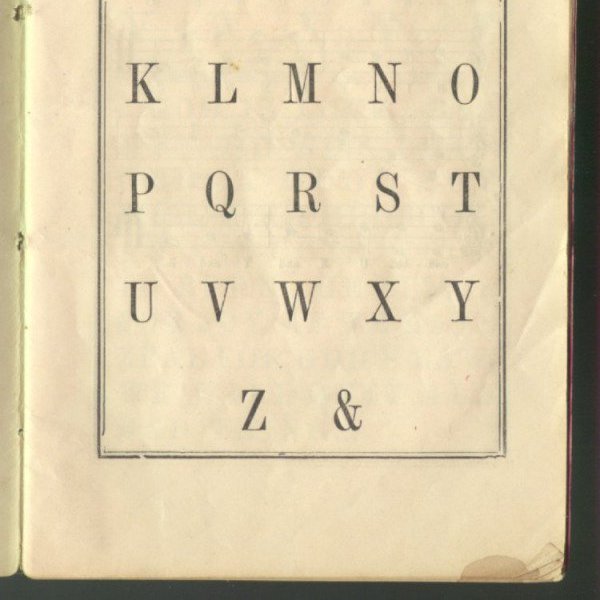
The first thing you need to know is that "&" used to be the 27th letter of the alphabet...
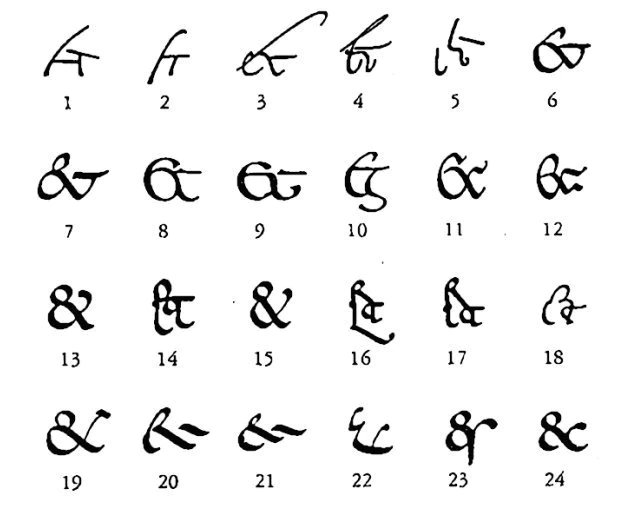
But there are three parts to this story. And the first begins over two thousand years ago in Ancient Rome with a single word: et. It's the Latin for "and". At some point Roman scribes started combining the two letters of et into a single symbol, which was the ancestor of our modern &.
The earliest example of the "et" symbol is actually from graffiti in Pompeii. In any case, it did not disappear with the fall of the Roman Empire.
Latin survived as the language of the Catholic Church and of scholarship in Medieval Europe. Scribes during the Dark Ages continued to use the & symbol. It evolved down the centuries, in places losing any semblance of the letters e and t whatsoever.
The second part of the story is that during the 18th and 19th centuries, as education and the teaching of literacy spread, & was added to the end of the alphabet as a sort of 27th letter.
On a related note, although "et cetera" is now usually just abbreviated as etc., for a long time it was instead abbreviated as "&c". The & was for et and the c for cetera.
The third and final part of the story is about how the alphabet was taught to children �� and how it was read out loud.
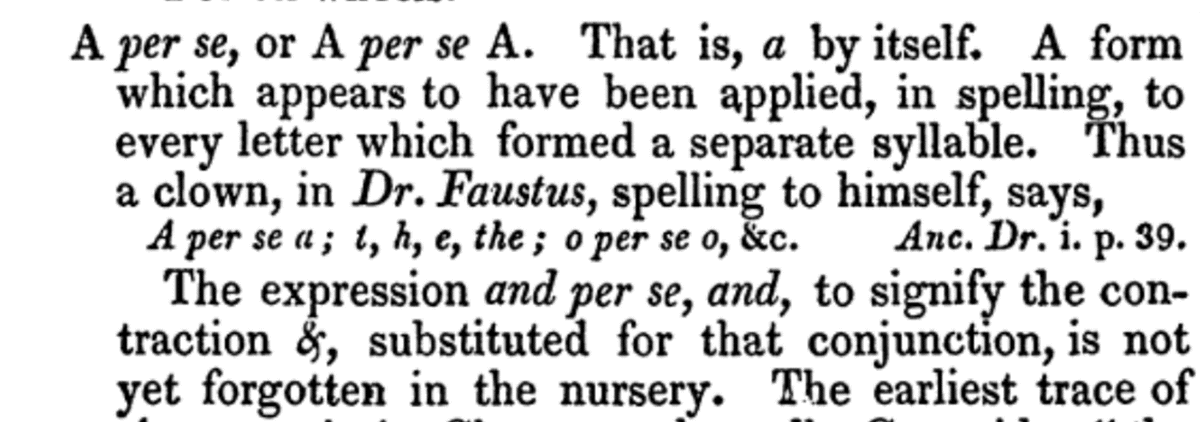
As this 1822 Glossary of Words and Phrases explains, it had been normal during the Renaissance, when speaking the alphabet, to add "per se" before any letter which could also be a word on its own — "per se" means "by itself" in Latin.
Take the letter A, which can also be a word of its own. When reading out the alphabet people would say "A, per se A, B, C, D, E, F, G, H, I, per se I..." and so on. O was also considered a word of its own.
Which means, when people got to the end of the alphabet, with & being the 27th letter, they would say: "S, T, U, V, W, X, Y, Z, and per se &."
When this old way of reading the alphabet was taught to children in the 18th century and they were reciting it aloud, they would garble "and per se " into what eventually became... ampersand.
A Dictionary of Slang and Colloquial English from 1905 relates some of the many other pronunciations school children apparently came up with:
"Ampersand. The sign &; ampersand. Variants: Ann Passy Ann; anpasty; andpassy; anparse; apersie; per-se; ampassy; am-passy-ana; ampene-and; ampus-and; ampsyand; ampazad; amsiam; ampus-end; apperse-and; empersiand; amperzed; and zumzy-zan."
Well, of all the many pronunciations that might have stuck, it was "ampersand" which came to be accepted and is now the official name for &... rather than zumzy-zan. So, from hurried Roman scribes to unruly school children, that's where "&" came from.
This combines 2 things that tick me off: not checking data & not knowing The Simpsons
2023: Nuclear technician salary in IL: $93,210
4 bedroom house in Springfield IL: $220,000
Burns illegally put him in a job req. a nuclear phys degree so he went to college in season 5 ep. 3
In a great (& destructive) irony, Mechanical Turk is just AI, now.
The MTurk crowdworking platform is a major place for researchers (and companies) to get humans to do small tasks & experiments. But this paper finds 33-46% of Turkers use LLMs to do tasks. https://t.co/MMO15yYMgj
Why read a self-help book published in 2023 when you could read one that was a best seller for 1,500 years?
This is the Consolation of Philosophy, written by a man called Boethius while he was in prison, awaiting execution, in 523 AD.
Here are its 8 most powerful ideas:
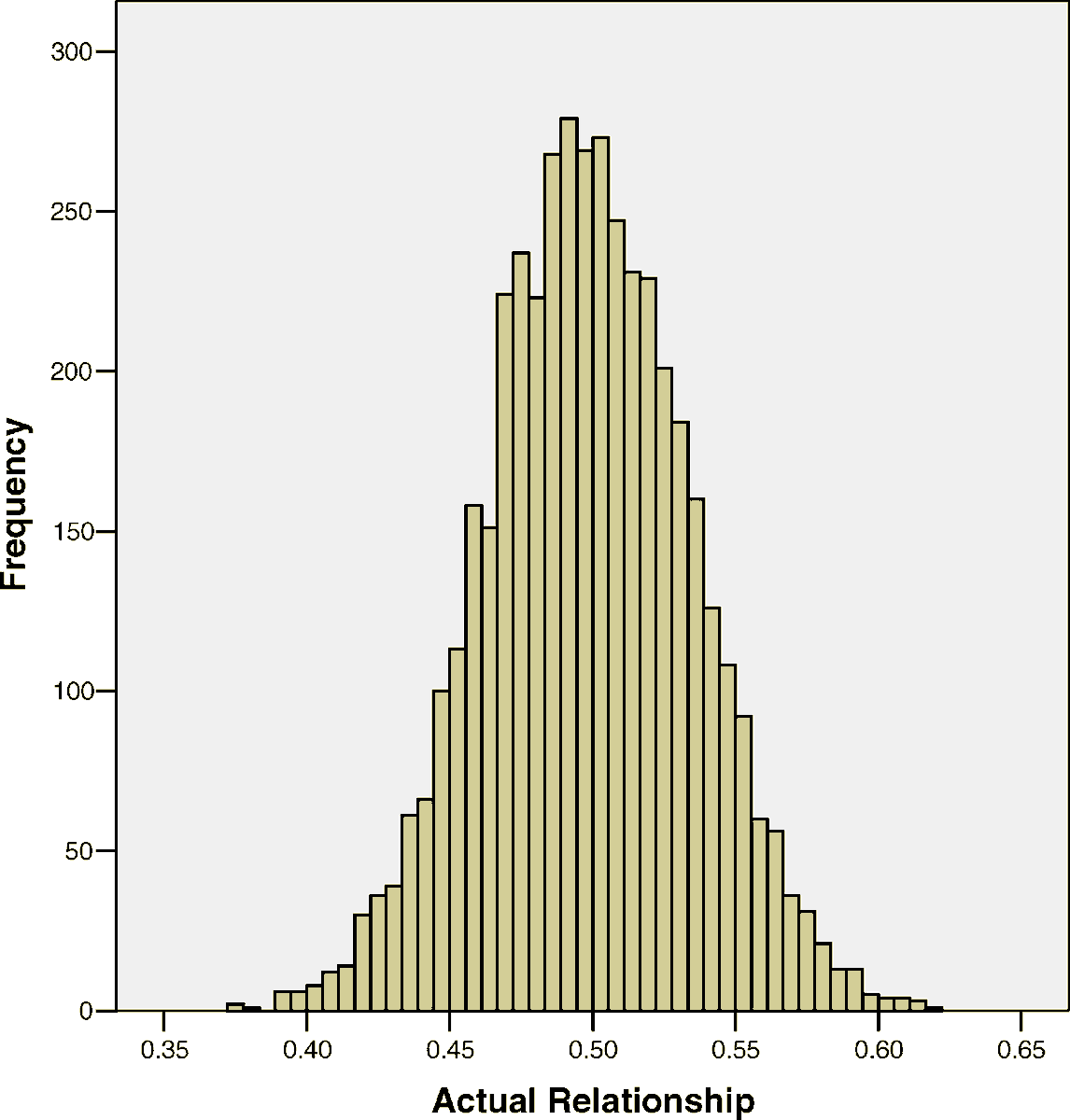
You often hear that full siblings "share 50% of their DNA."
But did you know this is actually the median and the range is pretty wide, roughly between 40–60%? https://t.co/KLeu4KnwgP
https://t.co/sna006rqR9
Hay una anécdota famosa en la cual el economista Milton Friedman fue a ver un proyecto de infraestructura en China. Cuando vio que trabajadores chinos empleaban palas para construir un canal en lugar de excavadoras, le preguntó a un funcionario la razón. El funcionario le respondió “Las palas crean más trabajo”. Milton, que era bastante ágil para detectar tonterías, le respondió: “¿Por qué mejor no usar cucharas en lugar de palas?”.
Muchas medidas económicas se juzgan no con base en su potencial para crear riqueza –es decir, más bienes y servicios que valoremos–, sino con base en el número de empleos que son capaces de crear.
Este es un vicio del pensamiento. Para los economistas, el trabajo es un medio y no un fin. Los seres humanos trabajamos para procurarnos de bienes y servicios. No trabajamos para trabajar.
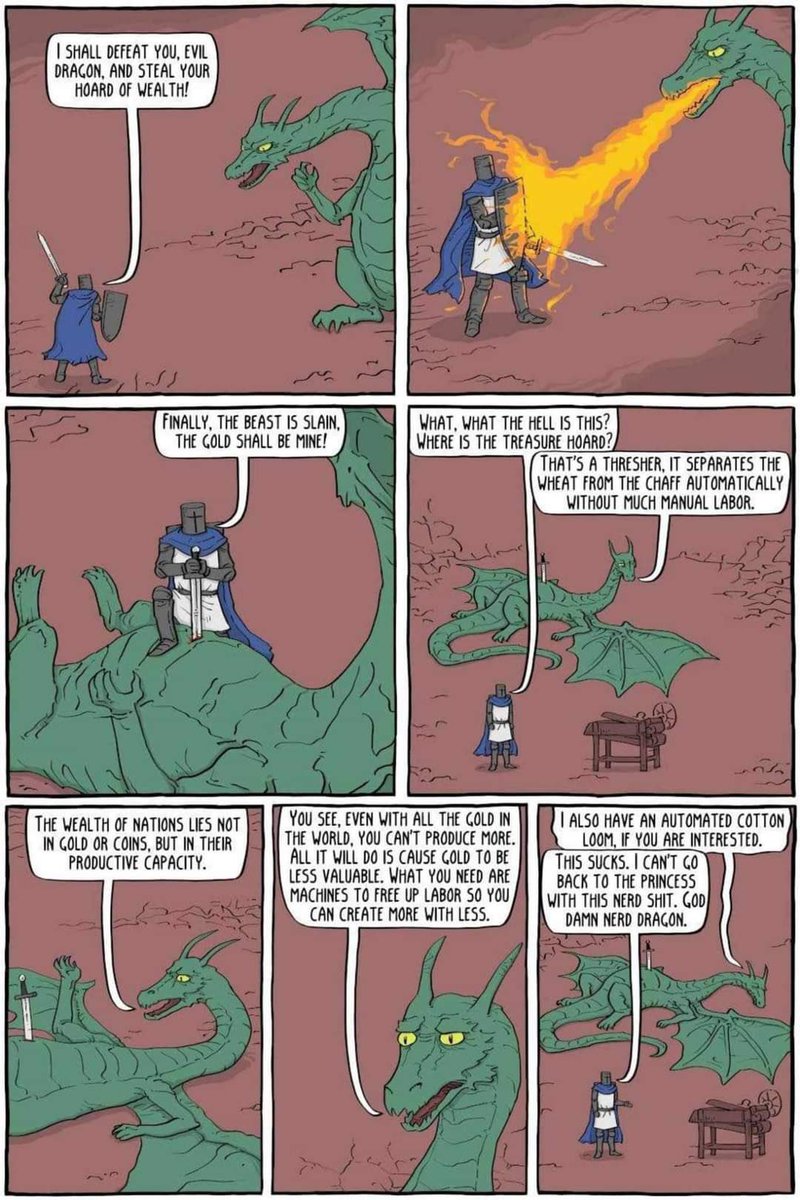
Este sesgo está detrás del miedo a los cambios tecnológicos ahorradores de trabajo. Y este sesgo, a su vez, está alimentado por una falacia: la falacia de la escasez del trabajo.
La falacia de la escasez del trabajo consiste en suponer que sólo hay un limitado número de trabajos por hacer. Entonces toda innovación o cambio tecnológico que ahorre trabajo dejará desempleadas por siempre a personas que otrora tenían una ocupación.
Lo cierto es que el trabajo no es escaso. Mientras haya fines insatisfechos, habrá oportunidades de empleo. El problema de un sistema económico es priorizar qué fines satisfacer y qué fines dejar insatisfechos, dado que nuestros recursos son escasos. Cuando los tractores reemplazaron a los asnos, bueyes y mulas y redujeron la mano de obra empleada en la agricultura, los trabajadores desplazados no se quedaron desempleados. Al contrario, su mano de obra quedó libre para la satisfacción de nuevos fines en donde su empleo era más valioso.
Cuando se introduce una nueva tecnología, siguiendo a Alchian y Allen (1983), ocurren tres tipos de efectos:
i. La nueva tecnología vuelve más productivas a ciertas personas, por lo cual pueden recibir salarios más altos. Como con la nueva tecnología, baja el precio de algunos bienes, se benefician al doble: reciben salarios más altos y pagan un precio menor por mejores productos.
ii. Algunas personas no reciben incrementos salariales a causa de la nueva tecnología, pues no se emplean en ocupaciones cuya productividad aumente en consecuencia. Pero se benefician de los menores precios que la nueva tecnología hace posible.
iii. Algunas personas son desplazadas de sus puestos de trabajo por culpa de la nueva tecnología y se transfieren a otros empleos. Estas personas entran, asimismo, en dos subcategorías: a) algunas ganan, en el neto, como consecuencia de los menores precios que las nuevas tecnologías hacen posibles y b) algunas pierden, aún después de contabilizar los beneficios de mejores productos a menores precios.
Discernir estos tres efectos nos ayudaría a mejorar considerablemente la oposición férrea al progreso de tecnologías ahorradoras de trabajo.