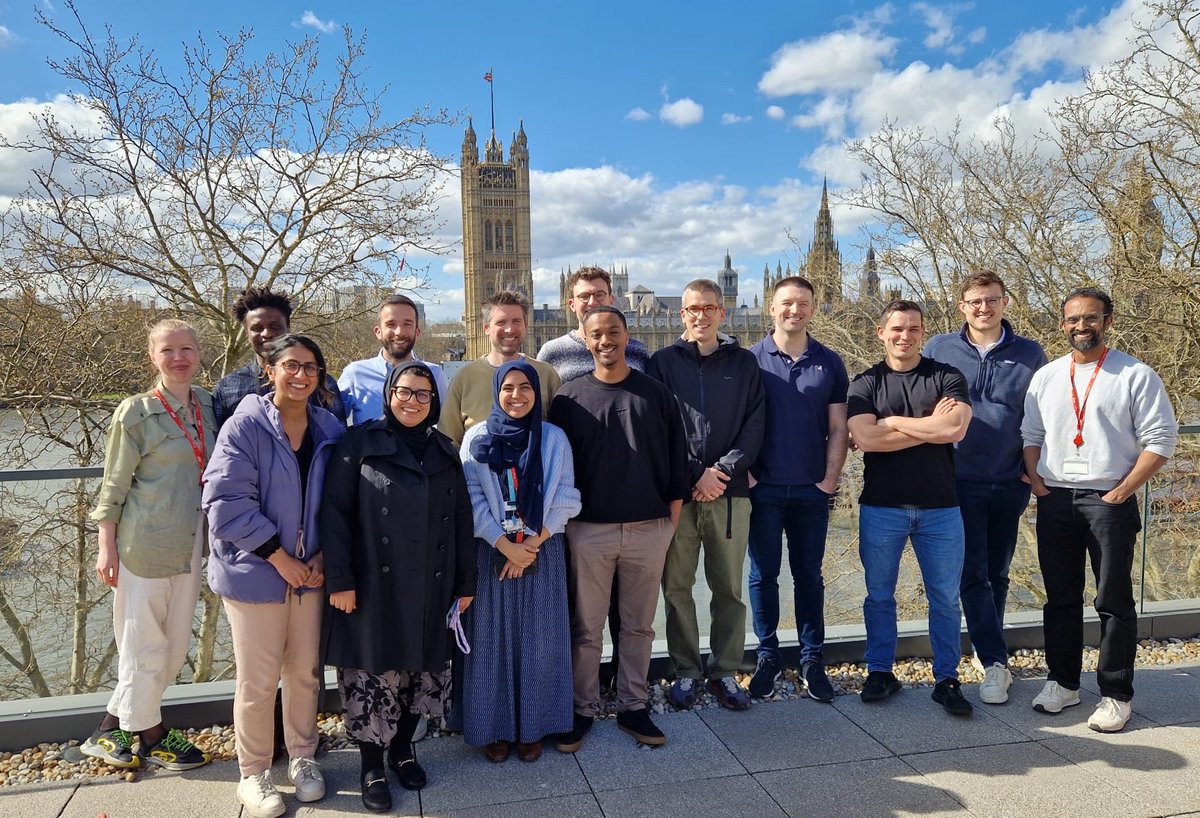
Really pleased to see our publication in @Nature, the @IDEALCollab framework for #surgicalrobotics evaluation. A mammoth effort from an international expert consortium. We consider device, clinician, system, and patient perspectives across IDEAL stages of robotics development
Surgical robotics are amongst the most complex devices entering healthcare - but how should we evaluate them? Published in Nature Medicine the IDEAL Robotics Colloquium outlines the latest guidance to aid researchers evaluating surgical robots: https://t.co/fK5KXY4PD2 (1/9)
told @Forbes londonmaxxing is the only way to go
the meme is spreading, how all good trends start
last week alone:
• the bull case for londonmaxxing doing the rounds curtesy of @GRITCULT
• @SuperteamUK mapping the whole maxxing movement with multiple posts
• @lou3ee playing visual shakespeare on @EFetheverywhere
easy to dismiss this as CT hype, but the interesting part is what’s been happening quietly underneath:
• FCA actually engaging with builders & sanboxxxxin'
• House of Lords stablecoin enquiry last week
• Multiple operators obtaining licenses (finally!)
serious conversations around stablecoins and onchain finance happening in the UK
none of this happens overnight
increasingly founders & vc's clustering again (slow but steady)
importantly best-in-class programmes running places here, there any everywhere;
- @base batches
- @encodeclub multiple hub
- @SuperteamUK somerset house
- @fabric_vc residency
remember ecosystems usually look obvious in hindsight
finally
waiting patiently for the mondao comeback arc v3 (@Timccopeland)
In npj Digital Medicine (2025), Ive, Olukoya et al. present an AI tool that uses NLP to flag patients at risk of unplanned ICU admission after elective neurosurgery. https://t.co/e8GqLNGamU
Key takeaways 🧵:
1/ Big News in #PituitarySurgery research!📣
The PitCOP study has recently published the 22 core outcomes for pituitary adenoma surgery research!
These were established through an international Delphi consensus study to guide the future of pituitary adenoma surgery research! 🧠
This week's video features Mr Hugo Layard Horsfall @hugo_lh, discussing his work on brain-computer interface technologies, and the specific challenges of working in this enormously novel and exciting area
#neurosurgery#neurotechnology#bci#neuropixel
My PhD project is out as a preprint!
We combined 2P and synchrotron X-ray to understand mouse olfactory bulb circuits, linking physiology to structure in 3 animals! https://t.co/ttULvIFh9o
🙌 @Trickymons, @APacureanu, @AndreasTSchafer, @esrfsynchrotron, @TheCrick
New preprint! We continue our exploration of paralinguistic features in the human brain with “Encoding of speech modes and loudness in ventral precentral gyrus” led by PhD student Aparna Srinivasan
🧵1/5
🚨 Delighted to announce our group's latest publication.
We developed an AI model to automatically recognise operative workflows in retrosigmoid vestibular schwannoma resections.
Here’s what we did and why it matters. 🧵
https://t.co/rUrjbGPXyM
We won Best Digital Marketing Agency of the year @TheDCW_X 🏆
Thank you @jamesbowater and to everyone involved, it was a brilliant event!
Back to the grind🫡
5 weeks to go! 19th-23rd May - Queen Square Neurosurgery Review Course! Registration: https://t.co/KkjRZVZd6B
A comprehensive and up to date review of neurosurgery. 5 days of didactic lectures & mock FRCS vivas, delivered in a hybrid format by expert national & international faculty. Aimed at neurosurgical trainees and fellows of all grades. Ideal for FRCS exam preparation.
The Royal College of Surgeons of England has awarded up to 34.5 CPD points for this event.
Thank you to all who joined us for the 9th London ImpaCT Meeting at @imperialcollege! Fantastic talks on neurotech & BCI by Prof Rylie Green, Dr Hayriye Cagnan, and Mr Aimun Jamjoom. Grateful for the insights and engaging discussion—exciting future ahead! More exciting events to come so get involved! 🧠 #Neurotech #BCI
Another great day in the mock OR for the third installment of KNL, focusing on the Far Lateral approach, with great weather welcoming our delegates from near and far! Next installment - the OZ...
A reminder of our ImpaCT meeting on wednesday at @imperialcollege !!! Not one to be missed - we have some fantastic speakers lined up. Free to sign up (see below!) 🚨 🧠
🚩What: The British Neurosurgical Research Group Meeting
🚩When: 8th-9th December 2025
🚩Where: The Royal College of Surgeons of England, London
Save the date, more details, including abstract submission deadlines will be announced very soon!
Contact: [email protected]@hani_marcus @roryjpiper @QSNeurosurgery
6/ To learn more about these important research priorities, read the full paper here and discover how they will guide the future of pituitary surgery.
https://t.co/OJuL9DOfZ0
1/ 🎉 Big announcement in #PituitarySurgery research!
The PitCop study has just announced the Top 10 Research Priorities for Pituitary Adenoma Surgery!
These were established through an international Delphi consensus to guide the future of pituitary surgery research! 🧠💡
🚨 Join us for the 9th London Impact Meeting at Imperial College London 🚨
📅 March 19, 2025 - 5pm
🎟️ Register: https://t.co/luhRWGaCmE
👥
Some fantastic talks lined up with some incredible speakers - not to be missed 🧠 #BCI#neurotech@imperialcollege
🚀 Calling all medical students interested in neurosurgical technology research!
Join our 6-month TeQ Group Internship Programme, where you'll be mentored to lead a project from idea to publication.
🗓 Deadline: 14th March
🔗 Apply now: https://t.co/t0uYdbaj9y
I'm convinced that FROs are the most consequential mechanisms for making progress in the neurotechnology space. The fact that Convergent are setting up this programme in the UK is SO exciting 🤯
Ya'll should:
1. Apply.
2. Tell the single most incredible person you know to apply.
What are patient preferences when it comes to motor BCI? This question is central to the translation and widespread adoption of BCI to potentially millions of people that may benefit from such devices.
https://t.co/BPd0qAlgDn
An ongoing question is how patient preferences differ across conditions and impairment severities, which highlights the importance of personalised BCI setups and tailored training regimens to meet individual needs.