HBES is an international society for scientists studying the evolution of human behavior 🌎🌍🌏 Journal: @EvolHumBehav 📖 Account managed by Yunsuh “Nike” Wee
How did belief in harmful magic come to be so widespread the world over? In their recent article, Planer and Sterelny argue that, ironically, the road to sorcery is paved with shamanistic intent.
https://t.co/uvPpe3eXwe
When people overestimate sexual interest, what has gone wrong? In a new article, Samara explain how expectations, cue discrimination, perceived error costs, and reporting can produce similar judgments, and how researchers can distinguish them.
https://t.co/bDtrEbKnmL
Possession is nine-tenths of the law – but maybe not for infants. Our new study finds that infants expect larger agents to win territorial conflicts, yet show no expectation or preference that whoever had something first will keep it. Prior possession – a cue both humans and non-human animals use to settle conflicts over resources – doesn't yet seem to guide infants' expectations or social preferences.
https://t.co/xDjJotT8m3
The MindCORE Research Fellowship at UPenn is now accepting applications!
🧠 Topic: Human intelligence & behavior
🗓️ Deadline: December 1, 2026
https://t.co/veelqcs6h3
#Postdoc#CognitiveScience
Young children put almost everything in their mouths, at a time when they’re especially vulnerable to infection. A new study mapping 39 germ-related behaviors from birth to age 10 finds key shifts around ages 2 and 4, and asks whether early exploration might be worth the risk.
https://t.co/FE9JGAflZx
Humans have long relied on cooperation to cope with unpredictability. A study in rural Bangladesh found that people in tightly connected moneylending networks were more willing to take risks, while those who could turn to more households for food and household items were less willing. These findings suggest that human decision-making under risk may have evolved to respond flexibly to the support available from others.
https://t.co/798U7ihKwL
New research on body attractiveness finds that “average” is not the whole story: while typical bodies do tend to be seen as attractive, judgments of typicality and attractiveness show different patterns. Typicality is more closely tied to how close a body is to the population average, whereas attractiveness depends on whether a body shows specific departures from the average, such as more pronounced curvature or muscularity. The pattern held across American and Chinese samples, for both naturally varying bodies and morphed caricatures.
https://t.co/uNUKmGq3Cb
Contrary to popular belief that they are muddled fantasists, children are naturalistic thinkers when left to their own devices. But they learn about supernatural possibilities, such as divine agency and the afterlife, from others in their family and immediate community.
https://t.co/MlzqpVAtVS
A study of 80,047 heterosexual adults in 92 countries found that greater openness to casual sex was associated with reporting fewer children within countries. The findings challenge its use as a simple marker of a “fast” life history strategy.
https://t.co/PvQFBh41m9
A long-standing debate in anthropology concerns whether people in other societies wholeheartedly believe that magic is an effective technology. Drawing on recent work in political science and psychology, Levy et al. argue that this debate should consider whether informants’ reports are sincere and accurate. Levy at al. suggest that people in small-scale societies - and those in WEIRD (Western, Educated, Industrialized, Rich, and Democratic) societies too - may exhibit a range of attitudes to magic: wholehearted belief (and disbelief), a more symbolic attitude, and even no fixed attitude at all.
https://t.co/NkpwmqEvSX
Do the stories a society tells shape how it treats nature? Using natural language processing on a catalogue of traditional folktales from around 600 societies, Bonikowski et al. measure not just how often nature appears but whether it acts or is acted upon. Groups whose folktales cast nature as an agent express more support for environmental conservation today, and the places they live have better environmental conditions.
https://t.co/CajYJYLMZo
New research shows that people want same-sex friends who are physically attractive and capable of producing resources as a hunter-gatherer, suggesting that humans have evolved friend preferences. Men were more likely than women to offer their contact information to a stranger after a half-hour conversation, suggesting that men have a lower threshold for making new friends.
https://t.co/6DRRAv7DK1
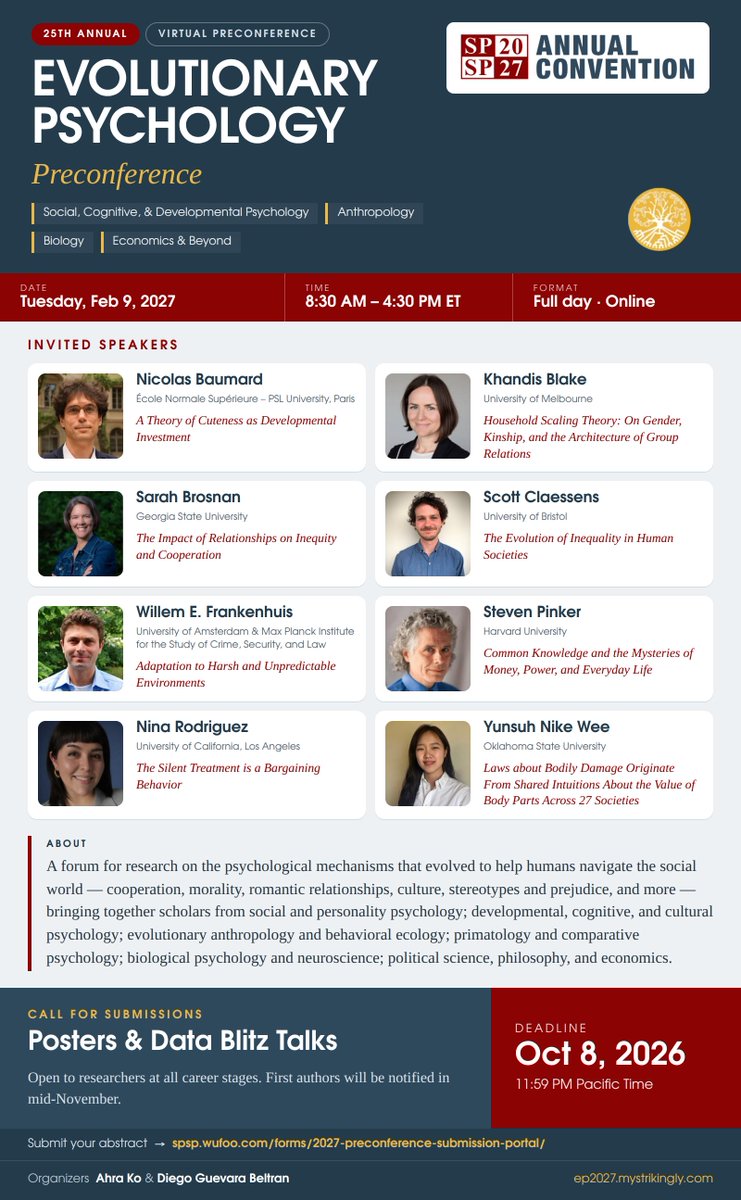
Only 1 day left to apply for the 25th Evolutionary Psychology Preconference at #SPSP2027@SPSPnews
🌐Feb 9: Full-day Virtual Preconference Send us your Datablitz & Poster proposals by Oct 8!
https://t.co/hS3KoVx1zV
Why do humans cooperate seamlessly in one situation, yet fail completely in another? 🐒🤝
Excited to feature Sarah Brosnan (Georgia State Univ) at the 25th Evolutionary Psychology Preconference at #SPSP2027!
🚨 Submit Datablitz/Posters by Oct 8: https://t.co/M0PW42vxj9
Join us at #SPSP2027 Ev Psy Preconference to hear Willem E. Frankenhuis explore how understanding stress-adapted cognition can help us better tailor education, policy, and interventions for individuals facing adversity.
⏳ Submit Datablitz/Posters by Oct 8 https://t.co/M0PW42vxj9
Two psych jobs at OSU: neuro/bio + clinical
Assistant Professor of Neurobiology Position: https://t.co/JFefSxrPtN
Open Clinical Position: https://t.co/7QsDBrl9VA
Excited to announce @sapinker as an invited speaker at the Evolutionary Psych Preconference at #SPSP2027!
He'll explore Common Knowledge—from traffic laws and money to why genteel hypocrisy beats radical honesty.
🚨 Submissions close Oct 8: https://t.co/M0PW42w58H
Join us for the 25th Evolutionary Psychology Precon at #SPSP2027@SPSPnews
🌐Feb 9: Full-day Virtual Preconference
🚨Submissions close Oct 8!
Send us your Datablitz & Poster proposals.
The program features outstanding speakers you'll not want to miss!
https://t.co/1or7viMvwX