Without farming, burning fossil fuels, and other ecologically disruptive activities, humans would not be much closer than chimpanzees to colonizing space—and thus securing the future of life on Earth.
https://t.co/hOWua3TRsC
Recent tariff hikes added at least $10,000 to the price of a typical home. Building regulations add $90,000, and can make up 40% of the cost of multifamily housing.
The best thing governments can do to address the housing crisis is to get out of the way.
https://t.co/gXj8BhvWnf
In many preindustrial societies, water was so filthy that drinking it became associated with poverty and low status.
Learn more about the everyday hardships of the past in @chellivia’s latest book, The Grim Old Days.
Wealthy societies can afford to screen for and treat conditions that our ancestors endured in silence.
That is a form of progress.
However, thanks to the way that our healthcare system is structured, that ever-expanding pool of diagnoses diverts resources away from the truly needy.
From @AdamOmaryPhD: https://t.co/ahK1CpxGKz
One of the great triumphs of entrepreneurial capitalism is how quickly air conditioning transformed from a rare luxury into an ordinary necessity.
Since 1952, the number of hours of entry-level work required to buy an air conditioner has fallen by nearly 99 percent.
https://t.co/fUfqoBa39Y
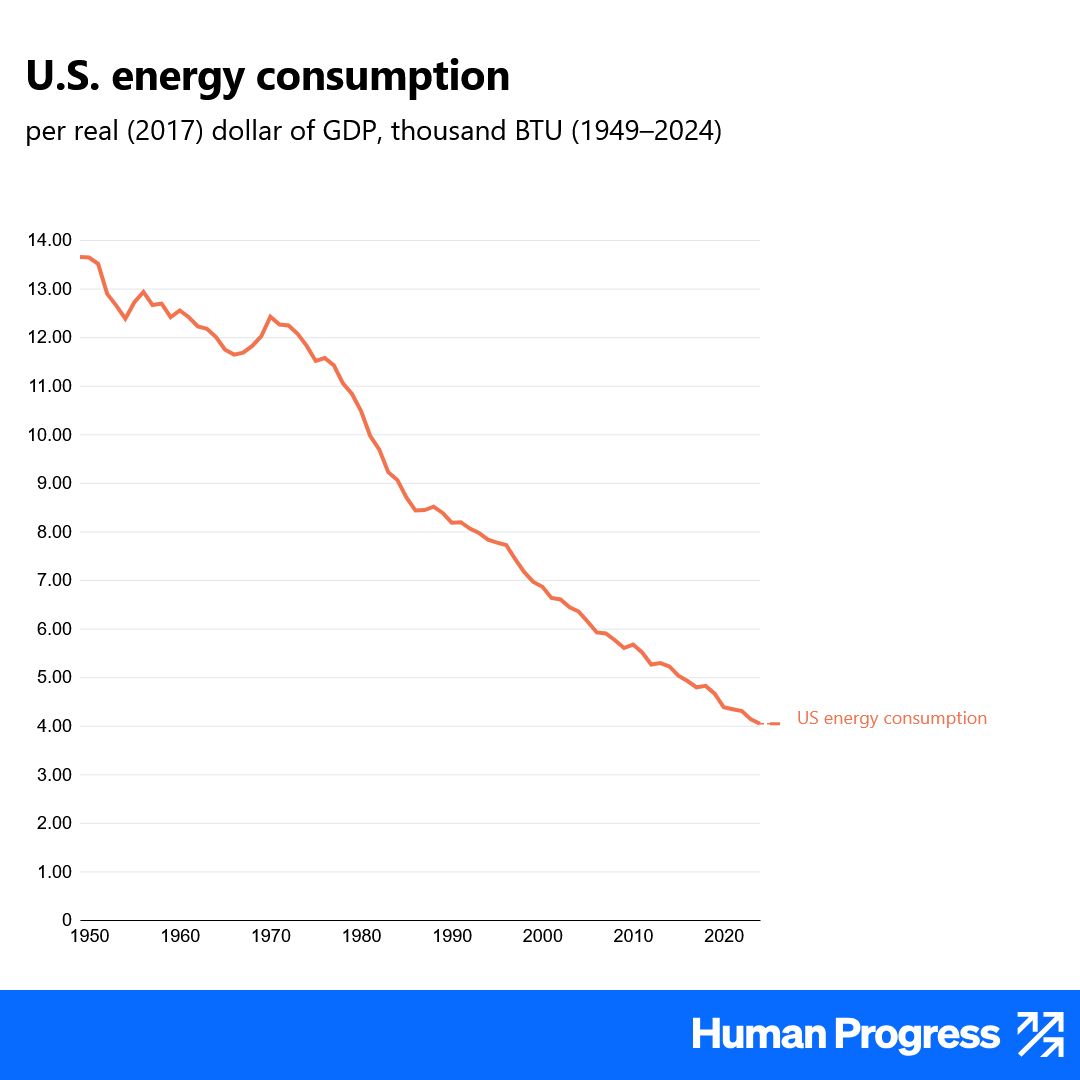
The US economy keeps getting more out of less.
The energy needed to produce a dollar of GDP has fallen by about 70% since 1949, and by half since 1990.
In 2024, it hit 4,040 BTUs per dollar, the lowest on record.
Explore the data: https://t.co/3i79ASgmAx
Social media platforms don’t just feed us headlines that align with our politics.
They also bait our ancient instincts and strongest emotions.
https://t.co/mdZNCTpe93
In the 1930s, US corn yields averaged 26 bushels per acre.
In 2025, that number reached 179.3 bushels per acre—with top-performing farms reaching an astonishing 624 bushels.
https://t.co/EPhZEcSYbi
When electricity was first developed, nobody could have predicted all the ways it would eventually transform human civilization.
@kristianstout of @LawEconCenter argues that AI is a similarly transformative technology: its greatest benefits may come from applications we haven't even imagined yet.
A recent analysis in The Economist finds that global inequality in consumption is falling.
In 2000, the richest 10% of humanity spent 40 times more than the poorest 50%.
In 2025, they spent around 18 times more.
https://t.co/x7EZWQrTZ5
Our evolved intuitions about fairness, competition, and resource scarcity are often at odds with sound economic policy.
Progress depends on building institutions that counteract these counterproductive instincts.
From @AdamOmaryPhD: https://t.co/bZI07j1a4r
Economies grow when transaction costs—the hassle and expense of getting buyers and sellers together—fall.
AVs are poised to become a prime technology that reduces transaction costs, enabling a boom in small-scale local trade because “come pick it up” will no longer mean an hour in traffic.
https://t.co/TMSvD0i53b
Nvidia has launched a new system designed to keep AI agents from taking unauthorized actions.
The system combines software that limits what an agent can access with an independent monitor that watches the agent and can block or quarantine it if it crosses those boundaries. The monitor runs on a separate processor from the one hosting the agent, putting it beyond the agent’s direct control.
When Friedrich Hayek titled his classic The Road to Serfdom, he did not mean it as praise.
He used “serfdom” to warn against a return to systems that crushed freedom and prosperity.
https://t.co/zr3RRYAJV6
IKEA has been a leading driver of furniture abundance.
In many cases, their retail prices are actually lower today than they were 40 years ago—even without adjusting for inflation or rising wages.
https://t.co/x8tGhXRw3K