XPeng will start selling its IRON humanoid in the second half of 2027, after first testing it in the company's own stores and offices - Brian Gu, vice chairman and president, at the Forbes Global CEO Conference on 12 October.
Before that: robots working alongside sales agents from early next year. IRON came off XPeng's newly commissioned production line in September, with mass production scheduled for this year.
So: a general-purpose machine meeting the public across a counter, not a fenced cell in a factory.
XPeng has delivered more than 60,000 vehicles in Europe. If the robot ever follows the cars, the date matters. The EU Machinery Regulation 2023/1230 applies on a mandatory basis from 20 January 2027, and the UK instrument comes into force the same day. Anything first sold in the second half of 2027 arrives under the new rules with no transition left.
For an operator that means conformity assessment, a technical file and trained staff before the first shift, not after.
Meridian Robotics is the compliance, insurance and training layer that gets a fleet from launch date to first shift.
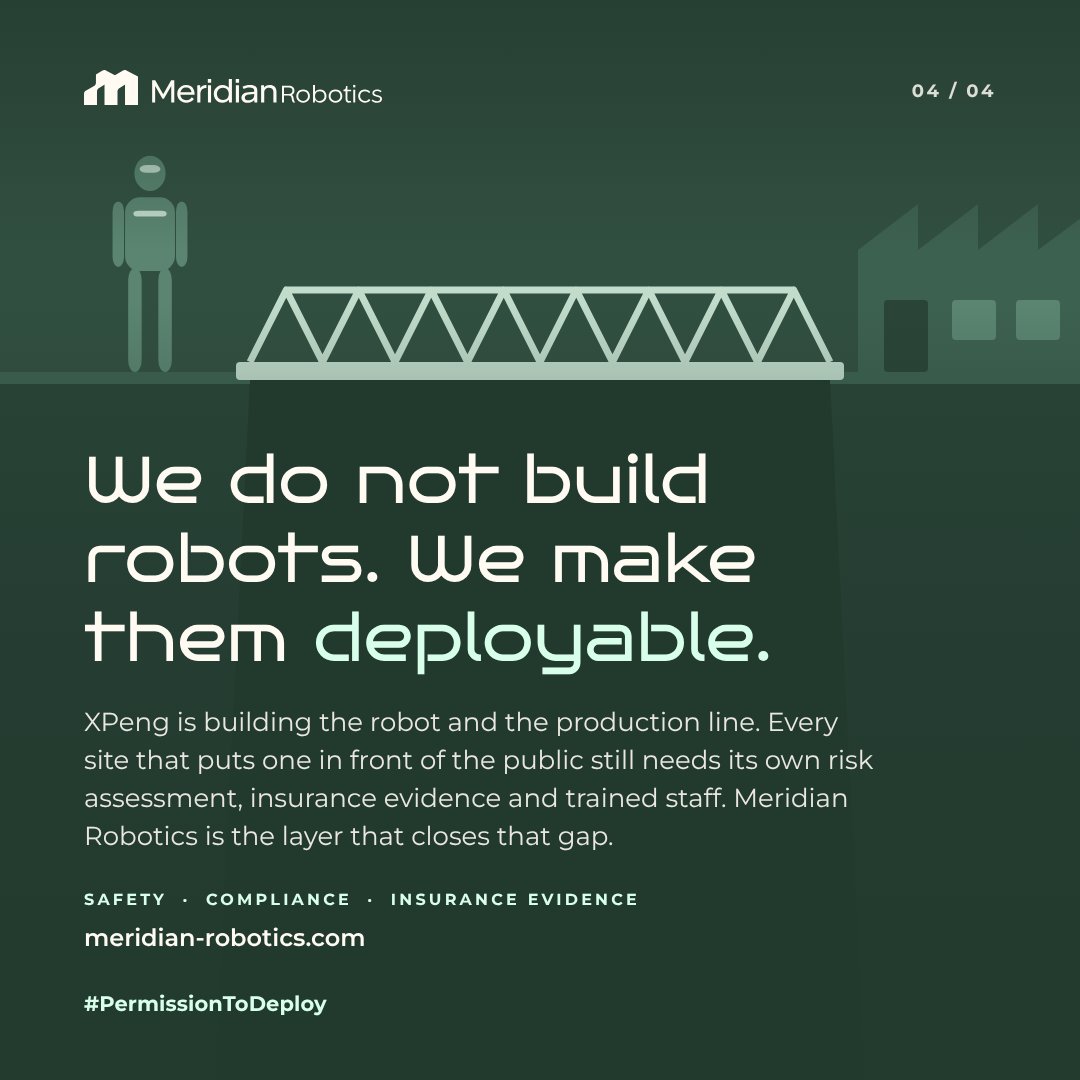
We do not build robots. We make them deployable.
Sources in the first comment.
#PermissionToDeploy #HumanoidRobots #MachineryRegulation #Robotics #Europe
Sources
Forbes, Jane Ho, "Forbes Global CEO Conference 2026: Chinese EV Maker Xpeng To Launch Humanoid Robots", 12 Oct 2026 - https://t.co/IHBrcGYp9I
XPENG, Paris Motor Show release, 1 Oct 2026 - https://t.co/lsPAXl0QxB
European Commission, Machinery, accessed 12 Oct 2026 - https://t.co/VLHa2MknJv
SI 2026/867, reg. 1(2) - https://t.co/XPLgubSKeS
Machinery Regulation + AI Act + Cyber Resilience Act. An AI enabled humanoid in Europe faces a triple compliance stack. Here's the timeline.
September 2026: Cyber Resilience Act reporting obligations took effect. Manufacturers of connected products must now report actively exploited vulnerabilities and severe incidents.
January 2027: Machinery Regulation (EU) 2023/1230 applies, with no grace period for new placements.
August 2027: EU AI Act high risk obligations for Annex I embedded systems apply (with the Digital Omnibus proposal potentially introducing a conditional two step timeline to 2028). Penalties reach €35m or 7% of turnover for prohibited practices.
December 2027: the Cyber Resilience Act's full security requirements apply to connected machinery.
Three regimes, three timelines, one machine. Nobody has fully reconciled them. The legal literature itself flags the dual compliance burden as unresolved.
For deployers, the practical question isn't 'which regulation applies?' It's 'what single evidence architecture satisfies all three?' Build the evidence once, properly, and resolve it per regime. Build it three times and you'll drown.
That is the design logic behind a unified, versioned safety case.
We do not build robots. We make them deployable.
Save this timeline. Share it with your legal and compliance teams.
#PermissionToDeploy #AIAct #MachineryRegulation #CyberResilienceAct #Compliance #EURegulation
Sources: Regulation (EU) 2023/1230 (Machinery Regulation); Regulation (EU) 2024/1689 (AI Act) and Digital Omnibus proposal (Nov 2025); Regulation (EU) 2024/2847 (Cyber Resilience Act), European Commission; Bird & Bird, 'Smart Robots, Dual Regulations' (2026)
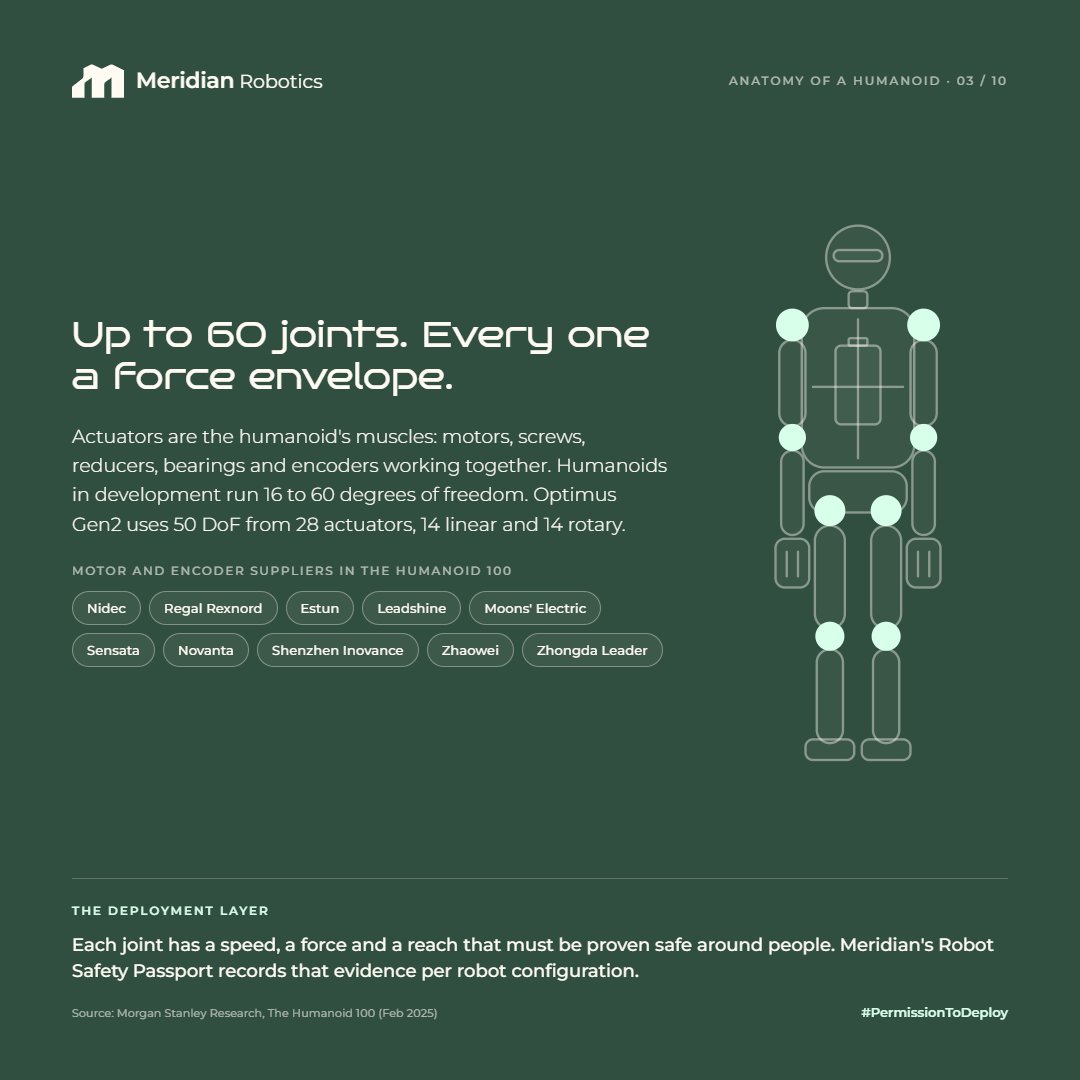
A humanoid is a machine with up to 60 joints, and every joint is a force envelope.
Actuators are the muscles: frameless torque motors, screws, reducers, bearings and encoders. Optimus Gen2 runs 50 degrees of freedom from 28 actuators, 14 linear and 14 rotary. Motors come from Nidec, Regal Rexnord, Estun, Leadshine and Moons' Electric; encoders and sensing from Novanta and Sensata.
Every one of those joints has a speed, a force and a reach that must be proven safe around people before the robot crosses the line into live operation.
Meridian's Robot Safety Passport records that evidence per robot configuration, joint by joint, so a competent person can sign it off and an insurer can rely on it.
#PermissionToDeploy #HumanoidRobotics #FunctionalSafety
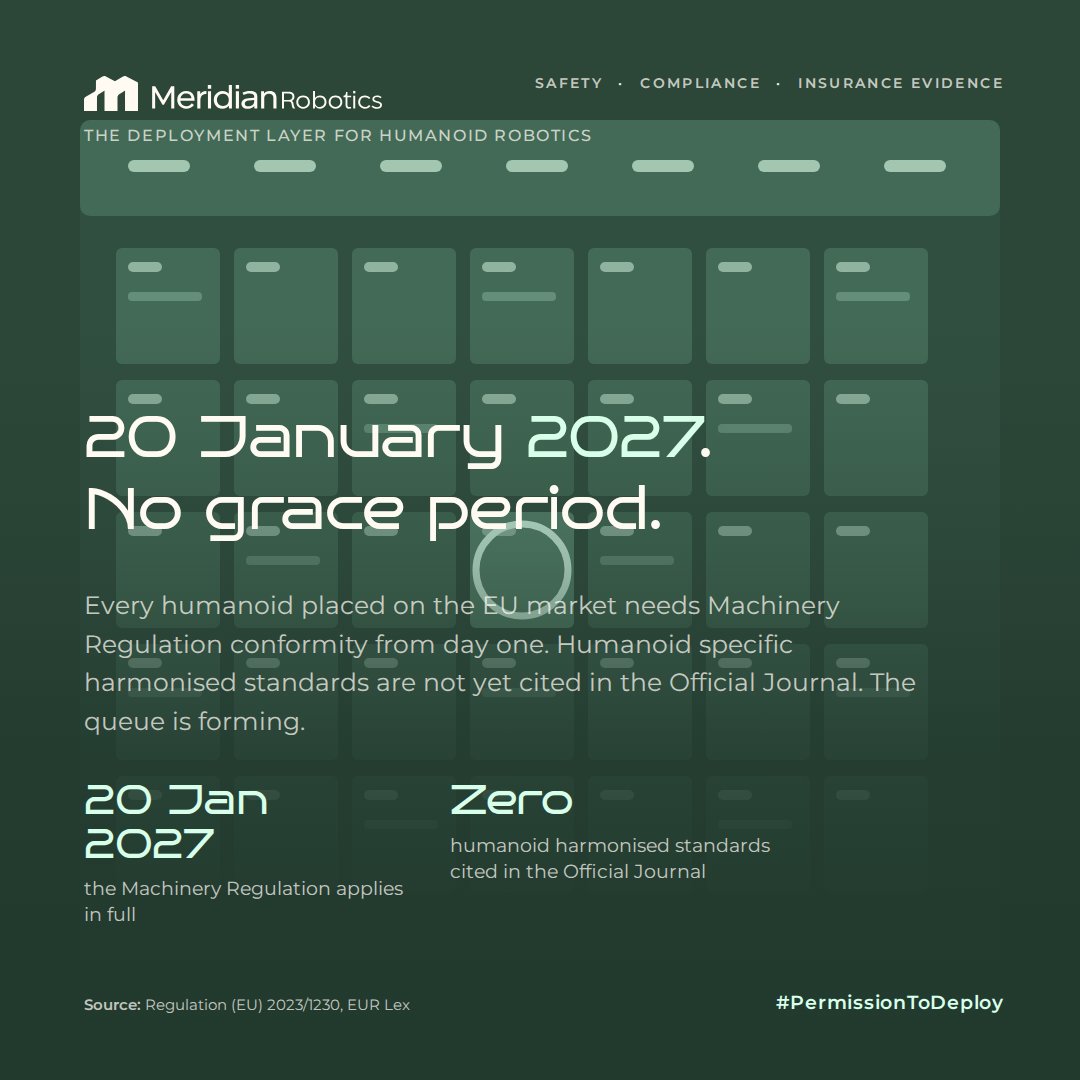
20 January 2027. No grace period. Every humanoid placed on the EU market needs Machinery Regulation conformity from day one.
Regulation (EU) 2023/1230 replaces the Machinery Directive and, for the first time, brings AI driven safety functions, autonomous behaviour and cybersecurity inside machinery conformity. It introduces a high risk machinery category with notified body involvement.
Two problems are converging on that date.
One: notified bodies face a certification queue, and humanoid specific harmonised standards are not yet cited in the Official Journal, forcing manufacturers into bespoke conformity routes.
Two: most deployers still treat compliance as an afterthought rather than a project plan workstream from vendor selection.
If you intend to deploy humanoids in the EU in 2027, your conformity work starts now, in 2026. The wall is real, the date is fixed, and the queue is forming.
Converting that regulatory wall into a certification pipeline is the single highest leverage move available to European robotics.
We do not build robots. We make them deployable.
Deploying in the EU in 2027? DM us and we'll share our Machinery Regulation readiness checklist.
#PermissionToDeploy #MachineryRegulation #EU2027 #CEMarking #Compliance #HumanoidRobots
Sources: Regulation (EU) 2023/1230, Official Journal of the European Union
The humanoid brain is the most valuable part of the robot, and the least accountable.
Foundational models from NVIDIA (Project GR00T), Alphabet, Meta, Microsoft and Baidu give the machine language and perception. Vision and compute semis from NVIDIA, Qualcomm, Intel, Ambarella, Horizon Robotics and Mobileye run it at the edge. Morgan Stanley counts 22 Humanoid 100 companies in the brain.
Here is the deployment problem. A model update changes what the robot will do on your floor, and no vendor re-asks your site for permission when it ships one.
In Meridian Command a software change is one of 22 change triggers that re-opens a deployment's permission state. The brain decides. Permission is a separate question, and it is ours.
#PermissionToDeploy #HumanoidRobotics #EmbodiedAI
A humanoid mutates through over the air updates. A one time compliance report cannot stay valid. The safety case has to be alive.
Traditional machinery compliance assumes the machine you assessed in January is the machine running in June. A humanoid breaks that assumption weekly: new model weights, new firmware, new tasks, new environments.
The EU has noticed. The Machinery Regulation treats substantial digital modification (including software and model updates) as potentially creating a new 'manufacturer' with fresh conformity obligations.
Our answer is the living safety case: every assessment versioned, every conformity claim bound to a specific software version and verified evidence, and automatically retriggered by a new task, environment, model update or incident.
Not a date that silently expires. An evidence state that visibly holds, or visibly doesn't.
One authored assessment resolves three ways: compliance file, underwriting risk profile, training and competency schedule. That is Meridian Command.
We do not build robots. We make them deployable.
How does your organisation track conformity through software updates today? Honest answers welcome.
#PermissionToDeploy #Compliance #SafetyCase #MachineryRegulation #HumanoidRobots #MeridianCommand
Sources: Regulation (EU) 2023/1230; Bird & Bird, 'Smart Robots, Dual Regulations' (2026)
On 30 September, Flourish launched Flourish 1: a wheeled semi-humanoid for the home at $3,555.
The machine: a torso and two arms on a wheeled pillar, 3ft 7in, 44lb, lifting up to 3.3lb and running up to twelve hours a charge. You teach it a task by demonstrating it through a phone app - about thirty minutes - and it then runs on its own.
Pre-orders are open for the first fifty units, with deliveries due in December. The jobs are laundry, bins, wiping a table, watering plants.
At that price the interesting question is not the home. It is the small business that buys one.
Sold to a household it answers to consumer product rules - in the EU, the General Product Safety Regulation, which has applied since 13 December 2024. [2] Put the same machine in a shop or a workshop and the duties change hands: under UK PUWER, whoever controls work equipment must make sure it is suitable for the job and used only by people with adequate information, instruction and training.
A consumer price is not a licence to deploy at work. Meridian Robotics is the compliance, insurance and training layer that closes that gap.
We do not build robots. We make them deployable.
#PermissionToDeploy #HumanoidRobots #ProductSafety #PUWER #Robotics
Sources:
Forbes, John Koetsier, "This $3,555 Humanoid Robot Is Slow, Basic, Cheap. Mission Accomplished.", 30 Sep 2026 - https://t.co/zVXtuNtYmG
https://t.co/02VEYsJvZK, "EU Regulation 2023/988 on General Product Safety: detailed guidance", updated 4 Nov 2025 - https://t.co/TLDpWIwSVG
HSE, "Provision and Use of Work Equipment Regulations 1998 (PUWER) - overview", accessed 5 Oct 2026 - https://t.co/bZhPAFBtIM
The last revision of the world's core robot safety standard took roughly eight years. Humanoid production cycles run in months. That mismatch is a policy variable.
ISO 10218's 2025 revision, which absorbed ISO/TS 15066 and added functional safety and cybersecurity requirements, took ~8 years to complete.
This is not a criticism of the standards community; rigour takes time. It is a structural observation: Western safety rules are produced by processes that neither generate nor exploit deployment data.
China inverts the sequence. Deployment is mandated; standards are codified alongside it, from operational evidence. Its first national humanoid standards framework (Feb 2026) catalogues 52 standards with an explicit roadmap to promote the results through ISO and IEC.
The synthesis: standards are infrastructure, not friction. But their TEMPO is a competitiveness variable. The binding constraint in the West is not that safety is valued too highly. It is that safety rules are produced too slowly.
Fund standards participation as infrastructure. Run supervised sandboxes that generate the evidence standards need. Speed and safety are not opposites.
We do not build robots. We make them deployable.
Standards professionals: what would halve the cycle time without cutting rigour?
#PermissionToDeploy #Standards #ISO #RobotSafety #Policy #HumanoidRobots
Sources: The Robot Report (2025) on ISO 10218:2025; Xinhua (Feb 2026); Carnegie Endowment (2025)
"Europe has a robot adoption problem. Adoption fails on financing, risk and compliance long before it fails on technology." That is Alexander Stevens, founder and CEO of Motion, in Brussels [1].
Motion raised $2m in pre-seed funding in August, led by Extantia Capital with Norrsken Evolve [1]. It supplies humanoids on a monthly fee that covers robot selection, task training, IT integration, fleet management, financing, insurance, compliance and maintenance [1]. It is running five pilots in Belgium [1] and says it chooses the robot to suit the task rather than tying itself to one maker [2].
What stands out is the list. Almost none of it is the robot. It is everything around the robot that decides whether a site can switch it on.
That is why the integrator matters, and why nobody gets to first shift alone: makers, integrators, testers, insurers and trainers each hold a piece. Meridian Robotics is the compliance, insurance and training layer that closes the gap between a pilot and permission to deploy.
We do not build robots. We make them deployable.
Image: Meridian Robotics brand images. The humanoid pictured is illustrative and is not the one discussed in this post.
#PermissionToDeploy #HumanoidRobots #RobotsAsAService #Robotics #Belgium
Sources:
https://t.co/tDxE54BuLM, "Motion lands $2M to expand humanoid robot deployments across Europe", 27 Aug 2026: https://t.co/LsKKDJHN8S, "Brussels-based Motion raises €1.7 million to tackle Europe's 'robot adoption problem'", 27 Aug 2026: https://t.co/uBpQtgoIwO
There is no published Western safety standard for a dynamically balancing bipedal machine. Not one.
The first relevant ISO instrument, ISO 25785 Part 1 (safety requirements for mobile robots with actively controlled stability), is still in development. The IEEE's own study group estimates first ratified humanoid standards are 18 to 36 months away.
Meanwhile the machines ship. Incumbent machinery safety consultancies know fixed base arms inside a cage, not a machine that collapses when it loses power, whose failure mode is a fall, and whose behaviour changes with every over the air update.
For deployers, the absence of a standard is not a free pass. It is the opposite: with no presumption of conformity route, every deployment demands a bespoke, defensible, first principles risk assessment.
That is exactly the work we do: assessment to ISO 10218:2025 and draft ISO 25785 Part 1, structured to be auditable by regulators and, by design, by underwriters.
The standard is coming. The deployments are here first. Bridge accordingly.
We do not build robots. We make them deployable.
Deployers: how are you handling conformity today, before the humanoid standard lands?
#PermissionToDeploy #ISO25785 #RobotSafety #Compliance #Standards #HumanoidRobots
Sources: ISO/CD 25785 Part 1 (Committee Draft, stage 30.60); ISO 10218:2025; IEEE Humanoid Study Group pathway study (Sep 2025) via The Robot Report
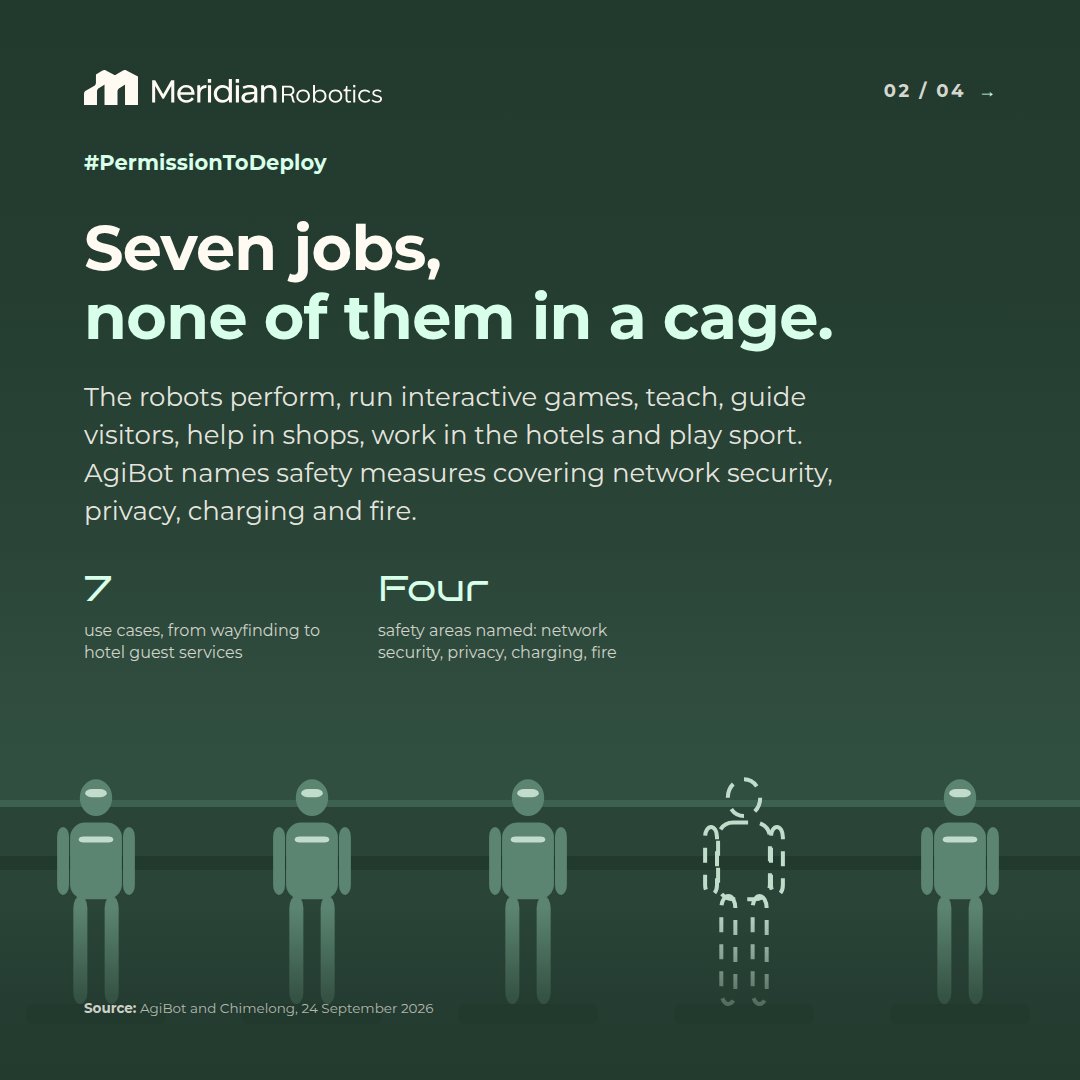
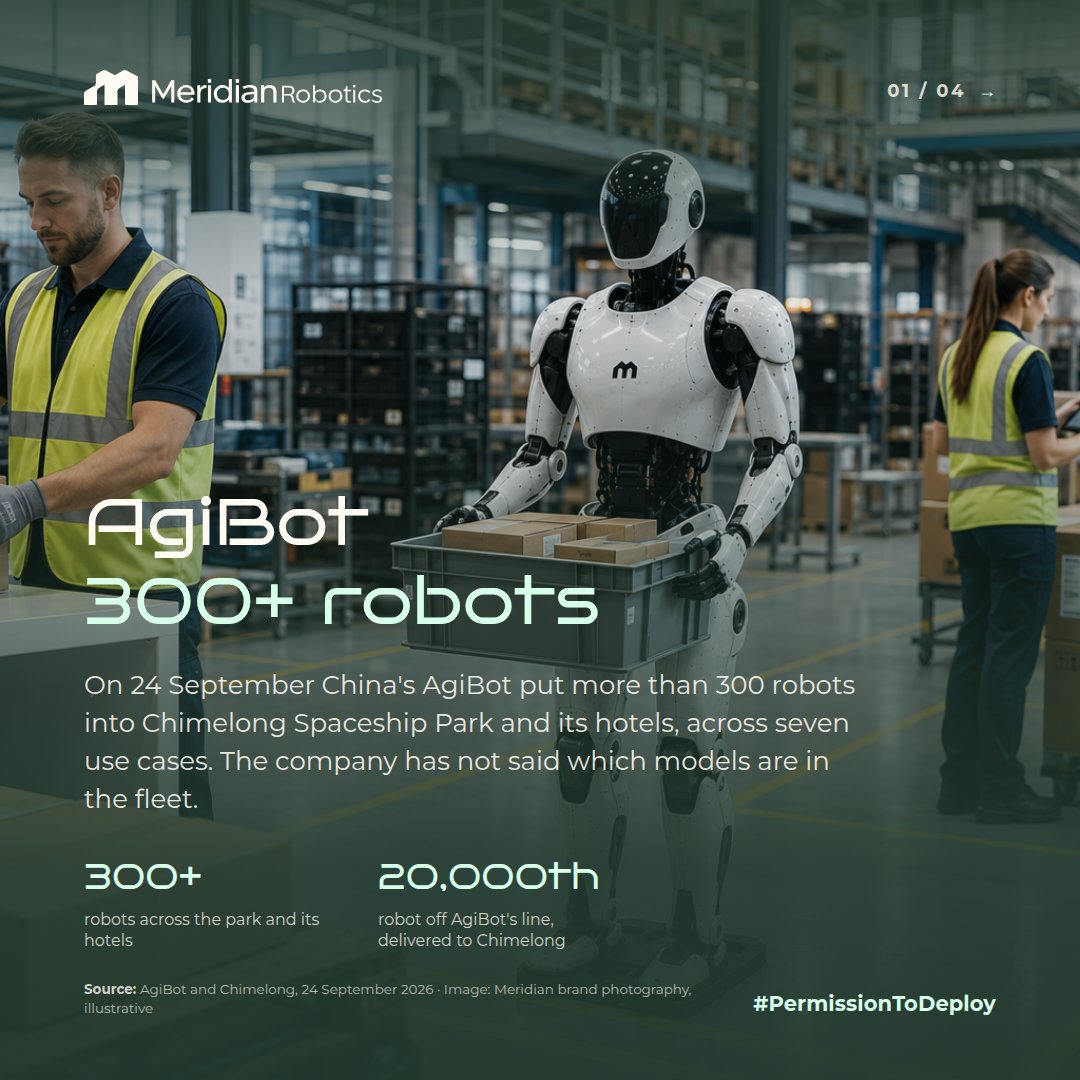
On 24 September, AgiBot and Chimelong put more than 300 robots into Chimelong Spaceship Park and its hotels in Zhuhai - the launch also marking the 20,000th robot off AgiBot's line.
Seven use cases: live performance, interactive games, education, visitor guidance, retail help, hotel guest services and sport. AgiBot lists safety measures covering network security, privacy, charging and fire.
What makes this different from a warehouse pilot is the public. These robots work among visitors - children, crowds, people who have had no induction.
The safety standard being written for humanoids, ISO/CD 25785-1, is explicitly for industrial mobile robots. The published standard for robots that work around people, ISO 13482, dates from 2014 and is now marked for revision.
An operator doing this in Europe would be writing its own case: the risk assessment for a public space, the insurance that answers when a visitor is hurt, and staff trained to supervise a fleet.
A theme park is not a factory, and the rulebook is written for the factory. Meridian Robotics is the compliance, insurance and training layer that closes that gap.
We do not build robots. We make them deployable.
#PermissionToDeploy #HumanoidRobots #Robotics #PublicSafety #China
Sources:
AgiBot and Chimelong, "Launch Large-Scale Embodied AI Theme Park with More Than 300 Robots", 24 Sep 2026 - https://t.co/AyR5IbgdXF
ISO, ISO/CD 25785-1, Safety requirements for dynamically stable industrial mobile robots, stage 30.60 (8 Jul 2026) - https://t.co/oKzjL9pheS
ISO, ISO 13482:2014, Safety requirements for personal care robots, stage 90.92 - https://t.co/UYmfpMTS2X
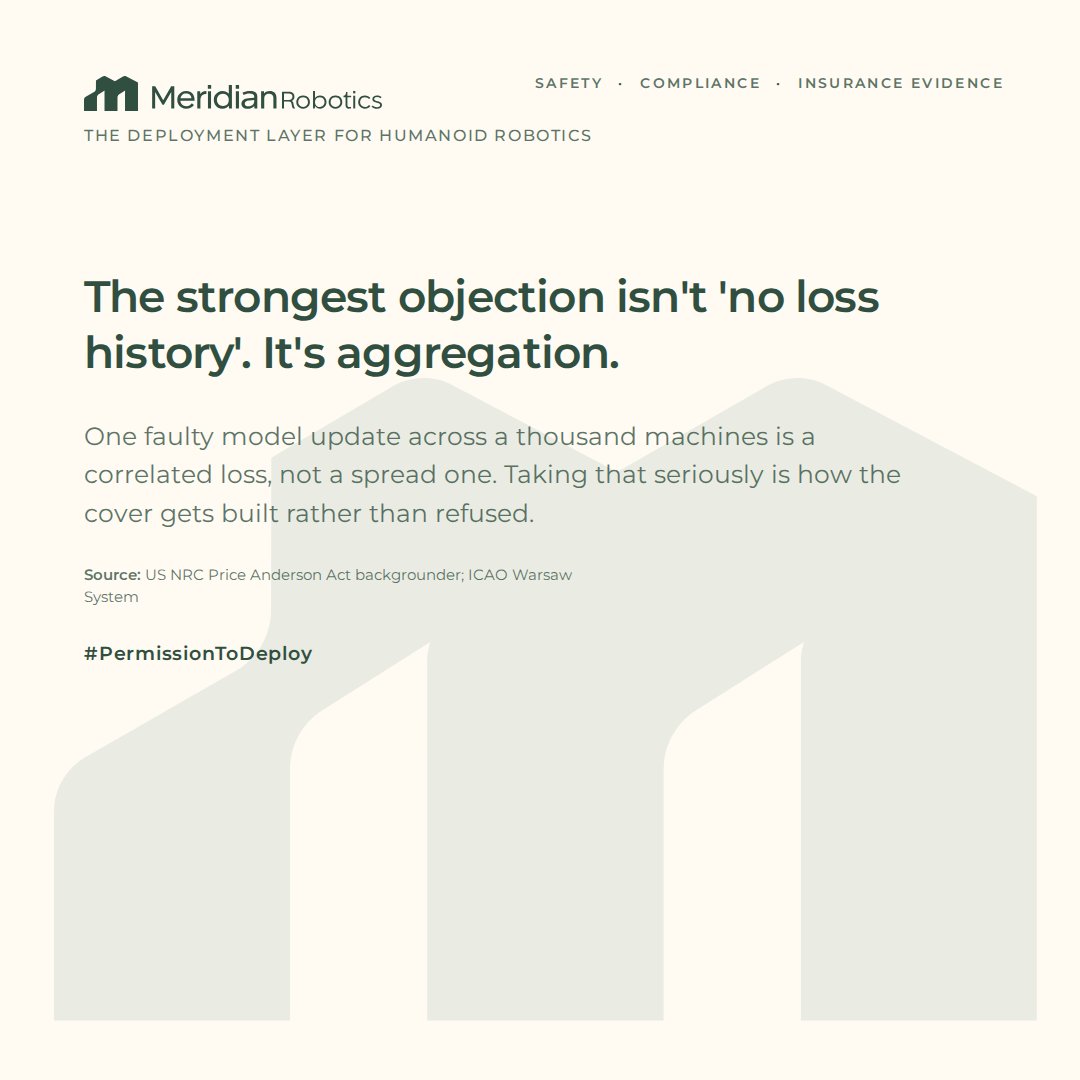
The strongest objection to humanoid insurance isn't 'no loss history.' It's aggregation. Let's take it seriously.
Correlated software across a fleet is a cyber style catastrophe exposure. A fleet wide software fault (one bad model update propagating to ten thousand machines overnight) is this class's true cat scenario.
The answer is not to leave the exposure accumulating silently inside wordings that never contemplated it. It is to build the modelling early: version level accumulation tracking, event caps, and reinsurance from day one, treated exactly the way cyber cat already is.
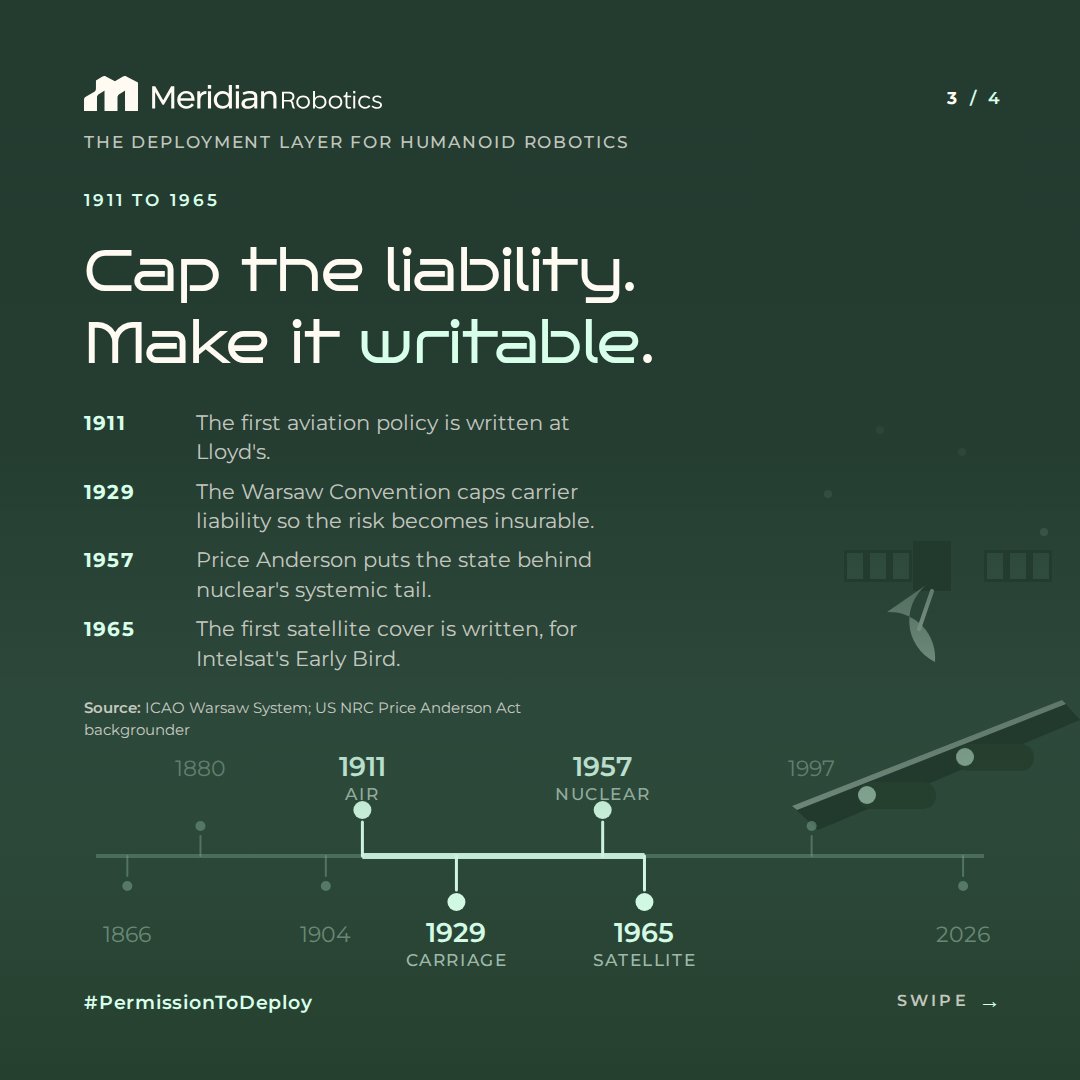
And for the genuinely systemic tail, keep the Price Anderson precedent in the drawer: a state backstop layered above maximum private capacity made nuclear financeable in 1957.
Moral hazard? The historical record says the opposite. HSB's inspectors made boilers safe. Warsaw's liability caps made airlines investable. Premium differentials enforce safety standards faster and more granularly than any regulator, because they reprice monthly, not legislatively.
Serious risks deserve serious architecture. That's the work.
We do not build robots. We make them deployable.
What else belongs on the humanoid cat modelling agenda? Genuinely asking.
#PermissionToDeploy #Reinsurance #CatModelling #AIRisk #Insurance #HumanoidRobots
Sources: US NRC Price Anderson Act backgrounder; Munich Re/HSB history; ICAO Warsaw System
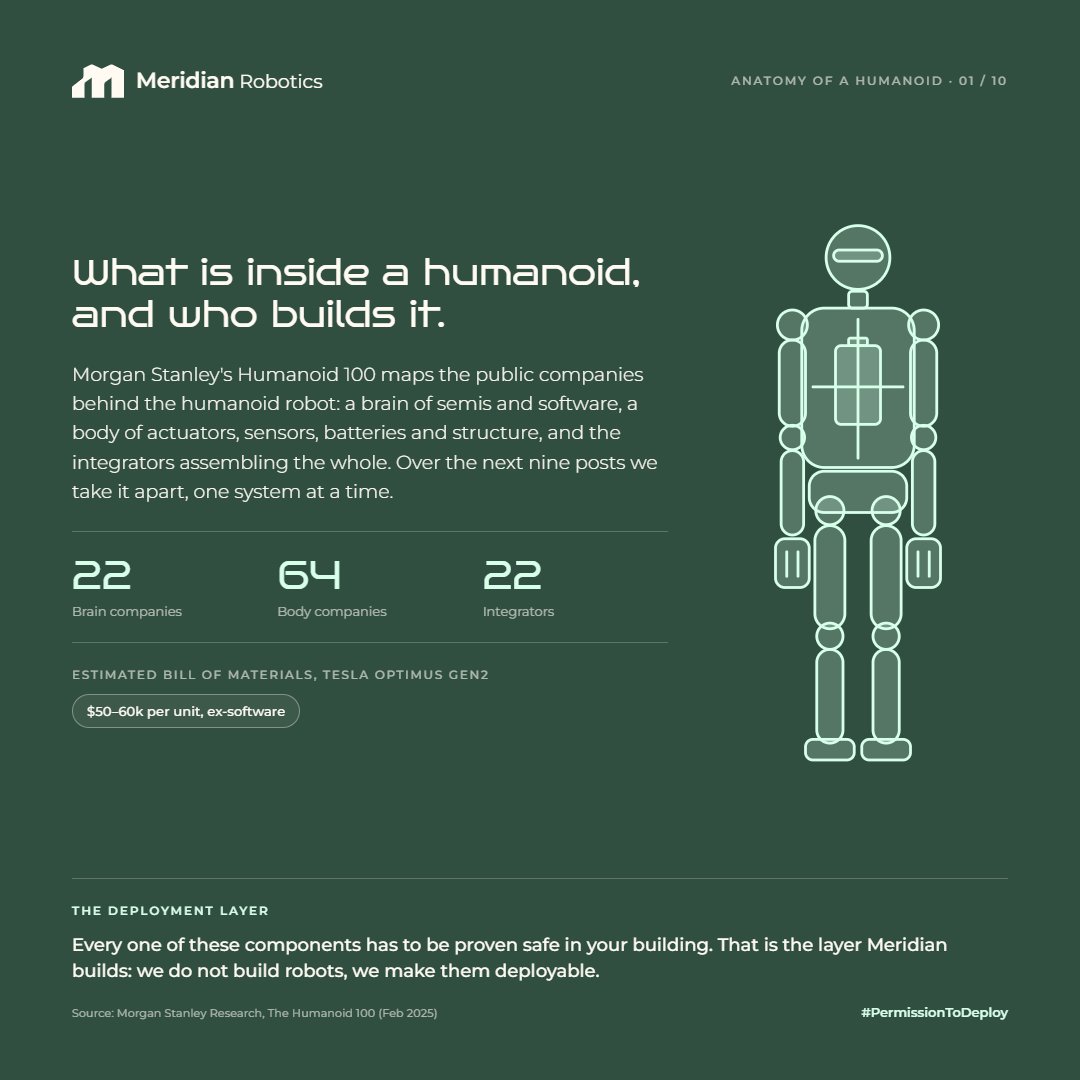
What is actually inside a humanoid robot, and who makes it?
Morgan Stanley's Humanoid 100 maps the public companies behind the machine: 22 in the brain (semis and software), 64 in the body (actuators, sensors, batteries, structure) and 22 integrators building the whole robot. Their estimate for a Tesla Optimus Gen2 bill of materials sits at $50–60k per unit before software.
Over the next nine posts we take the humanoid apart one system at a time, name the companies in each part of the supply chain, and ask the question none of them answer: who gives this robot permission to work in your building?
That is the layer Meridian builds. We do not build robots. We make them deployable.
#PermissionToDeploy #HumanoidRobotics #Humanoid100
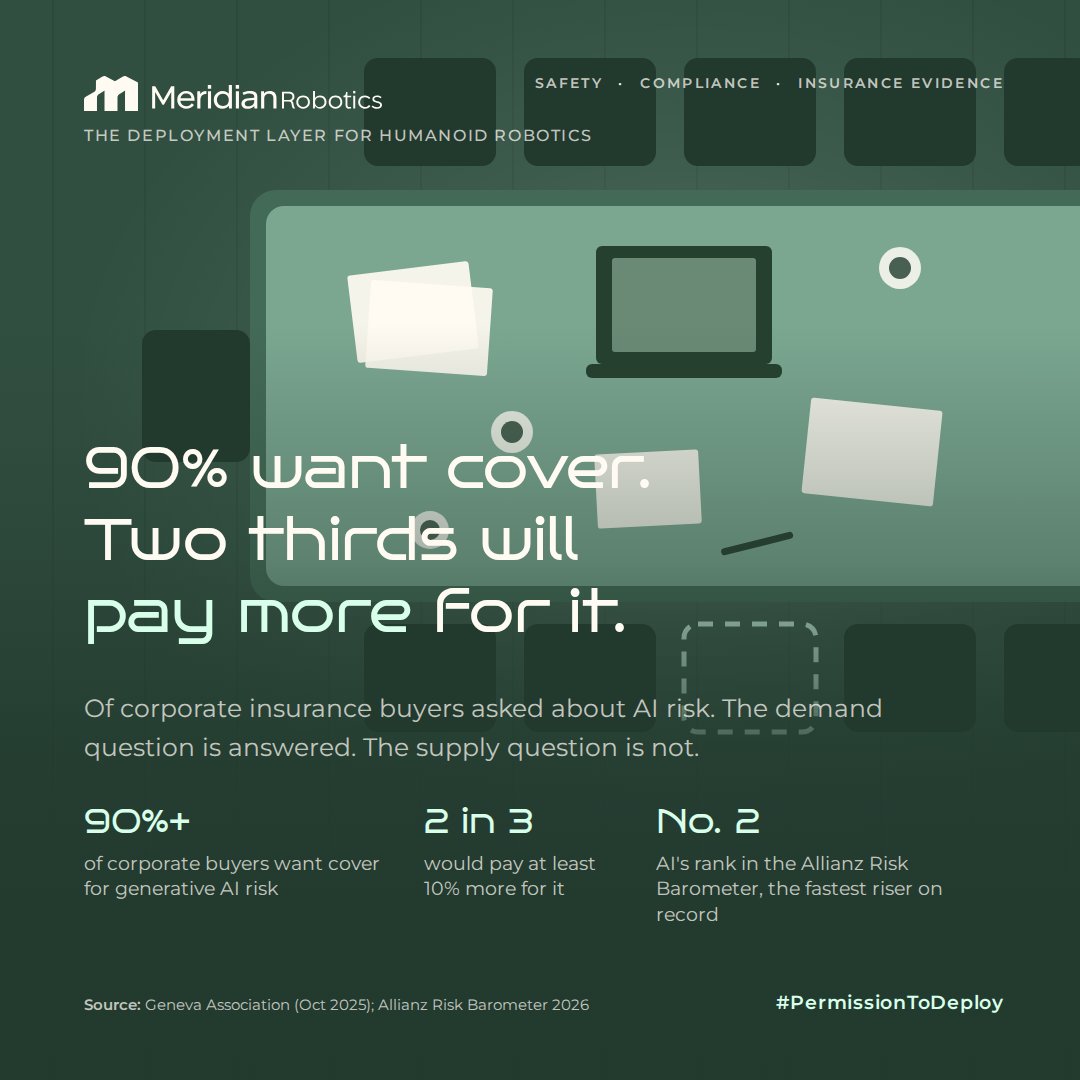
90%+ of corporate insurance buyers want AI risk cover. Two thirds would pay at least 10% more premium for it. The demand question is answered.
The Geneva Association surveyed six hundred corporate insurance decision makers in 2025: more than 90% want insurance protection for generative AI risks; over two thirds are willing to pay at least 10% higher premiums for it.
Allianz's Risk Barometer now ranks AI the number two business risk globally, the fastest riser in the survey's history.
Capacity exists too: global premiums passed $7.7tn in 2024; commercial P&C crossed a trillion; reinsurance capital stands at a record $769bn.
What is missing is not money, models or demand. It is a product.
And the first affirmative products are already live on Lloyd's paper: Armilla (led by Chaucer, 2025), Testudo (Apollo/Atrium/QBE, 2026), Munich Re's aiSure extended through Mosaic with $15m of AI developer capacity. The humanoid product is not a leap from this base. It is an assembly job.
We do not build robots. We make them deployable.
Brokers: are your clients asking about robot or AI liability yet? What are they told?
#PermissionToDeploy #Insurance #AIRisk #Brokers #Lloyds #SpecialtyLines
Sources: Geneva Association (Oct 2025); Allianz Risk Barometer 2026; Swiss Re sigma 2/2025 & 3/2025; Gallagher Re (2025); Armilla/Chaucer (2025); The Insurer (Feb 2026); Mosaic (Feb 2026)
88% fewer property damage claims. 92% fewer bodily injury claims. Machine risk CAN be measured well enough to price.
Waymo and Swiss Re compared 25.3 million fully driverless miles against a baseline built from over 500,000 human claims. The result: 88% fewer property damage claims and 92% fewer bodily injury claims than human drivers.
Telemetry did that. The machine logs everything, so the evidence base compounds continuously.
Tesla already prices policies in real time on driving data, and scores miles driven under its automation as its safest risk. LexisNexis quantified double digit loss cost reductions from driver assistance features across eleven million vehicles.
Robot underwriting will be telemetry underwriting. The tools are on the shelf.
The missing piece is the trusted, OEM agnostic layer that structures deployment data as underwriting evidence from day one. That is the layer we are building.
We do not build robots. We make them deployable.
Is telemetry conditioned cover the future of all machinery lines? Discuss.
#PermissionToDeploy #Telematics #AutonomousVehicles #Insurance #Waymo #HumanoidRobots
Sources: Waymo & Swiss Re study (Dec 2024); Tesla Insurance, real time driving based pricing; LexisNexis Risk Solutions (2021)
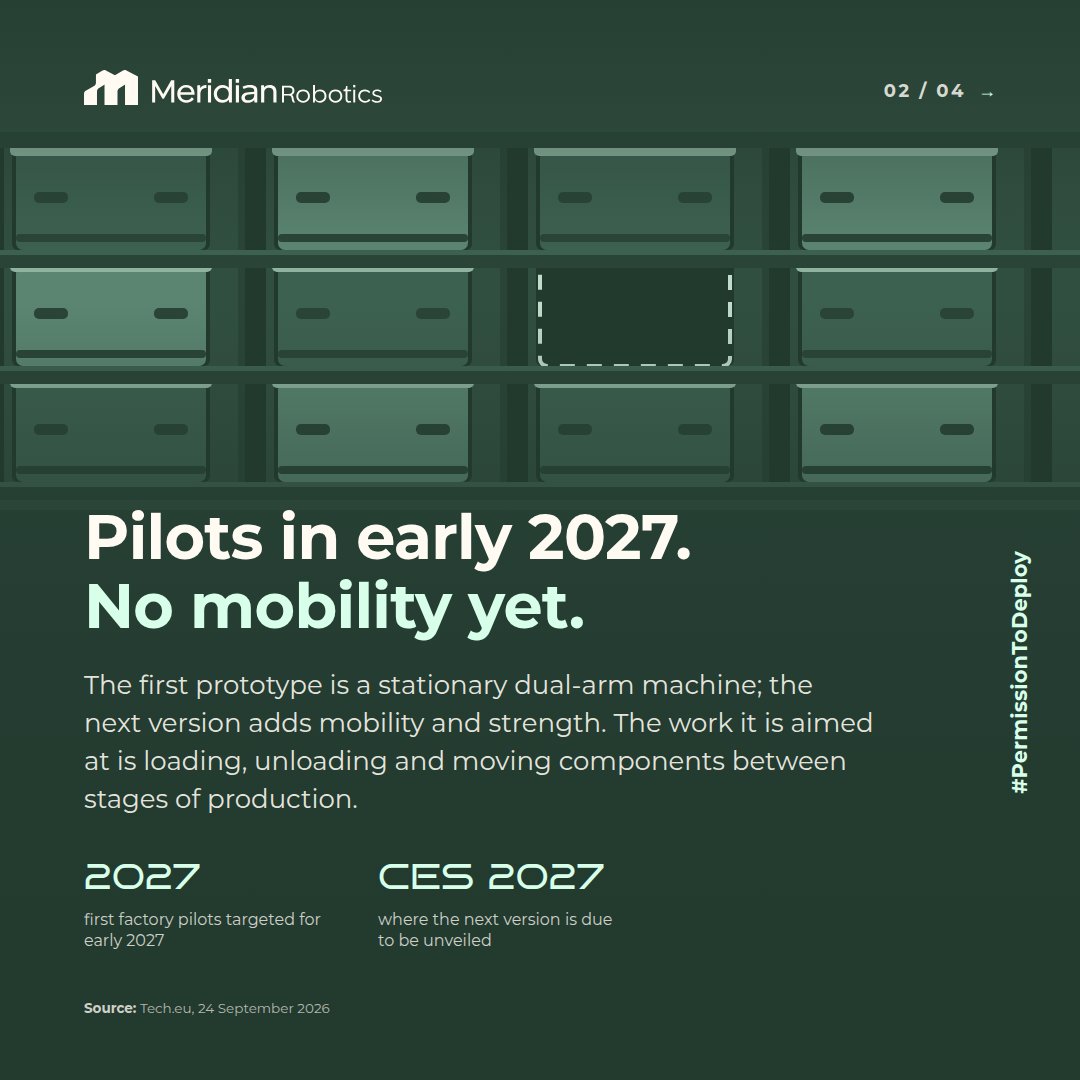
On 24 September, Tokyo-based O-ID announced a $1.2m pre-seed, led by TAWANI Ventures, to move its modular industrial humanoid towards production.
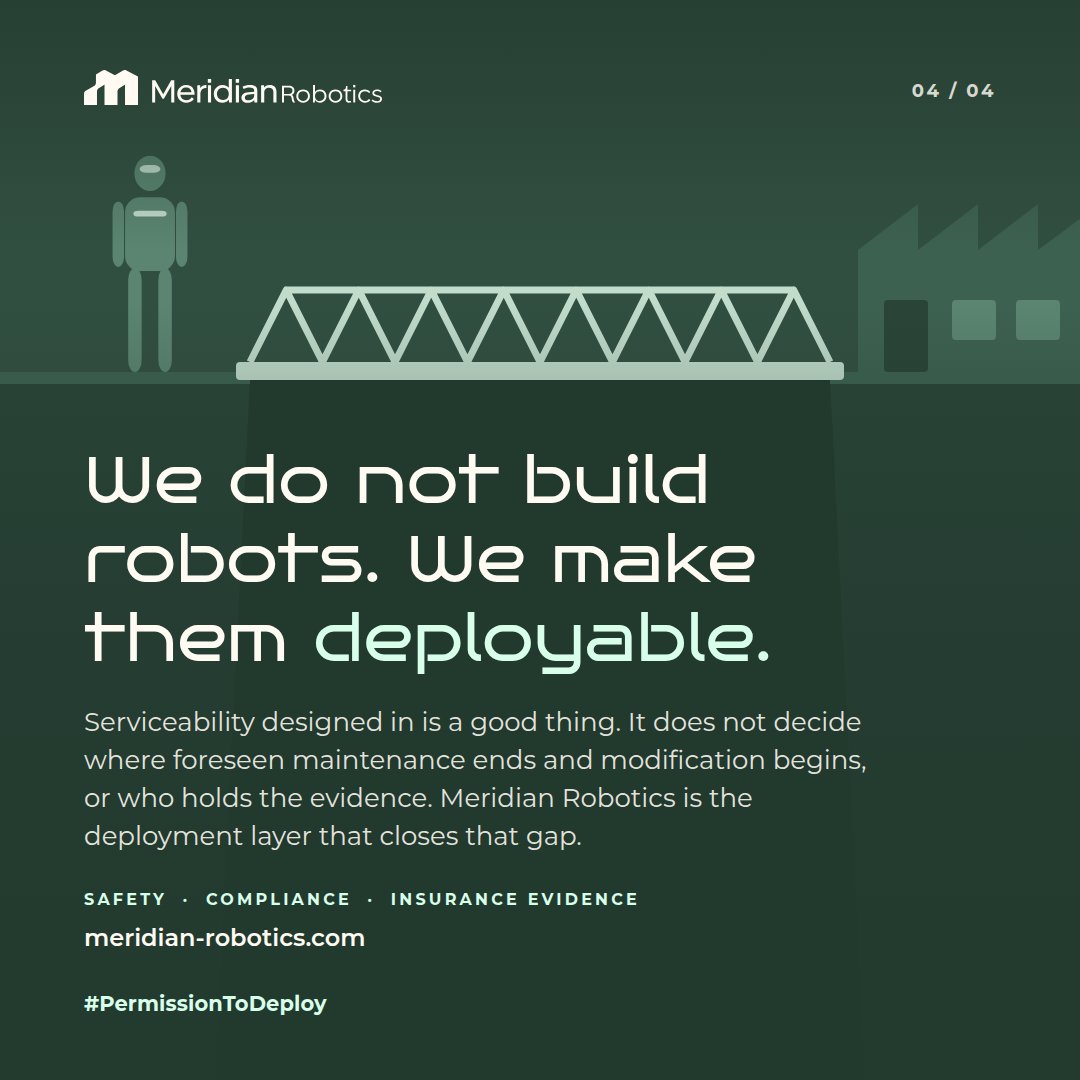
The design point is serviceability: "Every major module comes off and goes back on in about five minutes, on the floor, without tools." Onboard sensors flag parts approaching failure.
The first prototype is a stationary dual-arm robot; the next adds mobility. Factory pilots are targeted for early 2027.
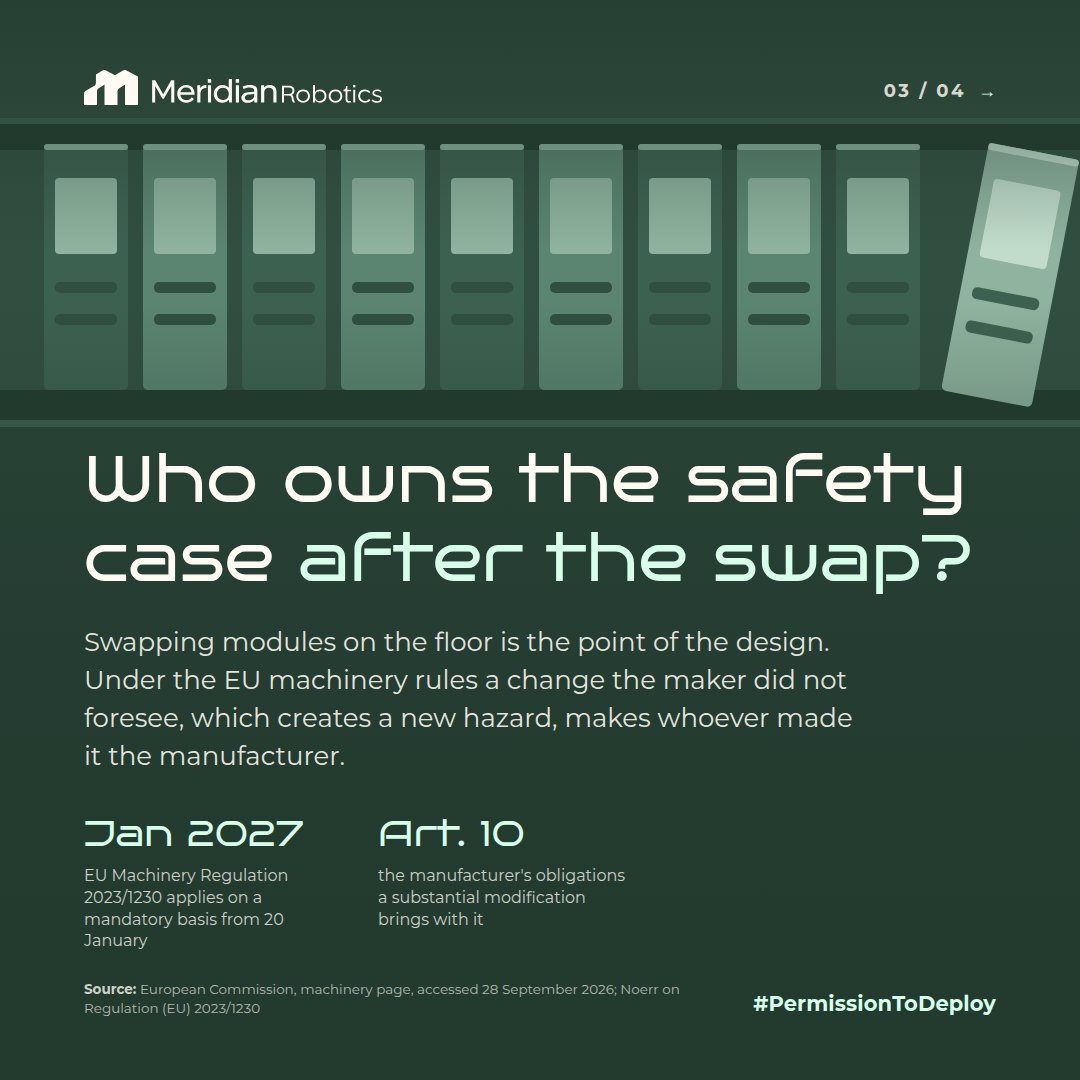
A machine built to be taken apart on the floor moves an interesting line. Maintenance the manufacturer foresaw is maintenance. A change it did not foresee, creating a new hazard, is a substantial modification - and under the EU machinery rules whoever makes it becomes the manufacturer, with Article 10's obligations. Regulation (EU) 2023/1230 applies from 20 January 2027, months after those pilots start.
For an operator that is practical: which swaps are in the instructions, who is trained to make them, and whose insurance answers.
Designed-in serviceability is not permission to deploy. Meridian Robotics is the layer that closes that gap.
We do not build robots. We make them deployable.
#PermissionToDeploy #HumanoidRobots #Manufacturing #MachinerySafety #Japan
Sources:
O-ID, "O-ID raises $1.2M pre-seed to build modular humanoids in Japan", 24 Sep 2026 - https://t.co/PPLsVUTt2Y
https://t.co/wIOKC8FUzi, "Brits in Japan raise $1.2M to put modular humanoid robots to work", 24 Sep 2026 - https://t.co/0pHWsa1ltT
Noerr, "Regulation (EU) 2023/1230 on machinery - a legal regime for machinery in Europe", accessed 28 Sep 2026 - https://t.co/4xiaF9LBsv
European Commission, Machinery, accessed 28 Sep 2026
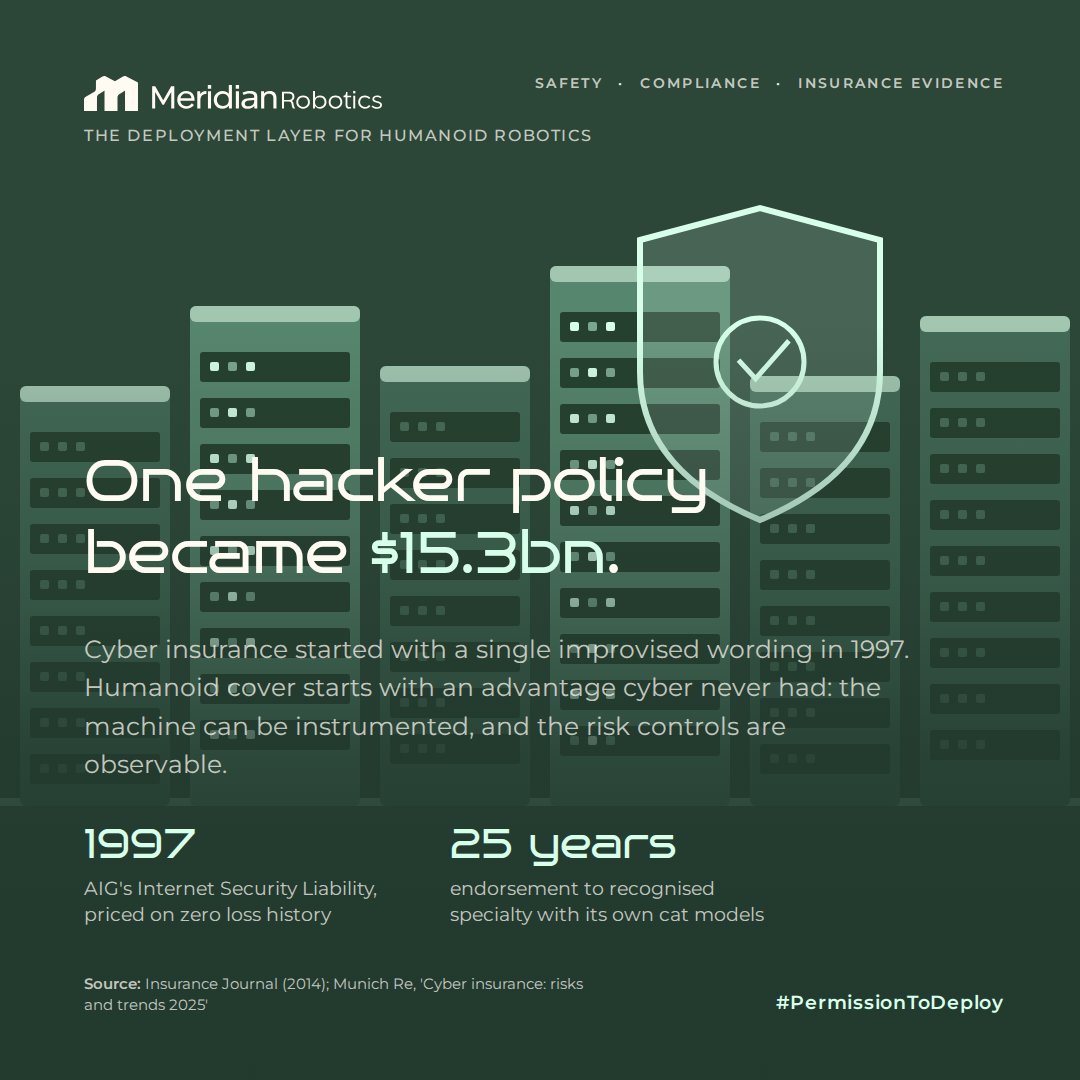
Cyber insurance: from one improvised 'hacker policy' in 1997 to a $15.3bn market. Humanoid cover starts with an advantage cyber never had.
AIG's Internet Security Liability product was presented at a risk management convention in 1997: a third party policy written with zero loss history.
Its maturation path took 25 years: bolted on endorsements, then standalone wordings, then a recognised specialty with its own reinsurance, cat models and MGA ecosystem. That path is the developmental route map for robot cover.
But humanoids arrive with something no previous class offered: machines that record their own evidence. Incident logs, near misses, software versions, intervention rates, human proximity hours. All logged continuously, per robot, per hour.
The actuarial record accumulates at fleet speed rather than calendar speed.
Pricing follows the class through three phases: bespoke engineer priced placements for today's pilots; fleet rated cover as telemetry accumulates; then a generalised small commercial product. Cyber took 25 years without machines that log their own evidence. This class will be faster.
We do not build robots. We make them deployable.
Underwriters: what data field would you most want from a deployed humanoid fleet?
#PermissionToDeploy #CyberInsurance #Insurtech #HumanoidRobots #Telemetry #Underwriting
Sources: Insurance Journal (2014); Munich Re, 'Cyber insurance: risks and trends 2025'
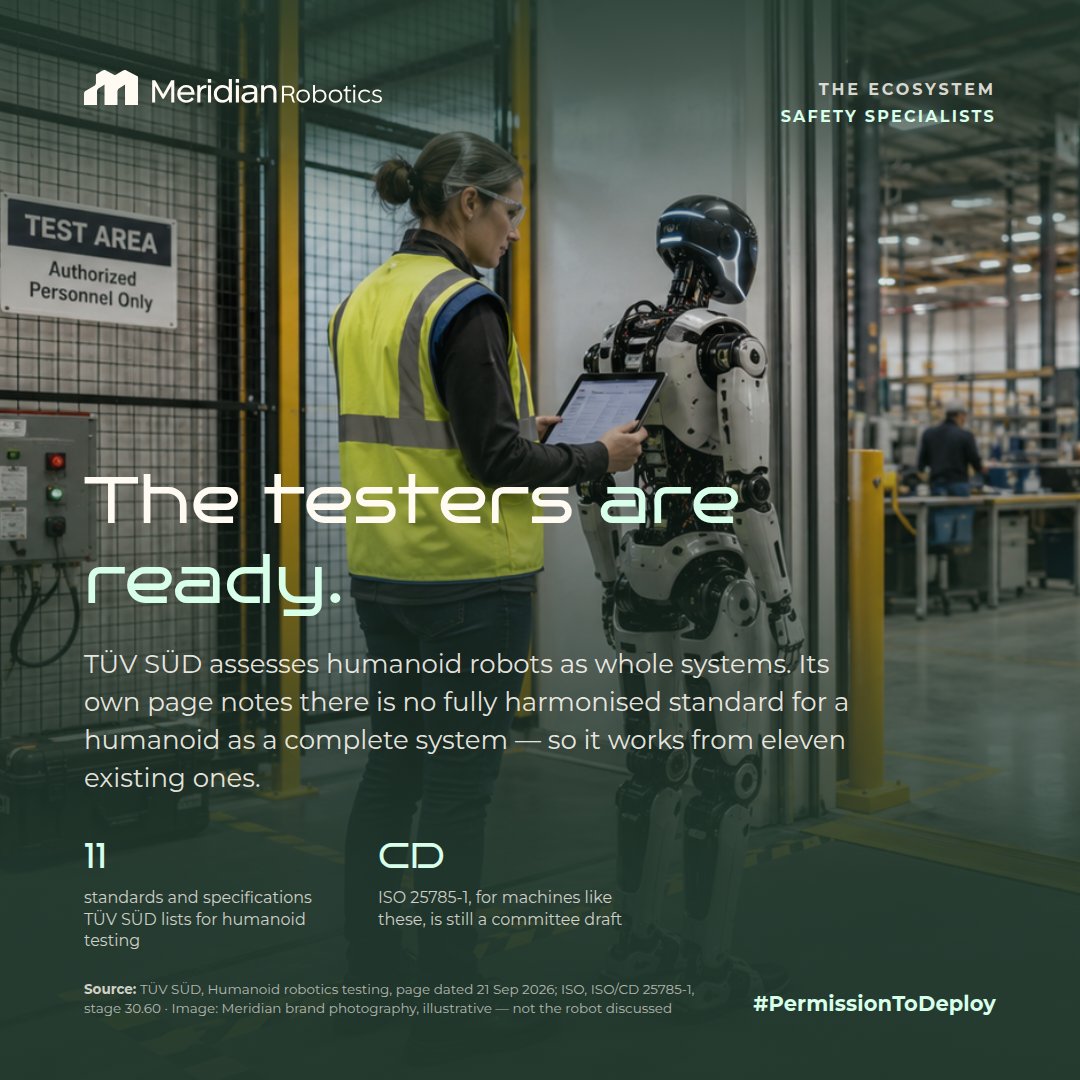
Who checks a humanoid robot before it works next to people? Not the company that built it.
TÜV SÜD tests and certifies humanoid robots as whole systems: sensors, mechanics, control systems, software, AI-enabled functions and cybersecurity, assessed together.
Its own page is candid: "There is currently no fully harmonised standard for humanoid robots as a complete system". So TÜV SÜD works from existing ones, from ISO 12100 on risk assessment to ISO 10218 for robots and IEC 62443 for cybersecurity. The standard written for machines like these, ISO 25785-1, is still a committee draft.
That is the ecosystem. The maker builds the machine. The testing house assesses it. The operator still has to show that this robot, on this site, with these people, is safe, insured and run by trained staff.
Nobody gets a humanoid to its first shift alone. Meridian Robotics is the compliance, insurance and training layer that closes the gap between a tested machine and a working site.
We do not build robots. We make them deployable.
#PermissionToDeploy #HumanoidRobots #RobotSafety #FunctionalSafety #MachinerySafety
Image: Meridian Robotics brand photography. The humanoid pictured is illustrative and is not the one discussed in this post.
Sources:
TÜV SÜD, Humanoid robotics testing & certification (page dated 21 Sep 2026): https://t.co/HC2ZweQpuD
ISO, ISO/CD 25785-1, stage 30.60 (checked 28 Sep 2026): https://t.co/MkO1oPWfmt
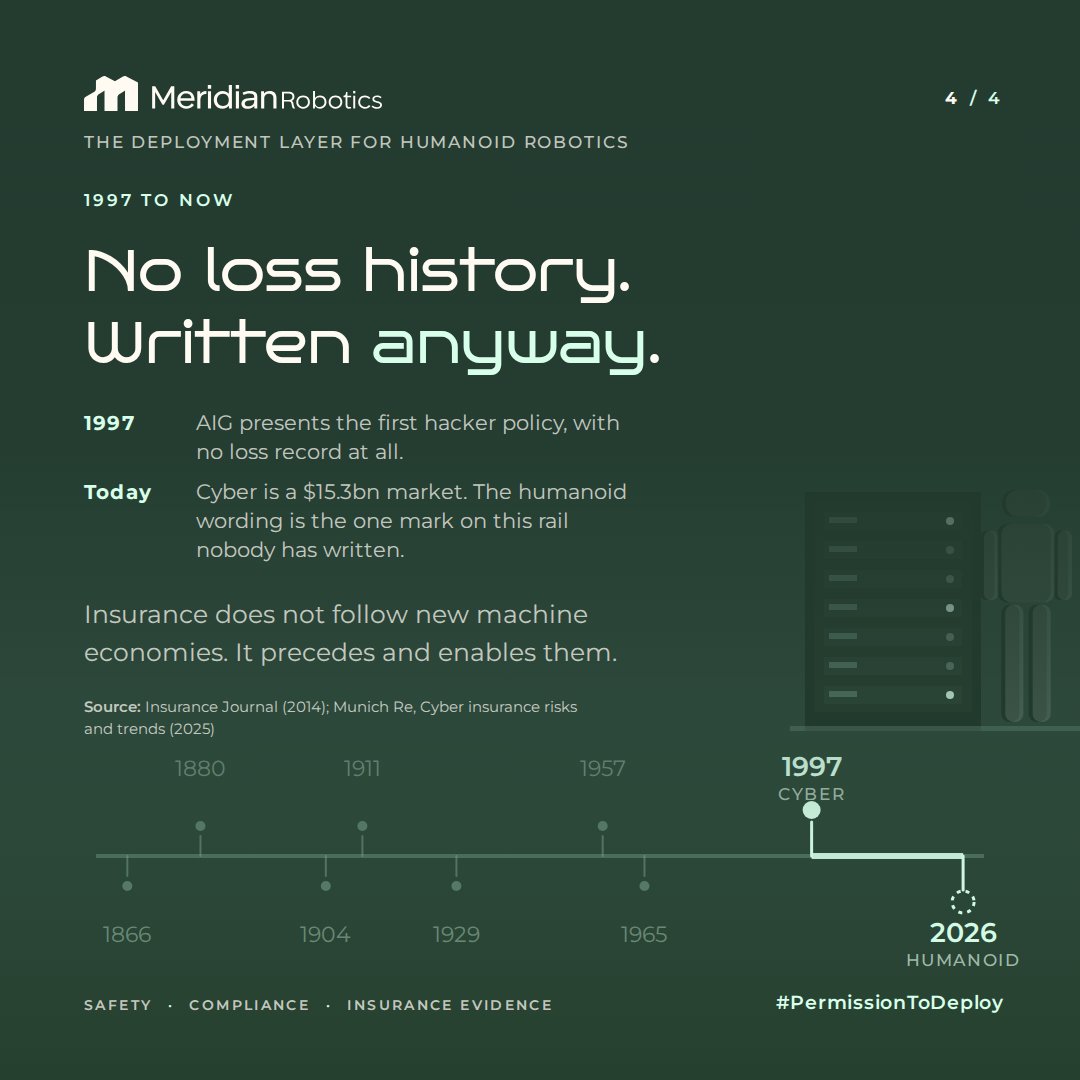
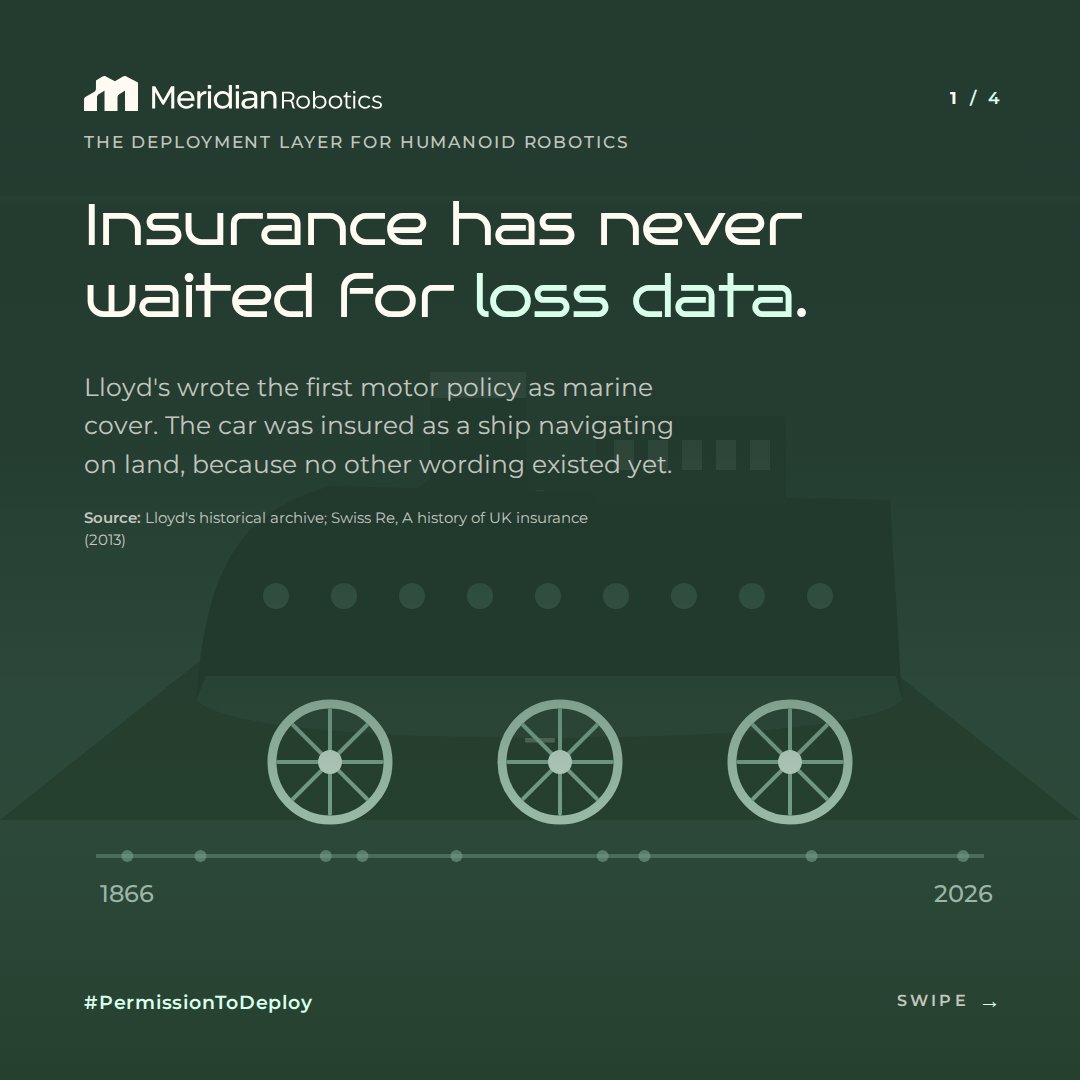
Lloyd's insured the first motor car as 'a ship navigating on land.' Insurance has never waited for loss data. A 160 year timeline:
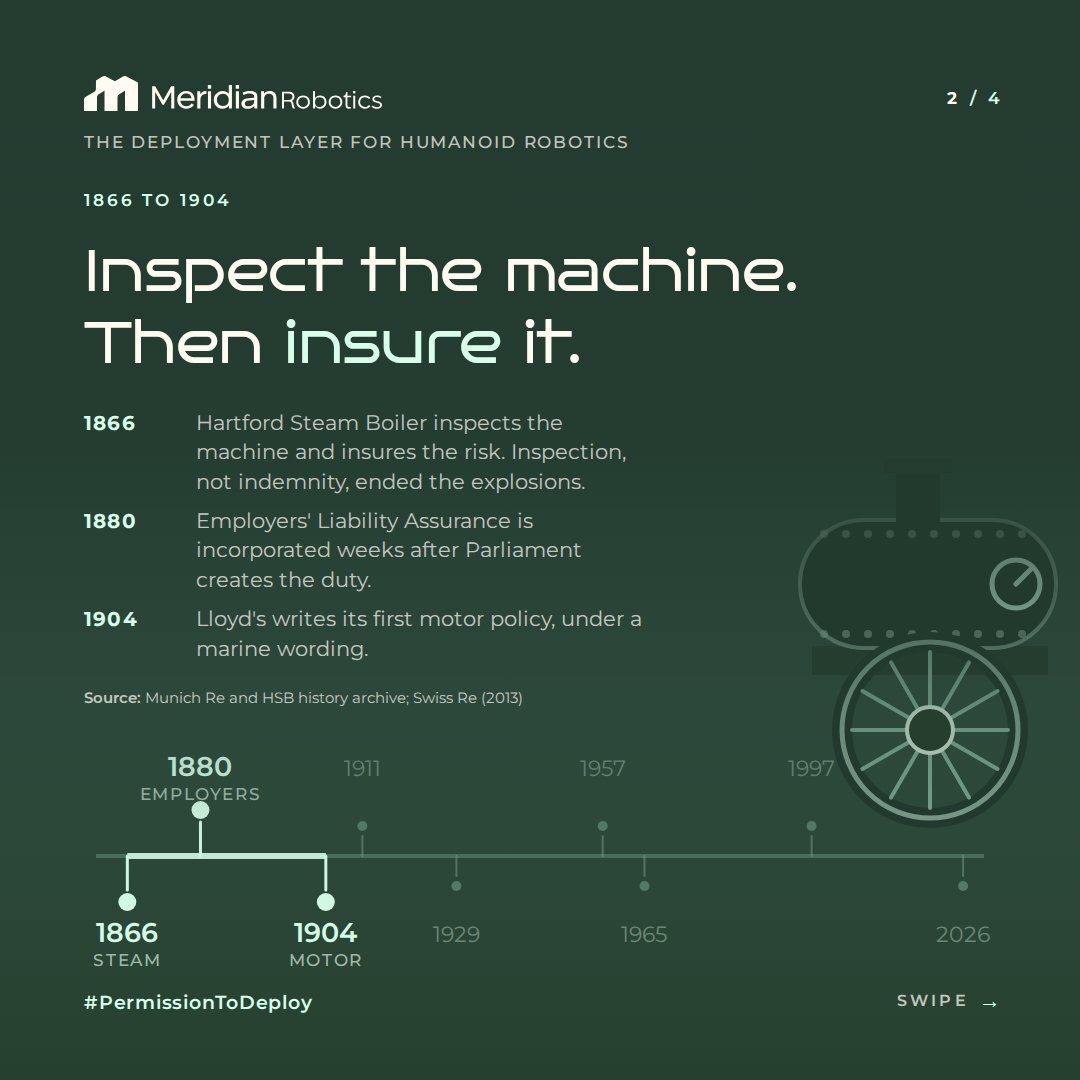
1866: Hartford Steam Boiler inspects the machine and insures the risk. 1880: Employers' Liability Assurance Corporation incorporated within weeks of Parliament creating the liability. 1904: Lloyd's writes its first motor policy under a marine wording. Compulsion follows adoption (Massachusetts 1927, UK Road Traffic Act 1930); the class is now the largest P&C line on earth, at over $800bn in annual premium.
1911: first aviation policy at Lloyd's. 1929: the Warsaw Convention caps carrier liability precisely so the risk becomes insurable. 1957: Price Anderson recruits the state as reinsurer of last resort for nuclear's systemic tail. 1965: first satellite cover, for Intelsat's Early Bird.
1997: AIG presents the first 'hacker policy' with no loss history whatsoever. Today cyber is a $15.3bn global market that Munich Re expects to more than double by 2030.
The lesson across a century and a half is uniform: insurance does not follow new machine economies. It precedes and enables them.
The idea that humanoids are 'uninsurable because there is no actuarial record' would have strangled every specialty class this market ever built.
We do not build robots. We make them deployable.
Which era is the best analogue for humanoids? Vote in the comments.
#PermissionToDeploy #InsuranceHistory #Lloyds #Innovation #HumanoidRobots
Sources: Swiss Re, 'A history of UK insurance' (2013); Lloyd's historical archive; Munich Re/HSB history archive; US NRC Price Anderson Act backgrounder; ICAO Warsaw System; Insurance Journal (2014); Munich Re cyber report (2025); Insuramore global motor rankings via Beinsure (2025)
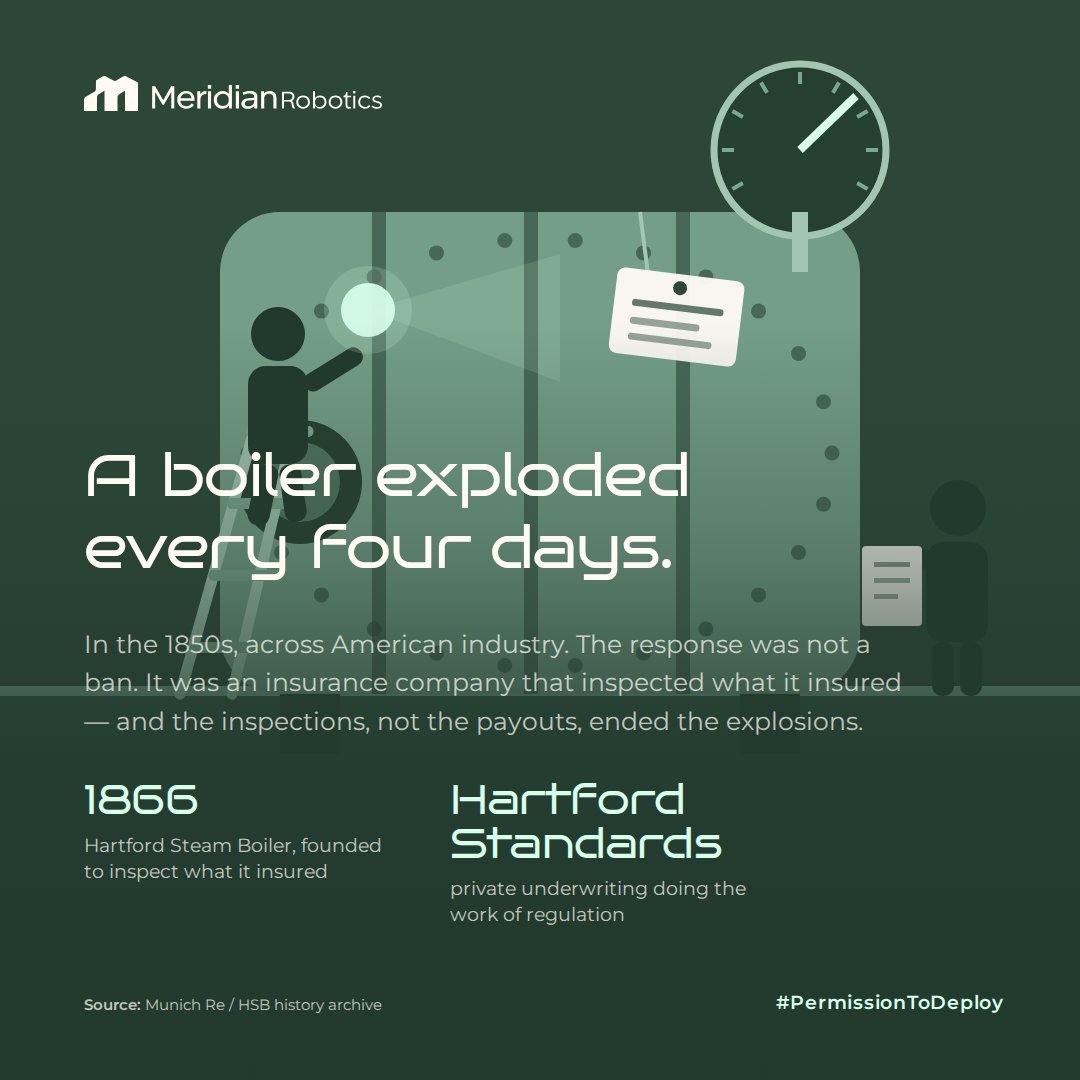
In the 1850s, American steam boilers exploded roughly once every four days. The response wasn't a ban. It was an insurance company.
The Hartford Steam Boiler Inspection and Insurance Company, founded 1866, was built on an idea that was radical at the time: the insurer should inspect the machine before and during the life of the policy. Prevention was the product; indemnity was the guarantee behind it.
HSB's 'Hartford Standards' became the de facto engineering specification for an entire industry: private underwriting discipline doing the work of public regulation, decades before regulators caught up.
It is the single best template for humanoid cover. Where loss history is absent, engineering must substitute for it: underwrite the inspection, not the loss triangle.
A humanoid policy conditioned on standards conformity, defined operational design domains, and continuous telemetry makes the insurer a party to the engineering conversation, and premium becomes the price signal that transmits safety standards through the industry faster than any regulator can.
1866 solved this problem. We just have to remember how.
Follow Meridian for the full 'insurance built every machine age' series.
#PermissionToDeploy #InsuranceHistory #HSB #RiskEngineering #HumanoidRobots #Underwriting
Sources: Munich Re/HSB history archive; Flynn, 'Permission to Deploy' (Jul 2026)


![HumanoidPaul's tweet photo. On 30 September, Flourish launched Flourish 1: a wheeled semi-humanoid for the home at $3,555.
The machine: a torso and two arms on a wheeled pillar, 3ft 7in, 44lb, lifting up to 3.3lb and running up to twelve hours a charge. You teach it a task by demonstrating it through a phone app - about thirty minutes - and it then runs on its own.
Pre-orders are open for the first fifty units, with deliveries due in December. The jobs are laundry, bins, wiping a table, watering plants.
At that price the interesting question is not the home. It is the small business that buys one.
Sold to a household it answers to consumer product rules - in the EU, the General Product Safety Regulation, which has applied since 13 December 2024. [2] Put the same machine in a shop or a workshop and the duties change hands: under UK PUWER, whoever controls work equipment must make sure it is suitable for the job and used only by people with adequate information, instruction and training.
A consumer price is not a licence to deploy at work. Meridian Robotics is the compliance, insurance and training layer that closes that gap.
We do not build robots. We make them deployable.
#PermissionToDeploy #HumanoidRobots #ProductSafety #PUWER #Robotics
Sources:
Forbes, John Koetsier, "This $3,555 Humanoid Robot Is Slow, Basic, Cheap. Mission Accomplished.", 30 Sep 2026 - https://t.co/zVXtuNtYmG
https://t.co/02VEYsJvZK, "EU Regulation 2023/988 on General Product Safety: detailed guidance", updated 4 Nov 2025 - https://t.co/TLDpWIwSVG
HSE, "Provision and Use of Work Equipment Regulations 1998 (PUWER) - overview", accessed 5 Oct 2026 - https://t.co/bZhPAFBtIM](https://pbs.twimg.com/media/HUGwyobW0AAO-91.jpg)
![HumanoidPaul's tweet photo. On 30 September, Flourish launched Flourish 1: a wheeled semi-humanoid for the home at $3,555.
The machine: a torso and two arms on a wheeled pillar, 3ft 7in, 44lb, lifting up to 3.3lb and running up to twelve hours a charge. You teach it a task by demonstrating it through a phone app - about thirty minutes - and it then runs on its own.
Pre-orders are open for the first fifty units, with deliveries due in December. The jobs are laundry, bins, wiping a table, watering plants.
At that price the interesting question is not the home. It is the small business that buys one.
Sold to a household it answers to consumer product rules - in the EU, the General Product Safety Regulation, which has applied since 13 December 2024. [2] Put the same machine in a shop or a workshop and the duties change hands: under UK PUWER, whoever controls work equipment must make sure it is suitable for the job and used only by people with adequate information, instruction and training.
A consumer price is not a licence to deploy at work. Meridian Robotics is the compliance, insurance and training layer that closes that gap.
We do not build robots. We make them deployable.
#PermissionToDeploy #HumanoidRobots #ProductSafety #PUWER #Robotics
Sources:
Forbes, John Koetsier, "This $3,555 Humanoid Robot Is Slow, Basic, Cheap. Mission Accomplished.", 30 Sep 2026 - https://t.co/zVXtuNtYmG
https://t.co/02VEYsJvZK, "EU Regulation 2023/988 on General Product Safety: detailed guidance", updated 4 Nov 2025 - https://t.co/TLDpWIwSVG
HSE, "Provision and Use of Work Equipment Regulations 1998 (PUWER) - overview", accessed 5 Oct 2026 - https://t.co/bZhPAFBtIM](https://pbs.twimg.com/media/HUGwyhsXcAErnOn.jpg)
![HumanoidPaul's tweet photo. On 30 September, Flourish launched Flourish 1: a wheeled semi-humanoid for the home at $3,555.
The machine: a torso and two arms on a wheeled pillar, 3ft 7in, 44lb, lifting up to 3.3lb and running up to twelve hours a charge. You teach it a task by demonstrating it through a phone app - about thirty minutes - and it then runs on its own.
Pre-orders are open for the first fifty units, with deliveries due in December. The jobs are laundry, bins, wiping a table, watering plants.
At that price the interesting question is not the home. It is the small business that buys one.
Sold to a household it answers to consumer product rules - in the EU, the General Product Safety Regulation, which has applied since 13 December 2024. [2] Put the same machine in a shop or a workshop and the duties change hands: under UK PUWER, whoever controls work equipment must make sure it is suitable for the job and used only by people with adequate information, instruction and training.
A consumer price is not a licence to deploy at work. Meridian Robotics is the compliance, insurance and training layer that closes that gap.
We do not build robots. We make them deployable.
#PermissionToDeploy #HumanoidRobots #ProductSafety #PUWER #Robotics
Sources:
Forbes, John Koetsier, "This $3,555 Humanoid Robot Is Slow, Basic, Cheap. Mission Accomplished.", 30 Sep 2026 - https://t.co/zVXtuNtYmG
https://t.co/02VEYsJvZK, "EU Regulation 2023/988 on General Product Safety: detailed guidance", updated 4 Nov 2025 - https://t.co/TLDpWIwSVG
HSE, "Provision and Use of Work Equipment Regulations 1998 (PUWER) - overview", accessed 5 Oct 2026 - https://t.co/bZhPAFBtIM](https://pbs.twimg.com/media/HUGwyYVXgAAbr0C.jpg)







![HumanoidPaul's tweet photo. On 30 September, Flourish launched Flourish 1: a wheeled semi-humanoid for the home at $3,555.
The machine: a torso and two arms on a wheeled pillar, 3ft 7in, 44lb, lifting up to 3.3lb and running up to twelve hours a charge. You teach it a task by demonstrating it through a phone app - about thirty minutes - and it then runs on its own.
Pre-orders are open for the first fifty units, with deliveries due in December. The jobs are laundry, bins, wiping a table, watering plants.
At that price the interesting question is not the home. It is the small business that buys one.
Sold to a household it answers to consumer product rules - in the EU, the General Product Safety Regulation, which has applied since 13 December 2024. [2] Put the same machine in a shop or a workshop and the duties change hands: under UK PUWER, whoever controls work equipment must make sure it is suitable for the job and used only by people with adequate information, instruction and training.
A consumer price is not a licence to deploy at work. Meridian Robotics is the compliance, insurance and training layer that closes that gap.
We do not build robots. We make them deployable.
#PermissionToDeploy #HumanoidRobots #ProductSafety #PUWER #Robotics
Sources:
Forbes, John Koetsier, "This $3,555 Humanoid Robot Is Slow, Basic, Cheap. Mission Accomplished.", 30 Sep 2026 - https://t.co/zVXtuNtYmG
https://t.co/02VEYsJvZK, "EU Regulation 2023/988 on General Product Safety: detailed guidance", updated 4 Nov 2025 - https://t.co/TLDpWIwSVG
HSE, "Provision and Use of Work Equipment Regulations 1998 (PUWER) - overview", accessed 5 Oct 2026 - https://t.co/bZhPAFBtIM](https://pbs.twimg.com/media/HUGwyw4WAAAbIXZ.jpg)

![HumanoidPaul's tweet photo. "Europe has a robot adoption problem. Adoption fails on financing, risk and compliance long before it fails on technology." That is Alexander Stevens, founder and CEO of Motion, in Brussels [1].
Motion raised $2m in pre-seed funding in August, led by Extantia Capital with Norrsken Evolve [1]. It supplies humanoids on a monthly fee that covers robot selection, task training, IT integration, fleet management, financing, insurance, compliance and maintenance [1]. It is running five pilots in Belgium [1] and says it chooses the robot to suit the task rather than tying itself to one maker [2].
What stands out is the list. Almost none of it is the robot. It is everything around the robot that decides whether a site can switch it on.
That is why the integrator matters, and why nobody gets to first shift alone: makers, integrators, testers, insurers and trainers each hold a piece. Meridian Robotics is the compliance, insurance and training layer that closes the gap between a pilot and permission to deploy.
We do not build robots. We make them deployable.
Image: Meridian Robotics brand images. The humanoid pictured is illustrative and is not the one discussed in this post.
#PermissionToDeploy #HumanoidRobots #RobotsAsAService #Robotics #Belgium
Sources:
https://t.co/tDxE54BuLM, "Motion lands $2M to expand humanoid robot deployments across Europe", 27 Aug 2026: https://t.co/LsKKDJHN8S, "Brussels-based Motion raises €1.7 million to tackle Europe's 'robot adoption problem'", 27 Aug 2026: https://t.co/uBpQtgoIwO](https://pbs.twimg.com/media/HUBe9NjXMAA0O0e.jpg)