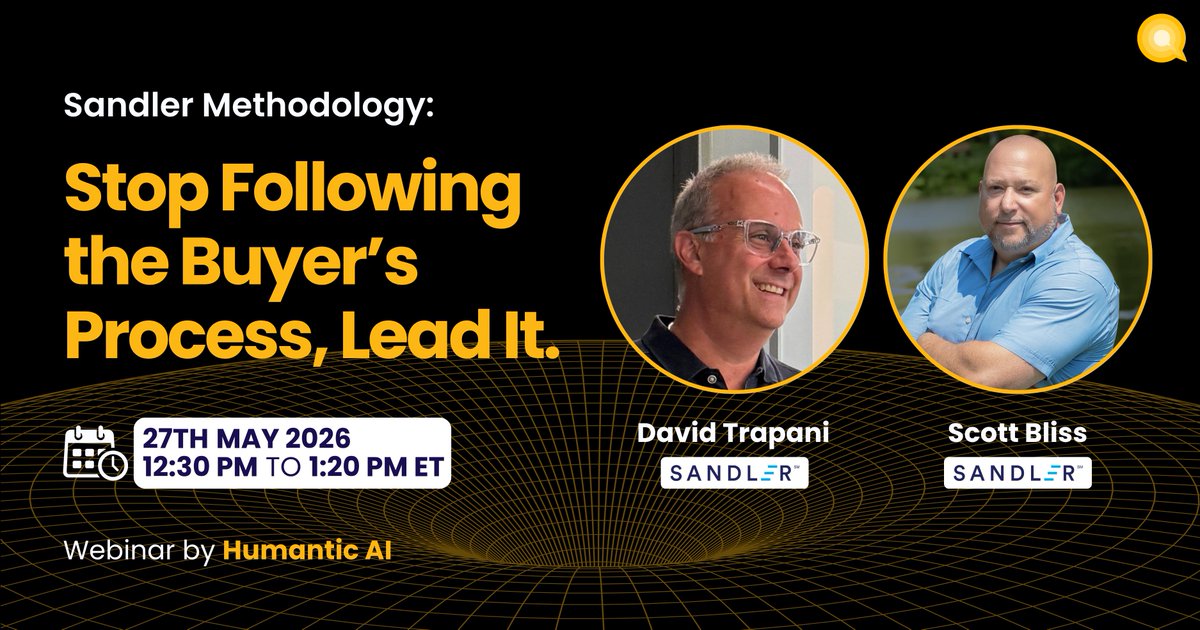
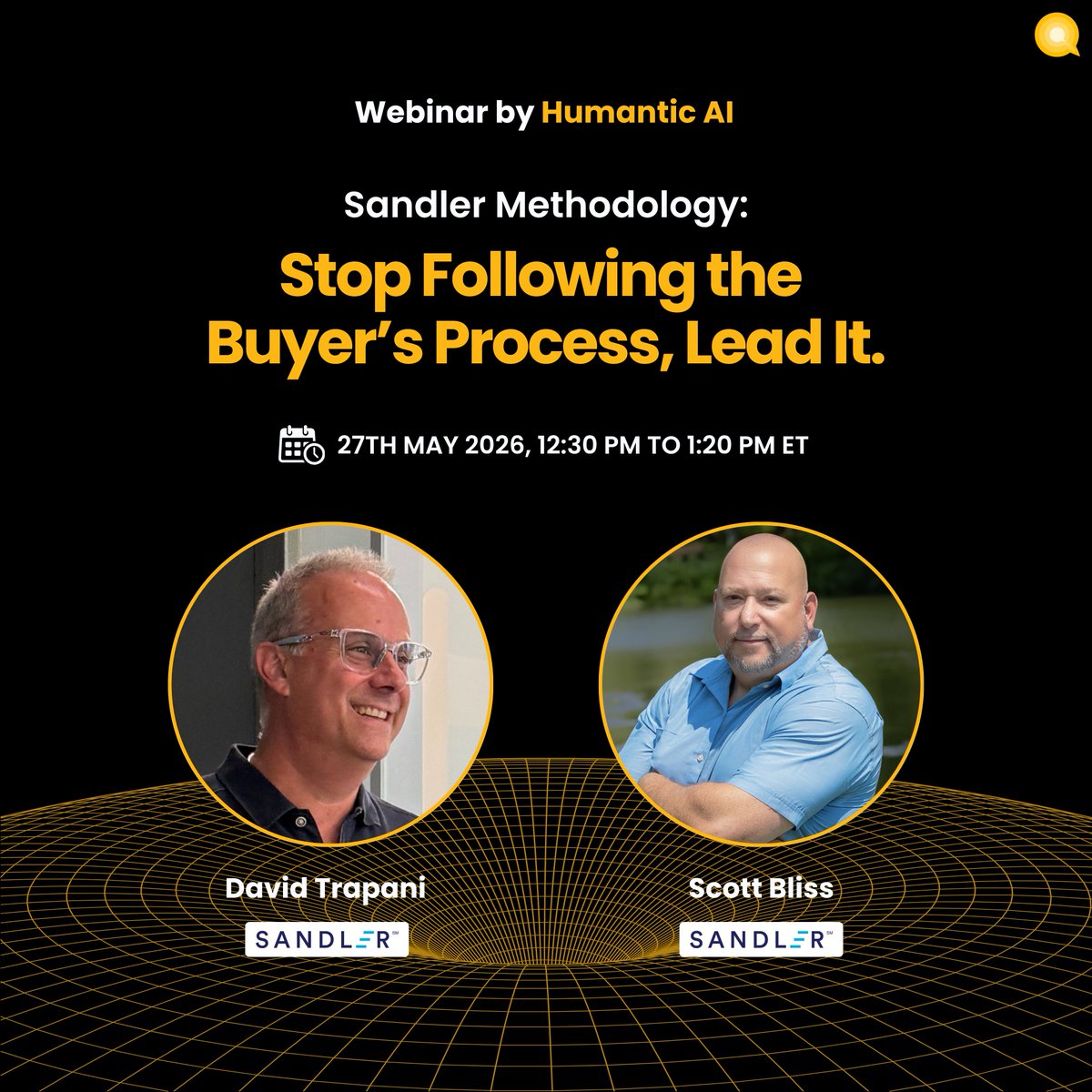
We go live in a few hours.
Scott Bliss & David Trapani from Sandler on how to stop following the buyer's process and start leading it.
Last chance to register 👇
https://t.co/ZrZGrMLvmz
#Sales#Sandler
Tomorrow. 12:30 PM ET.
Two Sandler experts. One session on the thing killing more deals than anything else right now.
Not the product. Not the price.
Control.
Grab your spot → https://t.co/ZrZGrMLvmz
#Sales#SalesLeadership
"Just checking in..."
That email exists because the buyer took control of your process, and you don't know how to get it back.
Scott Bliss & David Trapani from Sandler are going live this Wednesday to fix exactly that.
Register → https://t.co/ZrZGrMLvmz
#Sales#Sandler
The silence after a proposal
isn't shock at the price.
It's the buyer realizing
they now have to build an internal business case
and present it to someone senior.
And they're not sure how.
And they don't want to tell you that.
The reps who pick up on this
and offer to help build the internal case -
not sell the product again,
actually help with the sell inside their company -
those are the ones
who get the deal back on track.
Be useful to them,
not just persuasive to them.
New rep on the team.
First enterprise deal closed in 90 days.
No slides. Not one.
Every call was a conversation.
She asked something. They answered.
She asked a follow-up. They went deeper.
End of call three:
She wrote a two-page email.
Recapped exactly what she'd heard.
What she understood the problem to be.
What she thought the right move was.
They replied the same day.
'This is exactly right. Let's do it.'
Listening is a closing skill.
Most salespeople think they're running the deal.
They're not. The buyer is.
Joining us May 27: two Sandler trainers with 55+ years of experience breaking down how to take that control back - from the very first call.
12:30 PM ET → https://t.co/lvQJpISWba
#Sales #SalesLeadership
Same pitch.
Same rep.
Same product.
Different buyer.
One closed in two calls.
One took eight weeks of silence and one email.
The pitch wasn't the variable.
The person was.
Knowing what the person needs
to feel ready to move forward -
that's the work.
Buyer Intelligence makes that work
systematic instead of accidental.
95% of salespeople use ChatGPT for cold emails.
They all sound identical. That's why yours gets deleted.
A D-type buyer wants no greeting, no fluff - just numbers in 10 seconds flat.
Humantic AI rewrites your outreach for whoever's actually reading it.
Stop sending generic. Start getting replies.
#AIinSales #SalesTips
Rep thought the deal was stuck on price.
It wasn't.
It was stuck on trust.
The prospect didn't believe
the implementation timeline was real.
They'd been burned before.
By someone else, different product.
Four months longer than promised.
Two engineers tied up.
Nobody asked about it.
Nobody knew it existed.
Price negotiation for two weeks.
One 10-minute conversation
would have unlocked it.
The real blocker is rarely what it looks like.
When a buyer asks about competitors mid-conversation,
they already know who they are.
They've probably already talked to them.
The question isn't 'who else is out there?'
It's:
Are you going to get defensive?
Are you going to dodge it?
Or are you going to handle it with some honesty?
How you answer tells them more
about whether they can trust you
than anything in your deck.
It's a character check
disguised as a product question.
The follow-up email that got ignored for two weeks
was technically good.
Good structure. Clear ask. Right length.
Written for the wrong person.
The buyer processes decisions emotionally.
Validates with data afterward.
The email led with a framework.
Ended with three bullet points.
If it had started with a real scenario -
made them feel something -
then backed it with numbers -
different outcome.
Same information.
Different order.
That's the whole game.
Quarter ended.
Deals that were 'about to close' didn't.
Nobody was shocked.
Happened last quarter too.
The fix is not in the forecast.
The fix is not in the CRM.
It's in the pipeline.
Specifically: in the honest conversations
that need to happen
before a deal gets to late stage.
The forecast problem is downstream.
The real problem is upstream.
Fix the pipeline review.
Everything else follows.
Buying decisions go through a committee
not because companies are slow.
Because the person signing the contract
needs cover if it goes wrong.
A committee sign-off means
no single person holds the bag.
When they say
'we need to bring this to the team' -
they're not stalling.
They're protecting themselves.
That's completely rational.
Understanding it changes how you help
your champion build the internal case.
Which is the actual work.
The best reps on the team
don't just read the room when they're in it.
They came in already knowing something about it.
Not just the account.
The person.
What they care about.
How they communicate.
What would make them trust someone quickly.
What would make them cautious.
That's not a gut feeling.
That's preparation.
And preparation at that level
is what separates reps who get lucky sometimes
from the ones who are consistent.
The outreach email that actually got a reply
had one thing different from the 40 that didn't.
It started with something real about the person.
A talk they gave.
A post they wrote.
A specific challenge someone in their role
was publicly working through.
Not a compliment.
Not flattery.
Just evidence that someone actually paid attention.
That's what made it feel different.
Feeling different is the only way to get read
when every inbox looks the same.
The committee meeting isn't when they decide.
It's when they announce what they already decided.
The real decision happened before -
in the champion's head after your third call,
in a Slack thread,
in the hallway conversation before the meeting started.
By the time you're presenting to the full room,
two or three people have already shaped it.
The committee is the announcement.
The sales process that matters
is the one happening
between the people you're not in the room with.
Rep asked 'what's your timeline?' on every call.
Standard question. She had it in her notes.
She got answers.
End of Q2. Before the new fiscal year.
Before we hire the new head of ops.
What she never asked:
'What's driving that timeline?'
End of Q2 because there's a board meeting?
Because a contract expires?
Because it's just a rough guess?
The timeline question gets a date.
The 'what's driving it' question gets a deal.
Your product is the same as it was a year ago.
Your close rate changed
when your team started having different conversations.
Because they knew more about the person.
They could flex the talk track.
They could match the energy.
They could lead with what actually mattered
to that specific buyer.
The product didn't change.
The positioning didn't change.
The conversation did.
That's where the number moved.
They went quiet because they were embarrassed.
Budget got cut.
They didn't know how to tell you.
Nobody teaches buyers how to deliver bad news
to a vendor they actually like.
So when it gets uncomfortable,
the path of least resistance is silence.
It's not malicious.
It's just easier than the conversation
they don't know how to start.
A check-in that gives them an easy out
will get more replies than a follow-up that doesn't.
The call that closed the deal was the fourth one.
But the first three are what made it possible.
First call: they realized you understood their space.
Second call: they tested if the product held up.
Third call: they figured out if they could trust you
when things go wrong.
By the fourth, they'd already decided.
They were just confirming.
There's no shortcut in that sequence.
You can't compress it
without losing what it builds.