- MARKET STRUCTURE -
- Basics
@Moneytaur_ does not reference market structure often, not because its not important, but because these basics should be learned elsewhere. For this writeup, here’s a brief refresher before moving to some MT-specific concepts.
-------
- Trends
Trends are always relative to the timeframe.
Higher timeframe trends dominate lower ones.
Bullish Trend
Consists of a series of higher highs and higher lows.
Bearish Trend
Consists of a series of lower highs and lower lows.
📝A sideways trend is made up of smaller trends confined to a range.
-------
- Structure
Market structure is the foundation on which all key concepts in MT’s trading style are built. Liquidity, imbalances, and supply and demand are all rooted in structure.
Price action is the process that builds this foundation. PA follows liquidity, and this constant search for liquidity shapes structures.
Imbalances between buyers and sellers create directional moves (FVGs), while balance creates fair value zones (Ranges).
Balance → Imbalance → Balance → Imbalance
“If there’s no significant imbalances, there will be OBs and Supply/Demand fresh levels. If there’s no OBs and Supply/Demand fresh levels, there will be significant imbalances.
If there’s none at all it will ⚡️ into a ‘fresh’ level and build a new trading range.
Few…” https://t.co/UOSYiuqJrm
The higher the timeframe, the more robust the structure and the more reliable the signal. HTF > LTF.
Structure defines supply and demand, premium & discount, and creates liquidity zones. It also defines ranges. When price action moves beyond these range boundaries, there are four main possible outcomes:
• Break out/down: price breaks through the range and keeps moving.
• Rejection: price fails to break the range.
• Break out/down plus retest: price closes relevant candle bodies past the range and continues after retracing back into key liquidity.
• Fake-out: price breaks out/down, and then reverses.
Outcomes 3 and 4 differ clearly.
Fake-outs are usually sharp and aggressive, often leaving large wicks from stop hunts or liquidity grabs.
Retests tend to be slower and more deliberate, usually following higher timeframe candle closes past the prior range boundaries.
“Look for HTF body close above previous most significant swing highs. If not, it’s likely a false breakout. If it does, the highest probability play is waiting for a pullback into key level before continuation into the next HTF liquidity level, and if there’s none to take it will likely go to new ATH.”
https://t.co/0DG6h2dw79
- Internal vs. External Structure
External Structure
• The overall trend visible on a higher timeframe (relative to a lower timeframe).
• A weekly chart is made up of seven daily candles; compared to the daily, the weekly is external structure.
Internal Structure
• The smaller movements within the higher timeframe, seen on lower timeframes.
• Shows smaller trends inside the larger move.
Internal structure can shift short-term without changing the external trend. Always let the external (HTF) structure guide your HTF bias; internal structure offers early clues.
Example: (📈 in comments)
This 2W chart is external structure and clearly in an uptrend.
On this daily chart of the grey box, we are in a downtrend. This is internal structure.
The examples highlight the importance of always seeing structures in relation to each other.
M > W > D > H > M > S
Internal structure shifts can be the early clue that external structure may change. Let the higher timeframes define the macro structure and watch for early signs on lower timeframes.
-------
- Market Phases
The Four Market Phases
Accumulation
• Typically follows a downtrend but can appear anywhere market makers prepare for markup.
• The range lets market makers accumulate while pushing news to fit the narrative.
Buy Program (Bull Market/Markup)
• Follows accumulation or re-accumulation.
• The asset appreciates in value.
Distribution
• Typically follows an uptrend but can appear anywhere market makers prepare for markdown.
• The range lets market makers offload while pushing news to fit the narrative.
Sell Program (Bear Market/Markdown)
• Follows distribution or re-distribution, depending on context.
• The asset depreciates in value.
(📈 in comments)
- The Psychology of the Phases
Accumulation
Emotion: Skepticism, disbelief, apathy
Psychology: Most traders are fearful or disinterested. Market makers are quietly buying.
Behaviour: Retail avoids the market; volume is low; sentiment is bearish or indifferent.
Media manipulation: The most bearish news marks the bottom. “Markets are dead.”
Bull Market (Markup/Buy Program)
Emotion: Optimism, excitement, euphoria
Psychology: Confidence builds as prices rise. Retail starts buying in; FOMO.
Behaviour: Volume increases; media turns positive; public participation grows.
Media manipulation: Coverage increases and sentiment turns bullish in line with price.
🔺Intensifies with trend
Distribution
Emotion: Greed, overconfidence, denial
Psychology: Retail believes the trend will continue; smart money is offloading.
Behaviour: Volatility increases; price chops; bullish sentiment remains high.
Media manipulation: News remains bullish; influencers push FOMO narratives.
Bear Market (Markdown/Sell Program)
Emotion: Anxiety, fear, panic, capitulation, despair
Psychology: Retail sells in panic. Smart money prepares to accumulate again.
Behaviour: Heavy selling; negative news cycle; retail sells at loss.
Media manipulation: After the initial selloff, fear-driven headlines dominate.
🔺Intensifies with trend
🔺Understand that the system runs on predictable human behaviour. Stay hyper-aware of your own emotions and learn to flip them into signals instead of traps.
“When you feel you will make a lot of money by holding, it is close to the top. When you feel you will lose all your money by holding, it is close to the bottom.
Your own fear and greed emotions are two of the most powerful indicators you will ever find.” https://t.co/oHAxhgJtCy
-------
- Market Structure Shifts
Changes in structure are vital for gauging the probabilities of the next move. Understanding these shifts and the patterns that reveal them is essential for becoming consistently profitable.
BOS – Break of Structure
A BOS occurs when price closes relevant candle bodies past a significant high or low. It confirms a change in structure.
CHoCH – Change of Character
A CHoCH happens when price breaks structure in the opposite direction of the current trend. It’s the first signal of a possible trend reversal.
BOMS – Break of Market Structure
A BOMS is a clear break of market structure, usually on higher timeframes and significant levels. It confirms a shift in intent when validated and often shows higher volume and leaves FVGs behind.
- Trend Changes
Using trends, BOS, CHoCH, and BOMS helps identify key structural shifts in the market. Knowing when the market transitions from a buy to a sell program is crucial for being profitable.
“Buy program: Bullish BBs work wonders.
Buy program: Bearish BBs can often fail, unless optimal.
Sell program: Bearish BBs work wonders.
Sell program: Bullish BBs can often fail, unless optimal.” https://t.co/CWKVFBwZSe
Putting all learned concepts together helps us spot potential tops forming. Using the ideas above gives us further confirmation.
(📈 in comments)
-------
- MT’s 1,2,3 System (Squiggles)
For MT, structural shifts are an essential part of his setups. The system has three parts:
• A valid break of a key level (BOS)
• A retrace into liquidity
• Entry at the refined level to ride the reversal
This approach ensures we get the optimal entry after fuel is taken, letting us ride the trade longer with clearer invalidation and better RR.
“There’s no MTF or HTF candles closing above key PSH, so you don’t long here. For the highest probability long it’s the squiggle on the chart, with MTF (at least) close above key PSH plus pullback (the entry) before bullish continuation.” https://t.co/DwsTmv5NUI
“All “squiggles” mean the strategy is to wait for close above or below HTF key levels as stage 1 of 3, pullback or retracement into key levels if you can find them, and most of the time you can because bots always leave such levels with fuel behind, to come back later and reverse price again as stage 2 of 3 and this is your entry, and then continuation into the direction of the first move, stage 3. This is how these liquidity games work.”
https://t.co/20IM2XZU8d
Breakout trading is popular, but charts like the one below, and the effectiveness of squiggles, show its weakness clearly.
“You can always choose to long the breakout, but this isn���t going for high probability as it’s what all retail traders do, and the game’s designed to stop or liquidate them all, collecting fuel, and then proceed in the direction retail traders expected, which will then make them start revenge trading as they were ‘right but wrong’.”
-------
- Using Liquidity as a Guide
Market makers leave footprints that help us assign probabilities to the next move. Liquidity is key. When key levels are left behind and price action approaches a level without taking the liquidity first, chances are high, it will revisit to grab that fuel before continuing.
“A helpful hint to determine if a breakout will reverse into a key level before trend continuation is to check if there’s a key level left behind in the previous range that price is attempting to break out from. If the key level is present, especially on HTF and you can refine it into lower timeframes, the probability of a pullback into that level before continuation becomes significant, as price tends to gravitate toward such levels. Additionally, if there’s a key level above the swing high that can be taken, it could act as fuel for a drop into the lower level, setting up for a subsequent pump.” https://t.co/dLb32EUytJ
Alternatively, when no such levels exist, the probability is higher that the breakout/down is real and price action will continue in the direction.
“If you cannot find such, the probability for breakout into price discovery, without looking back for a while, is higher.” https://t.co/uxu7gczPIQ
-------
- Confirming a BOS
In general, higher timeframe structures need higher timeframe confirmations. Use timeframes relevant to the trade. For higher timeframe levels MT often looks for closures 12h or higher. Further HTF closures add confluence and reinforce the likelihood the break is real.
Always watch for body closes above or below the swing high or swing low.
(📈 in comments)
Without a confirmed BOS, we risk falling for fake moves. A confirmed BOS marks clearer intent. Wait for the signal, place orders where the fuel sits, and ride the continuation.
🔺Lately, more HTF closes have resulted in reversals. Market makers are aware that retail is looking at daily closes.
“Don’t fall for false moves. Learn to identify confirmed BOS on HTF and you will level up instantly.”
(📈 in comments)
There’s no single timeframe that automatically invalidates every setup. The last five minutes of a HTF candle can close below a level without any real prior price action in that area. Zoom in on lower timeframes and check what’s happening. Look for signs of strength or weakness to support your decision. Stay flexible and weigh all factors.
Things to consider:
• How optimal is the level?
• Where is the level located?
• Is the asset high volume?
• What are majors doing?
• How does price behave around the level?
• Are newly formed LTF structures being respected?
• Is there spoofing?
• What is order flow showing?
MT has posts calling for 12H+ closes to confirm or reject a level; others rely on 2H. This is closer to an art than a rule, an edge that only comes through screen time and real experience.
“Take notes on this PA, because it will change your game. You can go through timeframes up until 2H and you will notice there’s no candle bodies closing below the level where the 2D BB is at. The hint is there. From here I’ll wait for key SH or SL to be taken and find an entry on pullback or retracement. 0 candle bodies closed below 2D BB. Body, not whisker. At least a 2H full body, specifically for SOL as it’s a high TV coin.” https://t.co/NWU3jY4LnM
-------
- Timeframes
Moneytaur has his own definitions of timeframes. You can either adopt his schematics or come up with definitions that are a better fit for you.
“micro TF: 5min and lower
LTF: 15min > 2H
MTF: 2H > 12H
HTF: 12H > M+” https://t.co/ddmUmlaFK9
HTF (12h+)
• Hold the most liquidity and are the most reliable.
• The higher the TF, the clearer the signal of the predominant trend.
• 1W+ are macro timeframes.
• HTF plays = up to 3% of trading account, max 5% if optimal.
MTF (2h–12h)
• First reliable validations of BOS, CHoCH, BOMS.
• Key for refining levels.
• MTF plays = up to 2% of trading account.
LTF (5m–2h)
• Super-refined entries, exits, and stops.
• First possible signs of BOS, CHoCH, BOMS.
• Less reliable as they hold less liquidity.
• LTF plays = up to 1% of trading account.
mTF (<5m)
• Ultra-refined entries, exits, and stops.
• Entries or exits based on micro structure reactions to key levels.
“In micro timeframes, you can better see when a price reversal is likely, since the ⚡️ at key levels is a powerful sign of that. If you spend time in those timeframes when the price is reaching key levels where you expect a reaction, you’ll start to notice a pattern and better understand whether a reversal can actually occur or if the reaction is too weak. As for the ‘ping-pong’ at key levels, it’s the same, but weaker than in lower timeframes and harder to read, since you don’t see proper candle bodies, so you just have to get used to it.”
📝Note on Timeframes and TradingView
• TradingView anchors all intraday timeframes to the daily close.
• Timeframes that do not evenly divide into 24h will produce one partial candle at the end of each daily session.
• This shorter candle is always the last candle before the session reset at 00:00 UTC.
• So a 23h candle is 1 x 23h + 1 x 1h candle. When trading a 23h level, the chance is high that you are in reality taking a trade based off a 1h hOB.
There’s one more dangerous beast you’ll face in this game: addiction.
Because make no mistake, trading is not just numbers on a screen..It’s a drug. (or at least this is how I interpret it)
Every click, every win, every loss is designed to hook your brain in the same way a casino hooks gamblers.
That rush you feel when you hit a big trade?
That surge of euphoria?
That’s not luck, that’s dopamine and it’s no different from the high a gambler feels when the slot machine lights up.
The first time you taste it, you don’t realize what’s happening.
You think it’s just excitement, just part of the game, but your brain remembers and your nervous system craves that spike again.
And so you chase it.
At first, you chase consciously: “I just need another trade, another win, another setup”but then it slips into the subconscious.
You’re no longer trading because the setup is there. You’re trading because you need to feel.
You need to silence the emptiness, the boredom, the restlessness.
You tell yourself you’re “practicing" or convincing yourself you’re “testing a strategy", justifying it as "improvement" but deep down, you know the truth: you just can’t sit still.
The silence between trades becomes unbearable.
The calm feels like torture.
Your finger hovers over the button, itching to click, desperate to feel alive again because in that moment before execution, everything feels possible.
And that’s when the spiral begins.
Overtrading, revenge trading, doubling down on losers not because it’s logical, but because you’re chasing the high, desperate to escape the crushing low.
The game stops being about strategy, patience, or discipline.
It becomes about feeding the addiction.
The twisted (and cruel) part is that the market rewards this behavior just enough to keep you hooked.
You’ll take ten reckless trades, bleed slowly, and right when you’re ready to quit..BOOM.
A big win, a green candle that saves you and your brain lights up again.
You think: “See? It works. I can do this.” And you’re trapped.
This is the cycle, my friend..highs and lows, ecstasy and despair.
Euphoric one moment, devastated the next.
Like a junkie, you’re enslaved not by the substance itself, but by the chase.
It consumes you.
It robs you of peace, of time, of presence because even when you’re not trading, your mind is.
You’re replaying trades in the shower, checking charts on your phone at dinner, refreshing prices in the middle of the night, heart racing at 3 a.m. over a candle move that no one else in your life even knows exists.
You become a slave.
Glued to every tick, every move, as if missing one tiny fluctuation would ruin everything.
And before you know it, trading isn’t a skill you’re developing but an obsession that’s running your life.
The irony? The very thing you thought would give you freedom has become your prison.
Your world shrinks down to a screen. Your emotions are shackled to numbers. Your self-worth lives and dies with every trade outcome.
You stop measuring life in experiences, relationships, and growth but start measuring it in wins and losses.
Addiction doesn’t care whether you’re trading or gambling or chasing any other high, it only cares that you keep feeding it and it will take everything you have until there’s nothing left.
And only when you recognize this, when you strip away the lies, the excuses, the rationalizations, can you start breaking free.
Breaking free doesn’t mean quitting the market.
It means learning to detach.
It means treating trading like a business, not a drug.
It means being able to close the laptop and walk away, even when the urge is screaming inside you.
It means building the discipline to wait, the patience to sit in silence, the strength to let go of that desperate need for constant action.
Until you control the addiction, the addiction will control you and if you don’t master it, it will destroy you not just financially, but mentally, emotionally, and spiritually.
The market test your ability to resist your own self-destruction.
How to start trading like Institutional Players?
To start trading like smart money, focus on being well-prepared and treat your trading as if you're running a business. Institutional traders do not rely solely on indicators like RSI and MACD to make their decisions. Each position they take is carefully calculated, considering factors such as timing, costs, and execution.
To approach trading like smart money, follow these principles
1) Know your edge: Identify the advantage you have in the market that sets you apart from other traders. Your edge could be a unique trading strategy, exceptional analytical skills, or access to valuable information. Without a clear edge, your chances of success are limited.
2) Develop multiple plans with one goal: Create various trading plans that cater to different market conditions and scenarios, but ensure that all these plans are geared towards achieving a single, unified goal - consistent profitability. If you see my trading style, i come up with different potential outcomes and have a plan for each. Whichever of those outcomes happens i will profit from it. Retail is only buying & holding, which is exactly what whales told them to do. If you ask any of them what their targets are, either they don't know, or they want unrealistic targets. This is not a wise strategy.
3) Review and learn: Continuously evaluate your trades and performance to identify areas for improvement. Analyze your successes and failures, and learn from them. Adapt your strategies and plans as needed to maintain your edge in the market.
The above are the most important points to consider when you want to become a profitable trader. Not by learning a concept that banks “supposedly” use, but by approaching trading the same as banks and professionals do.
To establish your trading edge, consider the following steps
1) Education: Invest time and effort in learning about trading, financial markets, and the instruments you intend to trade. Gain a solid understanding of market dynamics, technical analysis, and fundamental analysis. Cut copy-trading and believing you will get rich quickly. Stop chasing or you'll just be +1 gambler in the market. Accumulate profits gradually over several months to years. Re-invest those profits, but on yourself. Buy knowledge.
2) Strategy development: Develop a trading strategy based on your knowledge and understanding of the markets. This may involve back-testing and tweaking your strategy to optimize its performance.
3) Risk management: Implement sound risk management principles to protect your trading capital. Set appropriate stop-loss levels, use position sizing to manage risk, and maintain a healthy risk-to-reward ratio (R:R)
4) Discipline (what most do not have): Develop the discipline to stick to your trading plan and adhere to your risk management rules. Emotional control is crucial for long-term trading success.
5) Continual improvement: Stay up-to-date with market trends and news, regularly review your trading performance, and refine your strategies as needed to maintain your competitive edge.
By learning market concepts that work, you can create a solid foundation for your trading journey. Follow these steps to develop and execute your edge effectively
1) Learn and build: Study concepts that work in the market, then create rules and strategies around these concepts. This knowledge will serve as the basis for your trading success.
2) Test and practice: Test your strategies on historical data and then practice with demo trading before transitioning to live trading. Ensure that you have proper risk management in place and understand that the initial stages will be a learning process towards a larger goal.
3) Develop multiple plans: Create a pre-market plan, an execution plan, and a post-market plan. These plans will guide you through the entire trading process and help minimize mistakes.
3a) Pre-market plan: Outline the steps you'll take to identify setups with your edge, analyze the markets, and determine when to take action. Make this plan as clear and detailed as possible.
3b) Execution plan: Establish guidelines for placing trades, managing risk, and making adjustments to your positions as market conditions change.
3c) Post-market plan: Review your trading performance, analyze both winning and losing trades, and identify areas for improvement.
4) Embrace a learning mindset: Recognize that you will always have losing trades. ALWAYS. Instead of moving on to the next trade without reflection, take the time to learn from your losses. Treat them as valuable lessons that contribute to your growth as a trader.
By implementing these steps and maintaining a disciplined approach to trading, you can increase your chances of long-term success and continuous improvement.
It is normal to lose money while learning. It’s the price to pay in order to learn life-changing skills. You must lose in order to earn later. Overtime you will optimize your game, and fail less.
By following these steps and maintaining a disciplined approach to trading, you enhance your prospects for long-term success and ongoing growth. Embrace the learning process and understand that it's normal to experience losses during the early stages. These losses serve as "tuition fees" for acquiring invaluable skills and knowledge that will change your life.
As you continue to optimize your strategies and learn from your mistakes, you'll gradually minimize losses and improve your overall trading performance. Remember, enduring losses early on can pave the way for greater profits in the future.
Look around, everyone's gambling on the markets. If you do it right, through the harder path, you barely have no competition, and all those people will keep losing money, to who?
- If there's a loser, there's as well a Winner. Be the Winner. Do the work and the crowd will make you a multi-millionaire.
⚠️ INVALIDATION ⚠️
Invalidating setups as early as possible can take you from an average trader to a great trader! Invalidation protects your capital and improves your discipline. When a trade no longer meets your criteria and you exit your position, you will minimise losses and prevent unnecessary drawdowns in your portfolio. This helps you preserve your trading or investing portfolio and stay in the game longer.
Once a setup breaks its structure or your conditions, holding onto the trade can lead to impulsive decisions driven by greed or fear. By invalidating early, you can remain objective and adhere to your trading plan, thereby maintaining the integrity of your strategy. Letting a broken setup run means you are trading without a consistent edge. Respecting invalidation points, regardless of the result, keeps your system reliable and measurable.
Closing a position early frees up capital, allowing you to redirect your funds to higher-probability opportunities elsewhere in the market that align with your strategy criteria instead of being stuck in a low-probability trade. Making this a habit will also build confidence in your decision-making. Each time you act decisively based on your chosen rules, you reinforce trust in your process and become a more disciplined, efficient trader.
It is important to keep an 👁️ on candle closes instead of wicks because you will end up invalidating a lot of valid plays otherwise. Plays can be invalidated last minute or adjusted [increasing/decreasing risk], so it's important to keep a close watch on the next candle closure on the timeframe you found the key level and Bitcoin, as it is the leader of the market.
MoneyTaur - "Regularly monitoring Bitcoin is a must when playing tight stops"
If Bitcoin is dumping, you wouldn't want to open a scalp long position on a low-volume coin.
If Bitcoin is pumping, you wouldn't want to open a scalp short position on a low-volume coin.
If Bitcoin is dumping [downtrend], you invalidate long positions and look for retracements into 🗝️ levels before bearish continuation.
If Bitcoin is pumping [uptrend], you invalidate short positions and look for pullbacks into 🗝️ levels before bullish continuation.
The Bitcoin example is down in the comments below 👇
This can be justified depending on your skill set.
MoneyTaur - "Don't long/short anything on LTF/MTF confirmations if Bitcoin is breaking past significant key levels/ranges"
MARKET STRUCTURE
A setup can be invalidated if there is no change in market structure. If there is no close above a PSH or below a PSL, this is an early signal to invalidate the setup. This is crucial as we look for high-probability setups only. Without a confirmed close, we have to assume the current trend will not continue.
If there is a confirmed break of structure and PA doesn't pull back and goes straight towards ATHs and confirms a new trading range, then you can invalidate that setup [For that specific moment]. The setup could still be valid in the future, depending on how powerful the key level is 👁️.
When you are missing confluence on a setup, it means you should approach the setup as a low-probability trade. The fewer confluences you have, the bigger the reasoning to invalidate the setup. You either risk less or completely ignore the trade and find opportunities elsewhere in the market.
There are plenty of opportunities in every market. Don't be so fixated on a setup if you deem the probability of success to be low.
The Litcoin example showing how to identify a MSS is down in the comments below 👇
You can read about market structure in this post 👉 https://t.co/VoP7RgwyTU
FIBONACCI RETRACEMENT
Occasionally, a key level will align with or near a fib level (0.5, 0.618-0.705 and 0.786). If the key level is not near a fib level, then proceed with caution. Usually, if I can't find a [untested] fib level with my key level, I would invalidate the play and choose to seek another opportunity or regularly monitor Bitcoin or other majors alongside my chosen trade to time the position. If the timing isn't somewhat simultaneous, I will invalidate the setup.
It is important to search for key levels on Bitcoin, Ethereum and other major charts as they'll act as strong confluences and will turn your setup from a low-probability trade into a high-probability trade.
You can read about Fibonacci retracement in this post 👉 https://t.co/ldQAUsTaZs
DISCOUNT & PREMIUM ZONES
Depending on where your key level lies in the specified range, it will indicate whether the setup should be seen as a high-probability trade or a low-probability trade.
Below the equilibrium is your discount zone where you will look for longs/buys. If market structure is turning bullish with confirmation and we are still in the discount region, you should invalidate any short setups [scalps] unless the setup is seen as an optimal trade.
Above the equilibrium is your premium zone where you will look for shorts/sells. If market structure is turning bearish with confirmation and we are still in the premium region, you should invalidate any long setups [scalps] unless the setup is seen as an optimal trade.
If MS is bearish while entering the discount zone, continue to look for short positions until you see a confirmed MSS.
If MS is bullish while entering the premium zone, continue to look for long positions until you see a confirmed MSS.
Market structure is very important! Until you see a market structure shift, remain with the same perspective on the market.
Trade with the trend, not against it.
You can read about discount & premium zones in this post 👉 https://t.co/t5nZOwuLz4
These are the 3 main things that can help you invalidate a setup before even positioning yourself in a trade. The main purpose for you is to put your capital in high-probability trades to preserve your capital and leave you with more winners than losers.
Recent Example across the market [05/06/25]:
In this situation, I remained with a long/buy perspective, invalidated any short setups and long setups that were too far. Keeping in mind that the local bottom occurred in early April, I had the thought that 🐳's will not give retail the pullback that they deeply desire as they currently want to build FOMO [Greed] by enticing late longs/buys.
▫️ Bitcoin failed to close below the PSL
▫️ USDT.D hit and respected its bearish key level
▫️ USDC.D hit and respected its bearish key level
▫️ TOTAL hit and respected its bullish key level
▫️ TOTAL3 hit and respected its bullish key level
▫️ Negative battle simultaneously erupted as these key levels hit between the most influential people in the world
▫️ Michael Taylor is quiet
▫️ Community [Inside & Outside] expecting lower levels to revisit
▫️ Most people are stuck in analysis paralysis
The picture for this example is below 👇
What about when we are already in a position and want to see early signs of invalidation?
Longs can be invalidated when you identify signs of weakness [SOW], and shorts can be invalidated when you see signs of strength [SOS] on the identified timeframe. The lower the timeframe, the earlier you'll see the signal for invalidation.
CANDLE CLOSURES
If you are already in a position, then you need to keep an 👁️ on the next candle close, depending on what TF you found your key levels on. Sometimes your level may have been invalidated before your stop loss was hit, and you need to see these signs as soon as possible. Meaning, if you found the key level on the 1D TF, you need to watch the next daily candle close to see if the candle closed above or below the key level.
This will be your flashing invalidation signal that you should always respect 🚨!
You may have to watch a couple of daily candle closes to see if the level is invalidated. It's not just about the next one, as the level could be invalidated in 2 or 3 days, etc.
When you can refine the key level, you must watch the reaction towards the refined key level. The invalidation signal will be shown earlier if you watch the refined level compared to the HTF key level. For example, you found a key level on the 1D TF, which can be refined down to the 4H TF. Instead of waiting for the next daily candle close [longer wait time], you can now watch the next 4H candle close to see if the refined level will be (in)validated.
This is very important as it will save you from losing a fully risked position. For example, you risked 1%, but you may only lose 0.5% or 0.3% risk by manually closing the position before your SL is hit.
Another version of this is to watch the equilibrium of your key level [0.5 Fib level of the identified OB]. If the candle closes below/above the equilibrium on the respective TF, this can be a SOW/SOS as the reaction towards the key level is weak.
This doesn't always mean you should always sell because the level is technically still valid, and there may also be external reasoning, but it's important to watch the reaction, as it will tell you if the key level is strong or not.
GBPUSD Example [13/05/25]:
Here we have a 8H BB + 0.5 Fib level and a confirmed MTF BOS. The key level also shows additional BBs on multiple TFs [7H, 6H, 4H and 30m]. As this level can be refined to the LTF, this tells you this level is even more valid and could provide a good R/R, but in this example, the key level was invalidated before my SL was hit.
As the level approached the level, I kept an eye on the next candle close on all TFs to see which one was earliest. On the 30m TF, the candle closed above the 30m BB, and on the 8H TF, the candle closed above the 8H BB too [Both candle closes occurred at 14:00 GMT]. This is an early sign that the level has been invalidated.
The next 7H and 6H candle closes occurred at a later time, which wouldn't be helpful, as we could've been stopped before the candle closes. This is why it's important to monitor which candle closes is closer in timing.
Now I choose to close my position manually at half the amount I originally risked, or I can wait for PA to sweep the liquidity that was ignored on the 8H/30m TF and close at BE.
This will be unpredictable, as you don't know if PA will sweep the liquidity that it previously ignored. In most cases, it will be better to close your position at a smaller loss than always trying to close your position at BE [Greed].
USDCAD Example [04/04/25]:
Here we have a MTF key level shown on 7 different TFs [21/16/15/14/13/12/11H BB] with a 0.5 Fib level and a confirmed MTF BOS. I had my SL covering the 8H OB + 0.618 Fib level. With additional TFs around the same key area, you can assume the key level would have some strength and potentially give you a high R/R opportunity.
As this trade occurred on a Friday, you have to be careful because the market will be closed until Sunday 22:00 GMT after Friday 22:00 GMT [This can change due to adjusted time zones].
As the PA approached the key level, I kept an 👁️ on the next candle close on all TFs to see which one was earliest. The key level was invalidated only on 1 TF before my SL was hit out of the 7 TFs. On the 11H TF, the candle closed above the 11H BB, closing on Friday at 20:00 GMT [2 hours before the market closed]. This is an early signal that the level has been invalidated, as all the other TFs' next candle close was on Sunday at 22:00 GMT [The opening of the market].
As I realised 2 hours before the market was about to close on the 11H TF, I decided to close my position manually at half the amount I originally risked. Accepting a 1% loss instead of a 2% loss [Preserving capital].
You cannot adjust your trades during the weekend, so I couldn't close my position manually.
This is why it's crucial to monitor all TFs identified to see which TF gets invalidated first. I would've been stopped at market open [Sunday evening], losing the full amount I originally risked if I didn't monitor the 11H TF.
AERO [SPOT] Example:
In this example, we are riding the wave with 🐳's from Aug '24 to Jan '25, trailing our SL and waiting for invalidation, which could potentially be a MSS or a close below a BB.
Skipping towards the end [Dec '24], we are now trying to look for invalidation points so we don't lose all our unrealised profits watching the market 🩸 alongside retail.
Our first flashing signal is the market structure. As we can see, PA failed to get above the SH [$2.372] and close above it on any HTFs. While looking at Bitcoin's market structure, you can see a 3-drive pattern forming, which is a sign of whale activity [distribution]. Although this is a great sign, this isn't a confirmed invalidation, as PA could have still gone up soon after.
On the weekly chart, a 1W BB formed, so you would trail your SL underneath that identified level. However, the following candle stick only wicks through it but never closes below it or the equilibrium of the 1W BB, so you may have never sold during that time. The following candle stick invalidated the 1W BB, but price closed at $1.476, which is much further down than near the 1W BB [$2 region], so you would've missed out on some profits as the candle closed ~23% away from the 1W BB on 23/12/24.
Going down to the 3D TF, you can see a 3D pBB was left behind, which aligned with an untested 0.5 Fib level, so you may have trailed your SL underneath that identified level. The 3D candle closed below that level, which is a SOW, so you would've sold at $1.56 on 20/12/24.
This sold price is higher than the one on the weekly chart, and you saw the invalidation 3 days earlier, so you would've saved some profits.
Going down to an even lower TF, you can see a 23H/21H BB that was left behind, which aligned with a 0.5 Fib level, so you may have trailed underneath that identified level. Price action made a double top [$2.335], failing to close above the PSH, and retraced back towards our 21H BB + 0.5 Fib level. The 21H candle closed below our 21H BB, which is a SOW, so you would have sold your position at $1.982 on 14/12/24, keeping in mind Bitcoin's MS as it was forming a 3-drive pattern during 22/11/24 to 17/12/24.
PA also proceeded to close below its PSL [$1.743] after closing below the 21H BB [confluence], which is a sign of bearish continuation.
This sold price is higher than the one on the 1W and 3D TF, so you would've saved even more profits as you have identified a key level on a lower TF to trail your SL at a higher price. Meaning you would have seen your invalidation way earlier, the only thing left to do is to execute, which is the hardest part due to psychology 🧠.
With any of these options, you would have saved yourself from experiencing a ~90% drop, which is the main thing we want to avoid. Invalidation is used to preserve capital and lose less than we might have originally.
With spot positions, I prefer to rely on candle closes rather than wicks hitting stop losses because of the confirmation.
Invalidation and stop losses are heavily linked. You can read about stop losses in this post 👉 https://t.co/A4ILDbw2Y2
Volume Spread Analysis (VSA)
VSA can be used once your key level is hit or when PA is nearing your identified key level. If there is a widespread candlestick with high volume approaching your bullish/bearish key level, which can be a SOS, price action may pierce through your key level.
I won't go into this in detail here because I'll be repeating myself, as I have already made a great post about VSA in the volume education post with examples in the comments showing validation to potential setups. You just have to see the opposite side of what I say, and you have your answer for invalidating setups.
You can read about volume in this post 👉 https://t.co/e8TpFietFC
I try to make these topics as friendly as possible, and it does take some time out of my day, so if you want me to provide more educational posts, please like and repost so they can reach more people 🙏
If you have any questions, put them in the comments below 👇
Everyone will get their chance to see their altcoin bags show bigger numbers in 2025.
My suggestion: move profits [though most won’t even reach profits…] into established companies positioned to explode over the next decade. I've shared some.
The potential % returns can be life-changing if you start gradually DCA’ing into those plays well before the decade closes. Study institutional portfolios.
Most cryptos won’t survive. Most cryptos are just shameless scams. Valhalla is waiting for the majority.
Ps:. Many of you know my macro targets for altcoins.
To even consider that one day you can be close to be an elite trader, you need to scan through 14-18 timeframes (sometimes more) on the coin you want to long/buy or short/sell.
MT Sizing Logic:
E.G 1000 (1% size) of 100k Account
• At risk 1% if flash move goes past your stop(=>no cross margin)
• Normally lose up to 0,35 of your position(SL)=>350
E.G 3,5% stop at 10x leverage
Leverage determined by 0,35/SL(e.g 1%=0,01)=35
https://t.co/41oYmu77hL
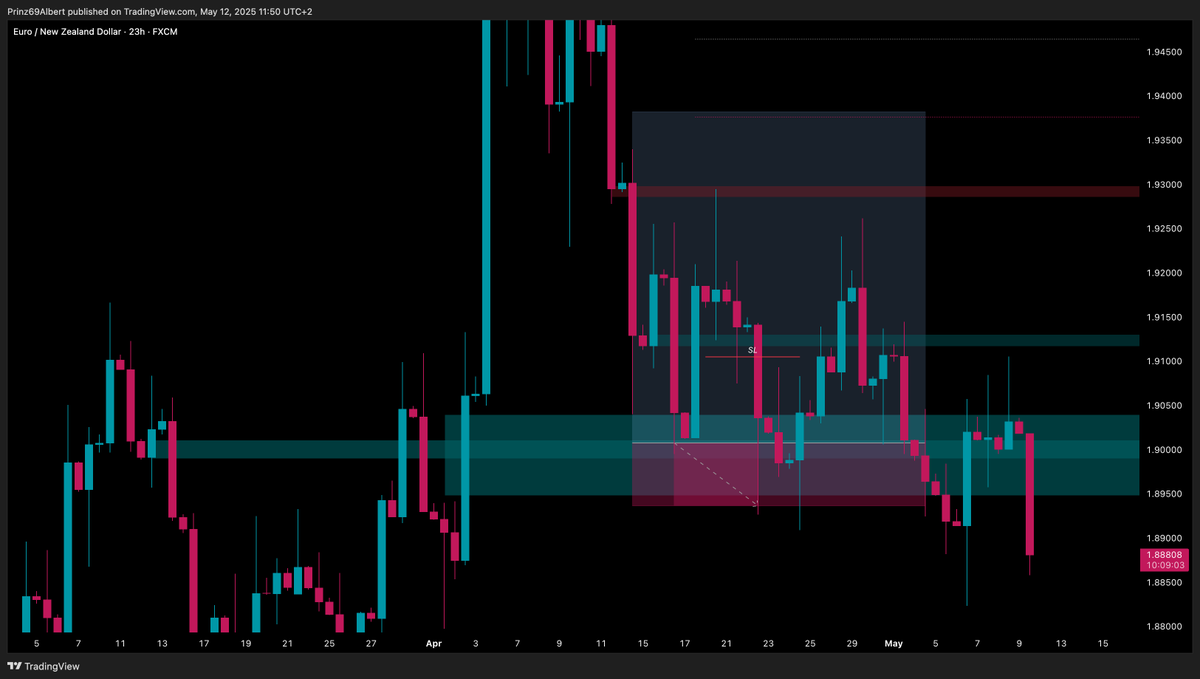
How to trail Stop Loss?
Some asked how to do it. I will show it on an example on a trade I took, shared by @radiusxbt on EURNZD.
First the Setup, it's a 1D BB refined on 23h.
23h entry hit - we are happy and ride it.
So like Taur taught, we look now for a TP. I always try to secure gains and don't care a lot about riding the highest RR all the time. But that's personal thing and you could be totally different and that's fine.
So I anticipated my TP level, a 2h BB and took some off - or slightly below cause I slept, but not important. Important is what? No BOS - so I stay cautious. Yes you could say it's too early on a 1D play, you could say "nice" and take some off and go BE or you could just do nothing.
I saw the no BOS situation and didn't want to pay anything back but secure some gains and make it a win. "But it's very low RR" - True.
But I don't care about that and trailed my SL below a 23h and gave it some room (I gave it room because spread often rekt me before and from time to time I learn from my mistakes).
So my Stop Loss, like you see in the picture, got not hit at the first touch of the 23h. I didn't change anything, because the Plan was made and I just relaxed.
End of Story - I secured small gains and avoided loss.
Now you might have an Idea how to trail, but you should find your own style. It could've happened that it retests the entry and moons or whatever, but I don't care about missed out gains so much, more about what's in my account.
So if you now In crypto positions and ask yourself how to trail, you maybe have an Idea.
Hope it helps!
If you want to make it through the "Great Reset" you need to become someone of more than average value. There's countless different skills to learn and knowledge to acquire. You can do that even from a cellphone nowadays.
"You'll own nothing and you'll be happy" is said by the WEF itself. Why do they want such?
- You owning nothing equals them owning everything. Subscription model for everything is next, so they can simply ban you if they wish, plus control your money, and if they wish they can make it expire if you don't spend it.
CBDCs would allow the government to monitor what you buy/sell. This would work in conjunction with UBI (Universal Basic Income) which would be paid through CBDCs. CBDCs give governments the power to control the people through money, and they already control the people through fear. Cash is private and millions of people all over the planet do such transactions. The elites cannot control it, so they want to abolish it.
If they wish, through CBDCs, the elites can reward/penalize it's citizens on whether they're Pro or Anti their policies. Example?
- If you're anti their immoral policies, they can simply make you not eligible for UBI and it could get worse because they control your money...
AI/AGI will lead to an unprecedented amount of job losses in the not so distant future. The UBI will be for the unemployed and to stimulate the economy. People will survive with "just enough", and all because they chose to ignore and procrastinate during the decade we currently are in. You'll own nothing...
A financial system collapse is likely before the end of the decade (not just yet and there's still opportunity to change your life - not with shitcoin chasing in my opinion though*...)
*Remember?
- You should develop a strong skillset, and this no one can take away from you. You should build 3+ income streams. There's time, but the clock is ticking...
This collapse would facilitate the coming dystopian future planned by the Globalists. The system crashing allows for the "Reset".
Again, for whatever happens next...there's time to build the solutions, but start moving now or you're pretty likely to regret later.
This is one of my long-term forecasts, and likely one of the most important of all.
My personal answer:
@ CMP my SL would be sitting below the FVG between swing B & C, I would have taken 35% profits @ swing A and would be looking to logically add onto the current position @ the BB (MTF/LTF risk) like a opposite hedge.
From start to finish: I would have first trailed my SL2 BE at around swing B formation but before it was formed into a SH. Being up around 3R and in good profits, without any clear liquidity levels or a swing until swing A, I'm doing a logical trail instead of a systematic trail. After swing B was reclaimed & swing C was stabilized, I would have taken small profits (around 5-10%) & trailed my SL again into profit below swing C but above BE which would be the Demand level. Now, once swing A was hit I would have TP'd 35% and trailed my SL again aiming between swing B and swing C which is where you would find the FVG.
Acceptable answers:
- If you tp'd at minimum 35%, trailing more wide after swing A based on market conditions (Below Demand instead of FVG) is okay. But realizing less profits than that (like 15%) and trailing that wide is leaving too much on the table.
- TP 35% @ swing B with a wide trailing SL
- I see some implementing new things such as fibs between swings, taking profits there is okay, but there is clear fresh liquidity levels which are more optimal for trailing
Bad answers (in my opinion):
- Trailing below the BB, that's too aggressive when you're only halfway towards your final TP target (speaking as if that is a very logical TP target) + it is HTF (stronger reversals). The BB is too close to CMP, wait for another swing B & C type formation to incur then trail below the BB is perfect.
- Not realizing at-least 35% gains if your SL is not trailed at minimum to the FVG. If you choose to trail wide, you should have more realized profits. If you choose to trail aggressively, you can realize less profits.
- SL not trailed in profit, especially if it's not even @ BE yet
Was going through old bookmarks and decided to put together some @Moneytaur_ posts that are either under-viewed in my opinion or I still find extremely valuable and worthwhile reading again🔖
🔹Whales build beliefs/narratives... to pull a 180°
https://t.co/eYSiEhO6Ii
🔹Liquidity in wicks
https://t.co/7SKbgmDa4i
🔹HTF Liquidity 🗝️
https://t.co/OKFOOAilTR
🔹SEVERAL top-calling charts to study
https://t.co/wJfImwnVLQ
🔹FET Analysis deep multi-post masterplan in depth (Helped me sell for 1,000% gain)
https://t.co/JG6HY7mTKA
🔹Don't chase PA @ CMP
https://t.co/YL4NwLqSpi
🔹Books 📚
https://t.co/XTBio9aEA3
🔹No significant FVGs/OBs = ⚡️
https://t.co/vpCFuflg5S
🔹Market activity is staged
https://t.co/1siJyWUJun
🔹Price Action vs indicators
https://t.co/5O93iQLr0t
🔹Trade Management (Trailing + planning)
https://t.co/NAd7kOOzPb
🔹"Certainty is the enemy of growth"
https://t.co/z6PMIRWbo0
🔹Spend profits on valuable learning
https://t.co/DOe7mHKOv7
🔹Bank Oligopoly
https://t.co/BngcfC3M3J
🔹Bull-Run Blueprint
https://t.co/BJIdx4huDV
🔹Whale TA > Retail TA
https://t.co/wOlazDSANP
🔹Bigger Picture: Life Advice
https://t.co/xFzDDyh4vx
🔹Truth about Life Goals
https://t.co/7m9EpDE6Qi
🔹How the cabal manipulates small caps (One of my favorites of his because this is when I started monk mode. I held PYR and watched this all unfold live, eyeing the PA that incurred when these "influencers" bull-posted on their timeline all together *aka pump n dumped*. All left behind large & fast printed lower-TF wicks.)
https://t.co/cD8UWiZc8d
@InsideTheChart@Exotcrypto It's often about the magnitude and velocity of the next HTF drop as it's a sort of false HTF bullish move IF not taking serious "fuel" and it hasn't thus far.
Psychological conditioning. After enough lying, they’ll hit you with the truth, and say “I told you so” right to your face.
And at some point, you’ll believe them again. You’ll feel excited and relieved. You’ll think this time is different and trust whales again. And that’s when they’ll wreck you, harder than before.
It’s always the same cycle: Lies > Truth > Trust > Destruction. Repeat.
The majority never even notice. They just reload the hope, and walk straight back into the trap.
📖 Jobs that'll thrive
Nobody has a crystal ball that can tell the future, but some people don’t need an ancient relic to foresee what’s going to happen, because they are currently building the future in which we will all live. It’s true that AI and Automation will create havoc among the workforce, rending a large part of the population useless and without economic value. Not only they will take many people’s jobs, but they will make the rich even richer.
Jobs that are less likely to be affected by AI or automation 👇
🔹Robot Manufacturer & Service Management
- People look at the likes of Boston Dynamics and scratch their heads. Although impressive, their robots are nowhere near close to what a human can do. What you should understand is that it’s not about the end goal, but progress. If you focus on how much progress they’ve made in the last couple of years and assume the industry will keep at it at a similar pace, you might be out of a job fairly soon. The biggest e-commerce stores and factories already employ large amounts of robots. 40% of the world robots are currently in the auto-industry, but other sectors want in.
The number of robots in the workspace is expected to triple in the next 10 years. Where do you come in? Somebody will have to build those robots. The thing is, it’s probably going to be a robot that builds them as well, so your only shot is to be one of the people that builds those robots which build other robots.
If you don’t make the cut there, you might want to focus on robot maintenance. These things will require upgrades, updates, and have their oil changed. Somebody’s got to take care of the robots. This might not sound glamorous, but it will be a highly lucrative business.
🔹eSports
- eSports is going to be huge. Some might say it will eventually overtake traditional sports. World championships take place on the same arenas the FIFA world cup does and in both cases, every seat is sold out. Universities now offer eSports scholarships and money is flooding into this space. People will get mad rich off of eSports, both investors and actual players. eSports as an industry has been growing exponentially: The thing is, we already proved that it works, So now we have to figure out what we can do with it.. It is now worth billions of dollars and is not mainstream yet!
🔹Raw materials management
- Ok, there will be Robots in the future doing most of the things. A productive way to approach this issue is: What are robots made of? What about the world we will live in?
...
Break that down and you’re off to a great start. Raw materials is the new name of the game. We’re already seeing countries like China use the money earned from selling you all those plastic toys to purchase everything they can get their hands on in terms of raw materials.
China continues to gobble up the world’s commodities, setting new records for consumption of everything from crude oil to soybeans. China has surpassed the U.S as the world’s biggest importer. It also dominates when it comes to iron, coal, copper and mineral fuels. Although the entire chain from extraction to delivery to refining will be impacted by automation, there will still be a great need for skilled workers that can manage and make sure everything is on track.
🔹Big Data & AI Scientists
- Algorithms will take over analytics. They already are able to crawl through massive quantities of data and pull out relevant summaries. Where do you come in? ...
Somebody needs to program the AI on what to look for, and what we need it to bring back from the mountains of data we are currently feeding the internet. People from the IT industry will see the rise of AI pretty quickly, not in the way most people expect it to be, but in a massive improvement in how quickly everything can be done. In just a few years, a single person will have a suit of simplified tools which he can use to replace an entire division. You’re either going to be that guy that uses the new tools, or you’re going to be out there looking for work.
🔹Artificial Bodies Manufacturer
- “Artificial bodies is likely to be the most lucrative industry of the century”
The market is likely to be split between augmented bodies and full on artificial ones. Think of it like this: if someone cut your arm of, would you still be you? What if we continue this process…how much can you remove from your body and still be you?
...
Some might say, almost everything except for your brain. Ok, let’s work with that. Your biological body is a pretty fascinating tool, which was developed over millions of years and has worked great so far, but to be honest it has its limitations. It wears off pretty rapidly, after 50 you start feeling weird, if one of the internal components fails, pretty much your entire system shuts down, it’s not super resistant, it needs constant fuel and shelter, and I can go on and on...
People are already using transplants and are augmenting their bodies. When it comes to how well we see, we either go the cyborg way – meaning you buy glasses – or you augment your body by getting eye surgery. This type of behavior will move on throughout the body. We no longer will be restrained by the limits of our physical bodies. Disabilities will be something of the past. Every aspect from production to implementation to maintenance of these new tools will require someone. Find your place in this new world and you should be set.
🔹Psychologist & Therapist
- Mental health is becoming more and more of a mainstream topic. The fast pace of everything around us is causing us to be more stressed than ever, social pressure to perform is at an all-time high, while we’re being bombarded by picture perfect lives everywhere we look on social media.
This will all get worse and we will need more tools to deal with the reality of our existence. That’s where professionals come in. People who can tailo an approach to your individual situation, who can connect with you on an emotional level and help you heal yourself, or at least manage your emotions better.
46% of adults have seen a counselor at some point, while 36% are open to it. Those number will go up.
🔹Gene Designer for Babies & Pets
- Yes, designer babies are just around the corner. Before you start freaking out about how we’re playing God and doing the work of the devil, let’s dive a little bit deeper. What if you or your partner got pregnant and identified that the baby will be born with poor sight or hearing, but you could choose to fix that pre-birth without any other side effects? What if you could offer your child a normal life through gene editing? Would you do it?
- Of course you would. There’s a fairly new technology called CRISPR (which I’m invested in since C-19 crash at 40$) which allows us to remove certain genes and replace them with new ones. This is probably the biggest leap and technological breakthrough of our century, but it’s still in its early stages. The thing is, we already proved that it works, so now we have to figure out what we can do with it.
Once we start correcting for unwanted defects in the human body, there’s a very small step towards adding things we might find useful, like better physicality, better metabolism and other attributes in general. Probably the first sector we’re going to see this implemented is around pets. You will be able to design your own perfect pet the same way you create a new character in SIMS. It's weird/scary isn't it?
- Well, adapt instead of fighting the inevitable. Be curious and learn so you're ahead and aware.
🔹Virtual World Designer
- VR & AR are the new frontier. A not so explored land filled with potential and awaiting to be built. That’s where you come in. Somebody will have to design everything in our newfound worlds, from buildings to chairs, to what inhabits it and more. Even better, you are no longer limited by the restraints of the real world.
Currently, 4.7 billion people are connected to the internet. Meaning they have some sort of virtual footprint in a digital world. Adoption of immersive VR will be slow and its likely to start with entertainment at first. But Virtual Worlds will not be for gaming purposes alone. It will be a lot more cost efficient to use virtual worlds as our main transactional and interactive environment. Why spend 2 hours in traffic to get to a meeting when we can just put on our goggles and meet at a virtual office?
We’re already doing most of our interactions with others in the virtual space. Yes, we're already in the Metaverse, but the early stages of something much bigger. You talk to people on WhatsApp, you look at their travel pics on Instagram, and consume this tweet from your mobile phone after I tweeted it using the internet. You don’t need to leave the house for any of these. Virtual worlds is the natural progression of these technologies and will be a part of our lives sooner than most think.
🔹Cybersecurity & Private Data Brokerage
- As we live more and more of our lives in the digital realm, cybersecurity will become more and more relevant to all of us. We’re already seeing world-wide debates about how our data is handled by big corporations. People have been giving away their data for free because they do not realize how valuable this type of information actually is.
Before social medias and cookies, you had to spend millions of dollars to get your hands on this type of info, but now, people give it away for free in exchange for memes and funny videos. Social platforms got the bargain of the century, making billions of dollars off of people’s data. On average a single US consumer’s data is worth at least $240 per year to companies like Facebook, or Google. Data brokerage is already billions of dollars industry, but it’s not as public as the rest, so people ignore it.
A lot of today's jobs will simply have people replaced by automation in the future. Most people are refusing to adapt though. Build.
The leverage i use is never fixed. It will depend on the SL. If i find an opportunity with a very tight stop (such as 0.4%) i can use 50X and still risk losing up to -20% of my position (+ fees).
If SL is 2% i will likely choose between 10 to 20X leverage.
If SL is 5% i will likely choose < 10X leverage.
If my SL is 10% i will likely play Spot only.
@karimandrioli Don't look for individual targets on altcoins. Look at the major charts available, like Bitcoin, ETH, USDT Dominance, Total [2/3], BTC Dominance, ETH/BTC, BVOL, major coins pair with BTC...
Your altcoins will not be mooning if major charts are at ♨️ levels.
Dr. Manhattan was born in 𝟏𝟗𝟐𝟗
The Roaring 20's started in 1920...
The Great Depression started in 𝟏𝟗𝟐𝟗
He can create, alter, and manipulate the laws of physics, and reality.
Below is not the 🌙
It's Mars
#Bitcoin & 🧘♂️
Don’t get frustrated in the process of whatever you're trying to achieve, because you need experience, and this no one will give to you. Time will, and it can take a while, but you either choose to spend a few years grinding for your financial freedom, or 45 years working for the boss until you retire too old to enjoy the best life has to offer.
If others can, you can.
I have never focused on making everything right.
I have never focused on perfection, but on achieving excellence.
I focused on making less and less mistakes over time. I wanted the mistakes. I wanted (and still want) the failures. I can optimize myself with them.
That's the true secret. It's the mindset. You already have the tools to begin the journey through the right path. You will fall, but remember...
Fall forward.


![CryptoChase02's tweet photo. ⚠️ INVALIDATION ⚠️
Invalidating setups as early as possible can take you from an average trader to a great trader! Invalidation protects your capital and improves your discipline. When a trade no longer meets your criteria and you exit your position, you will minimise losses and prevent unnecessary drawdowns in your portfolio. This helps you preserve your trading or investing portfolio and stay in the game longer.
Once a setup breaks its structure or your conditions, holding onto the trade can lead to impulsive decisions driven by greed or fear. By invalidating early, you can remain objective and adhere to your trading plan, thereby maintaining the integrity of your strategy. Letting a broken setup run means you are trading without a consistent edge. Respecting invalidation points, regardless of the result, keeps your system reliable and measurable.
Closing a position early frees up capital, allowing you to redirect your funds to higher-probability opportunities elsewhere in the market that align with your strategy criteria instead of being stuck in a low-probability trade. Making this a habit will also build confidence in your decision-making. Each time you act decisively based on your chosen rules, you reinforce trust in your process and become a more disciplined, efficient trader.
It is important to keep an 👁️ on candle closes instead of wicks because you will end up invalidating a lot of valid plays otherwise. Plays can be invalidated last minute or adjusted [increasing/decreasing risk], so it's important to keep a close watch on the next candle closure on the timeframe you found the key level and Bitcoin, as it is the leader of the market.
MoneyTaur - "Regularly monitoring Bitcoin is a must when playing tight stops"
If Bitcoin is dumping, you wouldn't want to open a scalp long position on a low-volume coin.
If Bitcoin is pumping, you wouldn't want to open a scalp short position on a low-volume coin.
If Bitcoin is dumping [downtrend], you invalidate long positions and look for retracements into 🗝️ levels before bearish continuation.
If Bitcoin is pumping [uptrend], you invalidate short positions and look for pullbacks into 🗝️ levels before bullish continuation.
The Bitcoin example is down in the comments below 👇
This can be justified depending on your skill set.
MoneyTaur - "Don't long/short anything on LTF/MTF confirmations if Bitcoin is breaking past significant key levels/ranges"
MARKET STRUCTURE
A setup can be invalidated if there is no change in market structure. If there is no close above a PSH or below a PSL, this is an early signal to invalidate the setup. This is crucial as we look for high-probability setups only. Without a confirmed close, we have to assume the current trend will not continue.
If there is a confirmed break of structure and PA doesn't pull back and goes straight towards ATHs and confirms a new trading range, then you can invalidate that setup [For that specific moment]. The setup could still be valid in the future, depending on how powerful the key level is 👁️.
When you are missing confluence on a setup, it means you should approach the setup as a low-probability trade. The fewer confluences you have, the bigger the reasoning to invalidate the setup. You either risk less or completely ignore the trade and find opportunities elsewhere in the market.
There are plenty of opportunities in every market. Don't be so fixated on a setup if you deem the probability of success to be low.
The Litcoin example showing how to identify a MSS is down in the comments below 👇
You can read about market structure in this post 👉 https://t.co/VoP7RgwyTU
FIBONACCI RETRACEMENT
Occasionally, a key level will align with or near a fib level (0.5, 0.618-0.705 and 0.786). If the key level is not near a fib level, then proceed with caution. Usually, if I can't find a [untested] fib level with my key level, I would invalidate the play and choose to seek another opportunity or regularly monitor Bitcoin or other majors alongside my chosen trade to time the position. If the timing isn't somewhat simultaneous, I will invalidate the setup.
It is important to search for key levels on Bitcoin, Ethereum and other major charts as they'll act as strong confluences and will turn your setup from a low-probability trade into a high-probability trade.
You can read about Fibonacci retracement in this post 👉 https://t.co/ldQAUsTaZs
DISCOUNT & PREMIUM ZONES
Depending on where your key level lies in the specified range, it will indicate whether the setup should be seen as a high-probability trade or a low-probability trade.
Below the equilibrium is your discount zone where you will look for longs/buys. If market structure is turning bullish with confirmation and we are still in the discount region, you should invalidate any short setups [scalps] unless the setup is seen as an optimal trade.
Above the equilibrium is your premium zone where you will look for shorts/sells. If market structure is turning bearish with confirmation and we are still in the premium region, you should invalidate any long setups [scalps] unless the setup is seen as an optimal trade.
If MS is bearish while entering the discount zone, continue to look for short positions until you see a confirmed MSS.
If MS is bullish while entering the premium zone, continue to look for long positions until you see a confirmed MSS.
Market structure is very important! Until you see a market structure shift, remain with the same perspective on the market.
Trade with the trend, not against it.
You can read about discount & premium zones in this post 👉 https://t.co/t5nZOwuLz4
These are the 3 main things that can help you invalidate a setup before even positioning yourself in a trade. The main purpose for you is to put your capital in high-probability trades to preserve your capital and leave you with more winners than losers.
Recent Example across the market [05/06/25]:
In this situation, I remained with a long/buy perspective, invalidated any short setups and long setups that were too far. Keeping in mind that the local bottom occurred in early April, I had the thought that 🐳's will not give retail the pullback that they deeply desire as they currently want to build FOMO [Greed] by enticing late longs/buys.
▫️ Bitcoin failed to close below the PSL
▫️ USDT.D hit and respected its bearish key level
▫️ USDC.D hit and respected its bearish key level
▫️ TOTAL hit and respected its bullish key level
▫️ TOTAL3 hit and respected its bullish key level
▫️ Negative battle simultaneously erupted as these key levels hit between the most influential people in the world
▫️ Michael Taylor is quiet
▫️ Community [Inside & Outside] expecting lower levels to revisit
▫️ Most people are stuck in analysis paralysis
The picture for this example is below 👇
What about when we are already in a position and want to see early signs of invalidation?
Longs can be invalidated when you identify signs of weakness [SOW], and shorts can be invalidated when you see signs of strength [SOS] on the identified timeframe. The lower the timeframe, the earlier you'll see the signal for invalidation.
CANDLE CLOSURES
If you are already in a position, then you need to keep an 👁️ on the next candle close, depending on what TF you found your key levels on. Sometimes your level may have been invalidated before your stop loss was hit, and you need to see these signs as soon as possible. Meaning, if you found the key level on the 1D TF, you need to watch the next daily candle close to see if the candle closed above or below the key level.
This will be your flashing invalidation signal that you should always respect 🚨!
You may have to watch a couple of daily candle closes to see if the level is invalidated. It's not just about the next one, as the level could be invalidated in 2 or 3 days, etc.
When you can refine the key level, you must watch the reaction towards the refined key level. The invalidation signal will be shown earlier if you watch the refined level compared to the HTF key level. For example, you found a key level on the 1D TF, which can be refined down to the 4H TF. Instead of waiting for the next daily candle close [longer wait time], you can now watch the next 4H candle close to see if the refined level will be (in)validated.
This is very important as it will save you from losing a fully risked position. For example, you risked 1%, but you may only lose 0.5% or 0.3% risk by manually closing the position before your SL is hit.
Another version of this is to watch the equilibrium of your key level [0.5 Fib level of the identified OB]. If the candle closes below/above the equilibrium on the respective TF, this can be a SOW/SOS as the reaction towards the key level is weak.
This doesn't always mean you should always sell because the level is technically still valid, and there may also be external reasoning, but it's important to watch the reaction, as it will tell you if the key level is strong or not.
GBPUSD Example [13/05/25]:
Here we have a 8H BB + 0.5 Fib level and a confirmed MTF BOS. The key level also shows additional BBs on multiple TFs [7H, 6H, 4H and 30m]. As this level can be refined to the LTF, this tells you this level is even more valid and could provide a good R/R, but in this example, the key level was invalidated before my SL was hit.
As the level approached the level, I kept an eye on the next candle close on all TFs to see which one was earliest. On the 30m TF, the candle closed above the 30m BB, and on the 8H TF, the candle closed above the 8H BB too [Both candle closes occurred at 14:00 GMT]. This is an early sign that the level has been invalidated.
The next 7H and 6H candle closes occurred at a later time, which wouldn't be helpful, as we could've been stopped before the candle closes. This is why it's important to monitor which candle closes is closer in timing.
Now I choose to close my position manually at half the amount I originally risked, or I can wait for PA to sweep the liquidity that was ignored on the 8H/30m TF and close at BE.
This will be unpredictable, as you don't know if PA will sweep the liquidity that it previously ignored. In most cases, it will be better to close your position at a smaller loss than always trying to close your position at BE [Greed].
USDCAD Example [04/04/25]:
Here we have a MTF key level shown on 7 different TFs [21/16/15/14/13/12/11H BB] with a 0.5 Fib level and a confirmed MTF BOS. I had my SL covering the 8H OB + 0.618 Fib level. With additional TFs around the same key area, you can assume the key level would have some strength and potentially give you a high R/R opportunity.
As this trade occurred on a Friday, you have to be careful because the market will be closed until Sunday 22:00 GMT after Friday 22:00 GMT [This can change due to adjusted time zones].
As the PA approached the key level, I kept an 👁️ on the next candle close on all TFs to see which one was earliest. The key level was invalidated only on 1 TF before my SL was hit out of the 7 TFs. On the 11H TF, the candle closed above the 11H BB, closing on Friday at 20:00 GMT [2 hours before the market closed]. This is an early signal that the level has been invalidated, as all the other TFs' next candle close was on Sunday at 22:00 GMT [The opening of the market].
As I realised 2 hours before the market was about to close on the 11H TF, I decided to close my position manually at half the amount I originally risked. Accepting a 1% loss instead of a 2% loss [Preserving capital].
You cannot adjust your trades during the weekend, so I couldn't close my position manually.
This is why it's crucial to monitor all TFs identified to see which TF gets invalidated first. I would've been stopped at market open [Sunday evening], losing the full amount I originally risked if I didn't monitor the 11H TF.
AERO [SPOT] Example:
In this example, we are riding the wave with 🐳's from Aug '24 to Jan '25, trailing our SL and waiting for invalidation, which could potentially be a MSS or a close below a BB.
Skipping towards the end [Dec '24], we are now trying to look for invalidation points so we don't lose all our unrealised profits watching the market 🩸 alongside retail.
Our first flashing signal is the market structure. As we can see, PA failed to get above the SH [$2.372] and close above it on any HTFs. While looking at Bitcoin's market structure, you can see a 3-drive pattern forming, which is a sign of whale activity [distribution]. Although this is a great sign, this isn't a confirmed invalidation, as PA could have still gone up soon after.
On the weekly chart, a 1W BB formed, so you would trail your SL underneath that identified level. However, the following candle stick only wicks through it but never closes below it or the equilibrium of the 1W BB, so you may have never sold during that time. The following candle stick invalidated the 1W BB, but price closed at $1.476, which is much further down than near the 1W BB [$2 region], so you would've missed out on some profits as the candle closed ~23% away from the 1W BB on 23/12/24.
Going down to the 3D TF, you can see a 3D pBB was left behind, which aligned with an untested 0.5 Fib level, so you may have trailed your SL underneath that identified level. The 3D candle closed below that level, which is a SOW, so you would've sold at $1.56 on 20/12/24.
This sold price is higher than the one on the weekly chart, and you saw the invalidation 3 days earlier, so you would've saved some profits.
Going down to an even lower TF, you can see a 23H/21H BB that was left behind, which aligned with a 0.5 Fib level, so you may have trailed underneath that identified level. Price action made a double top [$2.335], failing to close above the PSH, and retraced back towards our 21H BB + 0.5 Fib level. The 21H candle closed below our 21H BB, which is a SOW, so you would have sold your position at $1.982 on 14/12/24, keeping in mind Bitcoin's MS as it was forming a 3-drive pattern during 22/11/24 to 17/12/24.
PA also proceeded to close below its PSL [$1.743] after closing below the 21H BB [confluence], which is a sign of bearish continuation.
This sold price is higher than the one on the 1W and 3D TF, so you would've saved even more profits as you have identified a key level on a lower TF to trail your SL at a higher price. Meaning you would have seen your invalidation way earlier, the only thing left to do is to execute, which is the hardest part due to psychology 🧠.
With any of these options, you would have saved yourself from experiencing a ~90% drop, which is the main thing we want to avoid. Invalidation is used to preserve capital and lose less than we might have originally.
With spot positions, I prefer to rely on candle closes rather than wicks hitting stop losses because of the confirmation.
Invalidation and stop losses are heavily linked. You can read about stop losses in this post 👉 https://t.co/A4ILDbw2Y2
Volume Spread Analysis (VSA)
VSA can be used once your key level is hit or when PA is nearing your identified key level. If there is a widespread candlestick with high volume approaching your bullish/bearish key level, which can be a SOS, price action may pierce through your key level.
I won't go into this in detail here because I'll be repeating myself, as I have already made a great post about VSA in the volume education post with examples in the comments showing validation to potential setups. You just have to see the opposite side of what I say, and you have your answer for invalidating setups.
You can read about volume in this post 👉 https://t.co/e8TpFietFC
I try to make these topics as friendly as possible, and it does take some time out of my day, so if you want me to provide more educational posts, please like and repost so they can reach more people 🙏
If you have any questions, put them in the comments below 👇](https://pbs.twimg.com/media/GtFYCo4XwAAKQN7.jpg)
![CryptoChase02's tweet photo. ⚠️ INVALIDATION ⚠️
Invalidating setups as early as possible can take you from an average trader to a great trader! Invalidation protects your capital and improves your discipline. When a trade no longer meets your criteria and you exit your position, you will minimise losses and prevent unnecessary drawdowns in your portfolio. This helps you preserve your trading or investing portfolio and stay in the game longer.
Once a setup breaks its structure or your conditions, holding onto the trade can lead to impulsive decisions driven by greed or fear. By invalidating early, you can remain objective and adhere to your trading plan, thereby maintaining the integrity of your strategy. Letting a broken setup run means you are trading without a consistent edge. Respecting invalidation points, regardless of the result, keeps your system reliable and measurable.
Closing a position early frees up capital, allowing you to redirect your funds to higher-probability opportunities elsewhere in the market that align with your strategy criteria instead of being stuck in a low-probability trade. Making this a habit will also build confidence in your decision-making. Each time you act decisively based on your chosen rules, you reinforce trust in your process and become a more disciplined, efficient trader.
It is important to keep an 👁️ on candle closes instead of wicks because you will end up invalidating a lot of valid plays otherwise. Plays can be invalidated last minute or adjusted [increasing/decreasing risk], so it's important to keep a close watch on the next candle closure on the timeframe you found the key level and Bitcoin, as it is the leader of the market.
MoneyTaur - "Regularly monitoring Bitcoin is a must when playing tight stops"
If Bitcoin is dumping, you wouldn't want to open a scalp long position on a low-volume coin.
If Bitcoin is pumping, you wouldn't want to open a scalp short position on a low-volume coin.
If Bitcoin is dumping [downtrend], you invalidate long positions and look for retracements into 🗝️ levels before bearish continuation.
If Bitcoin is pumping [uptrend], you invalidate short positions and look for pullbacks into 🗝️ levels before bullish continuation.
The Bitcoin example is down in the comments below 👇
This can be justified depending on your skill set.
MoneyTaur - "Don't long/short anything on LTF/MTF confirmations if Bitcoin is breaking past significant key levels/ranges"
MARKET STRUCTURE
A setup can be invalidated if there is no change in market structure. If there is no close above a PSH or below a PSL, this is an early signal to invalidate the setup. This is crucial as we look for high-probability setups only. Without a confirmed close, we have to assume the current trend will not continue.
If there is a confirmed break of structure and PA doesn't pull back and goes straight towards ATHs and confirms a new trading range, then you can invalidate that setup [For that specific moment]. The setup could still be valid in the future, depending on how powerful the key level is 👁️.
When you are missing confluence on a setup, it means you should approach the setup as a low-probability trade. The fewer confluences you have, the bigger the reasoning to invalidate the setup. You either risk less or completely ignore the trade and find opportunities elsewhere in the market.
There are plenty of opportunities in every market. Don't be so fixated on a setup if you deem the probability of success to be low.
The Litcoin example showing how to identify a MSS is down in the comments below 👇
You can read about market structure in this post 👉 https://t.co/VoP7RgwyTU
FIBONACCI RETRACEMENT
Occasionally, a key level will align with or near a fib level (0.5, 0.618-0.705 and 0.786). If the key level is not near a fib level, then proceed with caution. Usually, if I can't find a [untested] fib level with my key level, I would invalidate the play and choose to seek another opportunity or regularly monitor Bitcoin or other majors alongside my chosen trade to time the position. If the timing isn't somewhat simultaneous, I will invalidate the setup.
It is important to search for key levels on Bitcoin, Ethereum and other major charts as they'll act as strong confluences and will turn your setup from a low-probability trade into a high-probability trade.
You can read about Fibonacci retracement in this post 👉 https://t.co/ldQAUsTaZs
DISCOUNT & PREMIUM ZONES
Depending on where your key level lies in the specified range, it will indicate whether the setup should be seen as a high-probability trade or a low-probability trade.
Below the equilibrium is your discount zone where you will look for longs/buys. If market structure is turning bullish with confirmation and we are still in the discount region, you should invalidate any short setups [scalps] unless the setup is seen as an optimal trade.
Above the equilibrium is your premium zone where you will look for shorts/sells. If market structure is turning bearish with confirmation and we are still in the premium region, you should invalidate any long setups [scalps] unless the setup is seen as an optimal trade.
If MS is bearish while entering the discount zone, continue to look for short positions until you see a confirmed MSS.
If MS is bullish while entering the premium zone, continue to look for long positions until you see a confirmed MSS.
Market structure is very important! Until you see a market structure shift, remain with the same perspective on the market.
Trade with the trend, not against it.
You can read about discount & premium zones in this post 👉 https://t.co/t5nZOwuLz4
These are the 3 main things that can help you invalidate a setup before even positioning yourself in a trade. The main purpose for you is to put your capital in high-probability trades to preserve your capital and leave you with more winners than losers.
Recent Example across the market [05/06/25]:
In this situation, I remained with a long/buy perspective, invalidated any short setups and long setups that were too far. Keeping in mind that the local bottom occurred in early April, I had the thought that 🐳's will not give retail the pullback that they deeply desire as they currently want to build FOMO [Greed] by enticing late longs/buys.
▫️ Bitcoin failed to close below the PSL
▫️ USDT.D hit and respected its bearish key level
▫️ USDC.D hit and respected its bearish key level
▫️ TOTAL hit and respected its bullish key level
▫️ TOTAL3 hit and respected its bullish key level
▫️ Negative battle simultaneously erupted as these key levels hit between the most influential people in the world
▫️ Michael Taylor is quiet
▫️ Community [Inside & Outside] expecting lower levels to revisit
▫️ Most people are stuck in analysis paralysis
The picture for this example is below 👇
What about when we are already in a position and want to see early signs of invalidation?
Longs can be invalidated when you identify signs of weakness [SOW], and shorts can be invalidated when you see signs of strength [SOS] on the identified timeframe. The lower the timeframe, the earlier you'll see the signal for invalidation.
CANDLE CLOSURES
If you are already in a position, then you need to keep an 👁️ on the next candle close, depending on what TF you found your key levels on. Sometimes your level may have been invalidated before your stop loss was hit, and you need to see these signs as soon as possible. Meaning, if you found the key level on the 1D TF, you need to watch the next daily candle close to see if the candle closed above or below the key level.
This will be your flashing invalidation signal that you should always respect 🚨!
You may have to watch a couple of daily candle closes to see if the level is invalidated. It's not just about the next one, as the level could be invalidated in 2 or 3 days, etc.
When you can refine the key level, you must watch the reaction towards the refined key level. The invalidation signal will be shown earlier if you watch the refined level compared to the HTF key level. For example, you found a key level on the 1D TF, which can be refined down to the 4H TF. Instead of waiting for the next daily candle close [longer wait time], you can now watch the next 4H candle close to see if the refined level will be (in)validated.
This is very important as it will save you from losing a fully risked position. For example, you risked 1%, but you may only lose 0.5% or 0.3% risk by manually closing the position before your SL is hit.
Another version of this is to watch the equilibrium of your key level [0.5 Fib level of the identified OB]. If the candle closes below/above the equilibrium on the respective TF, this can be a SOW/SOS as the reaction towards the key level is weak.
This doesn't always mean you should always sell because the level is technically still valid, and there may also be external reasoning, but it's important to watch the reaction, as it will tell you if the key level is strong or not.
GBPUSD Example [13/05/25]:
Here we have a 8H BB + 0.5 Fib level and a confirmed MTF BOS. The key level also shows additional BBs on multiple TFs [7H, 6H, 4H and 30m]. As this level can be refined to the LTF, this tells you this level is even more valid and could provide a good R/R, but in this example, the key level was invalidated before my SL was hit.
As the level approached the level, I kept an eye on the next candle close on all TFs to see which one was earliest. On the 30m TF, the candle closed above the 30m BB, and on the 8H TF, the candle closed above the 8H BB too [Both candle closes occurred at 14:00 GMT]. This is an early sign that the level has been invalidated.
The next 7H and 6H candle closes occurred at a later time, which wouldn't be helpful, as we could've been stopped before the candle closes. This is why it's important to monitor which candle closes is closer in timing.
Now I choose to close my position manually at half the amount I originally risked, or I can wait for PA to sweep the liquidity that was ignored on the 8H/30m TF and close at BE.
This will be unpredictable, as you don't know if PA will sweep the liquidity that it previously ignored. In most cases, it will be better to close your position at a smaller loss than always trying to close your position at BE [Greed].
USDCAD Example [04/04/25]:
Here we have a MTF key level shown on 7 different TFs [21/16/15/14/13/12/11H BB] with a 0.5 Fib level and a confirmed MTF BOS. I had my SL covering the 8H OB + 0.618 Fib level. With additional TFs around the same key area, you can assume the key level would have some strength and potentially give you a high R/R opportunity.
As this trade occurred on a Friday, you have to be careful because the market will be closed until Sunday 22:00 GMT after Friday 22:00 GMT [This can change due to adjusted time zones].
As the PA approached the key level, I kept an 👁️ on the next candle close on all TFs to see which one was earliest. The key level was invalidated only on 1 TF before my SL was hit out of the 7 TFs. On the 11H TF, the candle closed above the 11H BB, closing on Friday at 20:00 GMT [2 hours before the market closed]. This is an early signal that the level has been invalidated, as all the other TFs' next candle close was on Sunday at 22:00 GMT [The opening of the market].
As I realised 2 hours before the market was about to close on the 11H TF, I decided to close my position manually at half the amount I originally risked. Accepting a 1% loss instead of a 2% loss [Preserving capital].
You cannot adjust your trades during the weekend, so I couldn't close my position manually.
This is why it's crucial to monitor all TFs identified to see which TF gets invalidated first. I would've been stopped at market open [Sunday evening], losing the full amount I originally risked if I didn't monitor the 11H TF.
AERO [SPOT] Example:
In this example, we are riding the wave with 🐳's from Aug '24 to Jan '25, trailing our SL and waiting for invalidation, which could potentially be a MSS or a close below a BB.
Skipping towards the end [Dec '24], we are now trying to look for invalidation points so we don't lose all our unrealised profits watching the market 🩸 alongside retail.
Our first flashing signal is the market structure. As we can see, PA failed to get above the SH [$2.372] and close above it on any HTFs. While looking at Bitcoin's market structure, you can see a 3-drive pattern forming, which is a sign of whale activity [distribution]. Although this is a great sign, this isn't a confirmed invalidation, as PA could have still gone up soon after.
On the weekly chart, a 1W BB formed, so you would trail your SL underneath that identified level. However, the following candle stick only wicks through it but never closes below it or the equilibrium of the 1W BB, so you may have never sold during that time. The following candle stick invalidated the 1W BB, but price closed at $1.476, which is much further down than near the 1W BB [$2 region], so you would've missed out on some profits as the candle closed ~23% away from the 1W BB on 23/12/24.
Going down to the 3D TF, you can see a 3D pBB was left behind, which aligned with an untested 0.5 Fib level, so you may have trailed your SL underneath that identified level. The 3D candle closed below that level, which is a SOW, so you would've sold at $1.56 on 20/12/24.
This sold price is higher than the one on the weekly chart, and you saw the invalidation 3 days earlier, so you would've saved some profits.
Going down to an even lower TF, you can see a 23H/21H BB that was left behind, which aligned with a 0.5 Fib level, so you may have trailed underneath that identified level. Price action made a double top [$2.335], failing to close above the PSH, and retraced back towards our 21H BB + 0.5 Fib level. The 21H candle closed below our 21H BB, which is a SOW, so you would have sold your position at $1.982 on 14/12/24, keeping in mind Bitcoin's MS as it was forming a 3-drive pattern during 22/11/24 to 17/12/24.
PA also proceeded to close below its PSL [$1.743] after closing below the 21H BB [confluence], which is a sign of bearish continuation.
This sold price is higher than the one on the 1W and 3D TF, so you would've saved even more profits as you have identified a key level on a lower TF to trail your SL at a higher price. Meaning you would have seen your invalidation way earlier, the only thing left to do is to execute, which is the hardest part due to psychology 🧠.
With any of these options, you would have saved yourself from experiencing a ~90% drop, which is the main thing we want to avoid. Invalidation is used to preserve capital and lose less than we might have originally.
With spot positions, I prefer to rely on candle closes rather than wicks hitting stop losses because of the confirmation.
Invalidation and stop losses are heavily linked. You can read about stop losses in this post 👉 https://t.co/A4ILDbw2Y2
Volume Spread Analysis (VSA)
VSA can be used once your key level is hit or when PA is nearing your identified key level. If there is a widespread candlestick with high volume approaching your bullish/bearish key level, which can be a SOS, price action may pierce through your key level.
I won't go into this in detail here because I'll be repeating myself, as I have already made a great post about VSA in the volume education post with examples in the comments showing validation to potential setups. You just have to see the opposite side of what I say, and you have your answer for invalidating setups.
You can read about volume in this post 👉 https://t.co/e8TpFietFC
I try to make these topics as friendly as possible, and it does take some time out of my day, so if you want me to provide more educational posts, please like and repost so they can reach more people 🙏
If you have any questions, put them in the comments below 👇](https://pbs.twimg.com/media/GtFYCo2XcAItgaX.jpg)
![CryptoChase02's tweet photo. ⚠️ INVALIDATION ⚠️
Invalidating setups as early as possible can take you from an average trader to a great trader! Invalidation protects your capital and improves your discipline. When a trade no longer meets your criteria and you exit your position, you will minimise losses and prevent unnecessary drawdowns in your portfolio. This helps you preserve your trading or investing portfolio and stay in the game longer.
Once a setup breaks its structure or your conditions, holding onto the trade can lead to impulsive decisions driven by greed or fear. By invalidating early, you can remain objective and adhere to your trading plan, thereby maintaining the integrity of your strategy. Letting a broken setup run means you are trading without a consistent edge. Respecting invalidation points, regardless of the result, keeps your system reliable and measurable.
Closing a position early frees up capital, allowing you to redirect your funds to higher-probability opportunities elsewhere in the market that align with your strategy criteria instead of being stuck in a low-probability trade. Making this a habit will also build confidence in your decision-making. Each time you act decisively based on your chosen rules, you reinforce trust in your process and become a more disciplined, efficient trader.
It is important to keep an 👁️ on candle closes instead of wicks because you will end up invalidating a lot of valid plays otherwise. Plays can be invalidated last minute or adjusted [increasing/decreasing risk], so it's important to keep a close watch on the next candle closure on the timeframe you found the key level and Bitcoin, as it is the leader of the market.
MoneyTaur - "Regularly monitoring Bitcoin is a must when playing tight stops"
If Bitcoin is dumping, you wouldn't want to open a scalp long position on a low-volume coin.
If Bitcoin is pumping, you wouldn't want to open a scalp short position on a low-volume coin.
If Bitcoin is dumping [downtrend], you invalidate long positions and look for retracements into 🗝️ levels before bearish continuation.
If Bitcoin is pumping [uptrend], you invalidate short positions and look for pullbacks into 🗝️ levels before bullish continuation.
The Bitcoin example is down in the comments below 👇
This can be justified depending on your skill set.
MoneyTaur - "Don't long/short anything on LTF/MTF confirmations if Bitcoin is breaking past significant key levels/ranges"
MARKET STRUCTURE
A setup can be invalidated if there is no change in market structure. If there is no close above a PSH or below a PSL, this is an early signal to invalidate the setup. This is crucial as we look for high-probability setups only. Without a confirmed close, we have to assume the current trend will not continue.
If there is a confirmed break of structure and PA doesn't pull back and goes straight towards ATHs and confirms a new trading range, then you can invalidate that setup [For that specific moment]. The setup could still be valid in the future, depending on how powerful the key level is 👁️.
When you are missing confluence on a setup, it means you should approach the setup as a low-probability trade. The fewer confluences you have, the bigger the reasoning to invalidate the setup. You either risk less or completely ignore the trade and find opportunities elsewhere in the market.
There are plenty of opportunities in every market. Don't be so fixated on a setup if you deem the probability of success to be low.
The Litcoin example showing how to identify a MSS is down in the comments below 👇
You can read about market structure in this post 👉 https://t.co/VoP7RgwyTU
FIBONACCI RETRACEMENT
Occasionally, a key level will align with or near a fib level (0.5, 0.618-0.705 and 0.786). If the key level is not near a fib level, then proceed with caution. Usually, if I can't find a [untested] fib level with my key level, I would invalidate the play and choose to seek another opportunity or regularly monitor Bitcoin or other majors alongside my chosen trade to time the position. If the timing isn't somewhat simultaneous, I will invalidate the setup.
It is important to search for key levels on Bitcoin, Ethereum and other major charts as they'll act as strong confluences and will turn your setup from a low-probability trade into a high-probability trade.
You can read about Fibonacci retracement in this post 👉 https://t.co/ldQAUsTaZs
DISCOUNT & PREMIUM ZONES
Depending on where your key level lies in the specified range, it will indicate whether the setup should be seen as a high-probability trade or a low-probability trade.
Below the equilibrium is your discount zone where you will look for longs/buys. If market structure is turning bullish with confirmation and we are still in the discount region, you should invalidate any short setups [scalps] unless the setup is seen as an optimal trade.
Above the equilibrium is your premium zone where you will look for shorts/sells. If market structure is turning bearish with confirmation and we are still in the premium region, you should invalidate any long setups [scalps] unless the setup is seen as an optimal trade.
If MS is bearish while entering the discount zone, continue to look for short positions until you see a confirmed MSS.
If MS is bullish while entering the premium zone, continue to look for long positions until you see a confirmed MSS.
Market structure is very important! Until you see a market structure shift, remain with the same perspective on the market.
Trade with the trend, not against it.
You can read about discount & premium zones in this post 👉 https://t.co/t5nZOwuLz4
These are the 3 main things that can help you invalidate a setup before even positioning yourself in a trade. The main purpose for you is to put your capital in high-probability trades to preserve your capital and leave you with more winners than losers.
Recent Example across the market [05/06/25]:
In this situation, I remained with a long/buy perspective, invalidated any short setups and long setups that were too far. Keeping in mind that the local bottom occurred in early April, I had the thought that 🐳's will not give retail the pullback that they deeply desire as they currently want to build FOMO [Greed] by enticing late longs/buys.
▫️ Bitcoin failed to close below the PSL
▫️ USDT.D hit and respected its bearish key level
▫️ USDC.D hit and respected its bearish key level
▫️ TOTAL hit and respected its bullish key level
▫️ TOTAL3 hit and respected its bullish key level
▫️ Negative battle simultaneously erupted as these key levels hit between the most influential people in the world
▫️ Michael Taylor is quiet
▫️ Community [Inside & Outside] expecting lower levels to revisit
▫️ Most people are stuck in analysis paralysis
The picture for this example is below 👇
What about when we are already in a position and want to see early signs of invalidation?
Longs can be invalidated when you identify signs of weakness [SOW], and shorts can be invalidated when you see signs of strength [SOS] on the identified timeframe. The lower the timeframe, the earlier you'll see the signal for invalidation.
CANDLE CLOSURES
If you are already in a position, then you need to keep an 👁️ on the next candle close, depending on what TF you found your key levels on. Sometimes your level may have been invalidated before your stop loss was hit, and you need to see these signs as soon as possible. Meaning, if you found the key level on the 1D TF, you need to watch the next daily candle close to see if the candle closed above or below the key level.
This will be your flashing invalidation signal that you should always respect 🚨!
You may have to watch a couple of daily candle closes to see if the level is invalidated. It's not just about the next one, as the level could be invalidated in 2 or 3 days, etc.
When you can refine the key level, you must watch the reaction towards the refined key level. The invalidation signal will be shown earlier if you watch the refined level compared to the HTF key level. For example, you found a key level on the 1D TF, which can be refined down to the 4H TF. Instead of waiting for the next daily candle close [longer wait time], you can now watch the next 4H candle close to see if the refined level will be (in)validated.
This is very important as it will save you from losing a fully risked position. For example, you risked 1%, but you may only lose 0.5% or 0.3% risk by manually closing the position before your SL is hit.
Another version of this is to watch the equilibrium of your key level [0.5 Fib level of the identified OB]. If the candle closes below/above the equilibrium on the respective TF, this can be a SOW/SOS as the reaction towards the key level is weak.
This doesn't always mean you should always sell because the level is technically still valid, and there may also be external reasoning, but it's important to watch the reaction, as it will tell you if the key level is strong or not.
GBPUSD Example [13/05/25]:
Here we have a 8H BB + 0.5 Fib level and a confirmed MTF BOS. The key level also shows additional BBs on multiple TFs [7H, 6H, 4H and 30m]. As this level can be refined to the LTF, this tells you this level is even more valid and could provide a good R/R, but in this example, the key level was invalidated before my SL was hit.
As the level approached the level, I kept an eye on the next candle close on all TFs to see which one was earliest. On the 30m TF, the candle closed above the 30m BB, and on the 8H TF, the candle closed above the 8H BB too [Both candle closes occurred at 14:00 GMT]. This is an early sign that the level has been invalidated.
The next 7H and 6H candle closes occurred at a later time, which wouldn't be helpful, as we could've been stopped before the candle closes. This is why it's important to monitor which candle closes is closer in timing.
Now I choose to close my position manually at half the amount I originally risked, or I can wait for PA to sweep the liquidity that was ignored on the 8H/30m TF and close at BE.
This will be unpredictable, as you don't know if PA will sweep the liquidity that it previously ignored. In most cases, it will be better to close your position at a smaller loss than always trying to close your position at BE [Greed].
USDCAD Example [04/04/25]:
Here we have a MTF key level shown on 7 different TFs [21/16/15/14/13/12/11H BB] with a 0.5 Fib level and a confirmed MTF BOS. I had my SL covering the 8H OB + 0.618 Fib level. With additional TFs around the same key area, you can assume the key level would have some strength and potentially give you a high R/R opportunity.
As this trade occurred on a Friday, you have to be careful because the market will be closed until Sunday 22:00 GMT after Friday 22:00 GMT [This can change due to adjusted time zones].
As the PA approached the key level, I kept an 👁️ on the next candle close on all TFs to see which one was earliest. The key level was invalidated only on 1 TF before my SL was hit out of the 7 TFs. On the 11H TF, the candle closed above the 11H BB, closing on Friday at 20:00 GMT [2 hours before the market closed]. This is an early signal that the level has been invalidated, as all the other TFs' next candle close was on Sunday at 22:00 GMT [The opening of the market].
As I realised 2 hours before the market was about to close on the 11H TF, I decided to close my position manually at half the amount I originally risked. Accepting a 1% loss instead of a 2% loss [Preserving capital].
You cannot adjust your trades during the weekend, so I couldn't close my position manually.
This is why it's crucial to monitor all TFs identified to see which TF gets invalidated first. I would've been stopped at market open [Sunday evening], losing the full amount I originally risked if I didn't monitor the 11H TF.
AERO [SPOT] Example:
In this example, we are riding the wave with 🐳's from Aug '24 to Jan '25, trailing our SL and waiting for invalidation, which could potentially be a MSS or a close below a BB.
Skipping towards the end [Dec '24], we are now trying to look for invalidation points so we don't lose all our unrealised profits watching the market 🩸 alongside retail.
Our first flashing signal is the market structure. As we can see, PA failed to get above the SH [$2.372] and close above it on any HTFs. While looking at Bitcoin's market structure, you can see a 3-drive pattern forming, which is a sign of whale activity [distribution]. Although this is a great sign, this isn't a confirmed invalidation, as PA could have still gone up soon after.
On the weekly chart, a 1W BB formed, so you would trail your SL underneath that identified level. However, the following candle stick only wicks through it but never closes below it or the equilibrium of the 1W BB, so you may have never sold during that time. The following candle stick invalidated the 1W BB, but price closed at $1.476, which is much further down than near the 1W BB [$2 region], so you would've missed out on some profits as the candle closed ~23% away from the 1W BB on 23/12/24.
Going down to the 3D TF, you can see a 3D pBB was left behind, which aligned with an untested 0.5 Fib level, so you may have trailed your SL underneath that identified level. The 3D candle closed below that level, which is a SOW, so you would've sold at $1.56 on 20/12/24.
This sold price is higher than the one on the weekly chart, and you saw the invalidation 3 days earlier, so you would've saved some profits.
Going down to an even lower TF, you can see a 23H/21H BB that was left behind, which aligned with a 0.5 Fib level, so you may have trailed underneath that identified level. Price action made a double top [$2.335], failing to close above the PSH, and retraced back towards our 21H BB + 0.5 Fib level. The 21H candle closed below our 21H BB, which is a SOW, so you would have sold your position at $1.982 on 14/12/24, keeping in mind Bitcoin's MS as it was forming a 3-drive pattern during 22/11/24 to 17/12/24.
PA also proceeded to close below its PSL [$1.743] after closing below the 21H BB [confluence], which is a sign of bearish continuation.
This sold price is higher than the one on the 1W and 3D TF, so you would've saved even more profits as you have identified a key level on a lower TF to trail your SL at a higher price. Meaning you would have seen your invalidation way earlier, the only thing left to do is to execute, which is the hardest part due to psychology 🧠.
With any of these options, you would have saved yourself from experiencing a ~90% drop, which is the main thing we want to avoid. Invalidation is used to preserve capital and lose less than we might have originally.
With spot positions, I prefer to rely on candle closes rather than wicks hitting stop losses because of the confirmation.
Invalidation and stop losses are heavily linked. You can read about stop losses in this post 👉 https://t.co/A4ILDbw2Y2
Volume Spread Analysis (VSA)
VSA can be used once your key level is hit or when PA is nearing your identified key level. If there is a widespread candlestick with high volume approaching your bullish/bearish key level, which can be a SOS, price action may pierce through your key level.
I won't go into this in detail here because I'll be repeating myself, as I have already made a great post about VSA in the volume education post with examples in the comments showing validation to potential setups. You just have to see the opposite side of what I say, and you have your answer for invalidating setups.
You can read about volume in this post 👉 https://t.co/e8TpFietFC
I try to make these topics as friendly as possible, and it does take some time out of my day, so if you want me to provide more educational posts, please like and repost so they can reach more people 🙏
If you have any questions, put them in the comments below 👇](https://pbs.twimg.com/media/GtFYCo1WMAAaXVU.jpg)


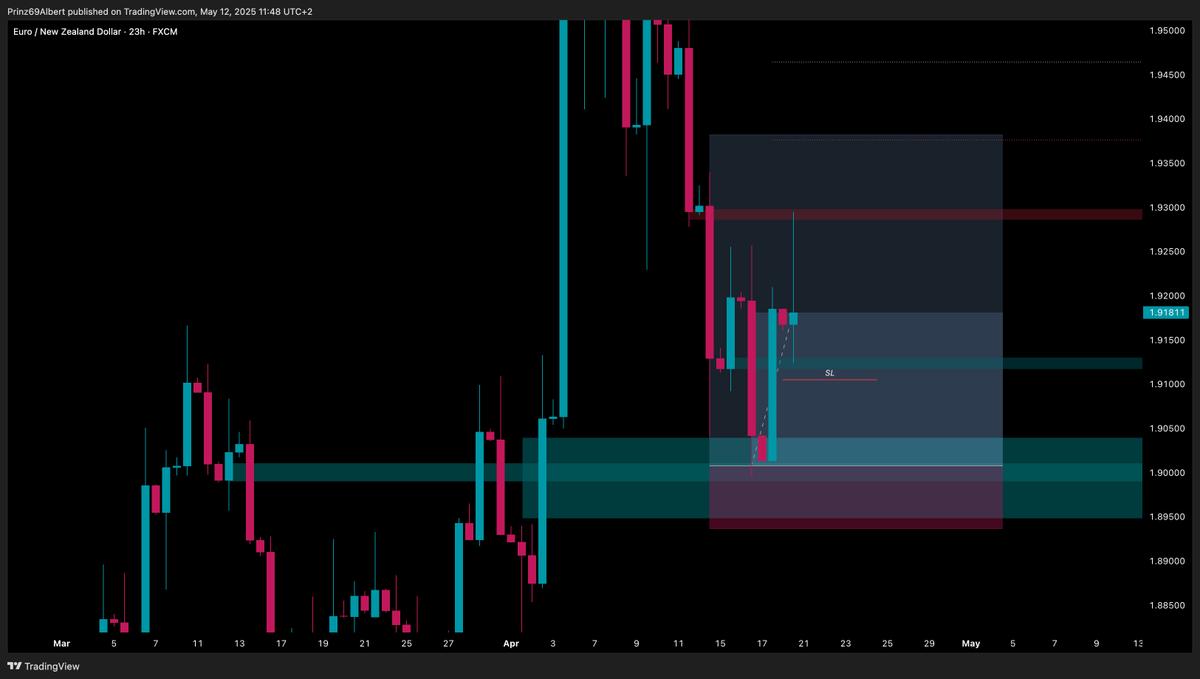


![CryptoChase02's tweet photo. ⚠️ INVALIDATION ⚠️
Invalidating setups as early as possible can take you from an average trader to a great trader! Invalidation protects your capital and improves your discipline. When a trade no longer meets your criteria and you exit your position, you will minimise losses and prevent unnecessary drawdowns in your portfolio. This helps you preserve your trading or investing portfolio and stay in the game longer.
Once a setup breaks its structure or your conditions, holding onto the trade can lead to impulsive decisions driven by greed or fear. By invalidating early, you can remain objective and adhere to your trading plan, thereby maintaining the integrity of your strategy. Letting a broken setup run means you are trading without a consistent edge. Respecting invalidation points, regardless of the result, keeps your system reliable and measurable.
Closing a position early frees up capital, allowing you to redirect your funds to higher-probability opportunities elsewhere in the market that align with your strategy criteria instead of being stuck in a low-probability trade. Making this a habit will also build confidence in your decision-making. Each time you act decisively based on your chosen rules, you reinforce trust in your process and become a more disciplined, efficient trader.
It is important to keep an 👁️ on candle closes instead of wicks because you will end up invalidating a lot of valid plays otherwise. Plays can be invalidated last minute or adjusted [increasing/decreasing risk], so it's important to keep a close watch on the next candle closure on the timeframe you found the key level and Bitcoin, as it is the leader of the market.
MoneyTaur - "Regularly monitoring Bitcoin is a must when playing tight stops"
If Bitcoin is dumping, you wouldn't want to open a scalp long position on a low-volume coin.
If Bitcoin is pumping, you wouldn't want to open a scalp short position on a low-volume coin.
If Bitcoin is dumping [downtrend], you invalidate long positions and look for retracements into 🗝️ levels before bearish continuation.
If Bitcoin is pumping [uptrend], you invalidate short positions and look for pullbacks into 🗝️ levels before bullish continuation.
The Bitcoin example is down in the comments below 👇
This can be justified depending on your skill set.
MoneyTaur - "Don't long/short anything on LTF/MTF confirmations if Bitcoin is breaking past significant key levels/ranges"
MARKET STRUCTURE
A setup can be invalidated if there is no change in market structure. If there is no close above a PSH or below a PSL, this is an early signal to invalidate the setup. This is crucial as we look for high-probability setups only. Without a confirmed close, we have to assume the current trend will not continue.
If there is a confirmed break of structure and PA doesn't pull back and goes straight towards ATHs and confirms a new trading range, then you can invalidate that setup [For that specific moment]. The setup could still be valid in the future, depending on how powerful the key level is 👁️.
When you are missing confluence on a setup, it means you should approach the setup as a low-probability trade. The fewer confluences you have, the bigger the reasoning to invalidate the setup. You either risk less or completely ignore the trade and find opportunities elsewhere in the market.
There are plenty of opportunities in every market. Don't be so fixated on a setup if you deem the probability of success to be low.
The Litcoin example showing how to identify a MSS is down in the comments below 👇
You can read about market structure in this post 👉 https://t.co/VoP7RgwyTU
FIBONACCI RETRACEMENT
Occasionally, a key level will align with or near a fib level (0.5, 0.618-0.705 and 0.786). If the key level is not near a fib level, then proceed with caution. Usually, if I can't find a [untested] fib level with my key level, I would invalidate the play and choose to seek another opportunity or regularly monitor Bitcoin or other majors alongside my chosen trade to time the position. If the timing isn't somewhat simultaneous, I will invalidate the setup.
It is important to search for key levels on Bitcoin, Ethereum and other major charts as they'll act as strong confluences and will turn your setup from a low-probability trade into a high-probability trade.
You can read about Fibonacci retracement in this post 👉 https://t.co/ldQAUsTaZs
DISCOUNT & PREMIUM ZONES
Depending on where your key level lies in the specified range, it will indicate whether the setup should be seen as a high-probability trade or a low-probability trade.
Below the equilibrium is your discount zone where you will look for longs/buys. If market structure is turning bullish with confirmation and we are still in the discount region, you should invalidate any short setups [scalps] unless the setup is seen as an optimal trade.
Above the equilibrium is your premium zone where you will look for shorts/sells. If market structure is turning bearish with confirmation and we are still in the premium region, you should invalidate any long setups [scalps] unless the setup is seen as an optimal trade.
If MS is bearish while entering the discount zone, continue to look for short positions until you see a confirmed MSS.
If MS is bullish while entering the premium zone, continue to look for long positions until you see a confirmed MSS.
Market structure is very important! Until you see a market structure shift, remain with the same perspective on the market.
Trade with the trend, not against it.
You can read about discount & premium zones in this post 👉 https://t.co/t5nZOwuLz4
These are the 3 main things that can help you invalidate a setup before even positioning yourself in a trade. The main purpose for you is to put your capital in high-probability trades to preserve your capital and leave you with more winners than losers.
Recent Example across the market [05/06/25]:
In this situation, I remained with a long/buy perspective, invalidated any short setups and long setups that were too far. Keeping in mind that the local bottom occurred in early April, I had the thought that 🐳's will not give retail the pullback that they deeply desire as they currently want to build FOMO [Greed] by enticing late longs/buys.
▫️ Bitcoin failed to close below the PSL
▫️ USDT.D hit and respected its bearish key level
▫️ USDC.D hit and respected its bearish key level
▫️ TOTAL hit and respected its bullish key level
▫️ TOTAL3 hit and respected its bullish key level
▫️ Negative battle simultaneously erupted as these key levels hit between the most influential people in the world
▫️ Michael Taylor is quiet
▫️ Community [Inside & Outside] expecting lower levels to revisit
▫️ Most people are stuck in analysis paralysis
The picture for this example is below 👇
What about when we are already in a position and want to see early signs of invalidation?
Longs can be invalidated when you identify signs of weakness [SOW], and shorts can be invalidated when you see signs of strength [SOS] on the identified timeframe. The lower the timeframe, the earlier you'll see the signal for invalidation.
CANDLE CLOSURES
If you are already in a position, then you need to keep an 👁️ on the next candle close, depending on what TF you found your key levels on. Sometimes your level may have been invalidated before your stop loss was hit, and you need to see these signs as soon as possible. Meaning, if you found the key level on the 1D TF, you need to watch the next daily candle close to see if the candle closed above or below the key level.
This will be your flashing invalidation signal that you should always respect 🚨!
You may have to watch a couple of daily candle closes to see if the level is invalidated. It's not just about the next one, as the level could be invalidated in 2 or 3 days, etc.
When you can refine the key level, you must watch the reaction towards the refined key level. The invalidation signal will be shown earlier if you watch the refined level compared to the HTF key level. For example, you found a key level on the 1D TF, which can be refined down to the 4H TF. Instead of waiting for the next daily candle close [longer wait time], you can now watch the next 4H candle close to see if the refined level will be (in)validated.
This is very important as it will save you from losing a fully risked position. For example, you risked 1%, but you may only lose 0.5% or 0.3% risk by manually closing the position before your SL is hit.
Another version of this is to watch the equilibrium of your key level [0.5 Fib level of the identified OB]. If the candle closes below/above the equilibrium on the respective TF, this can be a SOW/SOS as the reaction towards the key level is weak.
This doesn't always mean you should always sell because the level is technically still valid, and there may also be external reasoning, but it's important to watch the reaction, as it will tell you if the key level is strong or not.
GBPUSD Example [13/05/25]:
Here we have a 8H BB + 0.5 Fib level and a confirmed MTF BOS. The key level also shows additional BBs on multiple TFs [7H, 6H, 4H and 30m]. As this level can be refined to the LTF, this tells you this level is even more valid and could provide a good R/R, but in this example, the key level was invalidated before my SL was hit.
As the level approached the level, I kept an eye on the next candle close on all TFs to see which one was earliest. On the 30m TF, the candle closed above the 30m BB, and on the 8H TF, the candle closed above the 8H BB too [Both candle closes occurred at 14:00 GMT]. This is an early sign that the level has been invalidated.
The next 7H and 6H candle closes occurred at a later time, which wouldn't be helpful, as we could've been stopped before the candle closes. This is why it's important to monitor which candle closes is closer in timing.
Now I choose to close my position manually at half the amount I originally risked, or I can wait for PA to sweep the liquidity that was ignored on the 8H/30m TF and close at BE.
This will be unpredictable, as you don't know if PA will sweep the liquidity that it previously ignored. In most cases, it will be better to close your position at a smaller loss than always trying to close your position at BE [Greed].
USDCAD Example [04/04/25]:
Here we have a MTF key level shown on 7 different TFs [21/16/15/14/13/12/11H BB] with a 0.5 Fib level and a confirmed MTF BOS. I had my SL covering the 8H OB + 0.618 Fib level. With additional TFs around the same key area, you can assume the key level would have some strength and potentially give you a high R/R opportunity.
As this trade occurred on a Friday, you have to be careful because the market will be closed until Sunday 22:00 GMT after Friday 22:00 GMT [This can change due to adjusted time zones].
As the PA approached the key level, I kept an 👁️ on the next candle close on all TFs to see which one was earliest. The key level was invalidated only on 1 TF before my SL was hit out of the 7 TFs. On the 11H TF, the candle closed above the 11H BB, closing on Friday at 20:00 GMT [2 hours before the market closed]. This is an early signal that the level has been invalidated, as all the other TFs' next candle close was on Sunday at 22:00 GMT [The opening of the market].
As I realised 2 hours before the market was about to close on the 11H TF, I decided to close my position manually at half the amount I originally risked. Accepting a 1% loss instead of a 2% loss [Preserving capital].
You cannot adjust your trades during the weekend, so I couldn't close my position manually.
This is why it's crucial to monitor all TFs identified to see which TF gets invalidated first. I would've been stopped at market open [Sunday evening], losing the full amount I originally risked if I didn't monitor the 11H TF.
AERO [SPOT] Example:
In this example, we are riding the wave with 🐳's from Aug '24 to Jan '25, trailing our SL and waiting for invalidation, which could potentially be a MSS or a close below a BB.
Skipping towards the end [Dec '24], we are now trying to look for invalidation points so we don't lose all our unrealised profits watching the market 🩸 alongside retail.
Our first flashing signal is the market structure. As we can see, PA failed to get above the SH [$2.372] and close above it on any HTFs. While looking at Bitcoin's market structure, you can see a 3-drive pattern forming, which is a sign of whale activity [distribution]. Although this is a great sign, this isn't a confirmed invalidation, as PA could have still gone up soon after.
On the weekly chart, a 1W BB formed, so you would trail your SL underneath that identified level. However, the following candle stick only wicks through it but never closes below it or the equilibrium of the 1W BB, so you may have never sold during that time. The following candle stick invalidated the 1W BB, but price closed at $1.476, which is much further down than near the 1W BB [$2 region], so you would've missed out on some profits as the candle closed ~23% away from the 1W BB on 23/12/24.
Going down to the 3D TF, you can see a 3D pBB was left behind, which aligned with an untested 0.5 Fib level, so you may have trailed your SL underneath that identified level. The 3D candle closed below that level, which is a SOW, so you would've sold at $1.56 on 20/12/24.
This sold price is higher than the one on the weekly chart, and you saw the invalidation 3 days earlier, so you would've saved some profits.
Going down to an even lower TF, you can see a 23H/21H BB that was left behind, which aligned with a 0.5 Fib level, so you may have trailed underneath that identified level. Price action made a double top [$2.335], failing to close above the PSH, and retraced back towards our 21H BB + 0.5 Fib level. The 21H candle closed below our 21H BB, which is a SOW, so you would have sold your position at $1.982 on 14/12/24, keeping in mind Bitcoin's MS as it was forming a 3-drive pattern during 22/11/24 to 17/12/24.
PA also proceeded to close below its PSL [$1.743] after closing below the 21H BB [confluence], which is a sign of bearish continuation.
This sold price is higher than the one on the 1W and 3D TF, so you would've saved even more profits as you have identified a key level on a lower TF to trail your SL at a higher price. Meaning you would have seen your invalidation way earlier, the only thing left to do is to execute, which is the hardest part due to psychology 🧠.
With any of these options, you would have saved yourself from experiencing a ~90% drop, which is the main thing we want to avoid. Invalidation is used to preserve capital and lose less than we might have originally.
With spot positions, I prefer to rely on candle closes rather than wicks hitting stop losses because of the confirmation.
Invalidation and stop losses are heavily linked. You can read about stop losses in this post 👉 https://t.co/A4ILDbw2Y2
Volume Spread Analysis (VSA)
VSA can be used once your key level is hit or when PA is nearing your identified key level. If there is a widespread candlestick with high volume approaching your bullish/bearish key level, which can be a SOS, price action may pierce through your key level.
I won't go into this in detail here because I'll be repeating myself, as I have already made a great post about VSA in the volume education post with examples in the comments showing validation to potential setups. You just have to see the opposite side of what I say, and you have your answer for invalidating setups.
You can read about volume in this post 👉 https://t.co/e8TpFietFC
I try to make these topics as friendly as possible, and it does take some time out of my day, so if you want me to provide more educational posts, please like and repost so they can reach more people 🙏
If you have any questions, put them in the comments below 👇](https://pbs.twimg.com/media/GtFYCpEW8AAWDrh.jpg)