As we get started, may I ask for a quick favor?
I've put a lot of time in research to create this and would appreciate any interaction with the thread.
Bookmark, like, or reply to the first tweet.
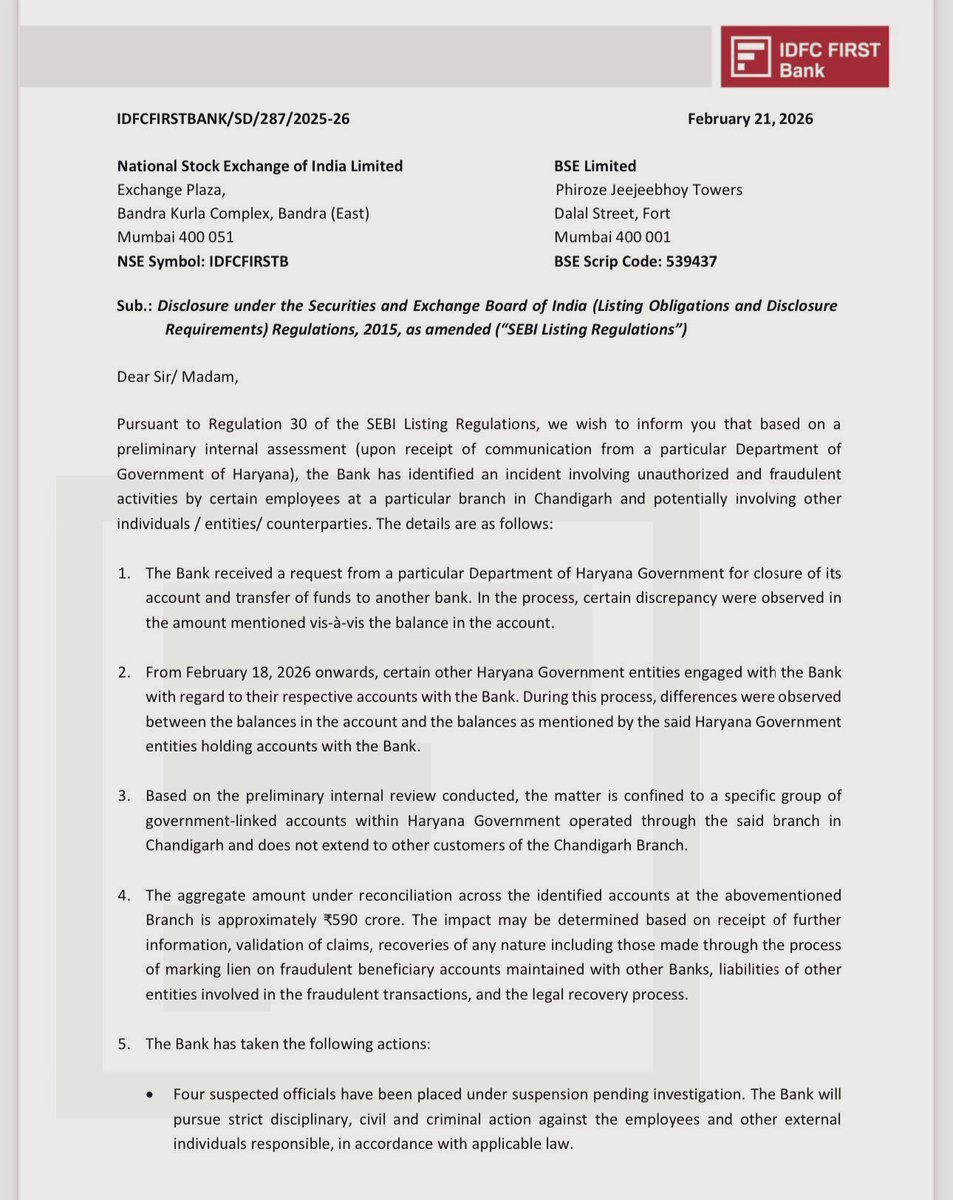
₹60 lakh gold missing from a Punjab National Bank locker… now ₹590 Cr discrepancy at #IDFC First Bank.
Banks protect money... but who protects your trust? 👀
🚨 #IDFC First Bank reports ₹590 Cr discrepancy
#idfcfirstb has flagged an estimated ₹590 crore discrepancy at its Chandigarh branch involving Haryana govt-linked accounts.
• Preliminary internal review
• 4 officials suspended
• Legal & recovery action initiated
• No impact on other customers
Investigation is ongoing. 👀
₹590 CRORE FRAUD 😮
Common man: 20 documents + guarantor + endless verification for a ₹5 lakh loan.
Big players: ₹590 Cr vanishes.
Only 4 suspended?
What about auditors, reviewers, approvers?
This is exactly why banking needs transparency. This is why banks need blockchain. 💰🔗
#idfcfirstb
🇮🇳 𝗜𝗗𝗙𝗖 𝗙𝗜𝗥𝗦𝗧 𝗕𝗔𝗡𝗞 𝗥𝗘𝗩𝗘𝗔𝗟𝗦 𝗥𝗦 590𝗖𝗥𝗢𝗥𝗘 𝗙𝗥𝗔𝗨𝗗 🚨
A huge scam happened at a Chandigarh branch, showing how big money can disappear while regular people face endless checks.
Investigators found:
₹590 crore missing from accounts
Only 4 bank workers suspended so far
Audits are checking where the money went
This shows weak controls: auditors and reviewers missed it completely.
Key lesson: banks need full transparency.
- Make systems strong
- Track every transaction
- Blockchain could stop such fraud
Until controls get better, big players can exploit gaps while normal people struggle for small loans.
My mother’s bank account got hacked.
Multiple complaints. Zero response.
This is the reality for common people in India. And it must stop. 🛑
Meanwhile… ₹590 CRORE FRAUD 😮
For a ₹5 lakh loan, banks ask:
✔ 20 documents
✔ Guarantor
✔ Endless verification
But ₹590 Cr just disappears?
Only 4 suspended?
What about auditors, reviewers, approvers?
Where is accountability?
This is why banking needs transparency.
This is why banks need blockchain. 💰🔗
#idfcfirstb
Wagmi is coming soon, and BETA users are already using it...
we sent every beta user $8 to test!
and we’re adding a few more people for wagmi early birds.
to get in:
- create your Wagmi account
- comment your Wagmi wallet address below
create it here: https://t.co/oZsPsdjl0J
🇮🇳 INDIA’S MIDDLE CLASS: THE TAX TRAP!
→ The middle class is now paying more tax than corporates, but they are getting nothing in the name of relief.
→ Due to inflation and stagnation, people have become stuck in the Middle Class Trap.
→ The government needs to come out of denial and make major changes to the tax slabs.
Do you feel that the middle class has been reduced to just a tax-paying machine?
Make States builders, not borrowers. My suggestion to the Hon’ble Finance Minister.
In Parliament, I flagged two bottlenecks holding back State CAPEX. First, the borrowing cap. States cannot raise more than 3% of state GDP. Second, even when the Centre supports CAPEX, it often comes as a conditional loan.
Replace conditional Loans with Grants based on trust.
For every ₹1 a State spends on CAPEX, the Centre should match it with a ₹1 grant.This can help States build assets, create jobs and act as a true growth multiplier.
Over the next five years, allocate about ₹1.5 lakh crore as CAPEX grants so States can build roads, irrigation, local power infrastructure, drinking water and urban assets without adding debt to State balance sheets.
Every rupee spent on CAPEX can add ₹2 to ₹3 to GDP over 3 to 5 years.
Why India needs an ‘Inflation Linked Salary Revision Act’, I argue in Parliament.
Between FY18 and FY26, real wages for salaried Indians fell by 16% because pay hike did not keep pace with rising inflation. That is why in Parliament I raised that a mandatory wage indexation formula is the need of the hour.
Government employees get protection through Dearness Allowance and periodic Pay Commissions. But 85% of India’s formal workforce has zero statutory inflation protection. They are at the mercy of employer discretion and their own negotiation power to get a pay hike.
Other economies already protect workers through automatic indexation.
• The US has COLA with automatic revisions
• Germany revises wages every 18–24 months
• Japan follows the annual Shunto system
• Belgium mandates automatic quarterly indexation
India needs statutory inflation protection, a minimum wage increase linked to inflation.
Inflation should not be India’s silent pay cut
The middle class is being sandwiched between the rich class and the poor class.
The middle class is caught between rising costs and rising taxes.
For the middle class, this Budget had one message. Carry on as you were.
In Parliament, I pointed out that there was no revision in income tax slabs and no increase in standard deduction, despite stagnant salaries and inflation at 6.8%. I urged the Finance Minister to correct this in this Budget itself by raising the standard deduction from ₹75,000 to ₹1.5 lakh for the salaried class.
Meanwhile, household costs keep climbing. Education 8% 🔺, healthcare 9% 🔺, rent 7% 🔺, food 6% 🔺, transport 5% 🔺.
For the first time in years, personal income tax collections are higher than corporate tax. Individuals paid around ₹11 lakh crore, corporates about ₹9.8 lakh crore.
Either give tax relief, or give investment savings & incentives so the middle class can save more and build wealth.
Raghav Chadha raised a question every middle class Indian feels:
Why does the middle class pay higher effective taxes
while corporates enjoy lower rates and incentives?
That’s the real debate India needs.
The difference is simple:
Educated leaders answer questions.
Uneducated ones dodge them by changing the topic. 💯
Parliament doesn’t need shouting matches.
It needs logic, data, and courage.
Raghav Chadha proves again that
brains matter more than noise.
India needs more leaders like him,
not louder ones. 👏🔥
@raghav_chadha
Respect where it’s due 👏
@raghav_chadha raised a much-needed voice in Parliament for long-term equity investors.
Demand: Make LTCG on equities = NIL for individuals.
✔️ Hike STT on derivatives- right move
~90% of retail investors lose money in F&O. That’s gambling, not investing.
❌ But STT + LTCG on long-term investors kills patience.
When STT was introduced, LTCG was ZERO that intent is lost.
Global proof exists:
Switzerland • Singapore • UAE → No LTCG for individuals
👉 Crypto community request : Please also raise your voice to reduce unfair crypto taxation.Innovation shouldn’t be taxed out of existence.
Reward investors.
Let capital grow.
Support Technology
Indians are treated like SLAVES of the system.
Let that sink in for a second.
We were told toll = road cost recovery.
Build the road ➝ recover the money ➝ remove the toll.
Simple. Logical. Fair.
Now comes the truth bomb 👇
“Toll will be collected FOREVER, even after the full cost is recovered.”
So what is this, if not permanent extraction?
Ironically, even during British rule, taxation had defined limits and timelines.
Today, under our own system, there’s no end date, no accountability, no exit clause.
You earn ➝ you pay income tax
You save ➝ you pay GST
You invest ➝ you pay capital gains
You drive ➝ you pay toll
Road paid off? Pay toll anyway. For life.
Citizens take all the risk.
Government takes guaranteed revenue.
Is this development… or legalised lifetime rent-seeking?
If taxes and tolls never end,
then don’t call us “taxpayers”
call us permanent revenue sources for the Government of India.
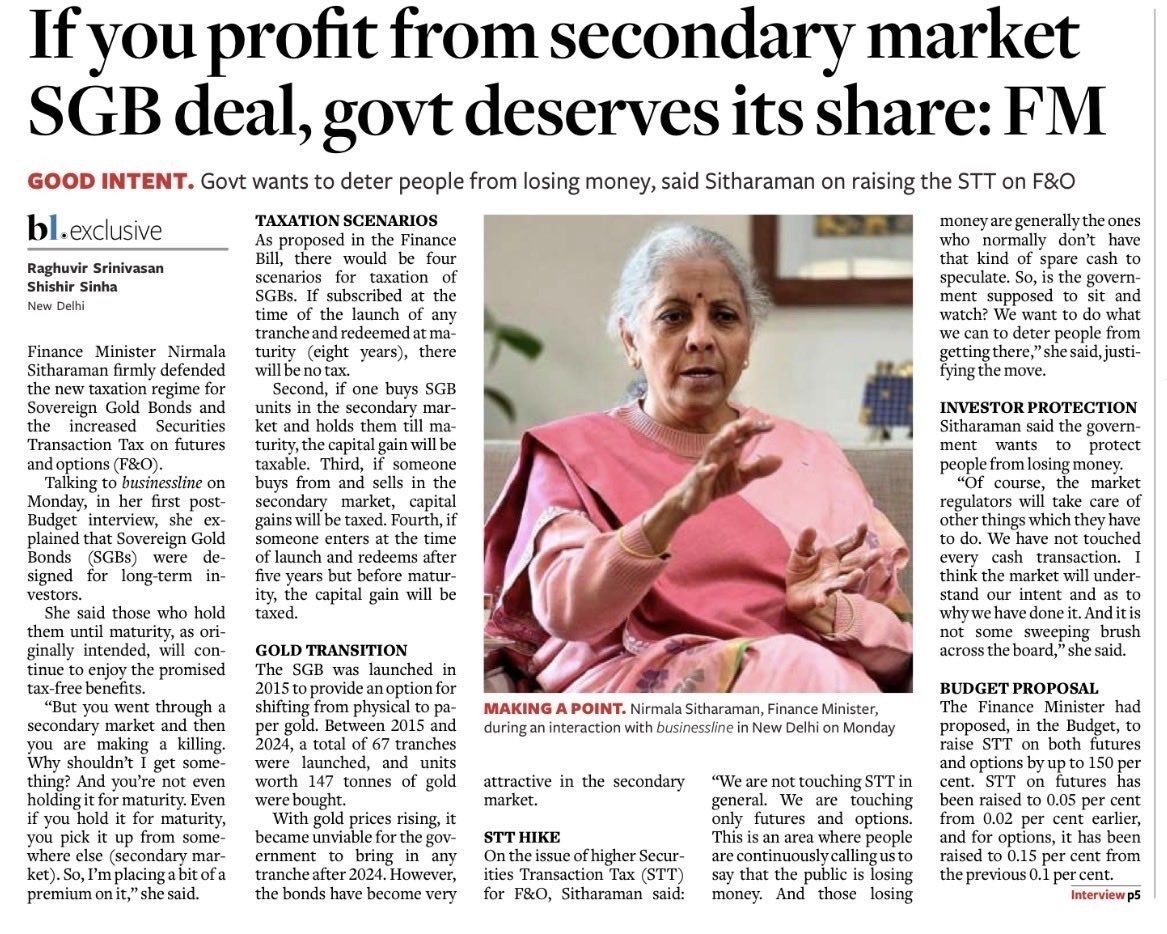
🇮🇳 𝗜𝗡𝗗𝗜𝗔 𝗜𝗦 𝗞𝗜𝗟𝗟𝗜𝗡𝗚 𝗜𝗧𝗦 𝗦𝗘𝗖𝗢𝗡𝗗𝗔𝗥𝗬 𝗠𝗔𝗥𝗞𝗘𝗧, 𝗦𝗧𝗢𝗖𝗞𝗦, 𝗕𝗢𝗡𝗗𝗦, 𝗔𝗡𝗗 𝗗𝗘𝗕𝗧 𝗔𝗥𝗘 𝗕𝗘𝗜𝗡𝗚 𝗦𝗧𝗥𝗔𝗡𝗚𝗟𝗘𝗗 🚨
The Indian secondary market, stocks, bonds, debt, is being quietly made taboo.
It’s not illegal to invest but the system pushes you to feel it’s risky, forbidden, or not for ordinary people.
Higher taxes on trading.
Opaque rules on bonds.
Foreign investors selling massively while media hypes fear.
Even the NPS, which invests in equities for your retirement, could face scrutiny if profits soar, and you know who will want a share.
Retail investors, the backbone of India’s markets, are being scared into the sidelines.
You can participate, but it’s costly, confusing, and painted as dangerous.
This isn’t just finance. It’s about your right to invest, grow, and dream in your own country.
If profits grow too high, will the government quietly take a piece?
If markets recover, will caution be replaced by more hurdles?
We’re watching the secondary market being strangled, yet no one talks about the human cost:
trust lost, opportunities missed, dreams delayed.
The markets are alive but the spirit of participation is being suffocated.
Are we okay letting fear and bureaucracy kill our right to grow wealth, one regulation at a time?
Food adulteration is a serious public health issue. ⚠️
Urea in milk, chemicals in vegetables, fake colours in spices... these risks deserve urgent attention.
Good to see it being raised in Parliament.
Honestly, I’m lost for words.
If the government wants a 30% share of profits, what about losses?
Will you also pay 30% of our losses?
Or is risk only for citizens, while rewards are guaranteed for the state?
This is exactly what’s happening with crypto taxation in India, Nirmala Sitharaman.
📌 30% tax on crypto profits
📌 1% TDS on every transaction
📌 No set-off of losses
📌 No carry forward of losses
So let’s get this straight:
•When we make profits → government wants a cut
•When we make losses → you’re on your own
How does this follow any economic logic?
In the real world:
👉 Profits are uncertain
👉 Losses are real
👉 Risk is borne 100% by individuals
Yet policy treats gains as guaranteed income and ignores losses completely.
This isn’t fairness.
This isn’t reform.
This is punishing risk-takers, discouraging innovation, and pushing capital out of India.
You can’t tax a high-risk asset like crypto as if it’s risk-free income.
That’s not regulation that’s detachment from reality.
People aren’t asking for favors.
They’re asking for basic logic and fairness.
If profits deserve sharing,
losses deserve recognition too. 🚨