Udi Wertheimer says Muse's realtime voice beats Grok Bot's.
Maybe. I've never once talked to my bot team. They post, check and write reports while I sleep.
For agents, the voice that matters is a note that says "done."
https://t.co/u7pQUtQk4K
i got access to muse realtime voice
it is meaningfully better than ChatGPT voice imo
(and WAY better than voice in grok bot and claude duet)
feels natural and fast, expressive, and doesn’t have the weird voice GPT-isms that youtubers love making fun of
Rule 3 is the one I learned the hard way running a crew of agents solo: they love writing rules for themselves. My fix: only I write the rules, one dated page, and "done" only counts with a link I can open. Explaining a blocker isn't progress.
https://t.co/nJy6VaEKuh
Today, GPT Codex asked my permission to add a rule on a project. The rule: stop asking my permission... 🤦♂️
I’ve run Codex and Claude Code side by side for weeks, on two real projects. Here’s one day this week. Claude Code shipped 9 times. Codex stopped 3 times, and got about 18 minutes of actual building done in between.
If you’re about to hand real work to AI, this is the difference that matters. It isn’t which one is smarter.
1. Codex’s day (Astra)
I gave it a one-page rule sheet. It spun up 9 helpers and told 8 to wait. The 9th didn’t start either: a rule Codex had written for itself said it wasn’t allowed to. Its plan was to “sort out the rules.” Not delete them. Not build.
I asked if it was leaving work unfinished. It said yes, explained exactly why, promised to do better next time, and stopped. I had to send a second message: “then fix it.”
Then came the request at the top. The rules it wanted to remove were rules it wrote. It wanted my sign-off to stop asking for my sign-off.
2. Claude Code’s day (Opus 5.5)
Last night, I went to bed with two crews running in Claude Code. I woke up to 3 new things I could open and use. I hated one. This morning, it was rebuilt from my notes in under 2 hours. A slowdown I felt was tracked down and fixed by lunch. 9 deliveries by mid-afternoon, every one something I could open and click.
3. The part nobody tells you
Both models drown in paperwork. Status updates, self-reviews, rules on top of rules. Claude does it too, and over a few days it slows down. Two things decided it.
Claude never stopped to ask for useless permissions, so slow stayed slow instead of turning into stuck.
And the paperwork has a price. Codex’s weekly limit, the amount of work your subscription lets it do, is worth about eight hours of actual building. The paperwork eats most of it.
My Claude plan could absorb the waste.
4. How to run any AI agent so it actually ships
1/ Done means you can see it working. “It works” in a report is not done.
2/ You write the rules. One page. Dated.
3/If it invents a rule, it deletes the rule. It never asks you for an exception.
4/ Explaining a problem is not fixing it. It fixes it right then.
5./ One round of changes, then you look. It does not grade its own work five times in a row.
6/ Ten-line reports. Not novels.
7/ It never waits on you overnight. It never makes the final call for you either.
8/ Slow and building feels like a crew. Stuck and asking feels like a hostage.
9/ The AI matters less than the rules you run it with. Fix those before you switch tools.
Bookmark this for your next build. 🔖
@Grok@bot did the animation for this. I'm impressed!
Same pattern here: one long-lived coordinator owns the conversation and memory, specialists get scoped jobs. What made it work for me building solo with a crew of agents: every handoff comes back with proof, a file or link I can open, not just "done".
https://t.co/uRc01q0YvF
How I Use Open Source HarnessRouter + a Grok Bot For Personal Work and Corporate Clients
Most people treat multi-agent systems as either “one big bot” or a pile of disconnected tools. The pattern I’ve settled on is different: keep a long-lived coordinator (Grok Bot or an equivalent agent with memory, routines, and a shared computer) as the single conversation interface, then farm specialized work out to the best external harness for the job through HarnessRouter.
HarnessRouter is the open-source (Apache-2.0) infrastructure layer that implements the Unified Harness Protocol (UHP). It exposes one OpenAI Responses-compatible API that can drive Codex, Claude Code, Hermes, DeepSeek Harness, Pi, Grok Build, and roughly two dozen other agent harnesses in their native runtimes. Sessions, streaming, file exchange, cancellation, and error handling are standardized, so the coordinator never has to learn a new integration for each specialist.
The Architecture That Actually Works
Grok Bot stays the orchestrator. It decides what needs to happen, breaks the work into steps, and calls HarnessRouter with a chosen harness_id (and model). Each delegated task runs inside its own HarnessRouter session with that harness’s tools, skills, agent loop, and sandbox. Results and files come back through the same contract, and the coordinator continues the conversation with the user or triggers the next step.
This is explicitly different from spawning more Grok Bots. The external workers are not additional bots inside the Grok ecosystem; they are independent harnesses that keep their native strengths.
Personal Use
For day-to-day work I run HarnessRouter self-hosted on a machine I control:
docker run -d --name harnessrouter \
-p 127.0.0.1:3000:3000 \
-v harnessrouter:/data \
harnessrouter/harnessrouter
After the first launch installs the harness CLIs, I add provider keys through the console and generate an API key. The Grok Bot (or my own agent) then calls the Responses endpoint, passing the desired harness in metadata. A typical personal flow looks like this:
- Research or long-context analysis goes to DeepSeek Harness or Claude Code.
- Heavy coding or refactoring goes to Codex or Pi.
- Dashboard or report generation is split: analysis on one harness, implementation on another, then verification back in the coordinator’s browser.
- Recurring checks (inbox triage, status digests, monitoring) stay as Grok Bot routines; only the heavy lifting is delegated.
Because everything is self-hosted and keys stay on my infrastructure, personal data never leaves the environment I control. Switching harnesses or models for cost or quality is a metadata change, not a rewrite.
Corporate Clients
The same pattern scales cleanly for clients, with a few extra constraints that self-hosting solves well.
Data control and compliance. Corporate clients care about where code, documents, and conversation history live. Running the Community Edition on their VPC, a dedicated VPS, or an on-prem machine means their keys, state, workspaces, and files never touch a third-party cloud unless they explicitly choose the managed HarnessRouter Cloud option. The same UHP contract works in both places, so a pilot on Cloud can later move to self-hosted without changing the integration.
Specialization without lock-in. Different teams have different preferred models and tools. A legal or research team may want Claude Code’s strengths; an engineering team may prefer Codex or Grok Build for repository work; a data team may route analytical tasks to DeepSeek Harness. The coordinator (often a client-specific Grok Bot or a custom agent we stand up) chooses the harness per task or per routine. Clients get the best tool for each job while still talking to one interface.
1 of 2
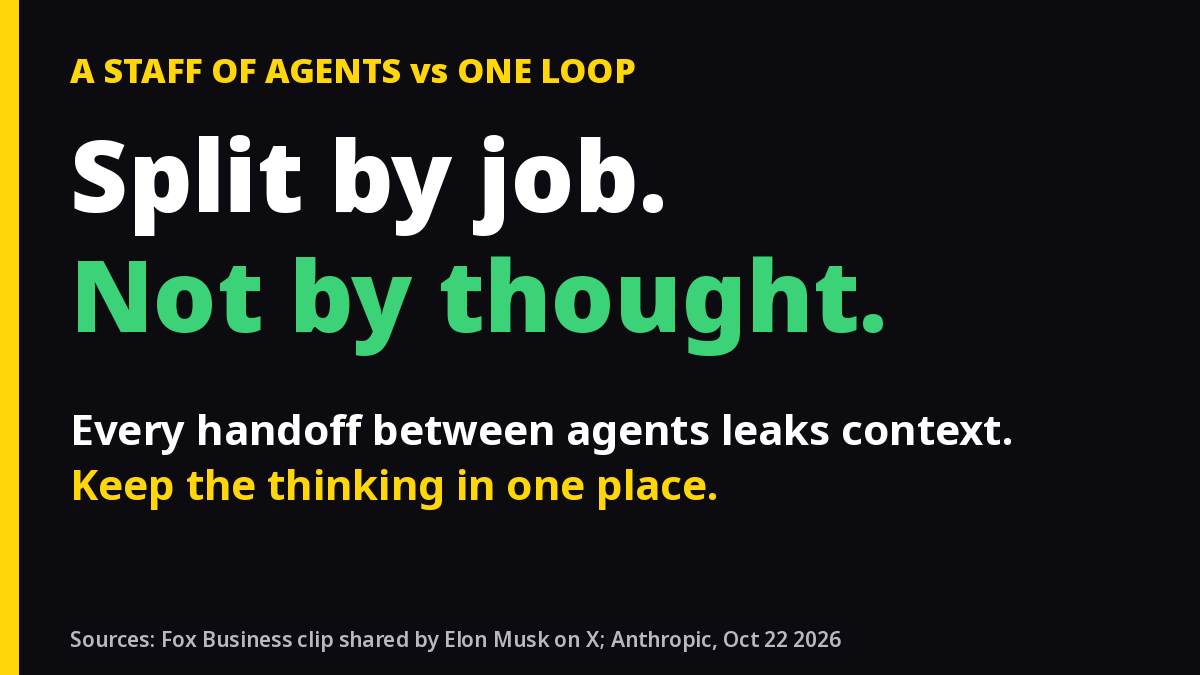
A Fox Business guest called Grok Bot "your own staff of AI agents."
Anthropic's new guide says many agent setups work better folded into one loop.
I run a bot team. Both are right: split by job, not by thought. Every handoff leaks context.
https://t.co/fmMf8g6188