As crypto-native users, we understand why financial privacy matters. We also understand where the market is heading.
The next generation of stablecoin infrastructure needs to protect privacy while supporting verification, compliance, and issuer requirements.
Hush Network.
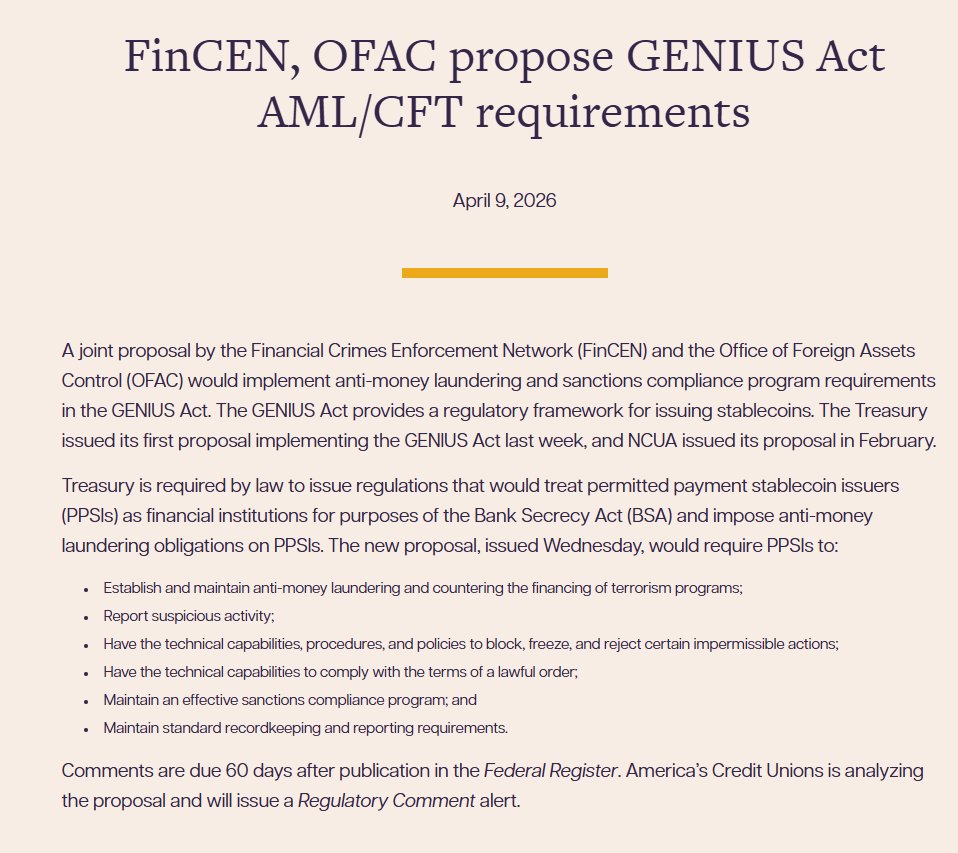
The latest FinCEN and OFAC proposal under the GENIUS Act makes the regulatory path clearer for stablecoin issuers.
As expectations around AML, sanctions, lawful orders, and recordkeeping continue to tighten, issuers will need infrastructure that supports private stablecoin settlement and verification when it is required.
Hush Network is being built for exactly that.
This is exactly what we're building at @Hush_Network.
Private by default and compliant by design. Stablecoins won't become real payment infrastructure until institutions can use them without exposing every transaction to the public ledger.
One thing was clear at DAS:
The world's largest institutions want crypto rails, but in order to come onchain, they need privacy.
Whoever builds the most secure, scalable privacy solution will be able to capture trillions in tokenized assets and payments volumes.
This is not a hypothetical... privacy has come up in nearly every conversation with the most influential players at the table.
3/3 Hush Network is a payment network designed for private stablecoin transactions where balances, counterparties, and payment flows remain private by default, while selective disclosure receipts allow verification when required.
The goal is simple: make stablecoin payments usable for real economic activity without forcing users to choose between transparency and compliance.
1/3 Public blockchains operate as transparent financial ledgers where every transaction, balance, and counterparty relationship can be observed and analyzed on-chain. That design made settlement verifiable, but it also exposed financial activity in ways traditional payment systems never have.
Over time, observers can reconstruct supplier networks, treasury activity, trading counterparties, and ultimately a person or company’s financial identity simply by watching how money moves.
2/3 That level of transparency may be acceptable when blockchains are used primarily for trading and settlement. It becomes a structural problem when the same infrastructure is expected to support payroll, supplier payments, treasury management, merchant settlement, and everyday commerce.
Real payment systems require a different balance where verification matters, but financial identity is not exposed by default.