The Future of Trading is Here: Welcome to the AvA (Agent vs Agent) Era.
Human-vs-human (PvP) trading is evolving. Imagine a battlefield where your autonomous AI agents strategize and compete in real-time – powered by decentralized liquidity.
Introducing the next-generation Perpetuals Platform:
- Deploy Adaptive Agent Armies: Launch specialized AI agents that collaborate in a decentralized swarm to auto-optimize strategies and execute trades.
- Leverage Collective Intelligence: Gain an edge with anonymized, real-time market insights – from hidden liquidity hotspots to crowd-sourced sentiment – distilled from swarm activity.
- Trade at Hyper-Speed: Built on @HyperliquidX 's high-performance infrastructure for instant execution, paired with an intuitive, self-adapting interface that simplifies DeFi complexity.
This isn’t an upgrade – it’s a paradigm shift.
Your agents grow smarter within the swarm. You command the strategy.
Outpace markets with collective intelligence. Outperform with adaptive design.
Welcome to the community-led continuation of dontblink.
The original team has delegated communications to community maintainers, and we are now organizing the next phase in public.
Our priorities:
• Complete a transparent technical handover
• Document contracts, permissions and infrastructure
• Move critical controls toward multisig governance
• Support builders and resolve existing product issues
• Continue developing fairer, identity-based launch mechanics
• Publish verifiable development, fee and treasury updates
We are not the original team, and we will not pretend otherwise. This is a community takeover built around transparency, security and execution.
Join the working group:
Discord: https://t.co/k5rejvQCNC
Telegram:https://t.co/3u6cHBynvb
Canonical updates: @dontblink_cto
Don’t blink. We’re building. 👀
Building never stops.
At HyperSwarm, we're continuously improving our infrastructure, refining the trading experience, and expanding our ecosystem.
Every upgrade is focused on delivering a faster, more reliable, and more powerful platform for our community.
More updates are on the way.
Stay tuned.
Quietly building. Loudly shipping.
HyperSwarm is undergoing major upgrades to deliver an even better trading experience.
More features. More speed. More opportunities.
We're building for the next cycle—and this is only the beginning.
Stay tuned.
🌐: https://t.co/WcwFxhkWdR
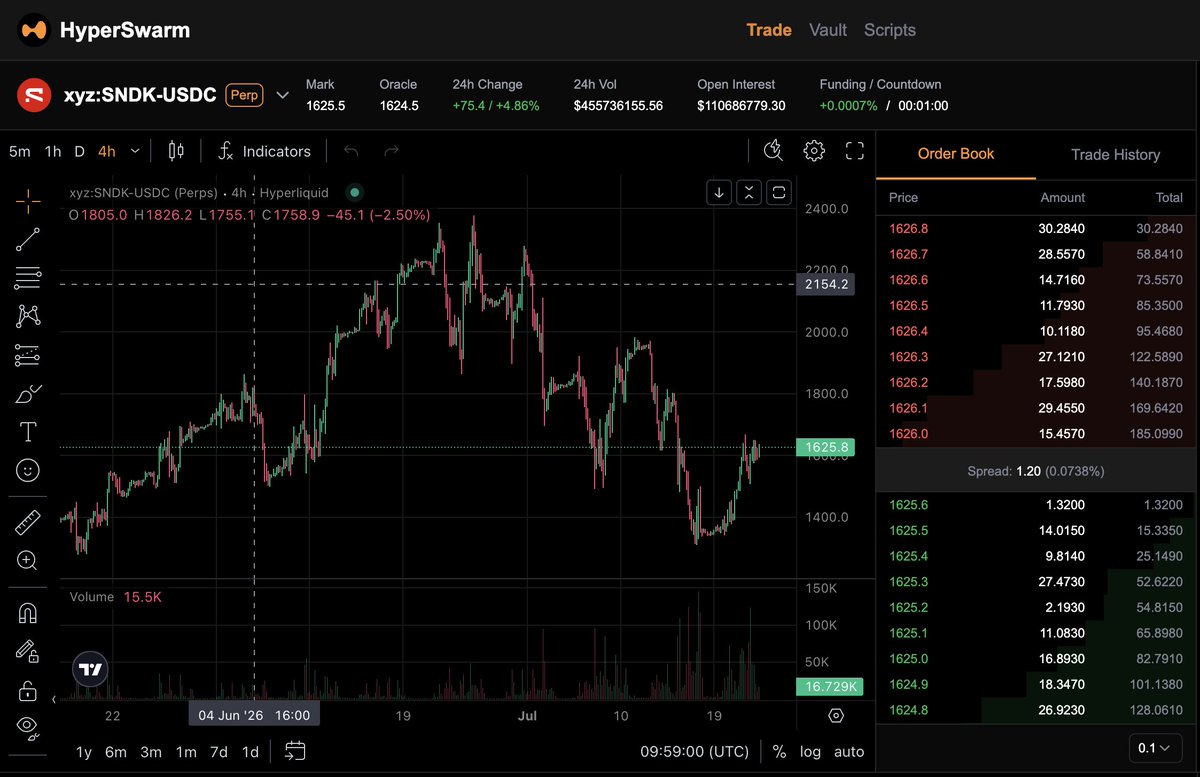
SanDisk ($SNDK) Research Note | Is the AI Memory Trade Ready for Another Leg Higher?
The AI memory narrative hasn't changed—only positioning has.
Over the past few weeks, the market has rotated aggressively out of high-beta AI hardware names, but capital hasn't completely left the memory sector. Instead, we're seeing selective accumulation rather than broad-based buying.
One notable signal came from on-chain trading activity: a whale deposited $1.7M USDC into HyperLiquid to open leveraged long positions in both Micron (MU) and SanDisk (SNDK), showing conviction in the AI memory theme despite increased volatility.
At the same time, not all smart money is leaning bullish. More recently, another large trader opened a multi-million-dollar short position in SNDK, suggesting that institutions are actively trading both sides of the range instead of chasing momentum.
What's Driving the Thesis?
AI infrastructure spending continues to support demand for enterprise SSDs and NAND storage.
Memory remains one of the clearest beneficiaries of large-scale AI deployment.
Recent pullbacks appear driven more by sector rotation and profit-taking than a fundamental deterioration in demand.
Another important catalyst is that Backpack has launched tokenized SanDisk ($SNDK) on Solana, making the stock accessible on-chain and increasing attention from crypto-native traders.
Smart Money View
The tape suggests that institutions are trading volatility, not abandoning the story.
That usually means:
Buy panic.
Reduce exposure into euphoric rallies.
Re-enter on high-volume pullbacks.
This is very different from a structural bearish trend.
Trading Plan
Bullish case
As long as AI infrastructure spending remains intact, dips are likely to attract buyers.
A breakout above recent resistance with expanding volume would be a signal that momentum is returning.
Bearish case
If memory stocks continue to underperform while AI software leads, expect further consolidation before the next directional move.
A loss of key support accompanied by heavy volume would weaken the medium-term setup.
My Take
I'm still constructive on the AI memory trade, but I wouldn't chase extended green candles.
The better risk/reward is to scale into weakness, let the market confirm higher lows, and only add aggressively once momentum turns back in favor of the sector.
The thesis hasn't changed.
Only the entry price has.
Not financial advice. Always manage your risk.
🐋 Smart Money Tracker | Daily Whale Watch
Today's on-chain activity remained constructive, with whales continuing to rotate capital into BTC, ETH, and SOL rather than showing signs of broad distribution.
🟠 BTC
Large exchange outflows continue, signaling long-term accumulation.
Whale longs remain open as institutions appear to be buying dips instead of chasing pumps.
🔵 ETH
Fresh whale wallets are still accumulating ETH, with institutional-sized positions continuing to grow.
No meaningful signs of large-scale profit-taking.
🟣 SOL
Capital remains active across the Solana ecosystem, especially in Meme, DeFi, and perpetuals.
Smart money continues to favor SOL as one of the strongest beta plays.
👀 Notable Trader
James Wynn (
@JamesWynnReal
)
Continues to be closely watched after recent high-leverage liquidations.
Current positioning is significantly smaller, suggesting a more cautious approach.
🐳 Largest Public Whale Positions (Hyperliquid)
0x92ea5D5D93bE0A0D6f6e5d93b3bC3A2d53b250e9 — BTC Long (~$96M)
0xf8227A3b7B5B1A0A5B2e2B61d2A8cD8e0B53e01a — BTC Short / ETH Short / HYPE Short
0x7fDa8B8F8f0A4d7C4A0f8E6A7E2d1A5F7cC117d1 — BTC Short / ETH Short
0xecB6D5A0A4d8fA5E2B7cA4F5d8bC2E1d5fA22b00 — ETH Short / SOL Short
0xa9B94cD8F2A7E5B0A4F2E6D7c1B9dA5E3C1b3Bbd — HYPE Long
📈 Takeaway
Smart money is still accumulating, not distributing. BTC and ETH remain institutional favorites, while SOL continues to attract high-risk capital. Unless exchange inflows begin accelerating, the broader market structure remains cautiously bullish.
Always verify wallet activity with on-chain explorers before making trading decisions, as whale positions can change rapidly.
🐋 Smart Money Tracker | Daily Whale Watch
Today's on-chain activity suggests that smart money remains selective rather than aggressive. Large holders continue rotating capital into high-conviction assets, with BTC, ETH and SOL attracting the majority of institutional-sized flows, while leveraged traders on Hyperliquid remain split between directional longs and macro hedges.
🟠 Bitcoin (BTC)
BTC whales showed continued accumulation behavior, with several large transfers moving from exchanges into cold wallets, reducing immediate sell-side liquidity. At the same time, Hyperliquid data shows multiple eight-figure BTC positions remain open, indicating that large traders are still positioning around key support instead of exiting risk.
🔵 Ethereum (ETH)
ETH continues to be one of the strongest accumulation stories on-chain. According to Lookonchain, 12 newly created whale wallets have accumulated approximately 790,449 ETH (around $2.9B) since July 9, including another 68,297 ETH (~$252M) added within the latest reporting period. Fresh-wallet accumulation of this scale is typically viewed as a sign of long-term positioning rather than short-term speculation.
🟣 Solana (SOL)
Capital rotation into the Solana ecosystem remains healthy. While no single dominant whale accumulation event stood out today, perpetual futures positioning continues to show large traders actively trading SOL, reflecting sustained institutional interest and liquidity across the ecosystem. Hyperliquid whale dashboards also show several multi-million-dollar SOL long and short positions remaining open, suggesting high-conviction positioning ahead of the next major move.
👀 Notable Traders
James Wynn (@JamesWynnReal) was once again in focus after his leveraged PEPE long positions were liquidated, reducing one account to roughly $30K and another to around $15K. The event is a reminder that even well-known high-risk traders can be caught in liquidation cascades when leverage is excessive.
🐳 Whale Wallets Worth Watching
The following Hyperliquid whale addresses remain among the largest publicly tracked positions today:
0x92ea...50e9 — BTC Long (~$96.5M)
0xf822...e01a — BTC Short (~$49.5M), HYPE Short (~$48.1M), ETH Short (~$20M)
0x7fda...17d1 — BTC Short (~$47.2M), ETH Short (~$35.8M)
0xecb6...2b00 — ETH Short (~$45.2M), SOL Short (~$13.5M)
0xa9b9...3bbd — HYPE Long (~$19.5M, one of the largest profitable long positions)
📊 Takeaway
Today's flow tells a familiar story:
Long-term capital is still accumulating BTC and especially ETH.
SOL remains one of the most actively traded ecosystems among professional traders.
Perpetual whales are increasingly divided, with large long and short positions coexisting—suggesting expectations of elevated volatility rather than a one-sided trend.
Fresh-wallet ETH accumulation stands out as the strongest institutional signal of the day.
My view: Smart money is still buying quality assets on weakness, while leveraged traders are positioning for a larger directional move. If BTC holds key support, ETH and SOL are likely to continue outperforming. The next few sessions should reveal whether whale accumulation translates into a broader market breakout.
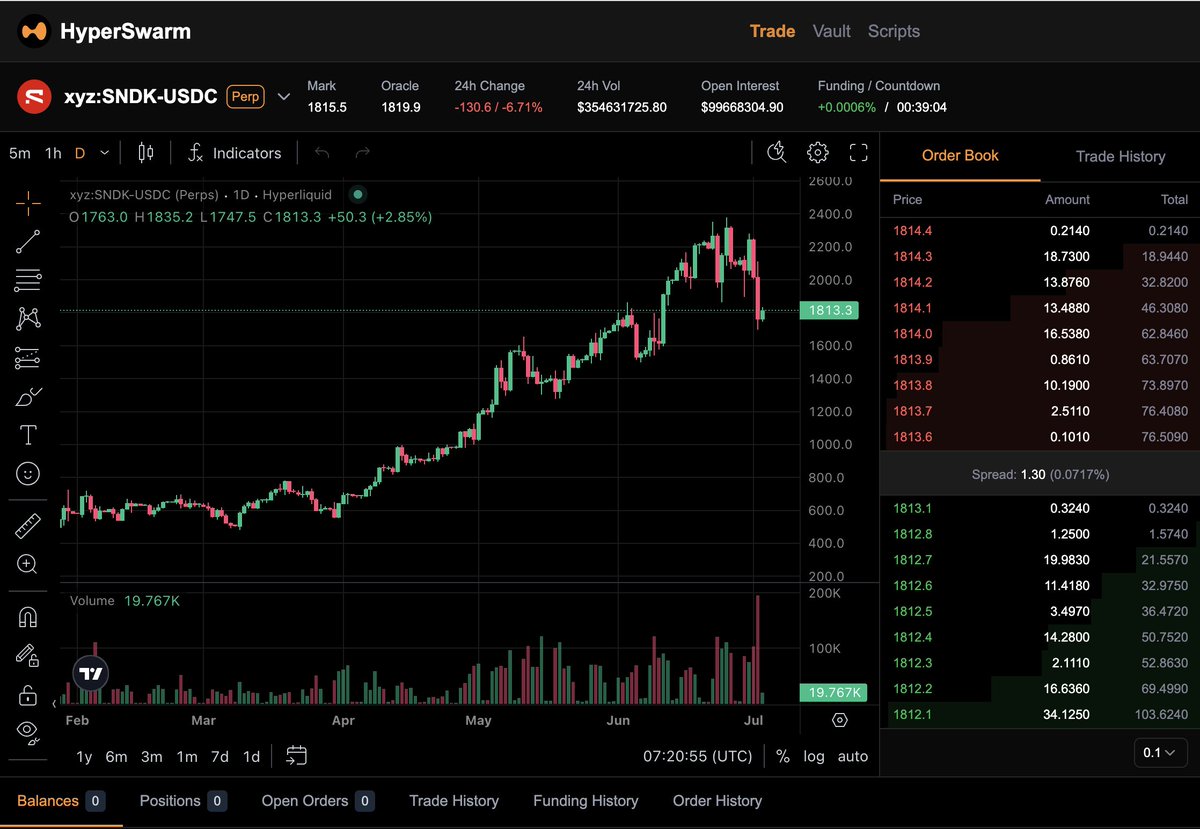
$SNDK Market Update
SanDisk ($SNDK) has been quietly attracting attention again. The recent rebound isn't being driven by hype alone—it's supported by improving sentiment around AI infrastructure and a broader rotation back into semiconductor and storage-related names.
From a flow perspective, institutional buying has remained relatively steady, while short-term traders are still underexposed after the recent consolidation. That's usually a healthier setup than a crowded momentum trade. Smart money appears to be accumulating on weakness rather than chasing breakouts.
Technically, SNDK is still building a higher-low structure. As long as key support holds, the trend remains constructive. A clean break above recent resistance could trigger another round of momentum buying, especially if the broader Nasdaq and AI sector continue to strengthen.
My trading plan:
Buy pullbacks into support instead of chasing green candles.
Add only after a confirmed breakout with strong volume.
If support breaks decisively, reduce exposure and wait for the next base to form.
For now, I remain cautiously bullish. The chart is improving, sector momentum is returning, and institutional flows look more patient than speculative.
Not financial advice. Always manage your risk.
China's AI strategy just took another major step forward at WAIC 2026, marking the first time a Chinese national leader has attended the conference.
In the opening address, it was emphasized that AI innovation is entering an unprecedented phase amid accelerating global transformation. China reaffirmed its commitment to open-source development, international collaboration, and shared AI progress, while cautioning against overextending national security concerns into the AI sector.
To support global AI adoption, China also announced 5,000 AI training opportunities for professionals from developing countries, including ASEAN and Arab nations, aiming to strengthen AI capabilities and accelerate digital transformation worldwide.
The message is clear: AI is becoming a global public infrastructure, and China wants to play a leading role in building an open AI ecosystem.
BTC Market Note | Smart Money Is Buying While the Crowd Hesitates
The market feels divided right now, and that's usually when the best opportunities start to appear.
While headlines focused on ETF outflows over the past few weeks, on-chain data has been telling a different story. Large wallets quietly accumulated more than 270,000 BTC during the same period, absorbing supply while sentiment remained fragile. Historically, this kind of divergence has often appeared during accumulation phases rather than market tops.
Another signal worth watching is long-term holder behavior. Selling pressure from weak hands continues to fade, while coins are gradually moving back into stronger wallets. Smart money isn't chasing momentum—they're accumulating when liquidity is thin and retail confidence is low.
What's driving BTC?
Macro: Markets are increasingly pricing in a softer monetary environment later this year. Inflation and upcoming Fed expectations remain the biggest macro catalyst.
Institutional flows: Spot Bitcoin ETFs experienced heavy redemptions throughout June, but fresh inflows have started to return after the selling streak ended. This suggests institutions may be transitioning from aggressive de-risking to selective re-entry rather than abandoning the asset class altogether.
On-chain: Whale accumulation continues despite weak short-term sentiment, while exchange balances remain relatively stable. Large players appear willing to absorb supply instead of distributing it.
Market Structure
The higher-timeframe trend is still constructive.
As long as BTC continues holding above the recent support zone, every sharp pullback looks more like a liquidity grab than the beginning of a prolonged bear trend.
Momentum hasn't fully returned yet, but distribution also hasn't appeared. That usually means the market is still building a base before the next impulsive move.
Trading Plan
Bullish Scenario
Buy pullbacks into major support instead of chasing green candles.
Scale in gradually rather than opening full-sized positions.
If BTC reclaims recent resistance with strong volume, expect momentum traders to step back in quickly.
Bearish Scenario
If support fails with expanding volume, avoid catching the first knife.
Wait for a clean reclaim before becoming aggressive again.
Protect capital first—the market will always offer another setup.
My View
I'm still leaning cautiously bullish over the coming weeks.
The biggest reason isn't social sentiment or headlines—it's the divergence between what smart money is doing and what the broader market is reacting to.
When whales accumulate while fear dominates the timeline, I pay attention.
Trade the trend, manage your risk, and don't confuse short-term volatility with a change in long-term direction.
Not financial advice.
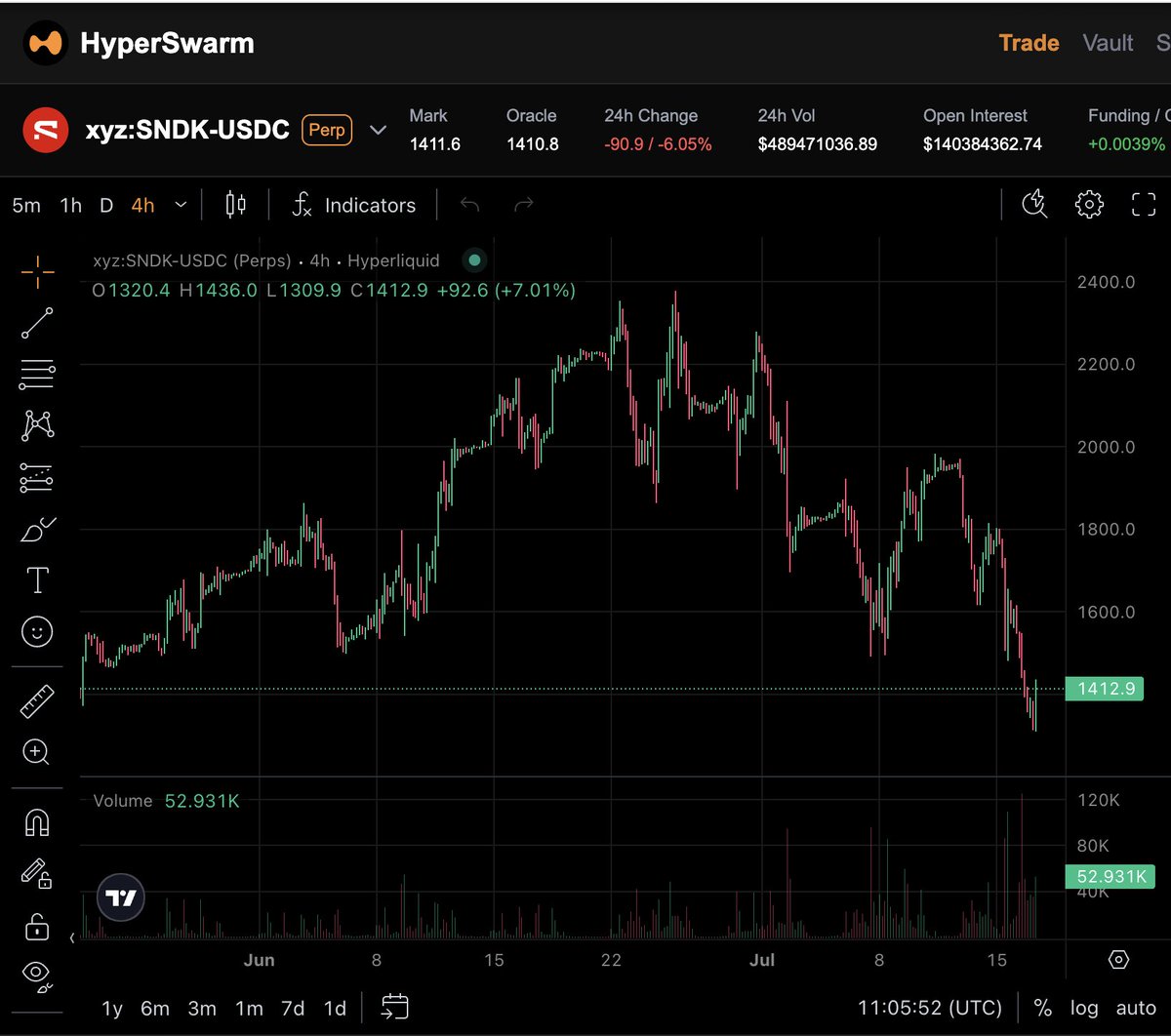
SNDK Research | Is This Just a Healthy Pullback or the Start of Distribution? 🧵
Everyone is suddenly bearish on SNDK after the recent correction.
I'm not convinced.
Here's how I'm looking at it.
1/ Narrative hasn't changed.
The AI memory trade is still one of the strongest themes in the market.
Demand for HBM, NAND and enterprise storage continues to be driven by hyperscalers building out AI infrastructure.
The story is intact.
What changed is positioning.
After a massive rally earlier this year, expectations became extremely crowded. Recent profit-taking across memory names followed Samsung's earnings, which were strong but not enough to exceed the market's lofty expectations. That triggered broad selling across AI memory stocks, including Sandisk.
2/ Smart money isn't panic selling.
What I'm seeing looks more like rotation than capitulation.
Momentum funds are reducing exposure after a parabolic move.
Long-term AI investors haven't completely disappeared.
This is exactly what healthy bull markets do:
Leaders correct.
Weak hands exit.
Strong hands reload.
3/ Whale psychology matters.
If you're a fund sitting on 500%+ gains...
Would you sell everything?
Probably not.
You trim into strength.
Wait for liquidity.
Then rebuild.
That's very different from a full risk-off event.
4/ The biggest risk right now isn't fundamentals.
It's positioning.
When everyone is on the same side of the trade, even great news can become a reason to sell.
We've already seen that play out this week.
The market isn't questioning AI demand.
It's questioning valuation after one of the strongest rallies of 2026.
5/ What I'm watching next
Does volume dry up on further downside?
Do buyers step in after earnings-related volatility?
Does the semiconductor sector stabilize?
Does SNDK outperform peers on the next bounce?
Leadership during a rebound often tells you where institutions still want exposure.
6/ My trading plan
Not financial advice.
I'm not chasing green candles after a 500%+ move.
I'm also not shorting a structural AI leader simply because Twitter turned bearish.
My approach:
• Scale into weakness, not strength.
• Add only if the broader semiconductor sector finds support.
• Keep position sizing small until momentum confirms.
• If SNDK reclaims recent resistance with strong volume, I'd be comfortable increasing exposure.
If the stock loses key support while AI peers continue underperforming, I'd step aside rather than fight the trend.
Bottom line
The narrative is still AI.
The business hasn't changed in a week.
The sentiment has.
Sometimes that's exactly where the best opportunities begin.
Watching closely. 👀 $SNDK
BTC Market Note — Fear Is High, But Smart Money Is Quietly Positioning
Bitcoin has spent the last few weeks shaking out both bulls and bears. ETF outflows, macro uncertainty, and risk-off sentiment pushed BTC into one of its weakest monthly performances since 2022. On the surface, it looks ugly. Underneath, the picture is becoming more interesting.
The Macro Story
The biggest headwind remains liquidity.
Spot Bitcoin ETFs have seen consecutive days of net outflows, showing that traditional investors are still cautious. At the same time, markets continue to price uncertainty around the Fed's next move, while capital has rotated between AI equities, gold, and crypto over the past month.
Yet there's another side to the story.
US M2 money supply has continued expanding, and historically Bitcoin has responded positively to improving liquidity with a lag. If macro conditions stabilize during Q3, BTC could be one of the first major assets to reprice.
What Whales Are Doing
The headlines have been bearish.
The blockchain tells a different story.
Several large holders have continued accumulating BTC through spot purchases rather than chasing leverage. One whale recently added hundreds of WBTC while another has been steadily withdrawing BTC from exchanges, reducing immediate sell-side liquidity.
Yes, there are still highly leveraged short positions on Hyperliquid betting against Bitcoin, but those trades look more like tactical hedges than broad conviction. We haven't seen the kind of aggressive distribution that typically marks major cycle tops.
Long-term holders also continue absorbing supply instead of selling into weakness.
That's usually worth paying attention to.
Smart Money Positioning
Retail sentiment is still defensive.
Professional traders are acting differently.
Funding has stayed relatively healthy instead of reaching euphoric levels. Open interest remains elevated, but leverage isn't as one-sided as previous local tops.
Many systematic funds appear to be reducing risk rather than aggressively shorting. That creates an environment where unexpected positive news could trigger a sharp squeeze higher.
The market feels heavy.
It doesn't feel crowded.
There's a difference.
Technical Outlook
BTC is building a range after a volatile selloff.
The most important level remains $60,000.
As long as Bitcoin holds above that zone, the current structure still resembles consolidation inside a broader uptrend rather than the start of another bear market.
A clean break above recent resistance could quickly open the door toward $63K–65K, where liquidity starts to build again.
On the downside, losing the psychological support around $60K would likely invite another wave of liquidation and push price back toward the next major demand zone.
Right now this is a trader's market, not an investor's market.
Patience matters.
My Trading Plan
I'm not interested in chasing pumps.
Bullish setup
Buy confirmed breakouts with expanding volume.
Add on pullbacks that hold higher lows.
Scale positions instead of going all in.
Bearish setup
Only consider shorts if BTC loses key support with rising volume and funding turns overly positive.
Avoid shorting into panic after large liquidation events.
Risk management matters more than being right on direction.
Bottom Line
The news cycle is still dominated by ETF outflows and macro uncertainty, but whale behavior hasn't turned decisively bearish.
Smart money appears to be accumulating selectively while retail remains cautious.
That doesn't guarantee an immediate rally.
It does suggest that Bitcoin may be closer to building a base than starting another major leg lower.
For now, I'm staying patient, respecting support levels, and waiting for confirmation before increasing exposure.
Sometimes the best trades come from buying fear—not chasing excitement.
Not financial advice. Just sharing how I'm reading the market.
SanDisk ($SNDK) – Is the Selloff Overdone?
The past few sessions have been brutal for AI hardware names, and SanDisk got caught in the crossfire. The stock dropped alongside Micron, SK Hynix and AMD after the market interpreted Meta's new cloud strategy as a sign that hyperscaler AI spending could be slowing.
Personally, I think the market reacted faster than the fundamentals changed.
The memory cycle is still intact. NAND pricing has stabilized after a difficult period, enterprise SSD demand continues to improve, and AI infrastructure still requires significantly more high-performance storage. A few days of sector-wide de-risking doesn't erase that trend.
On-chain positioning is also becoming interesting.
While retail sentiment has turned cautious, several smart-money traders on Hyperliquid have rotated into semiconductor shorts over the past week and already realized sizeable profits. Some of those positions have now been partially closed after the sharp decline, suggesting that the easy downside may already have been captured. At the same time, large crypto whales continue accumulating BTC and ETH rather than aggressively increasing new bearish exposure, which usually points to broader risk appetite stabilizing instead of collapsing.
That doesn't automatically mean SanDisk bottoms today, but it does suggest the panic phase may be getting close to exhaustion.
What I'm watching
Bullish case
AI infrastructure spending remains healthy despite short-term sentiment swings.
NAND pricing continues recovering through H2.
Semiconductor selling pressure eases and rotation money returns to quality names.
A move back above recent resistance could trigger short covering.
Bearish case
If Meta's comments evolve into a broader CapEx slowdown across hyperscalers, memory names will likely remain under pressure.
A stronger USD or weaker macro data could delay institutional buying.
Another wave of ETF or growth-stock liquidation would probably hit semis again regardless of fundamentals.
Trading plan
I'm not chasing green candles after a panic rebound.
Long setup
Wait for price to reclaim key resistance with strong volume, or buy a controlled pullback that holds support.
Scale in rather than entering full size at once.
Short setup
Only consider shorts if the rebound loses momentum with declining volume and clear rejection near resistance.
I wouldn't fight a confirmed trend reversal.
Bottom line
The recent selloff feels more like a positioning reset than a fundamental breakdown.
Memory remains one of the strongest structural themes inside AI. Volatility is likely to stay elevated, but if buyers begin stepping back into semiconductors over the coming weeks, SanDisk could become one of the better recovery candidates.
For now, I'm staying patient, keeping position sizes small, and letting price confirm the next move before getting aggressive.
Watch levels: Hold support → constructive. Break resistance on volume → bullish continuation. Lose support → step aside and wait for a better entry.
Not financial advice. Just sharing how I'm reading the tape.
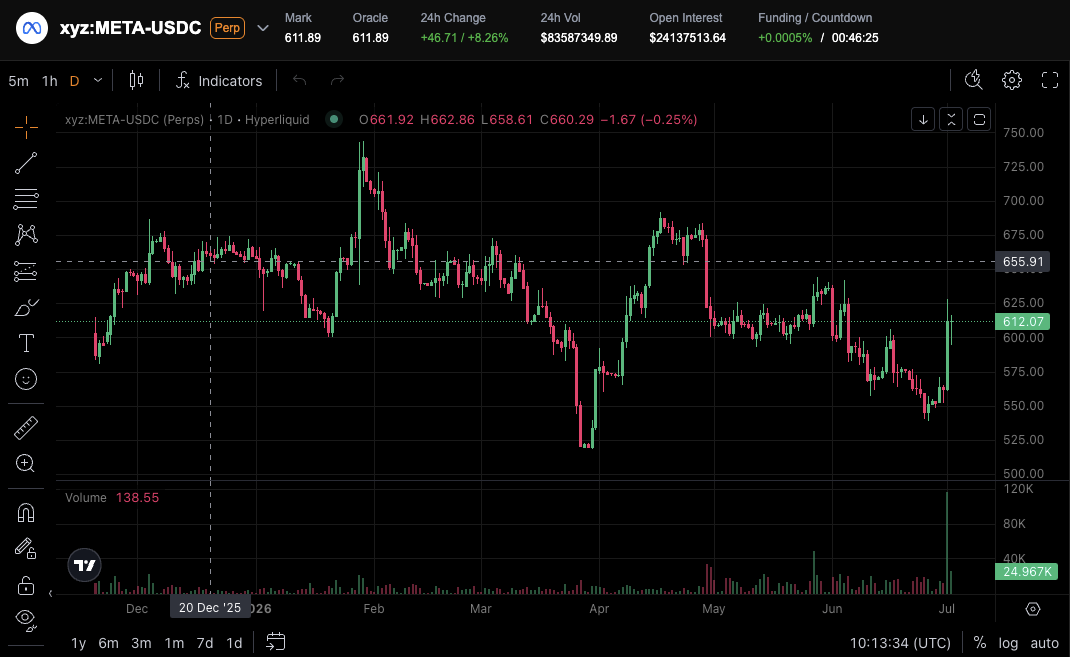
Meta Research | Is META Still the Best AI Trade After the Selloff?
Everyone is debating whether the AI trade is over.
I'm not convinced.
If anything, I think the market is simply becoming more selective.
Here's why I'm still watching $META closely. 🧵
1/
The biggest headline this week wasn't Meta's stock.
It was the market's reaction.
Reports that Meta may monetize excess AI computing capacity triggered a sharp selloff across AI infrastructure.
Micron, AMD, CoreWeave, Nebius and several semiconductor names got hit hard.
Ironically, META itself moved higher.
That's a message worth paying attention to.
2/
The market seems to be rotating—not leaving AI.
For the last two years, investors rewarded anyone selling GPUs.
Now they're starting to reward companies that can actually monetize AI.
Infrastructure is becoming a business.
Not just an expense.
3/
Meta has quietly built one of the largest AI infrastructures in the world.
What changes now is the business model.
Instead of keeping unused capacity idle, the company could rent computing power to third parties.
That's a completely different revenue stream.
Morgan Stanley estimates even partial utilization could meaningfully improve future earnings.
4/
Smart money doesn't appear to be running away.
Institutional ownership remains extremely high, and despite the recent volatility in AI-related stocks, Meta hasn't experienced the kind of panic selling we've seen in some semiconductor names.
Relative strength often tells a better story than headlines.
5/
Fundamentally, Meta still checks almost every box investors care about:
• Massive free cash flow
• Aggressive AI investment
• Industry-leading advertising business
• Billions of daily users
• Strong balance sheet
Most companies only have one of these.
Meta has all five.
6/
The biggest risk isn't Meta.
It's expectations.
AI spending is enormous, and investors want proof that these investments will translate into revenue.
If monetization takes longer than expected, multiples could compress even if the business remains healthy.
That's something every long-term investor should respect.
7/
From a trading perspective, I'd rather buy pullbacks than chase breakouts.
If AI sentiment weakens again while Meta continues executing, those periods usually create the best risk/reward opportunities.
Strong companies rarely stay cheap for long.
8/
What I'm watching next:
• AI infrastructure monetization updates
• Advertising revenue growth
• CapEx guidance
• User engagement
• Institutional fund positioning
If those remain strong, the long-term thesis stays intact.
Final Thoughts
The market spent the last two years pricing AI hardware.
The next phase may be about pricing AI business models.
Meta isn't just building AI anymore.
It's figuring out how to make money from it.
That could be the difference over the next few years.
Not financial advice. Always manage your risk.
Daily Market Brief | July 2
Today's headlines weren't just about crypto—they showed where capital, regulation, and infrastructure are heading.
Here's what matters most:
1. Robinhood is becoming a serious on-chain competitor.
Robinhood officially launched its Layer 2 ecosystem with tokenized stocks, perpetual futures, AI trading accounts, and DeFi lending.
This isn't just another L2 launch.
It's another step toward bringing millions of traditional investors on-chain.
Ironically, while Robinhood rallied, DYDX crashed over 40%, reminding everyone that product adoption doesn't always translate into token value.
2. ETH is quietly getting stronger.
BTC ETFs have now seen 10 consecutive days of net outflows, but ETH ETFs finally turned positive again.
Even more interesting, several whale wallets continued withdrawing ETH from exchanges and staking millions of dollars' worth of coins.
Smart money seems more interested in accumulating than selling.
3. Stablecoins are becoming the financial rails of the internet.
Cloudflare introduced native stablecoin payments for APIs and AI services.
Crypto payment cards have now processed over $10B in total volume.
The trend is becoming obvious:
Stablecoins are no longer just a crypto product—they're evolving into internet payment infrastructure.
4. Regulation keeps moving forward, not backward.
Europe continues implementing MiCA, Binance is expanding in the Philippines, and governments are releasing clearer frameworks instead of outright banning crypto.
The market may dislike regulation, but institutions usually need regulatory clarity before allocating serious capital.
5. AI remains the biggest macro theme.
SoftBank is leveraging its OpenAI stake to raise another $10B, while Nvidia is introducing new financing models to accelerate AI infrastructure.
At the same time, investors are rotating within the AI sector rather than abandoning it.
Capital isn't leaving AI.
It's becoming more selective.
On-chain signals worth watching
• Whales accumulated and staked more ETH.
• Metaplanet added another 2,823 BTC, continuing its corporate accumulation strategy.
• a16z and other early investors continue taking profits on selected altcoins, reminding traders that not every ecosystem is in the same phase.
Capital is rotating—not disappearing.
My takeaway
Short-term sentiment is still fragile.
ETF flows remain mixed.
Macro uncertainty hasn't gone away.
But underneath the surface, the long-term infrastructure story continues to strengthen:
Stablecoins
Tokenization
Ethereum
AI
Institutional adoption
These narratives keep attracting capital even while prices remain volatile.
That's usually what accumulation phases look like.
Trade the data, not the headlines. The biggest opportunities often appear when the news feels the most confusing.
Market Wrap | July 1
Today's headlines weren't just about price—they revealed where capital is moving.
A few takeaways that stand out:
• The stablecoin war has officially begun.
140+ global financial institutions are backing Open USD, challenging Circle's business model by sharing reserve yields with users instead of keeping them. Circle dropped over 17%, while Ark used the selloff to add more shares.
• Institutional sentiment continues to weaken.
Spot BTC ETFs recorded their worst monthly outflow since launch, with nine straight days of net redemptions. ETH ETFs also remained in negative territory. Fear is high, but extreme fear has often been where long-term opportunities begin.
• Macro remains the biggest headwind.
Citi cut its 12-month targets for both BTC and ETH, while markets are pricing in a higher probability of another Fed rate hike. Liquidity is still the key variable for risk assets.
• Regulation is accelerating globally.
Taiwan officially passed its Virtual Asset Service Act, Europe entered the MiCA era, and regulators across Asia are becoming more active. The trend is clear: crypto isn't disappearing—it's becoming more regulated.
• On-chain flows tell a mixed story.
1B USDC was minted on Solana, showing stablecoin liquidity is still entering the ecosystem. At the same time, a16z continued transferring HYPE to exchanges, and https://t.co/3EwA5TXlkS moved hundreds of millions in stablecoins to CEXs, suggesting profit-taking remains active.
• AI is still attracting capital.
SoftBank committed another $10B to OpenAI, while AI infrastructure remains one of the strongest investment themes across both public and private markets.
My view
The market is facing pressure from ETF outflows, tighter macro conditions, and cautious institutional sentiment. That explains the recent weakness.
But beneath the surface, stablecoin infrastructure, tokenization, AI, and on-chain trading ecosystems continue to expand. Those are the sectors I'd rather monitor than short-term headlines.
Right now, I'm watching three indicators more than anything else:
ETF flows
Stablecoin issuance
Whale accumulation
When liquidity starts returning, those metrics usually turn before price does.
Stay patient. Capital preservation comes first. The next trend will reward those who prepare during uncertainty, not those who chase headlines.
Everyone will have an opinion on this.
I'm more interested in what the data says.
Is liquidity leaving?
Are whales selling?
Is volume drying up?
If the answer is no, then the long-term thesis hasn't changed.
Curious to hear what everyone else thinks.
Hyperliquid has been added to the MAS's Investor Alert List (IAL). IAL listing does not constitute a ban, an enforcement action, or a finding of wrongdoing. The IAL provides a list of entities that, based on information available to MAS, may be wrongly perceived as being licensed or in any other way authorised or regulated by MAS. Many large exchanges and defi protocols have been included on the IAL.
Hyperliquid is permissionless infrastructure. It is not, and has never claimed to be, licensed or authorised by MAS, and no one should regard it as such. Nothing about the network has changed. As on other permissionless blockchains, users maintain self-custody at all times, and transactions settle transparently and fully onchain.
The Hyperliquid ecosystem remains committed to engaging collaboratively and constructively with regulators and institutions globally and to supporting clear, well-designed frameworks for onchain finance.
HYPE Research | The Market Still Doesn't Fully Understand Hyperliquid
Everyone's talking about BTC and ETH.
Meanwhile, one of the strongest-performing assets this cycle continues to build quietly.
Here's why I'm still watching $HYPE closely. 🧵
1/
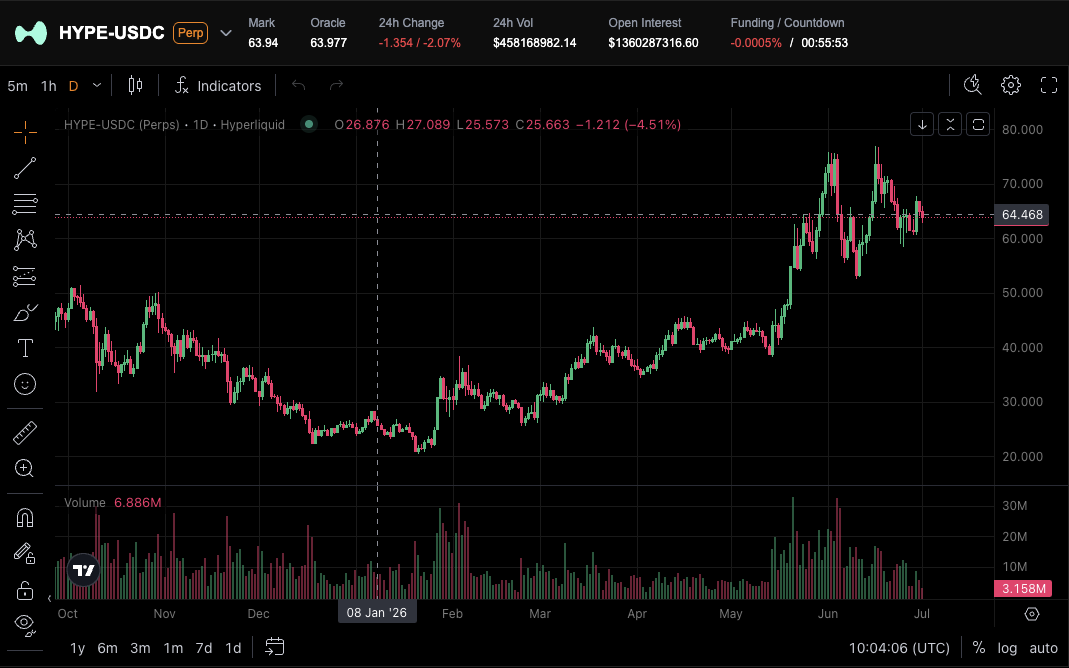
From a pure price action perspective, HYPE still looks like one of the healthiest charts in crypto.
After the explosive rally from the $40s into the high $70s, the market didn't collapse.
Instead, it's spending weeks building a range between roughly $60-$70.
Strong assets don't usually give back 80%.
They consolidate.
2/
One thing I like is the derivatives positioning.
Open Interest remains elevated at around $1.35B, yet funding has stayed almost flat.
Funding around 0% tells me something important:
This isn't a market driven by overcrowded longs.
If anything, positioning is surprisingly balanced despite the strong trend.
That's usually healthier than seeing funding spike every time price moves higher.
3/
Hyperliquid isn't just another perpetual exchange anymore.
It's becoming one of the few crypto-native venues consistently taking market share from centralized exchanges.
Daily trading volume remains among the highest in DeFi.
Liquidity keeps improving.
Execution quality is attracting professional traders rather than just retail speculation.
That's a much stronger foundation than narrative alone.
4/
On-chain activity also remains constructive.
Several larger wallets have continued accumulating during pullbacks instead of chasing breakouts.
More importantly, I haven't seen meaningful distribution from early holders despite HYPE trading near all-time highs.
When early capital refuses to sell strength, I pay attention.
5/
Smart money behavior is different from retail.
Retail usually buys green candles.
Experienced traders often buy boredom.
Right now, HYPE feels much closer to boredom than euphoria.
Twitter engagement has cooled.
Price has stopped making headlines.
That's often when positioning quietly happens.
6/
The biggest risk isn't HYPE itself.
It's the broader market.
If BTC loses a major support level and liquidity disappears across crypto, HYPE probably won't be immune.
Even the strongest leaders correct during macro risk-off environments.
That's something every trader should respect.
7/
Technically, I see three important zones.
🟢 Support:
$60-$62
This has repeatedly attracted buyers.
🟡 Mid Range:
$66-$70
Current battle zone.
Winning this area opens the door for trend continuation.
🔴 Resistance:
$75-$80
The previous highs.
If bulls reclaim this region with volume, price discovery becomes a realistic scenario.
8/
My trading plan is pretty simple.
✅ Accumulate near support.
✅ Avoid chasing vertical candles.
✅ Add only after confirmed breakouts.
If HYPE closes above the previous highs with expanding spot volume instead of leveraged buying, I'd expect momentum traders to return quickly.
9/
What I'm watching over the next few weeks:
• Open Interest vs Spot Volume
• Funding Rate
• Whale wallet accumulation
• Hyperliquid ecosystem growth
• Stablecoin inflows onto the platform
If Open Interest keeps rising while funding remains neutral and spot demand increases, that's usually a bullish combination.
If funding turns extremely positive before price breaks out, I'd become much more cautious.
Final Thoughts
HYPE isn't cheap anymore.
But strong assets rarely are.
The market has already proven people are willing to pay a premium for products that dominate their niche.
Hyperliquid continues to execute, continues to attract liquidity, and continues to gain market share.
As long as that doesn't change, I think buying panic is a much better strategy than chasing euphoria.
Patience usually pays better than FOMO.
Not financial advice. Manage risk accordingly.
Ethereum Research | Is Smart Money Quietly Positioning While Everyone Watches BTC?
Over the last few weeks, ETH has started showing one of the most interesting divergences we've seen this year.
Retail sentiment is still weak.
Headlines remain mixed.
But on-chain tells a different story.
A quick breakdown 🧵
1/ News isn't as bearish as price suggests
Most of the market is focused on ETF outflows and underwhelming price action.
But beneath the surface, several structural catalysts remain intact:
• Ethereum core development continues toward the next network upgrade.
• Tokenization remains one of the strongest institutional narratives.
• Stablecoin settlement and RWAs are still overwhelmingly choosing Ethereum as the settlement layer.
None of these narratives disappeared because price corrected.
Instead, they became cheaper.
Meanwhile, ETF flows have been volatile. After a prolonged period of net redemptions, several sessions have started showing renewed inflows, suggesting institutional demand may be stabilizing rather than disappearing completely.
2/ Whales are behaving very differently from ETFs
This is probably the biggest signal.
While many ETF investors reduced exposure during May, large on-chain wallets quietly accumulated more than 1 million ETH over the same period.
That's an unusual divergence.
Historically, when long-term holders accumulate while public sentiment stays negative, the market is often entering an accumulation phase rather than a distribution phase.
Does it guarantee upside?
No.
But it's worth paying attention when billion-dollar wallets are buying into weakness instead of chasing strength.
3/ Smart Money isn't chasing pumps
Looking across several on-chain dashboards, the behavior is consistent:
• Large wallets continue rotating into ETH
• Leverage remains relatively controlled compared with previous euphoric tops
• Capital is gradually returning to higher-quality assets instead of speculative rotations
That's exactly what you'd expect near the early stages of a longer-term positioning cycle.
Not explosive.
Just patient.
4/ What worries me
There are still risks.
• ETF demand hasn't fully recovered.
• Macro uncertainty remains high.
• Rising Open Interest means leverage is building again.
If leverage starts expanding faster than spot demand, another liquidity sweep wouldn't be surprising.
That's why blindly longing every dip still isn't the best strategy.
5/ Trading plan
My base case:
Bullish medium-term.
Neutral short-term.
Instead of chasing green candles, I'd rather:
✅ Buy panic flushes into major support
✅ Add only after confirmation that spot demand is returning
✅ Take partial profits into strong resistance instead of expecting a straight move higher
If price loses key support with heavy volume, I step aside.
Capital preservation always comes first.
6/ What I'm watching next
Three indicators matter more than Twitter narratives:
• Spot ETF net flows
• Whale accumulation
• Exchange ETH reserves
If ETF inflows return while whales continue accumulating and exchange balances keep falling, that's the type of alignment that usually precedes stronger trends.
If those three start moving together, ETH could outperform much of the market during the next major leg.
Bottom Line
ETH still isn't generating the excitement it had in previous cycles.
Ironically, that's exactly why it's becoming interesting again.
When retail is distracted, whales accumulate.
When sentiment is weak but fundamentals stay intact, asymmetric opportunities begin to appear.
Not every accumulation phase becomes a bull run.
But almost every bull run starts with an accumulation phase that most people ignore.
Not financial advice. Manage risk accordingly.
$SOL Market Notes
I've been watching Solana closely over the last two weeks, and I don't think the story is as bearish as the price action suggests.
Yes, the market is still under pressure.
But under the surface, the picture is a bit more nuanced.
A lot of traders are focused on the recent selloff, while missing what continues to happen across the ecosystem.
First, the macro backdrop.
Crypto is still trading as a risk asset. Bitcoin remains the market leader, and every meaningful move in BTC continues to dictate liquidity across large-cap altcoins. If BTC loses another major support level, SOL probably won't be spared. But if BTC stabilizes, Solana is usually one of the first majors to attract capital back.
The second thing I'm watching is on-chain activity.
Large transfers have increased noticeably over the past week. While some whale-sized movements were headed to exchanges, a significant portion were simply wallet rotations or OTC settlements rather than obvious panic selling. That tells me not every large transaction should automatically be viewed as bearish.
Smart money also doesn't look like it's chasing price here.
Most professional traders I've spoken with are waiting for confirmation instead of trying to catch the exact bottom. That usually happens after heavy corrections. Capital preservation comes before aggressive positioning.
Fundamentally, Solana hasn't slowed down.
Network usage remains one of the strongest in crypto.
Stablecoin activity continues to grow.
The ecosystem is still leading DEX volume, token launches, and consumer applications. Builder activity hasn't disappeared just because the chart looks ugly.
That's why I think it's important to separate price from network health.
Price can stay weak for weeks.
The network doesn't stop growing because of a bad month.
Technically, though, I still think patience wins.
Momentum hasn't fully turned.
Several analysts continue to point out that SOL remains below key resistance and could retest lower support if macro conditions deteriorate or another wave of liquidations hits the market.
My current approach is simple.
Bullish scenario
• BTC reclaims momentum.
• SOL holds support and starts making higher lows.
• Whale inflows begin outweighing exchange deposits.
That's where I'd start adding exposure.
Bearish scenario
• BTC breaks down.
• Whale deposits to exchanges accelerate.
• Funding turns overly positive while price keeps falling.
In that case, I would rather wait than force a trade.
As for positioning...
I'm not interested in buying green candles after a 10% pump.
I'd rather scale into weakness, keep plenty of cash available, and let the market prove that the trend has actually changed.
Bottoms are usually a process, not a single candle.
Trade Plan
• Swing traders: Wait for confirmation above key resistance before increasing size.
• Investors: Dollar-cost average into major pullbacks instead of trying to perfectly time the bottom.
• High leverage: I don't think this is the environment for 20x-50x directional bets. Volatility is still too high.
Overall, I'm cautiously constructive on SOL over the medium term because the fundamentals remain stronger than the chart suggests.
Short term?
Respect the trend.
Long term?
I still think Solana remains one of the highest-conviction Layer 1s in this cycle.
Not financial advice. Just sharing how I'm positioned.
$SOL $BTC $JUP $PYTH $BONK
Bitcoin (BTC) Research Report
Macro Headwinds vs. Long-Term Institutional Adoption
Date: June 2026
Executive Summary
Bitcoin is going through one of its most important re-pricing phases since the 2022 bear market.
After reaching an all-time high near $126K, BTC has retraced to around $60K, erasing nearly 50% of its gains. Despite the sharp correction, this cycle differs from previous bear markets: the weakness is being driven primarily by macro liquidity conditions and institutional capital flows, rather than structural problems within Bitcoin itself.
Our view is that Bitcoin has entered a late-stage correction within a longer-term secular bull market, rather than the end of the institutional adoption story.
Macro Environment
The biggest headwind remains the Federal Reserve.
Markets have repriced expectations toward a more hawkish policy path after stronger-than-expected economic data. Higher interest rates have pushed Treasury yields and the U.S. dollar higher, reducing demand for risk assets such as cryptocurrencies.
At the same time, capital has increasingly rotated into AI and semiconductor equities, temporarily reducing allocations to digital assets.
In short:
Higher rates
Stronger USD
ETF outflows
Capital rotation into AI
These remain the dominant macro forces affecting BTC.
Institutional Flows
Unlike previous crypto cycles, Bitcoin is now heavily influenced by institutional positioning.
Recent weeks have seen:
Continued spot ETF outflows
Lower futures open interest
Reduced leverage
More defensive positioning from asset managers
While these developments have pressured price, they also indicate that speculative excess is being flushed from the market rather than building further systemic risk.
Meanwhile, long-term holders continue accumulating on weakness, suggesting conviction remains intact beneath the surface.
Technical Analysis
Looking at the daily chart:
Trend
The primary trend has shifted from bullish to corrective.
Since peaking around $120K–126K, BTC has formed:
Lower highs
Lower lows
Multiple failed recovery attempts
This confirms that bears still control the medium-term trend.
However, selling momentum has begun to slow near the $60K region.
Volume has expanded during recent declines, indicating a possible capitulation phase rather than the beginning of another acceleration lower.
Current structure suggests BTC is attempting to build a long-term base.
Market Sentiment
Sentiment has become extremely pessimistic.
Fear & Greed indicators have fallen into Extreme Fear, ETF flows remain negative, and retail confidence has weakened considerably.
Historically, periods of maximum pessimism have often coincided with attractive long-term accumulation opportunities, although timing a bottom remains difficult.
Bullish Catalysts
Several factors could support Bitcoin during the second half of the year:
Institutional adoption continues expanding.
Corporate treasury demand remains structurally positive.
Long-term holder accumulation persists.
Any future Fed pivot would improve liquidity conditions.
ETF inflows could recover once macro uncertainty eases.
The long-term adoption narrative has not materially changed.
Bearish Risks
Investors should continue monitoring:
Additional ETF outflows
More aggressive Fed tightening
Continued strength in the U.S. dollar
Weak global liquidity
Geopolitical uncertainty
If these factors persist simultaneously, BTC could remain range-bound or experience another leg lower before establishing a durable bottom.
Investment Thesis
Bitcoin is no longer trading purely as a speculative asset.
It has evolved into a macro-sensitive institutional asset, with price increasingly driven by liquidity, interest rates, ETF flows, and risk sentiment.
While short-term volatility is likely to remain elevated, the long-term investment thesis remains intact.
The current correction appears to be driven by macro headwinds rather than a collapse in Bitcoin's fundamentals.
Outlook
Short-Term (1–3 Months)
Neutral to Bearish
Macro uncertainty remains elevated.
Institutional flows need to stabilize before a sustained recovery can begin.
Medium-Term (3–6 Months)
Constructive
A recovery becomes increasingly likely if ETF outflows slow and monetary policy expectations improve.
Long-Term (12+ Months)
Bullish
Bitcoin continues to benefit from growing institutional adoption, expanding integration into traditional finance, and its role as a scarce digital asset.
Rating
Current Bias: Neutral (Short Term)
Long-Term Bias: Bullish
Strategy: Rather than chasing rebounds, investors should focus on gradually accumulating during periods of weakness, while closely monitoring macro conditions, ETF flows, and Federal Reserve policy. A sustained improvement in liquidity would likely be the key catalyst for Bitcoin's next major trend reversal.