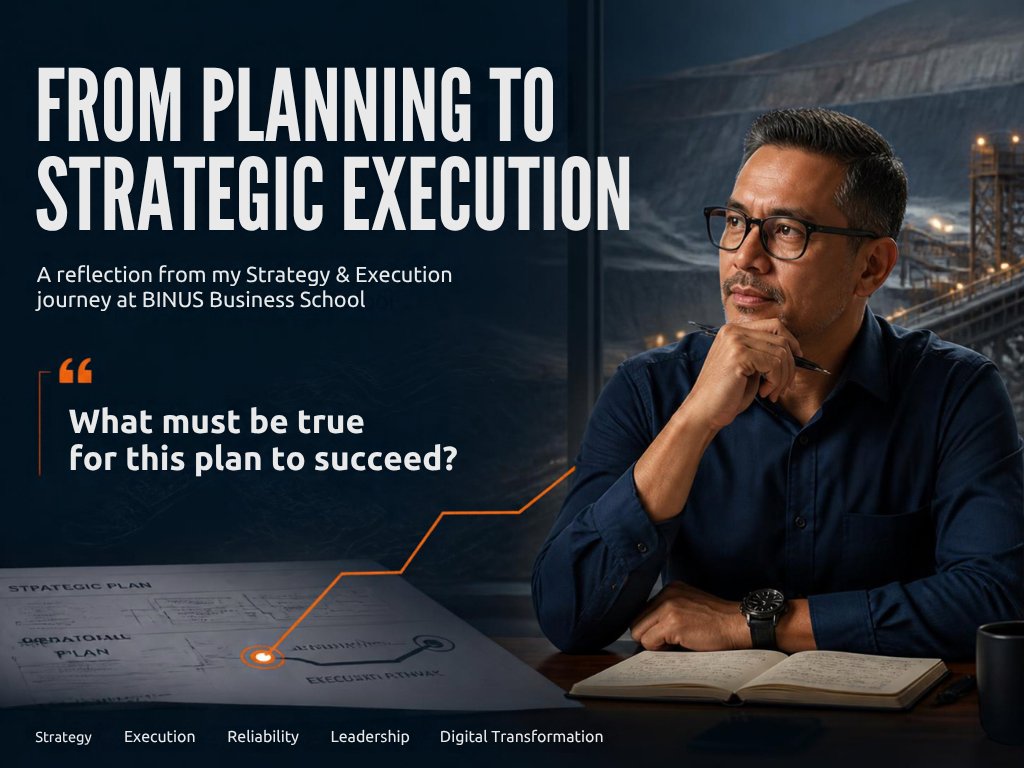
Starting early this morning.
Quiet surroundings. Clear mind. Work in progress.
Sometimes the best way to create clarity is simply to begin.
#MorningThoughts#BeyondPlanning
One experience that significantly shaped how I think about strategy was my Master’s journey at @bbs_binus , where I focused on Strategy & Execution.
I began the program with several years of experience in planning, maintenance, and mining operations.
The program encouraged me to look beyond operational planning and consider broader questions:
How does strategy translate into execution?
How do organizations align people, resources, capabilities, and priorities?
And why do strong strategies sometimes fail despite good intentions?
One key lesson remains with me:
Strategy is not complete when the plan is approved.
Strategy becomes real when the organization can execute it consistently.
My studies deepened the connection between my operational experience and the underlying strategic concepts.
It also changed the questions I ask today, shifting from:
“What is the plan?”
to:
“What must be true for this plan to succeed?”
This shift continues to influence my approach to strategic planning, reliability, leadership, digital transformation, and execution.
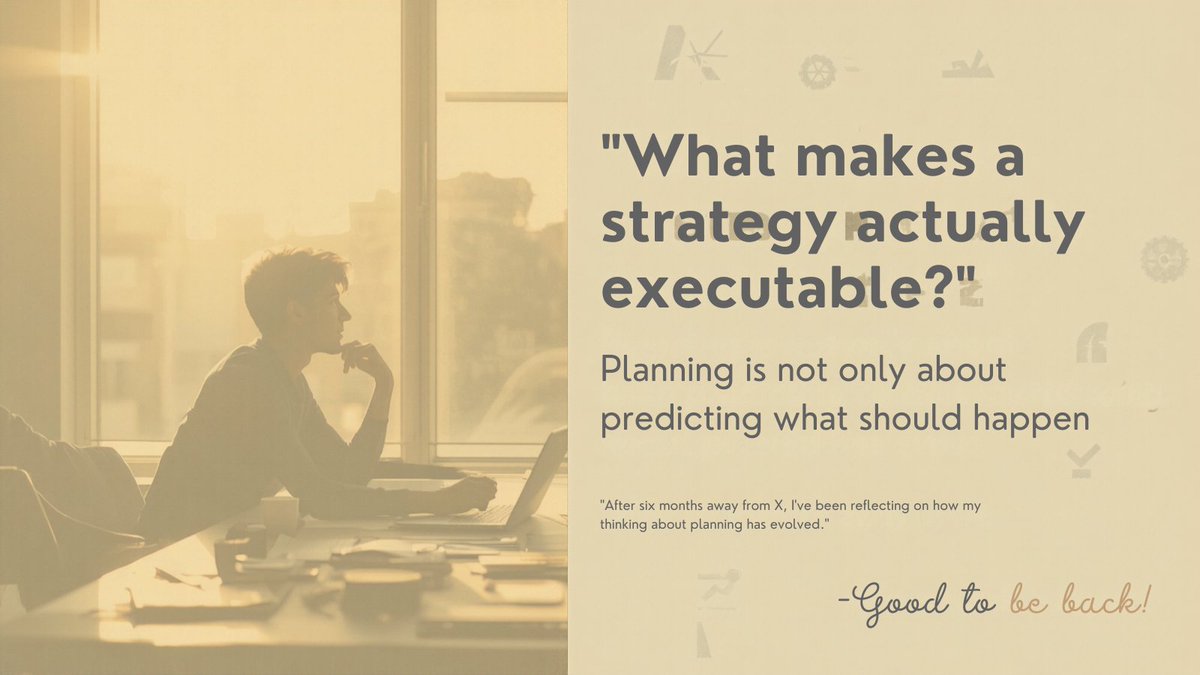
After six months away from X, I’ve been reflecting on how my thinking about planning has evolved.
I used to focus heavily on building the right plan.
Today, I’m increasingly interested in a harder question:
What makes a strategy actually executable?
Because a good plan alone is not enough.
Execution depends on reliable assets, capable people, available resources, access to the right information, clear decisions,and the ability to respond when conditions change.
That shift has changed how I think about planning:
Planning is not only about predicting what should happen. It is about creating the conditions that allow the right things to happen.
This is an area I want to explore more deeply: the intersection of strategic planning, reliability, execution, and increasingly, AI.
Good to be back.
BP.013 | Human–AI Executive Partnership™
Artificial Intelligence is now a core part of every organization’s operating environment. However, technology alone does not deliver sustainable competitive advantage.
Research from global institutions such as McKinsey, MIT Sloan, Deloitte, PwC, KPMG, PMI, Stanford, and leading academic publications shows that organizations succeed not by adopting AI faster, but by building stronger leadership and organizational capabilities around it.
These findings informed the development of the Human–AI Executive Partnership™ framework.
The future will be shaped by leaders who integrate human decision-making, artificial intelligence, and organizational knowledge to drive better decisions, stronger execution, and sustainable value creation.
This nine-part research series examined the evolution from AI adoption to capability, the changing role of executives, organizational transformation, governance, global trends, and the path from insight to measurable impact.
Our perspective is simple:
AI amplifies capability. Leadership determines value.
While technology processes information at unprecedented speed, directors are still responsible for purpose, ethics, strategic judgment, and accountability. Sustainable performance arises when people, knowledge, processes, and intelligent technologies operate as an integrated system.
This publication does not aim to predict the future. Instead, it helps leaders build the capability to shape it.
Thank you to everyone who followed the BP.013 Research Series. We hope these insights support better conversations, decisions, and organizations.
Think Beyond Planning.
#BeyondPlanning #ArtificialIntelligence #Leadership #ExecutiveCapability #StrategicPlanning #DigitalTransformation #KnowledgeManagement #BusinessStrategy #Innovation #FutureOfWork #AssetManagement #Mining #ExecutiveLeadership #AI #OrganizationalExcellence
This statement reinforces that constructive democracy depends on capable leaders, informed voters, and cooperation across communities. The victories may be incremental, but they reflect a growing confidence in forward-looking leadership and policy direction. Congratulations New York City for to Mayor @ZohranKMamdani 🇺🇸🇺🇸🇺🇸
@WSJ Fashion cycles are fascinating—what was once retro becomes timeless again. The 1960s mid-thigh cut shows how heritage style and modern taste often meet in the details.
@Reuters A reminder that the semiconductor supply chain isn’t just technical—it’s geopolitical. South Korea’s position highlights the complex balancing act between economic interdependence and national security.
@HarvardBiz Letting go of mistakes is more than emotional resilience—it's a leadership skill. Reflection is important, but progress demands we stop looping and start learning.
@DailyMail Border policy can be incredibly complex and unforgiving, even for well-intentioned travelers. Hopefully this sparks a wider conversation about clarity and fairness in international travel protocols.
💬 Is your university on the rise or fall?
Nature Index gives us a glimpse into how countries are investing in science, innovation, and academic excellence.
Let’s discuss.
RT if your institution made the list! 📚
#NatureIndex2025#AcademicRanking#STEM
Top Research Institutions 2025 – Based on Nature Index (China dominates the list)
The 2025 @NatureIndex is out!
Here are the Top 10 Global Institutions by high-quality research output.
🔥 China dominates the list, with 8 of the top 10 institutions coming from 🇨🇳
Let’s break it down 👇
#NatureIndex #AcademicResearch #ChinaScience
📊 What is “Share” in Nature Index?
It’s a fractional count based on author affiliations on papers published in 82 top-tier journals.
More accurate than raw publication counts.
#NatureIndexMethod