AI and Rare Disease.
Current: Life Science @AnthropicAI and Clinical Genetics @seattlechildren
Past: @OpenEvidence, MD-PhD @harvardmed / @MIT_CSAIL, @Stanford
Every single early-stage biotech investor and biotech researcher should read the linked paper on reading a mouse study.
Cage effects, early deaths, broken axes, n-hacking with small effect sizes, artifacts from fluid retention delaying weight-linked termination, "Something that works 20% actually doesn’t work at all.”
https://t.co/W2QibzgyWs
Thrilled to share new work from our experimental biology lab at @AnthropicAI. Led by world-class biochemist Januka Athukoralage, we built a rapid method for the isolation and structural characterization of vaults. It turns out these massive structures are not just found in eukaryotic cells, but also in prokaryotes and even phages. We solve the structure of one of these phage vaults, and then demonstrate we can engineer additional repeats into the wall to make it bigger.
One thing I can't get over about these vaults. They seem to be widespread across life - we assembled them from 8 different bacteria and bacteriophages. But they are just so massive - bigger than ribosomes, AAV, and even some phage capsids. Why devote so much energy to making these huge complexes? They have to be doing something useful - I hope that's the question that gets answered next.
Amazing collaboration with @PeterHYoon, @amirshanehsaz, @eric_kabrams, and @mgdurrant! Grateful to our team for making Claude an amazing labmate and to Anthropic for supporting this type of work on fundamental biology.
Natural mysteries abound - let's get to solving them!
Links here:
Blog: https://t.co/O6VtahFIvo
Technical report: https://t.co/erue23SFWl
Good question. ASO amenability and tina slightly lesser extent gene therapy amenability assessments have consensus guidelines (eg N1C) and we have folks who wrote these guidelines and who run ASO assessments at Harvard and Oxford on the panel. We are not asking for sequence design.
We acknowledge that drug repurposing is inevitably more speculative which is why it’s impossible at present to auto-grade or compare against a “correct” answer. But I do believe that a panel of experienced developers can read a rationale and generate fairly high signal feedback to an approach, and/or raise sets of things that should be considered for an indication. Ideal world we’d have a wet lab eval but alas not this year.
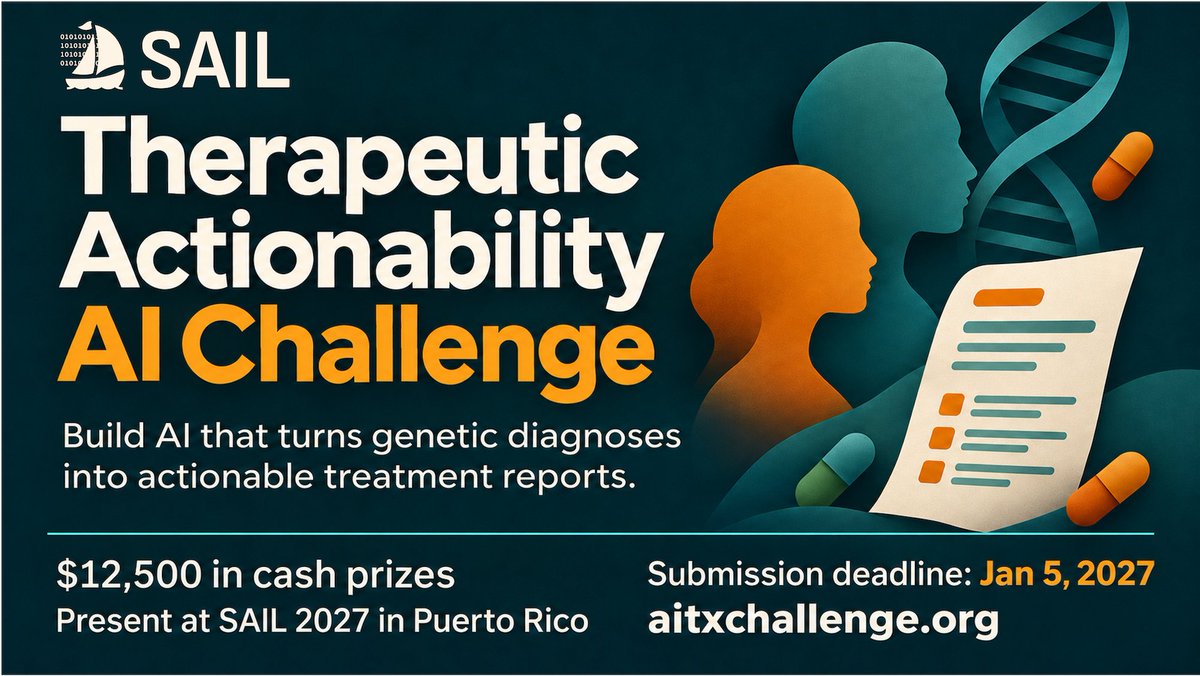
🚨Introducing the SAIL Therapeutic Actionability AI Challenge🚨
~450M people have a rare disease, often facing decades-long journeys to find therapies. <10% of rare diseases have an FDA-approved one.
We think AI can help close this gap.
Submit your model by Jan 5.
Details 👇
I believe that the best way to accelerate curing disease is to run lots of real drug programs with Claude, across disease areas and stages of development, and get a little better at it every day. The bottlenecks are everywhere, not just in the initial stages of molecule design that tend to dominate the public discourse.
Today we're sharing early results from six research partnerships, using Claude in things like CAR-T design, lead optimization for antibodies, drafting of regulatory documents, and partnering with a new biotech company built to run many more programs than a small team usually can. We're also sharing results for the first time from our own drug programs in rare childhood disease.
Our approach to drug development owes a lot to @Prof_Oak_ . His "pipeline-in-a-person" vision was the first take on how to use AI in drug development that I found to be simultaneously AI-pilled and rigorously grounded in cold, hard reality. Welcome to Anthropic, Cody!
Excited to share full data for BEAM-301 in GSD1a, covering the first two dose cohorts
** Importantly, 2/3 patients at the 2nd dose level achieved maximum fasting duration and no longer require corn starch supplementation after a single dose of BEAM-301
https://t.co/3NLHB2S4CH
Saline: a cheap and easy treatment for the common cold.
In this trial, hypertonic saline nasal rinsing + gargling:
1) shortened illness by 1.9 days
2) reduced OTC medication use by 36%, and was
3) linked to 35% fewer reported household infections
@HealthAINav@OpenEvidence Yeah, lots of efforts ongoing at OE to work with societies writing guidelines to find and fill holes in guidelines, as well as some other cool projects in the “filling gaps” space the announcements for which are forthcoming.
I’ve long felt that @OpenEvidence query data is the medical equivalent of the Google street view cameras, providing a first-hand look at how clinicians navigate the terrain of clinical knowledge, both knowns and unknowns.
IMO there is so much utility in using these data to discover trends in our practice, holes in our guidelines, emerging clinical needs, opportunities for impact.
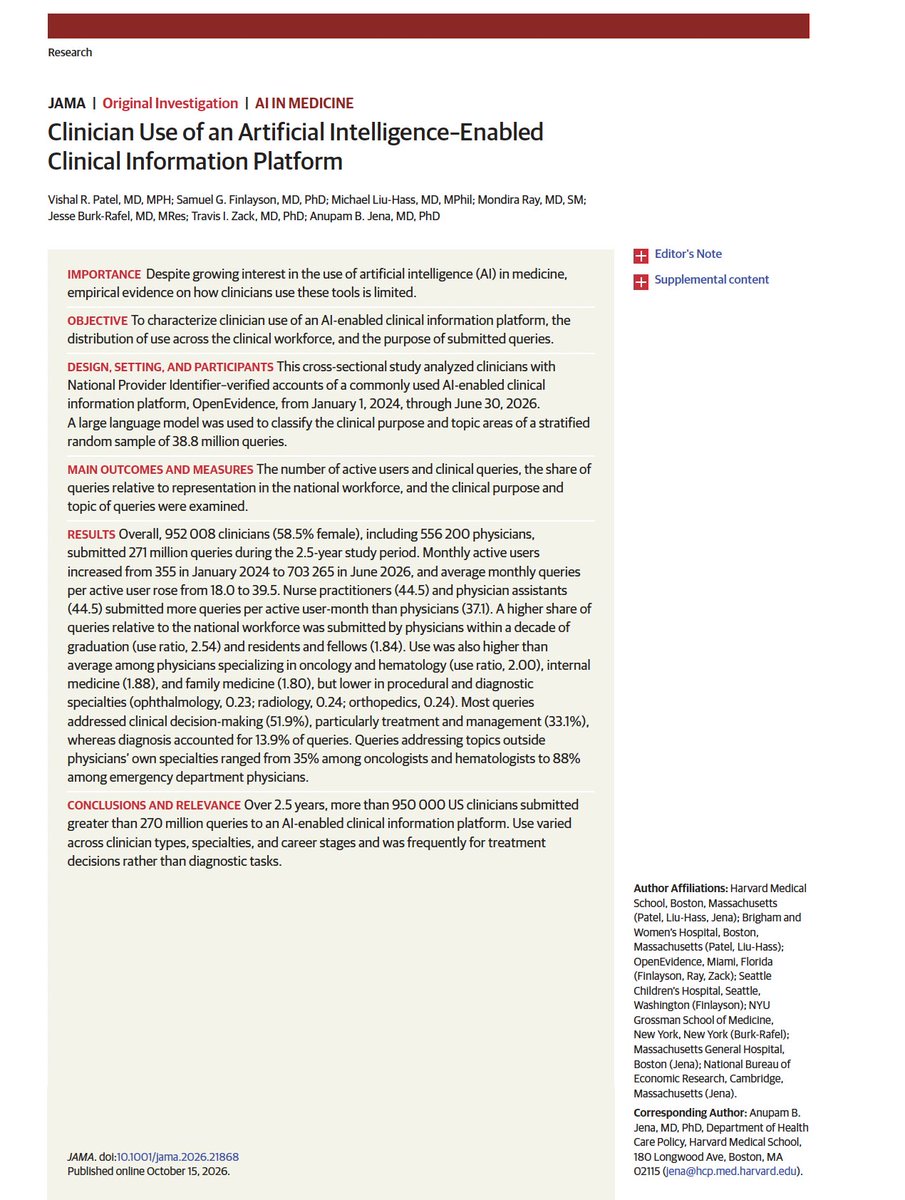
But obviously, any mining of these data has to be approached with great care, for patient safety and clinician trust. This paper is a first measured step in publishing trends from OE data (other than implicitly through work with, eg society guidelines). It focuses on basic trends in who is using the platform and for what purpose. Excited to see it out. So much fun working with @TravisZack2 and our colleagues from Harvard on this.
Other efforts are in the works and I hope there is much more to come in the genre of @OpenEvidence -> new evidence.
In @JAMA_current led by @vrpatel97, @IAmSamFin and @AnupamBJena: how are US 👨⚕️ actually using AI? We analyzed 271M queries from 950K+ clinicians on @OpenEvidence over 2.5 years. Monthly active users grew from 355 to 700K+, and 9/10 kept coming back.
Link: https://t.co/tah3qHa8rp