Data and Statistics Are Tools for Effective and Good Governance
Data and statistics are indispensable tools for effective and good governance. They enable us to assess performance, measure progress, identify challenges, and learn from the experiences of others. Although the next World Statistics Day will be celebrated on 20 October 2030, I have chosen to commemorate it today because it is usually celebrated on 20 October, and to encourage our people to appreciate the importance of statistics in national development.
It is globally known that nations grow and develop by learning from others. In Nigeria, we learnt or adopted almost everything about our governance from other nations. While we got our presidential system from the US, other aspects of our socio-economic and governance systems were adopted from the United Kingdom, flowing from our colonial heritage. These include our legal, educational, banking, health, communication and agricultural systems, etc.
As individuals, we also recognise that life is a process of learning to improve, develop and grow. That is the natural process through which we all became medical doctors, economists, engineers, bankers, lawyers, mechanics, painters and professionals in other disciplines. Moreover, we always want to learn from comparable experiences and similar people. This is how we interrogate nations with visible progress and achievements that are verifiable through data and statistics, generally referred to as evidence.
Good governance principles are anchored on global best practices, which entail acknowledging, borrowing and adopting what works best in other climes. Global best practices are also parameters and benchmarks for comparative politics and performance.
The problem with our incompetent and corrupt APC-led government is the confusion of hubris with leadership. This stems from a lack of patriotism and a total absence of commitment to a better Nigeria. This is why the government lacks the required humility, patriotism and disposition to learning and is fixated on governing our richly endowed nation with corrupt, ineffective and reactive policies, which inevitably produce poor and retrogressive outcomes.
Verifiable data and facts confirm that Bangladesh is a developing country with a population of about 178 million people. Undisputed and verifiable statistics affirm that Bangladesh achieved significant poverty reduction between 2010 and 2022. This lifted about 34 million people out of poverty and reduced extreme poverty rates from 12.2% to 5.6%.
It is not by accident that indexes such as the Human Development Index (HDI) and Transparency International’s Corruption Perceptions Index are sources of evidence on human progress. It is also widely known and confirmed that the significant poverty reduction was achieved through five key pillars: agricultural growth, export-oriented manufacturing, microfinance and NGOs, social safety nets, and human capital and infrastructure.
As the above pillars through which Bangladesh significantly reduced poverty are not too difficult to understand, the appropriate thing a patriotic and effective government would have done is to learn humbly and diligently how Nigeria can also significantly reduce its embarrassing and shameful poverty level. Moreover, just as it is in Bangladesh, so it is with the remarkable leadership in Vietnam, Rwanda, Morocco, India and many other developing nations.
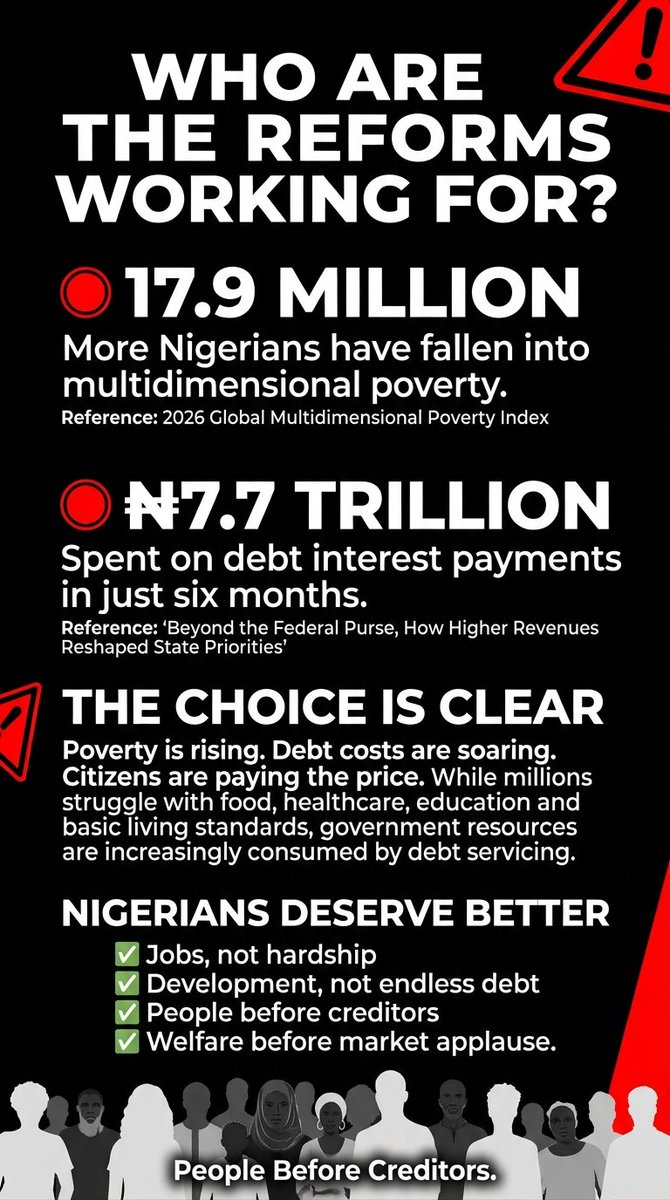
Unfortunately, the disingenuous, incompetent and corrupt APC government cannot give what it does not have. It is limited in its global worldview, unwilling to learn and deeply consumed by its inclination towards state capture through the corrupt control of our national resources and bad governance. That is why Nigeria, a richly endowed and blessed country, is now classified as the poverty capital of the world, with a poverty rate of about 63% and over 140 million Nigerians living in multidimensional poverty.
Scripture say WEN D RIGHTEOUS RULES D PEOPLE REJOICE
PBAT has caused citizens cry/lament bcos no viable economy!
Since 2023 where are:
●lndustries
●Factories
●Refineries
●Assembly plants
●Steel&Textile mills
●Agric
●Airlines
●electricity
Nigerians which one have you got?
●RiversState civil servants how much promotions and incentives did Wike give you during his 8years of governance?
●How much electricity did Wike provide for Rivers State?
●How many new ports did Wike create?
●What did Wike do to stop perennial floodings in Rivers State?
BECAUSE we love Nigeria we want it to succeed inspite of who is in AsoRock,ignoring tribalistics,nepotistics &party bigots
Pls say Chinese president who has excelled,is he frm N.S.E.or West?
AsoRock listen to& implement d policies used by nations like:China,Singapore,Rwanda etc,
On his way to Equatorial Guinea,Tinubu rode in a gleaming new car to d airport, leaving tongues wagging.A glamorous,armoured black Cadillac Escalade reminded many of d NPN days. Such a show of opulence in f immediate aftermath of d hunger protests seemed an act of defiance. Sad..
CAN THIS EVER HAPPEN IN NIGERIA?
Dutch Prime Minister
Mark Rutte Left Govt Office On Bicycle After Handg Over Power,after 14Years In Office
Watching This Video I Shook My Head For Africa 🌍
This Is A Working Country Where Politicians Come To Serve d People And Not To Be Served
CAN THIS EVER HAPPEN IN Nigeria?
Dutch Prime Minister Mark Rutte Left Govt Office On Bicycle After Handg Over Power after 14Years In Office
Watching This Video I Shook My Head For Africa
This Is A Working Country Where Politicians Come To Serve d People And Not To Be Served
Singapore succeeds by M. P. H. policies
Meritocracy
Pragmatism
Honesty
Favoritism,tribalism,sectionalism, nepotism &party affiliations only cause backwardness & stagnation& underdevelopment.
Remember Singapore has with M.P.H.policies become 1st world frm 3rd world nation
Yes.
Nigeria can be changed overnight by:
The JUDICIARY
With a state of emergency in d judiciary,everyone'll be forced to change &sit up and Nigerians'll learn to live upright b/c of fear of imprisonment!