The DiLoCo team at Google DeepMind and Google Research is proud to release Decoupled DiLoCo, the next frontier for resilient AI pre-training.
Decoupled DiLoCo enables training with datacenters across the world, using heterogeneous hardware, and never halting the system despite hardware failures.
I'm super excited to release DiPaCo, a new kind of mixture of experts, that can scale engineering-wise to data centers across the entire world!
A few words about it in this thread 🧵
Presenting Confident Adaptive Language Modeling (CALM), a novel method that allows language models to dynamically modify computational effort when generating text. Learn how CALM can accelerate text generation while preserving output quality → https://t.co/Nm7yyT8sMA
Excited to announce that @sukritkalra and @pschafhalter will be presenting at @EuroSys_conf on Thursday our work on developing a new execution model (D3), and an execution engine (ERDOS) that enables autonomous vehicles to adapt and to avoid collisions.
Attend their talk to learn about how we validated our execution engine by building an open-source self-driving car stack, which we deployed both on simulated and real-world cars.
Joint work with the above, @mejoeyg and Ion Stoica.
Our solution enables an application to pick the most appropriate fault-tolerance mechanism for each part of the application, and to combine the chosen fault-tolerance mechanisms such that the application recovers in a globally consistent state in the event of a failure.
At SoCC today, I will be presenting our work (with @m_isard and Martin Abadi) on offering efficient fault-tolerance for complex dataflow applications that combine batch, stream, and iterative processing. #socc21
Paper: https://t.co/zjrfMfQuSN
Today in the Unmanned Vehicle award session of #ICRA2021, @sukritkalra will present our work on Pylot, an adaptable platform for developing autonomous vehicles. Our platform provides plug and play modules to deploy AVs in simulation and real-world.
Working on self-driving cars? Check out our paper on Pylot, a modular pipeline for exploring latency-accuracy tradeoffs in self-driving cars (accepted to ICRA 2021).
https://t.co/EPwnes9FrK
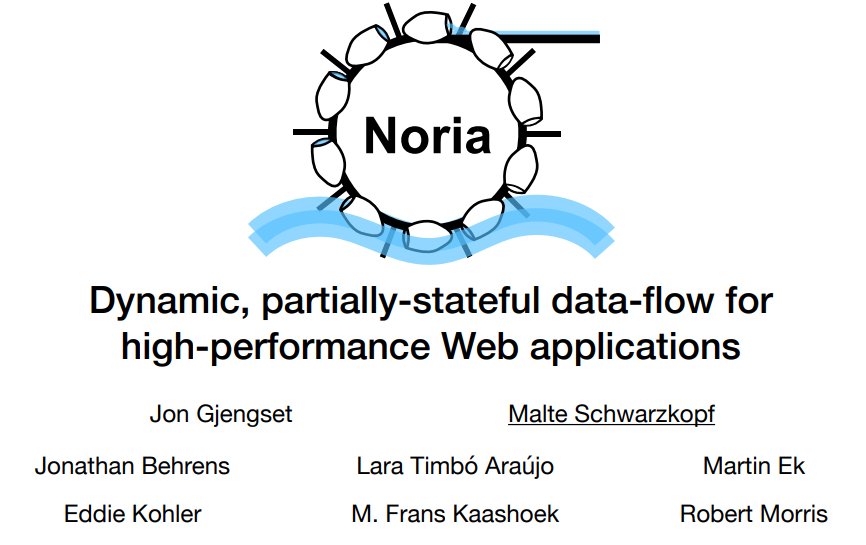
Slides for our #osdi18 talk on Noria, a new data-flow system that makes web applications fast, are now available: https://t.co/LZYIm96WlM (joint work with @Jonhoo, @xexd and others). Will take no more than 17 minutes to view, promised!
Interested in AI and ML? Consider applying to the first Transylvanian Machine Learning Summer School, which has a great line-up of lecturers and instructions: https://t.co/r1Fk5s6HB4
@frankmcsherry@dataArtisans@ApacheFlink I've tried to reproduce some of the experiments in the paper. After I configured Flink a bit I observed that Flink's recovery latency is roughly as high Drizzle's, and 10x smaller than the values in Figure 7.
@frankmcsherry@mrry People are free to interpret the "L" however they wish, but they should not forget that Laptopman brings truth, justice, the scientific way!