We are happy to announce the he official partnership with Nosana.
Nosana powers ICPX!
Read down below on V1 release.
V1.1 to V2 releasing over the coming days.
https://t.co/mLO2rZKCPN
Host open source AI models on decentralised infrastructure, pay only for the jobs you run.
That is what ICPX is built for, and @nosana_ai is the compute network powering every single job behind the scenes. 🤝
@ICPXProtocol 🤝 @nosana_ai
Nosana 🤝 ICPX
@ICPXProtocol is a pay-per-job GPU compute platform for AI agents, model deploys, inference, fine-tuning and evals, giving builders a simple flow to pick a workload, pay and launch.
Nosana powers ICPX end to end, running the GPUs behind every job 🙌
🔗 https://t.co/panhs98BQU
Without ICPX, your apps are juggling 12 different integrations across laptops, home servers, enterprise clusters, cloud providers, GPU marketplaces and decentralised networks. Different APIs, different auth methods, different billing systems.
ICPX sits in the middle and coordinates all of it through one protocol layer.
The ICPX Github Organisation is being set up.
1. Code that has reached a state of readiness beyond ICPX beta, will be open-sourced.
2. Github App integration into ICPX cloud, for one-click deploys similar to Vercel.
Currently we support GO, Nextjs, Python, Rust.
https://t.co/twryrpyxPv
This is what $ICPX with @nosana_ai actually solves.
Most GPU providers rent you a machine and charge you whether it is running or not. You book the instance, it sits there, and the clock keeps ticking regardless of whether your workload is active. For small teams and startups that only need compute in bursts, that model does not make sense. You end up paying for a lot of nothing.
@ICPXProtocol and @nosana_ai change this completely. Nosana brings the decentralised GPU supply, a distributed network of available machines that ICPX can route jobs to on demand. ICPX sits on top and handles the orchestration, smart routing your workloads to active capacity and only billing you for the time your instance is actually running. When the job is done, the compute is released. You are not holding onto a machine you are not using.
The result is that you get enterprise grade hardware, H100s, H200s and RTX 4090s, accessible at a fraction of what centralised providers charge, and you only pay for useful work. Training runs, inference, model evaluation, fine tuning, AI agent execution. All of it on demand, all of it settled in $ICPX tokens, with every job burned into the protocol supply.
Decentralised compute that actually makes financial sense. Run everything, pay only for what you use.
https://t.co/CRi8BY9PBo
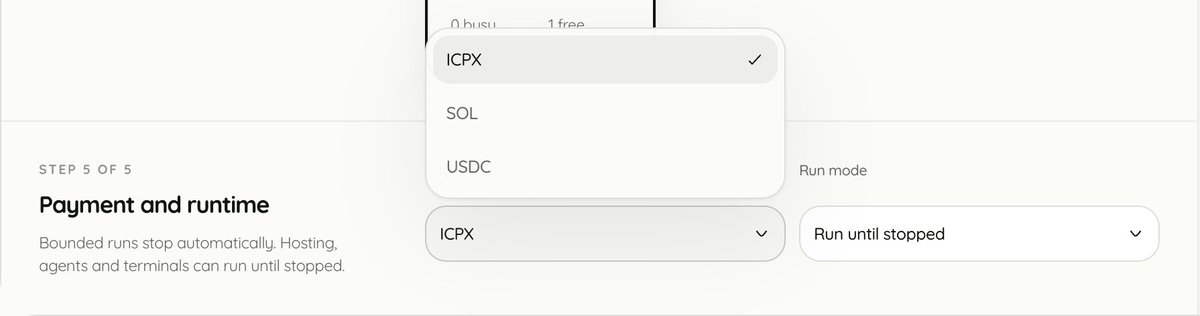
Payment and runtime
Choose the payment asset and runtime behavior. Bounded jobs auto-stop. Services like terminal, hosted apps, model APIs, and agents can run until stopped.
Can be paid in ICPX, SOL or USDC.
End of thread @ICPXProtocol
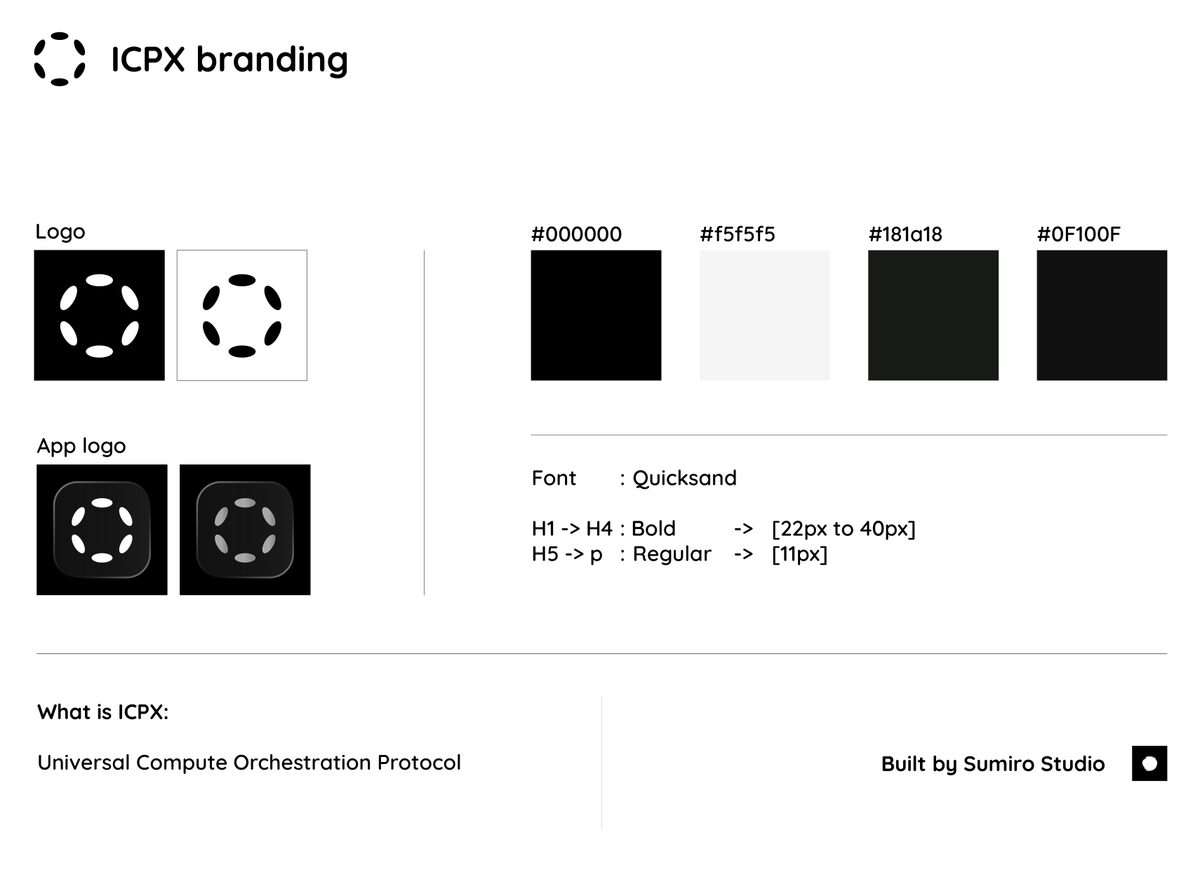
ICPX now has a better aligned visual identity.
The logo is built from six independent nodes arranged in a continuous circle. Each node represents a different compute source, device, provider, cluster or network.
Together, they form one coordinated system.
https://t.co/ij1LFqJ9oA
Traditional GPU -> Productive time.
With traditional GPU rental you are paying for a dedicated instance whether you are actually using it or not. Idle time costs the same as productive time. settle payments in $ICPX
The problem with most crypto projects is simple.
They build a product, launch a token, and let people pay in dollars or SOL anyway. The token becomes a badge with a price attached. No one actually needs it.
$ICPX flips this completely.
GPU compute jobs on ICPX are priced and settled in $ICPX tokens. If you want to run a model, fine tune it, or execute an AI agent, you need the token to do it. Not hype. Actual demand.
This has worked before.
A project priced their services directly in their own token a couple years ago. Nothing massive. But because people had to own the token to access the service, the coin went to a 10 million market cap anyway. No one even really used it that much.
$ICPX has real infrastructure behind it.
Enterprise grade H100s, H200s and RTX 4090s. Powered by Nvidia and Google GPU cloud partner programs. No downtime. No waitlists. Accessible to anyone at a fraction of what centralised providers charge.
If the userbase is real, the market cap follows.
Not from hype. From builders who need GPU compute having to acquire and spend $ICPX to get it.
That is the difference between a token and a protocol.
https://t.co/CRi8BY9PBo
We have released Draft Version 1 of our ICPX paper.
As we mature and reach a milestone of launching the full web application, it is time to start releasing the first draft of our paper and roadmap.
Read below 👇
https://t.co/6COtJ8CN9n
Our website will have a small overhaul too, with updated information and interactive roadmap.
https://t.co/twryrpz5F3
A Universal Compute Orchestration Protocol
We are adding support for GLM 5.2 and @qvac one-click deployments.
Will be rolling out in the coming days.
Stay tuned, multiple updates on progress every day!
Paid in ICPX tokens, SOL or USDC.
https://t.co/u7TnQdBZWq
ICPX protocol paper releases tomorrow.
The full foundational layer for ICPX and future.
Every search, document, design, software application, autonomous agent and business workflow increasingly depends on AI inference. Yet nearly all AI today relies on centralised cloud providers where users surrender control of their data, developers rent infrastructure indefinitely and compute remains concentrated inside a handful of hyperscale datacenters.
This model introduces structural weaknesses.
Data must leave the environment where it originates. Privacy depends on trusting third parties. Infrastructure failures affect millions of users simultaneously. Costs continue to increase as GPU demand grows faster than supply. Developers become dependent on centralised pricing, availability and policy decisions.
ICPX proposes a different architecture.
Rather than building another AI provider, ICPX functions as a universal orchestration layer capable of executing AI workloads across multiple classes of compute while maintaining a single developer interface.
Compute may originate from:
- Private home devices
- Office infrastructure
- Enterprise clusters
- Edge hardware
- Community-owned GPU operators
- Decentralised compute providers
- Future confidential compute networks
The protocol determines where workloads should execute according to privacy requirements, latency, available hardware, cost, trust assumptions and user-defined policy.
https://t.co/twryrpyxPv