@ICRC's regional delegation for the US & Canada. Tweeting humanitarian action, #IHL and stories of our work around the world. 🎧 Intercross: The Podcast.
Life or Death: Our new video on how civilians can become especially vulnerable to the loss of essential services when a technology company’s products and services are shared between civilians and militaries in situations of armed conflict.
Read more 👉https://t.co/Rb0tdQQhTj
More than 130 armed conflicts are taking place worldwide, with devastating consequences for millions of people. But it is not too late to reverse course.
Changing how wars are fought requires political will. That is why Brazil, China, France, Jordan, Kazakhstan and South Africa, together with the ICRC, launched the Global IHL Initiative - to make respect for international humanitarian law a political priority and limit suffering in armed conflict.
At the UN General Assembly, representatives from the six founding States joined the ICRC President in calling for renewed respect for the rules of war.
So far, 118 States have formally joined the Initiative. Now, that commitment must translate into action.
Learn more about the Global IHL Initiative 👉🏼 https://t.co/NRuYy4N6JN
"Everyone says it's already happening, it's already too late. No, it's not too late."
ICRC President warns that as weapons become more autonomous, clear limits are needed to preserve meaningful human control over the use of force.
🎥 Watch the full ABC Insiders interview: https://t.co/6lhZat2BjO
🎧 Listen to the interview: https://t.co/T5lBp75wy4
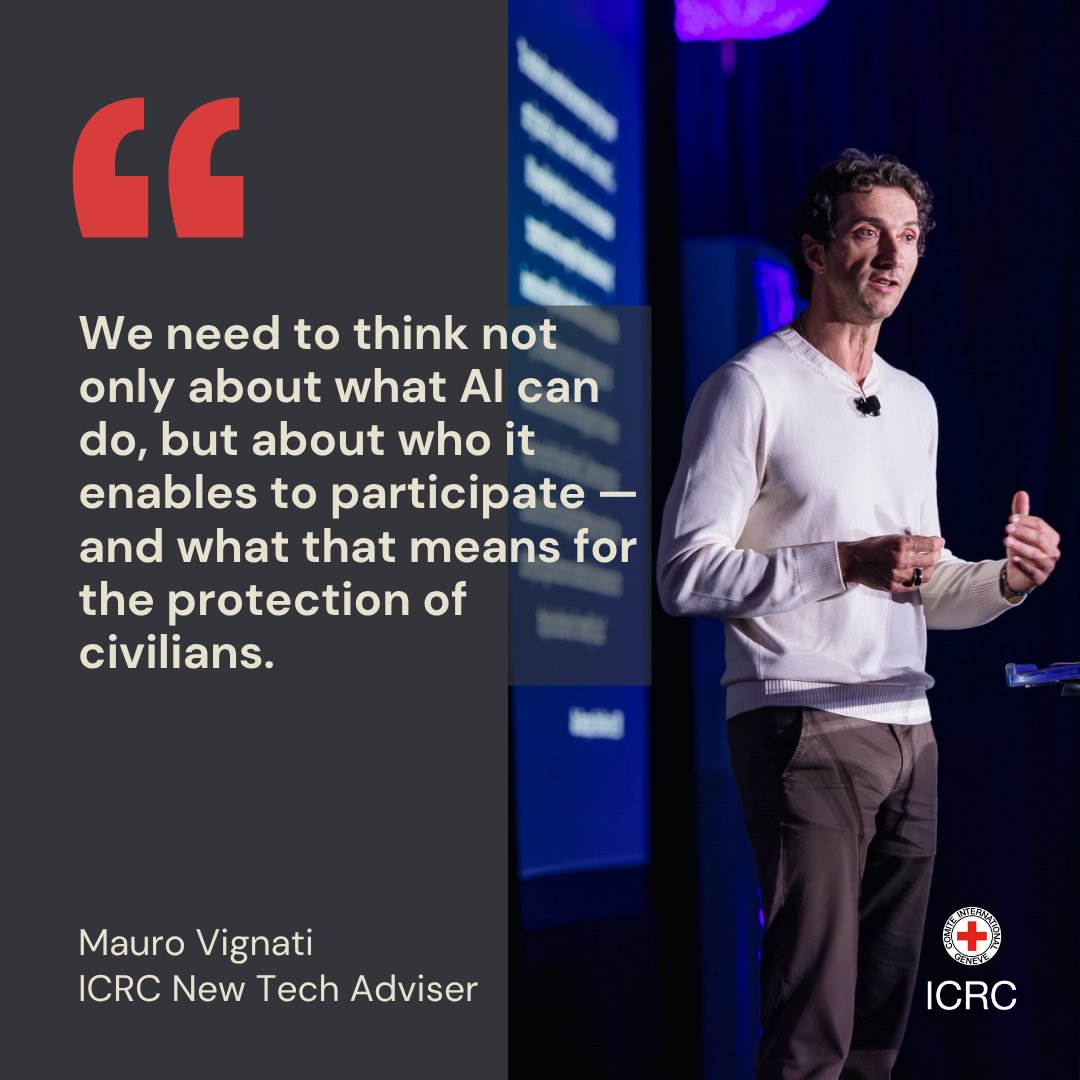
As AI lowers the barriers to sophisticated cyber capabilities, what could that mean for civilians in armed conflict?
At @labscon_io , ICRC’s Mauro Vignati explored how wider access to AI could reshape cyber operations — and why governance needs to keep pace.
"A human life is a human life!"
At today's #UNGA81 high-level side event, #ICRC President Mirjana Spoljaric called for renewed global commitment to #IHL and the protection of civilians in armed conflict.
Read the full statement: https://t.co/PATll10I5b
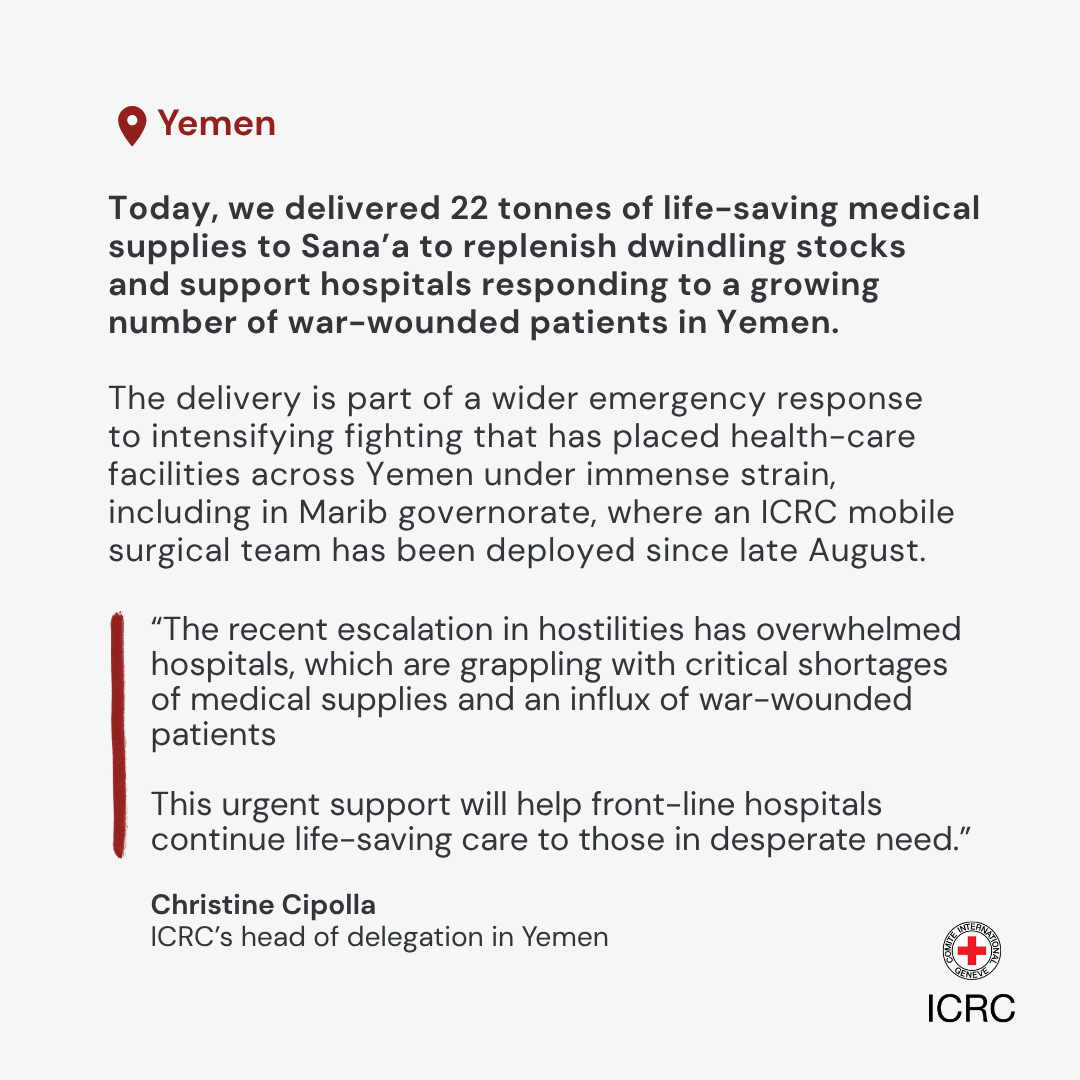
📍Yemen | As fighting intensifies, hospitals and health-care workers are under growing pressure to care for people who need urgent treatment.
Today, we delivered 22 tonnes of life-saving medical supplies to Sana’a as part of a wider emergency response to healthcare facilities across Yemen.
Our teams are working on all sides of the front lines to ease human suffering and support health-care services, so they can continue reaching people in need.
Read more 👉🏽 https://t.co/2NlmPMByIb
Deepfakes can manipulate the information people rely on in armed conflict—and undermine trust in humanitarian organizations.
ICRC Legal Adviser @J_T_Horowitz explains what's at stake at the Billington CyberSecurity Summit 🎧
Learn more about deepfakes https://t.co/xL4CWi3b66
📍Middle East | The recent escalation of hostilities affecting Yemen and Saudi Arabia risks a further expansion of conflict in the region that, if not contained, could worsen the already devastating humanitarian situation faced by millions of people.
Concrete steps must, at all times, be taken to protect civilians and essential infrastructure.
Read the full statement from the ICRC president 👉🏼 https://t.co/GVp8Ly3F6v
At the request of the relevant parties, we facilitated the transfer of five individuals released from Israeli detention to Lebanon.
One individual was transferred on Thursday, and four others on Friday, with full respect for the safety and dignity of the individuals involved.
Many families in Lebanon are still waiting for answers about the fate of loved ones who may be detained, deceased or otherwise unaccounted for.
Read more 👉🏽https://t.co/TnH1xTpZZF
Can a weapon ever be “controlled” if it can remain lethal for 30 years after it’s fired?
Cluster munitions are designed to cover wide areas, can leave unexploded remnants, and continue to threaten civilians long after fighting ends.
As States Parties meet in Laos for the 3rd Review Conference of the Convention on Cluster Munitions, ICRC experts Fahad Ahmed and Maarten Abeel examine why universalizing the treaty matters and the dangers of normalizing weapons we cannot fully control once used.
Read more on @ICRC_LawPolicy blog 👉🏽 https://t.co/NSpWIaaxD7
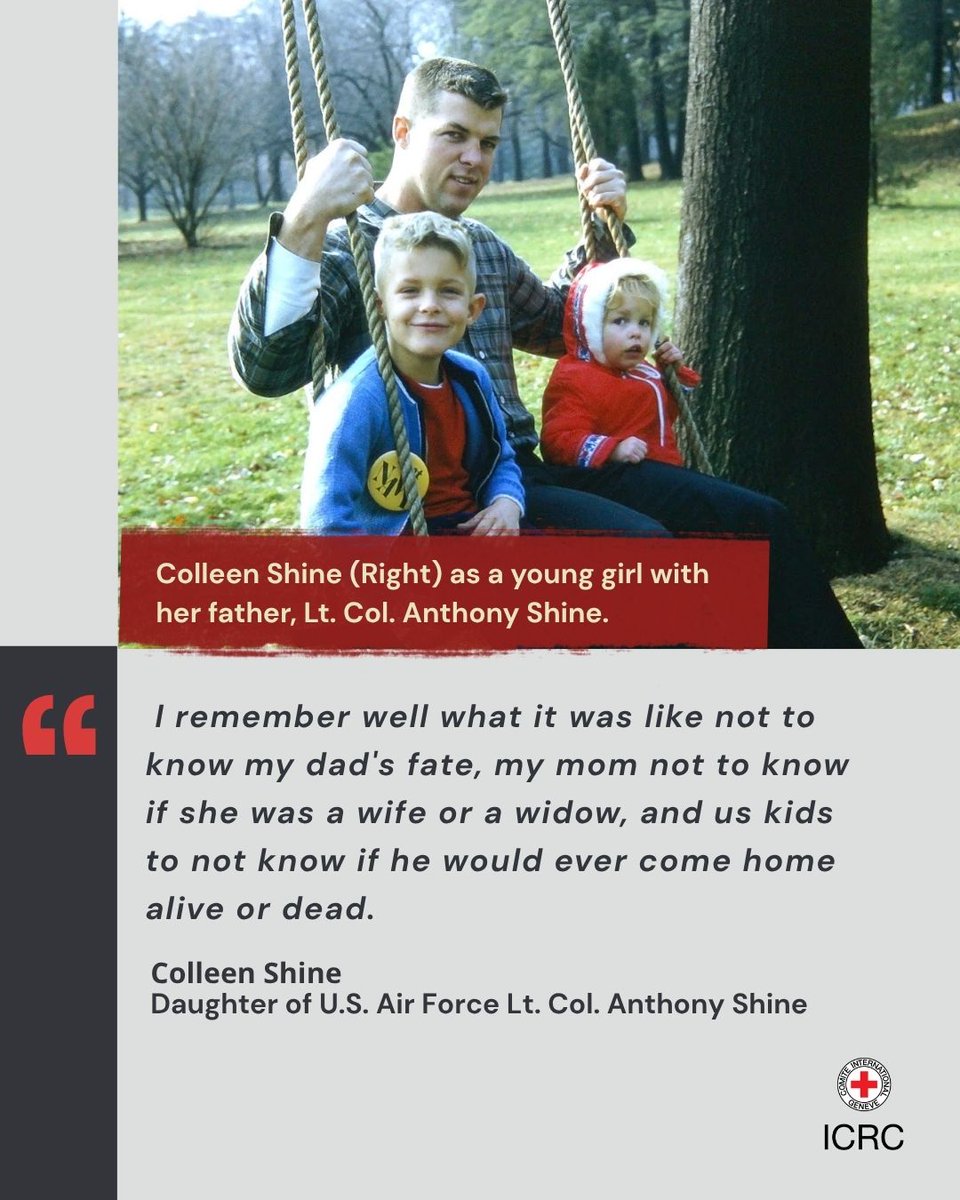
Colleen Shine successfully received answers on the fate and whereabouts of her father. Now she volunteers with @GoldStarSDIT to advocate for others in similar situations & says marking #IDOD brings about renewed support for families of the missing.
https://t.co/uhjl3ef6L9
Pam Cain is still searching for her father Col. Oscar Mauterer, who disappeared during Vietnam War over 60 years ago. On #IDOD we stand in solidarity w. those still seeking to know what happened to their loved ones who went missing during war. 👇
https://t.co/uhjl3ef6L9
States need to act now to set clear international regulations on autonomous weapons systems.
"A failure to act quickly and decisively will cost lives. It will leave future generations to inherit a world in which the absence of clear and specific prohibitions and restrictions on these weapons opens the door to practices that would erode the protections international humanitarian law is meant to guarantee."
In a joint appeal, the Secretary-General of the @UN, @antonioguterres and the President of the @ICRC, Mirjana Spoljaric, renew their call for States to urgently adopt a legally binding instrument to regulate autonomous weapon systems with clear prohibitions and restrictions.
Read more 👉🏽 https://t.co/xFQ1Y7zYar
Companies rarely know how armed forces are using their satellites — and that blind spot could quietly turn civilian infrastructure into a target. 🛰️
Listen here for more on satellites, war and IHL 🎧👇
https://t.co/dlFOQPm59U
📍Democratic Republic of the Congo | Attacks against volunteers and humanitarian personnel are unacceptable.
The Red Cross societies of the DRC and Uganda, the IFRC, and the ICRC are deeply concerned about recent attacks on Red Cross volunteers involved in the Ebola response.
One hundred days after the official declaration of the Ebola outbreak, 12 volunteers have been injured, ambulances have been damaged (including one that was set on fire) and emergency response equipment has been destroyed during 11 violent incidents.
Learn more in our joint news release: https://t.co/4spFINixwv
Military operations in outer space do not occur in a legal vacuum: they are constrained by International Humanitarian Law. 🛰️
Infrastructure civilians depend on—including in space—must be protected.
Listen here for more on satellites, war and IHL 🎧👇
https://t.co/eEWAlz1LNi
On World Humanitarian Day, we salute staff and volunteers. When they are attacked, essential services are disrupted—and communities suffer. Protecting humanitarian personnel is not a nicety, but an obligation. They preserve a space for humanity. 🤝🚑
@redcrosscanada@RedCross
ICRC teams in Colombia along with the @cruzrojacol are heading to Choco, an rural area close to the epicenter of last week's earthquake, to evaluate the humanitarian needs of those impacted most.
Listen to more en Español 👇👇👇
Estamos en camino hacia la zona de San José del Palmar, en Chocó, para visitar comunidades afectadas por el terremoto del pasado 10 de agosto y que también enfrentan las consecuencias de los conflictos armados.
Nuestros colegas Jair y María Elena cuentan más desde el terreno.
📍Gaza Strip | For Palestinians in Gaza, the impact of the hostilities continues, making their daily lives incredibly difficult amid fear and uncertainty of what the future holds.
Click here for more 👇🏻
https://t.co/KoPyLTBvC7
📍DR Congo | Jeannette once made a living through trade. When armed conflict forced her to flee, the money she had invested in her business became what her family needed simply to survive.
We supported her with seeds so she could turn to farming and begin rebuilding a source of income.