Imagine a generation that understands:
•money,
•investing,
•budgeting,
•entrepreneurship,
before adulthood.
That’s the vision behind IFG Institution.
We are committed to making financial education practical, relatable, and accessible.
Every investment does one of four things.
YOU LEND
Treasury bills, bonds, commercial papers, fixed deposits, money market funds
YOU OWN A BUSINESS
Stocks, index funds, ETFs, mutual funds
YOU OWN SOMETHING PHYSICAL
Real estate, REITs, gold, farmland
YOU BUILD IT
Your business, your skills, your pension
Crypto sits on its own.
Lending is safe and slow. Owning is faster. Building pays most and fails most.
Start with lending.
When resources are limited, people are forced to exercise self-restraint, politeness, and compliance just to navigate everyday life. That's not humility
Starting small does not make you small, it only shows how reasonable and responsible you are. It is not the volume of the amount you start with that matters, don’t look down on what you have.
Before you go out to buy anything, always ensure you explore all necessary avenues to find out where to get goods at a better price. It is not good financial management spending more for what you could have spend less.
No matter how financially handicapped you are, do not allow it affect your thoughts negatively. If you can think positively, you can generate ideas to make it big. Money does not answer to negative thoughts.
Regardless of the huge amount of money at your disposal today, if you cannot multiply cash flow on a continual basis, you are poor. It is only a matter of time for the money to finish.
As a body building solutions in this space, I resonate deeply with this. Many graduates leave school financially illiterate despite years of corporate finance theory. At IFG Institution, we’re bridging that gap by teaching practical skills on building assets, Well said!”
Career is more than making money. Yet, money has a way of reducing many inconveniences of life. That is why I still find it strange that a young person can attend a university for four or five years and graduate without anyone making a deliberate effort to educate him or her on personal economy and finance.
Yes, universities teach corporate finance, accounting, economics, and broad frameworks on how companies and governments optimize factors of production to create value. But very few systems teach young people how to manage their own money, build assets, allocate capital, and develop long-term financial independence. For me, that remains one of the major gaps in modern education. If education is the liberation of the mind, financial liberation should be a required course.
As a banker, I learned one important lesson early: how much you earn is only a small component of financial success. Many people focus entirely on income while ignoring investment and associated allocation. But wealth is rarely built only from wages; wealth is built from systems, discipline, and compounding capital which is money with direction. Yes, money is a scalar quantity, but capital is a vector quantity, having both magnitude and direction {revisit your JSS3 Integrated Science notebook}.
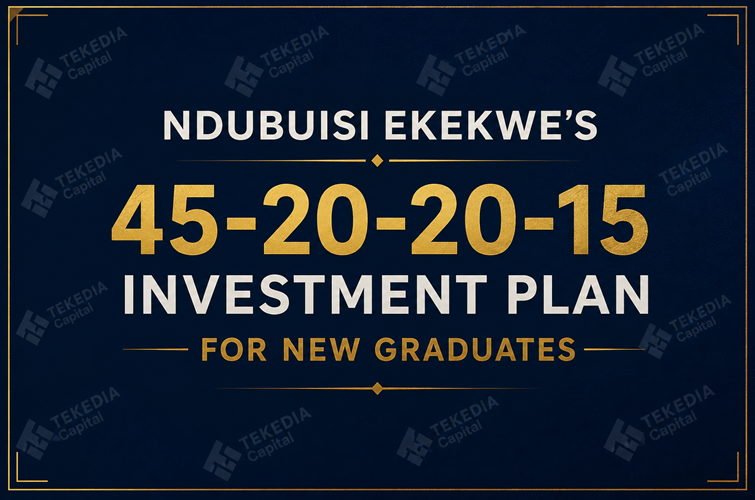
Interestingly, financial independence requires moving from a static phase to a dynamic phase, like mechanics in physics. In other words, you must take action. And taking action begins with having a plan. In my first month as a banker, I developed what I called the 45-20-20-15 Strategy, a simple portfolio allocation framework I still explain today in Tekedia Mini-MBA when discussing financial planning and personal economy for young professionals.
The structure was straightforward:
45% – Self and Family: (Car, accommodation, clothing, family, etc.)
20% – Personal Development: (Professional certifications, books, training, conferences, capability dev)
20% – Others: (Flexibility, lifestyle, emergencies, miscellaneous)
15% – Investments: (Dividend-paying stocks, etc)
Running simple projections using assumptions around dividends, compounding, inflation, and currency stability, I estimated that for every five years of disciplined investing, the portfolio could eventually generate the equivalent of about two years of wages without active work. (This did not turn out well as Naira lost value and messed up my model. Had I done this in US, a bestseller would have emerged).
That realization changed my understanding of money forever. Of course, my allocation system has evolved over time because life itself evolves. But one thing has remained constant: there is always a plan, including to compensate for Naira gyration.
Simply, if you do not allocate your resources consciously, circumstances will allocate them for you. But remember: circumstances are poor fund managers. Video here https://t.co/Ma30MVx0tK
Imaginations of being wealthy are good, but better is your capacity to effectively manage your present income, because if you cannot manage #10,000, you cannot manage #100,000, and if you cannot effectively manage your monthly salary, you cannot manage your retirement benefit.
The Chairman of Nigerian Exchange Group, Alhaji Umaru Kwairanga, has called on African capital markets and financial institutions to expand beyond traditional industries such as oil, banking and manufacturing by embracing the continent’s fast-growing creative and innovation economy as a viable investment asset class. https://t.co/oMeTTgTfk8
“I want to invest… but I don’t know what’s legit.”
“I don’t want to lose my money.”
“I don’t even know where to start.”
If this sounds like you, Episode 2 is for you.
We’re having a practical conversation on how to invest using Lambeth Capital and @investbamboo while also understanding safety, trust, and how to avoid common mistakes.
Saturday, 23 May 2026
6:00 PM WAT
@ngxgrp
https://t.co/wZP9U6aFEN