I know philosophers who dine out their whole career in exposition of the brilliant Hannah Arendt.
When COVID-19 hit, every single one kept his mouth shut.
A British biologist looked at 200,000 years of human history and found that the entire reason humans broke out of poverty was not intelligence, not language, not even agriculture, but one mechanism so simple a 6-year-old could explain it.
His name is Matt Ridley.
He is a zoologist by training, an evolutionary biologist by career, and in 2010 he wrote a book called The Rational Optimist that quietly argued the most important fact about human progress had been hiding in plain sight for the entire history of economics.
Naval Ravikant has been telling people to read everything Ridley has ever written for the last 15 years. The reason is the argument inside this one book.
For 200,000 years, anatomically modern humans walked around with the same brain you have right now. Same skull size. Same neural architecture. Same raw capacity for language, planning, and abstract thought.
For roughly 190,000 of those years, almost nothing happened. Generation after generation lived and died inside the same Stone Age toolkit their great-great-grandparents had used. Then somewhere around 50,000 years ago, the line on the chart of human progress started to tick upward. Then it bent. Then it exploded.
The question Ridley spent years on was the only question that mattered. What changed.
It was not the brain. The brain had been the same for 190,000 years. It was not language, which had existed long before the takeoff. It was not even agriculture, which arrived only 10,000 years ago and was actually preceded by the upward bend, not the cause of it.
What changed was that humans started trading with strangers.
This sounds too small to be the answer. Ridley argues that it is the answer to almost everything. The moment one human exchanged a useful object with another human from a different group, something happened that no other species on earth had ever done.
Two ideas that had developed in isolation came into contact. The flint knapper learned what the spear maker had figured out. The fisherman from the coast learned what the hunter from the forest had figured out. The two pieces of knowledge fused into something neither side could have produced alone.
Ridley calls this ideas having sex. The phrase sounds frivolous and it is meant to. The point is that ideas, like genes, get better when they combine with other ideas from different lineages.
An idea sitting inside one head, no matter how brilliant the head, eventually hits a ceiling. The same idea exposed to ten thousand other ideas does something genes do under sexual reproduction. It mixes. It recombines. It produces offspring nobody planned.
The cleanest proof of this argument is the most uncomfortable case study in the book. Tasmania.
Around 10,000 years ago, rising sea levels cut Tasmania off from mainland Australia. A population of roughly 4,000 humans was now isolated on an island, with no possibility of contact with the rest of humanity. They had the same brains. The same language. The same starting toolkit as their cousins 150 kilometers north. The natural experiment was now running.
What happened next is something no economist or geneticist had ever predicted.
The mainland Australians kept inventing. Boomerangs. Spear-throwers. Fishing nets. Bone needles for sewing fitted clothes. Watercraft with paddles. Their technology compounded slowly across the centuries.
The Tasmanians went the other way. They did not just fail to invent the new tools their cousins were developing. They started losing the tools they already had. Fishing was abandoned within a few thousand years. Bone tools disappeared. Fitted clothing disappeared. They forgot how to make fire from scratch and started carrying lit firebrands from camp to camp instead, relighting their fires from a neighbor's whenever their own went out.
By the time European explorers arrived in the 17th century, the Tasmanians had the simplest toolkit of any human society ever recorded. Their material culture had gone backward for 8,000 years.
The archaeologist Rhys Jones called it a slow strangulation of the mind.
Joseph Henrich at Harvard later proved with formal mathematical models that there was nothing wrong with Tasmanian brains. There was something wrong with their network. A toolkit requires a critical mass of people exchanging skills to maintain itself.
The act of teaching a skill is imperfect. Every generation loses a small percentage of what the last generation knew. If your population is large enough and trading widely enough, those losses get caught and corrected by someone else who still remembers.
If your population shrinks below a certain threshold and stops mixing with outsiders, the small losses compound until entire technologies disappear.
This is the part that should haunt anyone reading this in 2026.
Intelligence is not a property of the individual brain. Intelligence is a property of the network the brain is connected to. A genius in isolation will produce less than a mediocre thinker inside a dense exchange of other mediocre thinkers.
The thing your ancestors needed in order to break out of 190,000 years of stagnation was not better brains. It was better connections between brains they already had.
The implication for any individual is direct and uncomfortable. If you are smart and isolated, you will be outproduced by people half as smart who are connected.
The most successful people in any field are almost never the smartest people in it. They are the ones positioned at the intersection of the most idea flows. They are reading more authors than their competitors. They are talking to more people from more disciplines. They are in the rooms where ideas from different lineages bump into each other.
Ridley ends the book on the line that sounds optimistic but is actually a warning its this "The future will be invented by people who connect ideas, not by people who guard them."
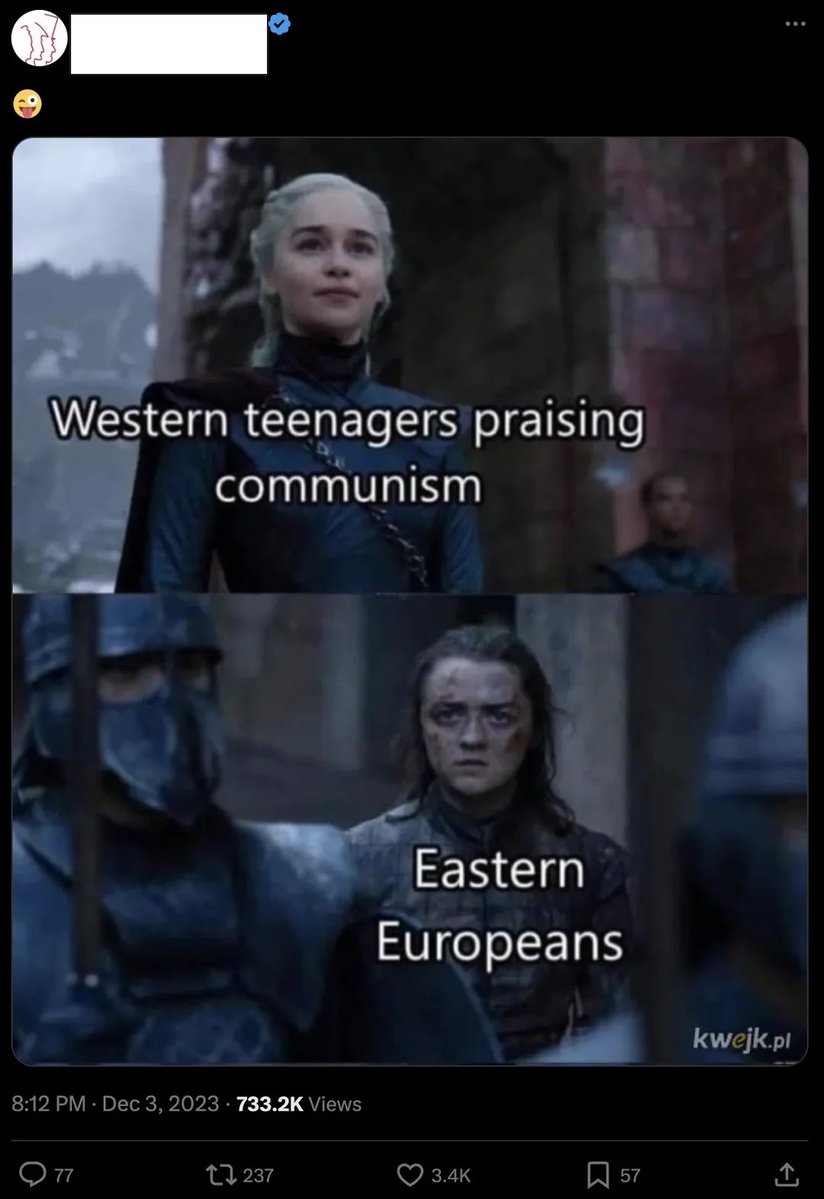
Hey, western commie!
Nothing makes me laugh harder than a guy or a girl tweeting about "great communism" from a $1,400 phone, in a 3-bedroom suburban house, with a fridge full of food.
Comrade.
You would not survive week one.
And here is why.
In the USSR you couldn't just quit your job to "find yourself." Not working was a crime. Literally. They called it "social parasitism." They put the future Nobel laureate Joseph Brodsky on trial for it. Your podcast about late-stage capitalism would've gotten you five years.
You picture yourself as a commissar. You'd be in a queue. Three hours. For maybe bread. The commissars were a tiny elite with their own shops, their own hospitals, their own everything. You weren't invited. You'd be the guy informing on his neighbor for an extra ration.
That brave political take you posted today? In 1949 USSR deported 20,000+ people to Siberia in three days for a lot less - for just being LOCALS. Whole families. Children. Cattle cars. You'd have lasted until your first "actually Stalin was misunderstood" reply landed in front of the wrong person.
The gulag wasn't an edgy metaphor. Roughly 18 million people passed through it. Unpaid labor, -40°C, digging canals nobody needed. But please, tell me more about how you'd "organize the workers" from the group chat.
Things get bad and you want to leave? You can't. There's a wall. There are dogs. There are guards who shoot. The whole design was that you couldn't go.
The people romanticizing it from a comfortable suburb can always book a flight home. People in the USSR couldn't even move to the neighbouring city without permission.
So wear the Che shirt. Read rge Red Book by Mao. Enjoy the iPhone he'd have confiscated, the internet he'd have banned, and the free speech that lets you praise the exact system that would have shot you for using it.
Some of us actually remember how it went.
Was not ready for Eric Church to deliver the best commencement speech I’ve ever heard.
Six guitar strings. Six pillars of a life.
Faith. Family. Spouse. Ambition. Community. You.
Tune them when you’re whole, not just when you’re broken.
Watch the whole thing.
This original medieval-style dance piece is in G minor, with a chord progression that alternates between Gm and Cm, incorporating variations like Gm6 and Cm6 for that hypnotic flow.
El "Lacrimosa" es el fragmento más conmovedor y famoso del Réquiem en re menor, K. 626 de Wolfgang Amadeus Mozart. Es una pieza cargada de misticismo, no solo por su belleza melódica, sino porque marca el momento exacto en que la vida del compositor se apagó.
There's a physicist at Stanford named Safi Bahcall who modeled this exact principle and the math is wild.
He calls it "phase transitions in human networks." When you're stationary, your probability of a lucky event is limited to your existing surface area: the people you already know, the places you already go, the ideas you've already been exposed to. Your opportunity window is fixed.
When you move, your collision rate with new nodes in a network increases nonlinearly. Double your movement (new conversations, new cities, new projects) and your probability of a serendipitous encounter doesn't double. It roughly quadruples. Because each new node connects you to their entire network, not just to them.
Richard Wiseman ran a 10-year study at the University of Hertfordshire tracking self-described "lucky" and "unlucky" people. The single biggest differentiator wasn't IQ, education, or family money. Lucky people scored significantly higher on one trait: openness to experience. They talked to strangers more, varied their routines more, and said yes to invitations at nearly twice the rate.
The "unlucky" group followed the same routes, ate at the same restaurants, and talked to the same 5 people. Their networks were closed loops. No new inputs, no new collisions.
Luck isn't random. Luck is surface area. And surface area is a function of movement.
The lobster emoji is doing more work than most people realize. Lobsters grow by shedding their shell when it gets too tight. The growth requires a period of total vulnerability. No protection, no armor, soft body exposed to the ocean.
That's the cost of movement nobody posts about. You have to be uncomfortable first. The new shell only hardens after you've already moved.
Did you know that the composer of the famous Game of Thrones soundtrack is Iranian?
This is a cover of the iconic piece on the Iranian Daf, arranged by Reza Sajjadi and the original composer of this music is Ramin Djawadi 🔥
Notice who is playing it?
Instead of saying ‘I love you’ some people will say:
I am here to help
You matter to me
You can have the last piece
Call anytime
I made you a meal
I miss you
I hope you had fun
Be safe
You are my best friend
I am sorry, I was wrong
I admire you
Listen to words that are said.
30,000 hours of footage, equivalent to 3 years and 7 months, were filmed to capture the blooming of 77 types of flowers….and the result is spectacular.
Jill got a paycheck for $0 this week.
She’s one of 730K federal workers keeping the country running without pay.
Meanwhile, Trump’s out of town and Congress is getting paid.
Working people are holding it down while the powerful play games with our lives.
https://t.co/TZY65bWHwk
Bill Maher just ENDED Kamala Harris’s career with a brutal 2-minute monologue.
This one hurts. The ending is the icing on the cake.
“Kamala Harris’s new memoir of the 2024 election is called 107 Days. But it should have been called ‘Everyone sucks but me.’
“107 Days is a victim’s title because get it, she only had 107 days to win. Yeah, and a billion and a half dollars and a built-in army of about 75 million people who’d vote for any human-adjacent life form that wasn’t Trump.
“But in 107 Days, nothing is ever Kamala’s fault. Biden lets her down by not stepping down sooner. (Pouty face emoji). Gavin Newsom, he was asked for his endorsement but texted ’hiking.
“Gavin Newsom, he was asked for his endorsement, but texted ‘Hiking. Will call back.’ But then never did. And then he didn’t even ask her to prom.
“America itself lets Kamala down by not being ‘ready’ for the running mate she really wanted, Pete Buttigieg. So she stuck with the Home Depot paint salesman [Tim Walz], and the rest is HERstory. Poor Kamala. We made her the star of a rom-com and didn’t even give her a gay best friend.
“Kamala writes that on election night, when it was clear she lost, an aide peeled the words ‘Madam President’ off the cupcakes before handing them out. Oh, geez, that’s like a scene from Bridget Jones Runs for President, for Christ’s sake.”
CNN’s Van Jones shocks viewers by putting the mainstream media on blast for IGNORING the mass slaughter of Christians in Nigeria.
“The fact that there’s almost no response from the global left and no attention from mainstream media is a CRIME against African people, black people, and human rights.”
MAHER: “You’re talking about young people. A lot of them seem to know one thing: white people did some very bad things in this world, and they certainly did. But there are other things to know… Nigeria: this is an actual planned genocide. They really want to kill all the Christians in that country, and they are systematically doing it.”
VAN JONES: “And the fact that there’s almost no response from the global left and no attention from mainstream media is a crime against African people, black people, and human rights. I agree with that 100%.”
Van Jones then laid out a theory about why networks like CNN have failed to cover the crisis in Nigeria. It’s one that will for sure get people talking.