Export controls since 2010: ~$158B market cap loss for US firms, ~$18B for Chinese targets (per Fed economists).
China's domestic chip equipment share went from 25% → 35% in one year.
Cheng & Mueller call it what it is: unilateral disarmament dressed up as containment. We kneecap American companies while China builds around them.
https://t.co/sGYqf4Vdof
@bkuerbis analyzes Project Glasswing and the changing institutional economics of bugs. If the bug discovery premium is gone, what about patch verification? https://t.co/NtYi3yAami
@liam_epstein What a joke. US got its lead in AI/semiconductors by serving global markets, making profits, and using them to improve. You're saying the only way to stay in the lead is to deprive our chip firms of 35% of their market and protect them from competition?
@bkuerbis analyzes Project Glasswing and the changing institutional economics of bugs.
If the bug discovery premium is gone, what about patch verification?
https://t.co/NtYi3yAami
Much of the current media coverage frames the Anthropic-DoD dispute as an ethical conflict: a reckless Pentagon trying to weaponize AI versus a principled company standing firm on responsible use. While not entirely wrong, this framing it misses what is most important.
https://t.co/BR7xAE6eTa
@ARozenshtein 1) it's called "terms and conditions" and the government is no different from any other contracting party. So the answer to 1) is clearly Yes.
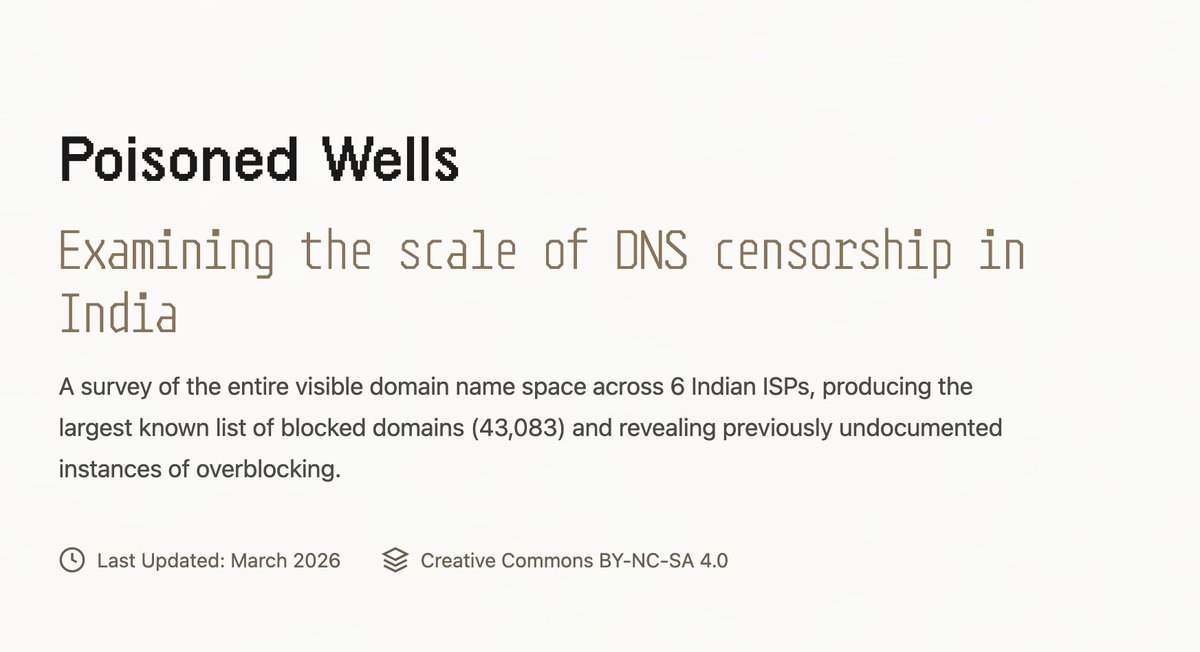
India’s internet is far more restricted than officially acknowledged. This is the largest study of #DNScensorship in #India till date, both in
terms of test list coverage as well as the size of blocklist. Monumental work by .@Squeal
Excited to share “Poisoned Wells,” which presents the largest point-in-time study of website blocking in India to date. I tested the blocking of 294 million apex domains across six Indian ISPs, sending 1.76 billion DNS queries in total.
As I have said since the beginning, this is about the principle of the thing for both parties. Anthropic is saying private firms should be able to set the terms on which they offer products and services to the government. USG is saying no, private firms may not set terms of use. In other words, the USG is saying that companies who provide services to the military are not quite “contractors” but instead assets to be deployed at will by the government, only to be constrained by the government’s interpretation of the law. There is no difference in principle from the government saying “we unilaterally dictate the price of every service and product we procure.” After all, price is just another term in a contract. This is why the government’s stance has a certain appeal, but is ultimately conceptually incoherent and a fundamental departure from the principles of ordered liberty that you and I both share.
The “coloring within the lines of our republic” response is for the government to say, fine, we won’t give you business and we will give business to your competitors. Perhaps even to make a public stink about it. I don’t know a single person who objects to that or thinks it’s illegitimate for the government to do.
But instead what the government is doing is trying to destroy Anthropic, using policy measures reserved only for foreign adversaries. This is obviously a different-in-kind response, and all principled classical liberals should reject it outright. This is not hard, or at least it should not be.
In short: You are focusing on the wrong thing. Of course DoW is free to have a principle that they will accept no limitations on their use of technology. The problem is that their policy response is not just doing that, but instead attacking the basic principles of private property: that people have the right to set the terms of their engagement with the government.
Voices from academia, policy, industry and civil society shared insights on AI and geopolitics, international trade, innovation and more at Internet Governance Project's session today on AI governance and global economic development
The biggest problem with "AI Safety/Alignment" is that they homogenize "AI" into a single thing. The good thing about @deanwball's emphasis on common law/tort solutions is that it reduces the governance problem to specific applications. "Guardrails" for what? chatbots? facial recognition in law enforcement? autonomous vehicles? medical devices?
A common assumption of traditional AI safety/alignment is that solving the problems they envision will require extraordinary acts, basically a wartime footing.
So far that just hasn’t proven to be the case. It seems like these *are* genuine problems, *and* they’re being managed okay so far. There is still much work to be done, but it may not require the extraordinary effort once imagined.
Some people in AI safety, often the more technically inclined, see this and seem happy about it. Others, often the more politically inclined, either don’t agree or choose to ignore this; those types remain on the warpath, but their rhetoric seems increasingly discordant with reality.
If by "purely libertarian" you mean Rothbardian anarcho-capitalism then we've all outgrown it. The dream of a world without any state, in any form, is as unrealistic as a Marxian world without any markets. That's why we promote political economy - there's a role for both, but it's a evolving, dynamic relationship that has to be figured out
@deanwball Do you consider the LLM service provider a content producer or an intermediary? That should answer the question of whether Section 230 should or should not apply to chatbots
Huston's data also shows that 95% of the transferred number blocks had been held by the selling party for more than 5 years. From 2017 - 2019, over 70% were held for 10 years or more. Since 2021, over 90% were held for more than 10 years.
Please use the link below to join the information session on Georgia Tech's MS degree in Cybersecurity (Policy track) today from 1:00 PM to 2:00 PM Eastern Time:
https://t.co/YG23pRjCXf