Congratulations to IIT Bombay team comprising George Christopher Panneer Selvam (Phd student) and Hari K (postdoctoral fellow) led by Prof. S. Shankaranarayanan, Physics for being awarded the first prize in the 77th Edition of Gravity Research Foundation (USA) essay competition-2026.
Link: https://t.co/Qq6J3gHm0r
This competition has a storied history dating back to 1949, with past winners including Stephen Hawking and Roger Penrose.
The Science: Can we "hear" the dark universe?
For decades, the nature of Dark Matter - the invisible "glue" that holds galaxies together - has remained one of science’s greatest mysteries. A leading candidate is the "Primordial Black Hole" (PBH), a tiny relic left over from the first fractions of a second after the Big Bang. While these black holes have the mass of an entire mountain range or a large asteroid (anywhere from 100 billion to 100 quadrillion tons), they are incredibly compact. An asteroid-mass black hole is smaller than a single atom, yet it carries the gravitational punch of a physical object hundreds of kilometers wide. However, because these black holes don’t emit light, they are nearly impossible to find.
In this essay, we propose a new way to "see" the invisible. Our theory suggests that interstellar hydrogen gas can act as a "quantum sensor". When a asteroid-mass black hole passes through a cloud of hydrogen, its extreme gravitational curvature physically warps the atoms. This warping causes the hydrogen to absorb radio waves in a unique, complex pattern we call a "Gravitational Spectral Forest". By tuning next-generation radio telescopes to listen for this "forest", astronomers may finally be able to confirm the existence of primordial black holes, solving a 50-year-old mystery about the origin of our universe.
This is only the second time in the history that a research group from an
Indian Institution has received the first prize. First time was by late Prof. Padmanabhan in 2008.
#Gravity #DarkMatter #BlackHoles #IITBombay #Physics #ANRF #ANRF_ARG #ANRF_CEO #QuantumSensing #Astrophysics #DST
AI is entering classrooms — and IIT Madras is helping teachers lead the way.
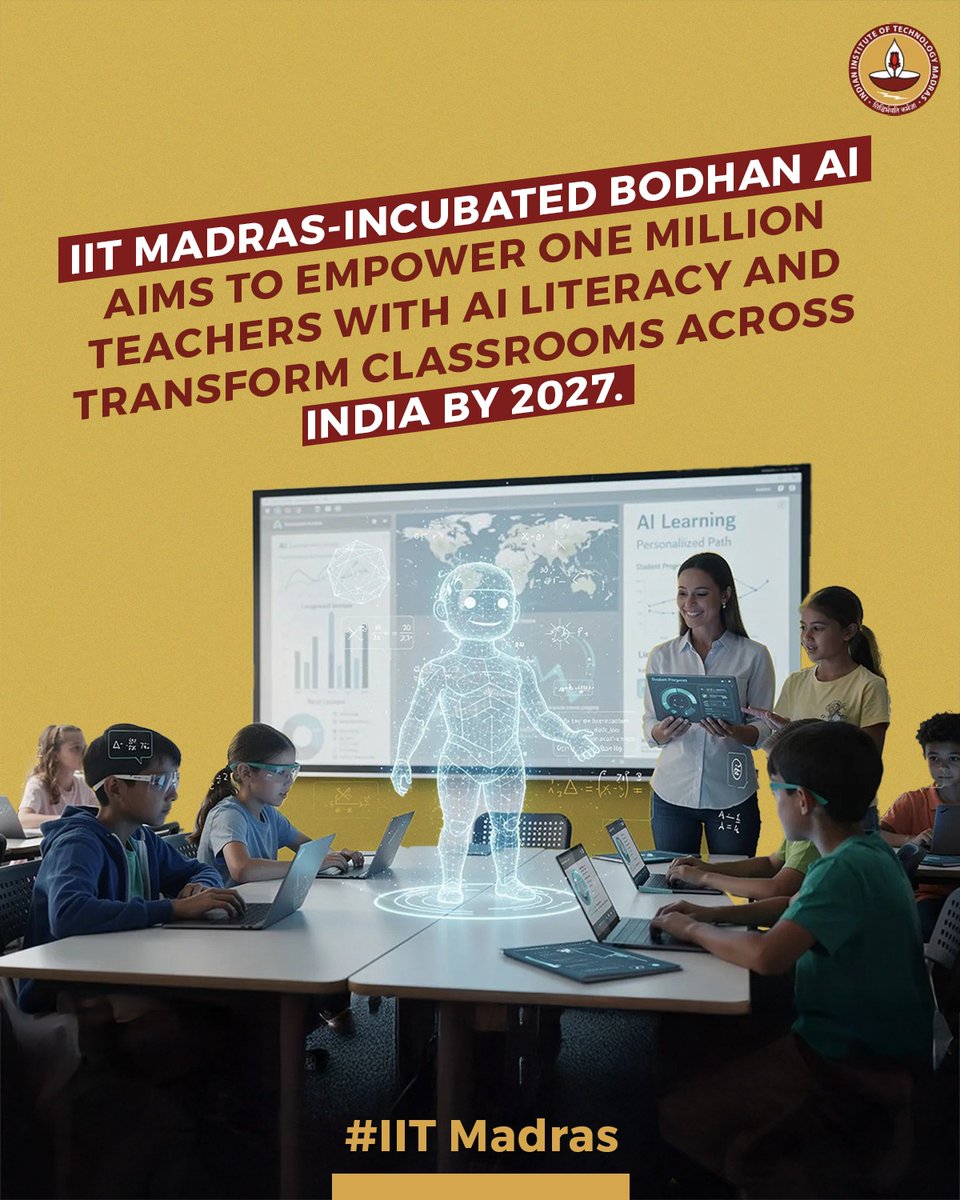
As reported in Enterprise AI, The Economic Times, Bodhan AI, a Centre for Excellence for AI in Education incubated at IIT Madras, has launched a nationwide initiative to train one million teachers in Artificial Intelligence by 2027.
The “AI Literacy for Teachers” programme aims to help educators integrate AI into everyday teaching — from lesson planning and worksheet creation to multilingual content delivery, assessments, and evaluation. By simplifying routine tasks, the initiative seeks to give teachers more time to focus on meaningful learning experiences for students.
The programme will roll out in phases through pilot initiatives in the coming months, with the first public cohort set to launch on Teachers’ Day, September 5.
Through initiatives like these, IIT Madras continues to drive inclusive, technology-enabled education for the future.
Read more at: https://t.co/o3dQqjUzxx
@EconomicTimes@iitmadras@Bodhan_AI
An alumnus of IIT Kharagpur, Pichai continues to inspire millions worldwide through his visionary, calm, & future-focused leadership in shaping the AI era. His remarkable journey is a proud reflection of IIT’s enduring legacy of innovation, excellence, and global leadership.
#TechTuesday Delivering DNA, RNA, and proteins into cells is key to advancing gene therapy and targeted treatments—but existing methods face challenges like cytotoxicity and low viability.
In this study, Ms Donia Dominic, Department of Engineering Design, IIT Madras, Dr Rajdeep Ojha, Department of Physical Medicine and Rehabilitation, Christian Medical College, Dr Moeto Nagai, Department of Mechanical Engineering, Toyohashi University of Technology, and Dr Srabani Kar, Department of Engineering Design, IIT Madras (also affiliated with the Department of Physics, IIT Hyderabad), and Dr Tuhin Subhra Santra, Department of Engineering Design, IIT Madras (also affiliated with the School of Interdisciplinary Studies, IIT Madras), have developed a reduced graphene oxide-based photoporation platform.
This light-driven, high-throughput system enables efficient, low-toxicity delivery of biomolecules across cell types—transfecting up to a million cells in seconds.
A promising step forward for gene therapy, drug discovery, and regenerative medicine.
Read Here: https://t.co/yKrw9IgBZ2
Read Full Study Here: https://t.co/DUTrSLSptj.
@iitmadras
At @iitmadras, sustainability remains central to its vision and action.
From pioneering research in clean energy and climate resilience to fostering a green and biodiverse campus, the institute continues to drive meaningful impact.
On this Earth Day, we reaffirm our commitment to Our Power. Our Planet.—advancing a sustainable future for generations to come.
#EarthDay #IITMadras #OurPowerOurPlanet #GreenFuture #Sustainability
The JEE measures performing under pressure on a particular question format. It doesn't measure curiosity, creativity, resilience, or the ability to actually build something. Then we wonder why Indian engineering graduates struggle with innovation.
https://t.co/u7V2R4k4WJ
#JEE
IIT Madras Zanzibar, the first international campus established by an IIT, invites applications for its 2026 intake across undergraduate and postgraduate programmes in Data Science, AI, and Chemical Process Engineering.
Established in 2023, the campus has evolved into a diverse and inclusive academic hub with strong international representation and a 100% placement rate for its first https://t.co/uYYy0SVLH6 cohort.
With a focus on academic excellence, research, and innovation, the campus continues to strengthen global learning and industry engagement.
🗓 Screening Tests:
https://t.co/uYYy0SVLH6 – 26 April 2026
BS – 6 June 2026
Apply now: https://t.co/Vk3DcErTnl
@iitmadras@ogeiitm@IITMZanzibar
#IITMadras #Zanzibar #AdmissionsOpen #GlobalEducation
'Certification in Quantum Computing and Machine Learning'
8th batch launched by the Continuing Education Programme (CEP), #IITDelhi
For more information, please click: https://t.co/4CeiVhyAVo
Apply Now Link: https://t.co/UJrkcj4aIv
Last Date to Apply: July 24, 2026
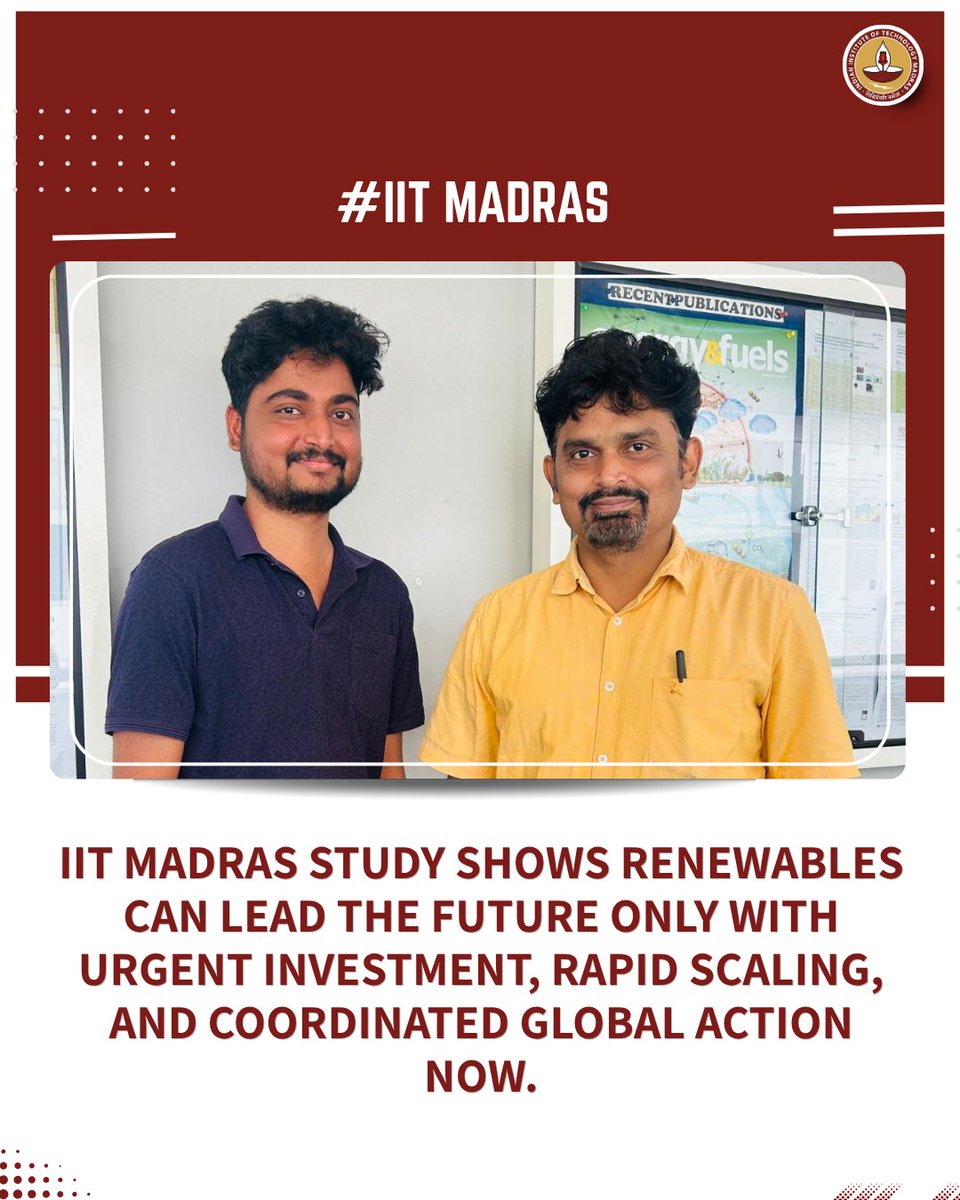
Can renewable energy realistically power the world by 2050?
A recent study by IIT Madras, authored by Prof. Jitendra S. Sangwai and doctoral scholar Rajat Dehury, Department of Chemical Engineering, IIT Madras, presents a critical perspective. It finds that under current growth rates, renewables may surpass fossil fuels only between 2047 and 2053. Achieving this transition earlier—by the late 2040s—would require significantly accelerated investment.
The study highlights the urgent need to double renewable energy investments and substantially increase spending on power grids and energy storage to meet COP28 targets.
It also emphasises that renewables alone will not suffice. A multi-technology approach, including carbon capture, advanced storage, and grid modernisation, is essential.
The pathway to net-zero exists, but it demands immediate, coordinated, and large-scale action.
Read the study here: https://t.co/NHo70Zofxx.
@iitmadras
#EnergyTransition #ClimateAction #NetZero #Sustainability #IITMadras
https://t.co/w9JIJZXTBk
22 institutions from across Northeast India have signed a historic Letter of Intent (LoI) to establish the Northeast India–Japan International Academic and Research Consortium!
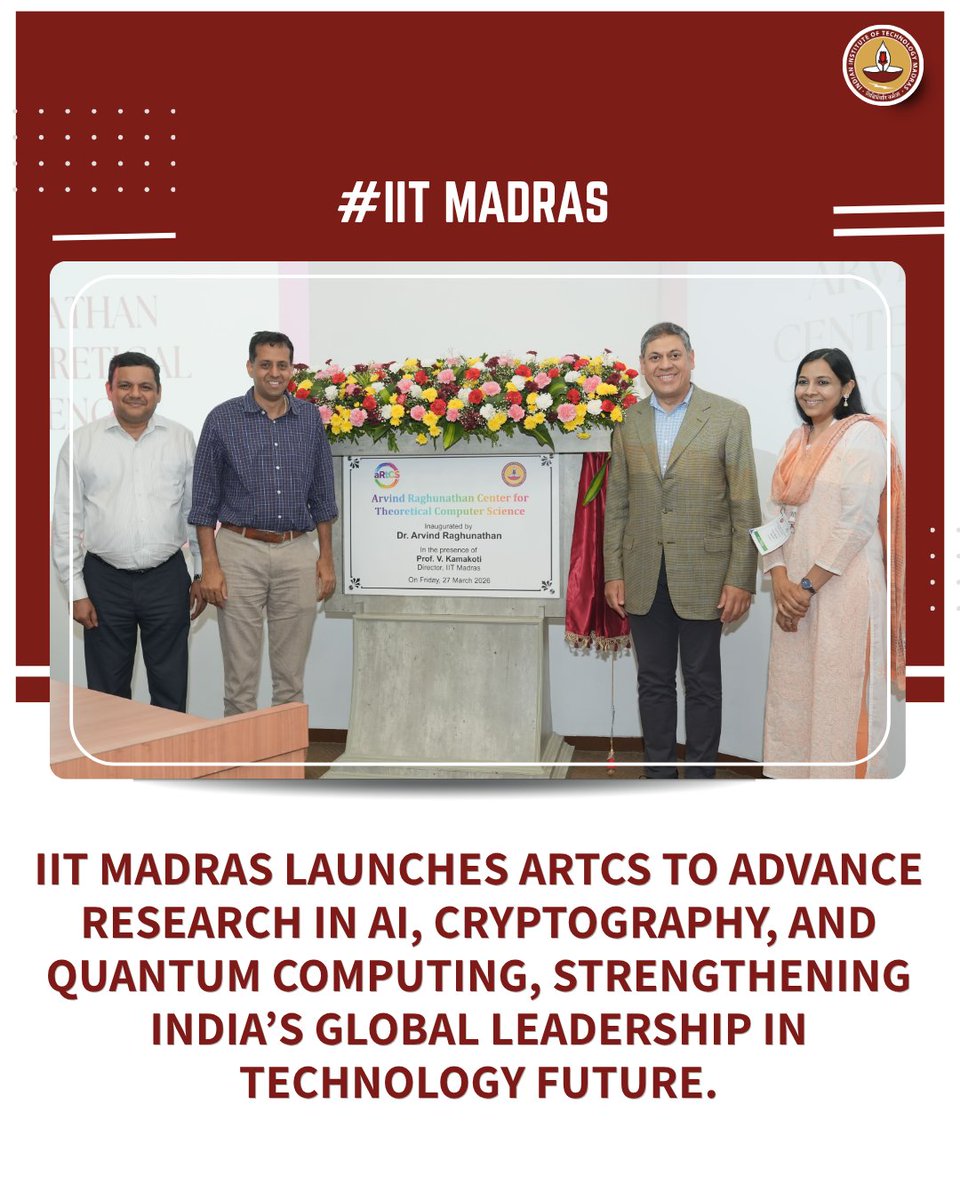
IIT Madras is pushing the boundaries of computing, cryptography, Artificial Intelligence, and quantum technologies through the newly launched Arvind Raghunathan Centre for Theoretical Computer Science (ARtCS).
Established with a ₹23 crore endowment from alumnus Mr Arvind Raghunathan, Founder of Roc Capital Management, the Centre will lead deep, theory-driven research addressing core challenges in data security, computational complexity, algorithms, and AI privacy. By combining rigorous mathematical foundations with real-world applications, the initiative aims to drive breakthroughs in secure digital infrastructure, quantum-safe cryptography, blockchain systems, and trustworthy AI.
The Centre will be coordinated by Prof. Shweta Agrawal, Mr Venky Harinarayan and Mr Anand Rajaraman, Faculty Fellow, Department of Computer Science and Engineering, IIT Madras, who highlighted its vision of fostering a collaborative ecosystem rooted in scientific curiosity and excellence.
With a strong emphasis on interdisciplinary collaboration, ARtCS will bring together global experts from academia, industry, and policy to build a vibrant research ecosystem—advancing India’s leadership in next-generation technologies and reinforcing IIT Madras’ position at the forefront of foundational computer science research.
@iitmadras
#IITMadras #AI #QuantumComputing #Cryptography #Research #Innovation