What if CAR therapy didn't require extracting and engineering cells?
KAIST's new approach reprograms immune cells inside the tumour using mRNA-loaded lipid nanoparticles.
Preclinical (ACS Nano, Nov 2025). Here's how it works.
#Oncology#CancerResearch#Immunotherapy
In melanoma mice, the therapy suppressed tumour growth and triggered a systemic immune response. Still preclinical - human trials, safety, and broader validation remain ahead.
Its mRNA-LNP delivery platform, however, is already proven at scale.
Conventional CAR-macrophage therapy is slow, expensive, and complex - cells must be extracted, engineered, expanded, and reinfused. An injectable that performs the engineering inside the tumour could reshape the economics and accessibility of CAR therapy for solid tumours.
Solid tumours are full of macrophages, but the tumour microenvironment silences them. KAIST's approach uses lipid nanoparticles carrying mRNA to reprogram those dormant cells to express CAR proteins and attack cancer - inside the body, without ever leaving.
A shingles vaccine may do more than prevent shingles.
In a Welsh cohort of 282,500 adults, dementia patients who were vaccinated had substantially lower dementia mortality (~30% vs ~50%). Findings were replicated in Australia and published in Cell (2025).
#Alzheimers#Dementia
Key caveat: this is observational, not an RCT. Harvard’s Alberto Ascherio calls it promising but says trials are needed.
The shingles vaccine is already recommended for 50+.
If the signal holds, the public‑health impact could be significant.
A 2025 Nature study in Wales found vaccinated adults had a 20% lower dementia risk over 7 years.
Birthdate based eligibility created near identical groups, making this one of the strongest natural experiments we have.
Hypothesis: the chickenpox virus remains dormant in nerve cells and may periodically reactivate, driving chronic neuroinflammation linked to Alzheimer's.
Shingles vaccination could reduce that burden by suppressing reactivation.
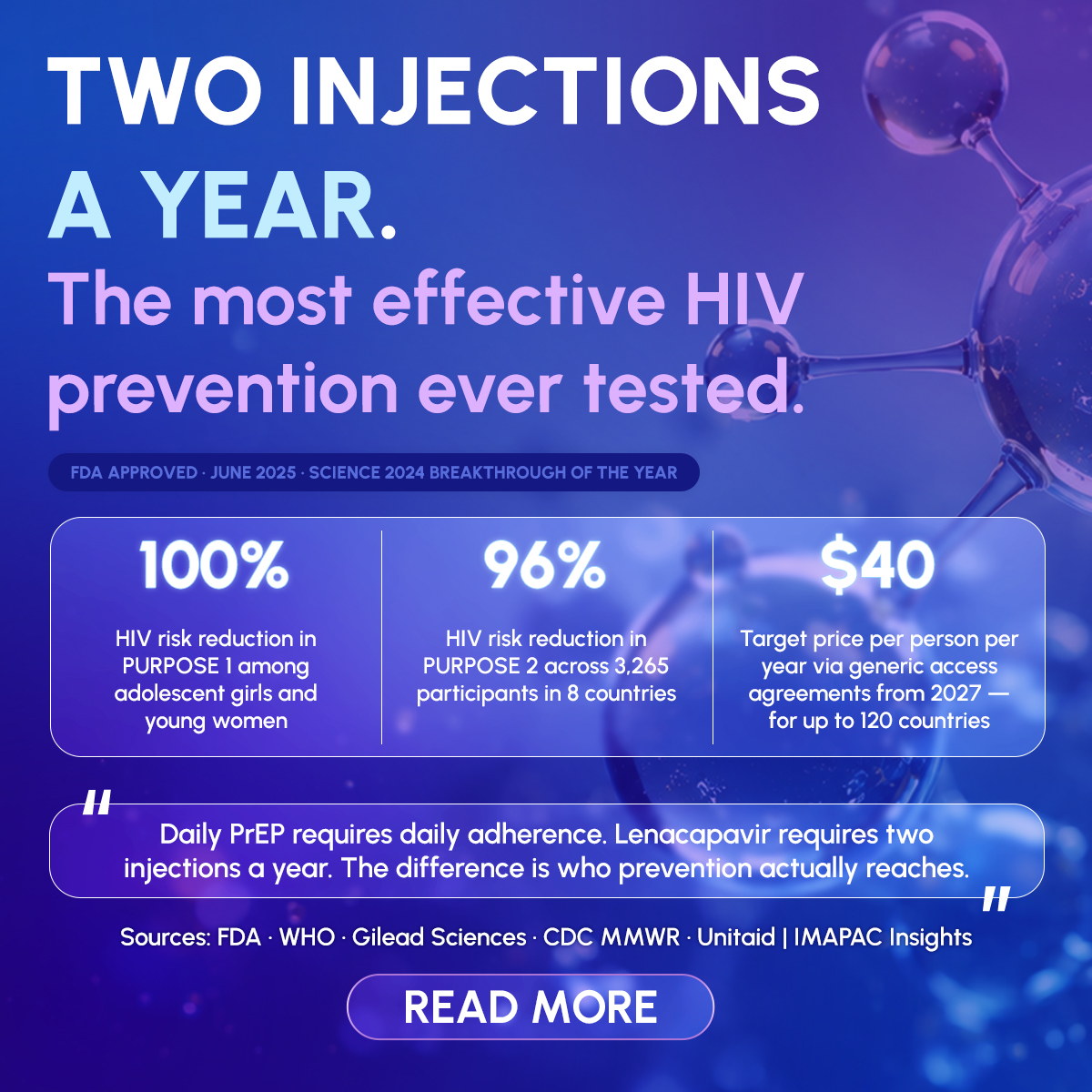
Two injections a year. Zero HIV infections in trials.
Science's 2024 Breakthrough of the Year is now approved for HIV prevention.
Brazil helped generate the data, yet can't access a generic version.
#HIV#PrEP#Lenacapavir#GlobalHealth
Brazil helped generate the data behind lenacapavir in PURPOSE 2. Yet it's excluded from generic licensing agreements expected to bring prices down to $40/year across much of the world.
The trial included Brazil. The access deal doesn't.
Why does twice yearly matter? Daily PrEP is highly effective, but many users discontinue within a year.
Two injections annually eliminate the need for daily adherence. That's not a small improvement.
It's a fundamental change in HIV prevention.
PURPOSE 1: 2,134 young women in South Africa and Uganda. Zero HIV infections with lenacapavir. 100% risk reduction.
PURPOSE 2: 3,265 participants in 8 countries, including Brazil. Two infections. 96% risk reduction.
The strongest HIV prevention results ever reported.
The first child in history to be cured of DIPG, a brain cancer with a median survival of 9-10 months.
No surgery. No cure.
Until a clinical trial in France assigned him a drug, and his tumour disappeared.
#DIPG#ClinicalTrials#Oncology#BrainCancer
The breakthrough wasn't just the drug -it was the trial design.
BIOMEDE matched treatment to tumour biology.
BIOMEDE 2.0 now focuses on everolimus, while another trial has produced a second long-term tumour-free survivor.
Clinical trials made both possible.
Of 233 children in the trial, only Lucas's tumour vanished.
He later told doctors he had stopped taking the drug. The cancer never came back.
Researchers suspect a rare mutation made his tumour exceptionally sensitive to treatment.
Diagnosed at six, Lucas Jemeljanova joined France's BIOMEDE trial after travelling from Belgium. Randomly assigned everolimus, he saw his tumour disappear completely.
"Over a series of MRI scans, I watched as the tumour completely disappeared." - Dr Jacques Grill