A charitable organisation dedicated to improving, supporting and promoting education and debate in medical ethics.
Co-owner of the JME and MH Journals.
There are two weeks to go until the call for abstracts for #PGBC2026 is closes!!
Join us at the University of Warwick from the 7-8th of September!
Here’s the link to submit, submissions close on the 31st May! Let us know if you have any questions!
https://t.co/U0QnhNV4WG
🚨 New Special Issue of Journal of Medical Ethics https://t.co/tQcvoV7UTt
Read the free editorial led by Shalom Chalson: How Smarter Systems Lead to Tougher Judgements: https://t.co/aeEiXmHnT3
So excited to announce that the call for abstracts for #PGBC2026 is open!!
Join us at the University of Warwick from the 7-8th of September!
Here’s the link to submit, submissions close on the 31st May!
https://t.co/NOfaC5jCSW
#bioethics#medicalethics
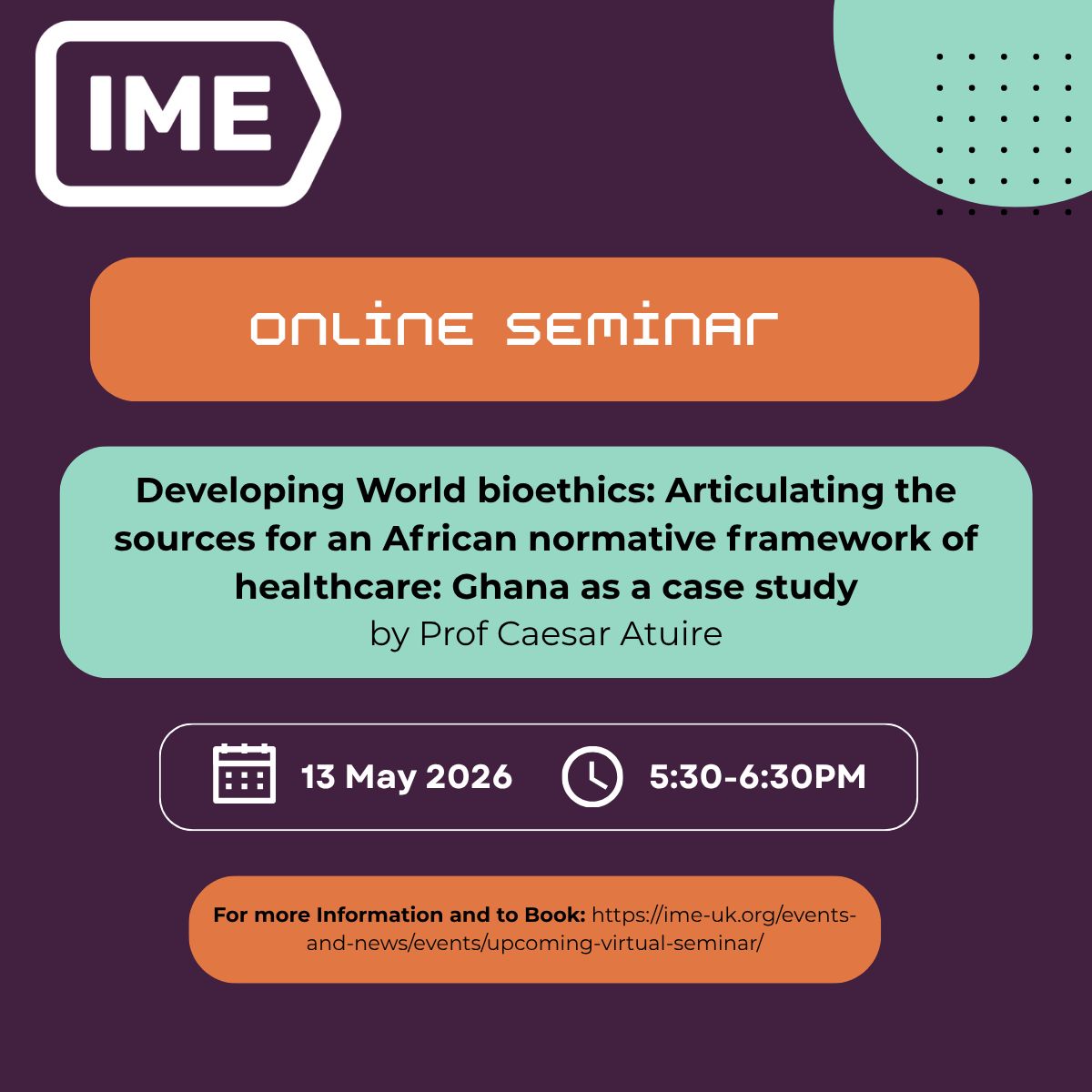
There is still time to book on for our next virtual seminar!
Don't delay!
Developing World bioethics: Articulating the sources for an African normative framework of healthcare: Ghana as a case study
📅 Wednesday 13th May
⏲️ 5:30-6:30pm
For more Information and to Book: https://t.co/5zuQxcxjvh
Prof Caesar Atuire Virtual Seminar:
Developing World bioethics: Articulating the sources for an African normative framework of healthcare: Ghana as a case study
📅 Wednesday 13th May
⏲️ 5:30-6:30pm
For more Information and to Book: https://t.co/7Rgp3p7kLO
Prof Caesar Atuire Virtual Seminar:
Developing World bioethics: Articulating the sources for an African normative framework of healthcare: Ghana as a case study
📅 Wednesday 13th May
⏲️ 5:30-6:30pm
For more Information and to Book: https://t.co/7Rgp3p7kLO
Prof Caesar Atuire Virtual Seminar:
Developing World bioethics: Articulating the sources for an African normative framework of healthcare: Ghana as a case study
📅 Wednesday 13th May
⏲️ 5:30-6:30pm
For more Information and to Book: https://t.co/7Rgp3p7kLO
I gave my comments on incentivising blood donation. My view: when altruistic systems fail to meet demand, it is important to incentivise donation. Time is money. In medicine, time is life.
📜New Correspondence: Adla Sukkar, a researcher and medical practitioner in Gaza, writes about what happens when anaesthetic agents run out: clinicians bear the burden of deciding who gets the standard of care and who doesn't.
https://t.co/EtH9jt4Gro
@briandavidearp
Spain's Constitutional Court ruled that proceeding with euthanasia for Noelia Castillo did not breach fundamental rights, rejecting her father's appeal — a case that reflects the tension between individual decision-making and the role of families in deeply personal medical choices.
Spain's Constitutional Court affirmed she had full capacity to decide. This is reportedly the first case approved primarily on grounds of psychiatric suffering alongside physical disability.
How should clinicians assess decision-making capacity when suffering is both physical and psychological?
#MedEthics #Bioethics
https://t.co/hTGTfdl3iT
The first episode of the new Medical Humanities podcast is now live. In this episode we ask a controversial question - what's the point of the Medical Humanities? Find the episode wherever you get your podcasts #medhums
No person is an island. The individual capacity to act and decide is made possible through relationships. What does this mean for the right not to know?
Read here: https://t.co/upry1NqOeJ
A moment for reflection in medical ethics:
The House of Lords has voted to support pardoning women previously convicted under abortion laws, and to back decriminalisation.
For medical ethicists and clinicians, this invites thoughtful consideration: How do legal frameworks shape clinical practice? How should medicine respond when patient care intersects with criminal liability?
The relationship between law, ethics and medicine continues to evolve.
#MedicalEthics #Bioethics #ReproductiveHealth #MedLaw
https://t.co/G6AtLOBew0
🔬 A live public health ethics question:
The University of Kent is managing a MenB outbreak. Students have been advised they can go home — raising a classic tension: individual freedom of movement vs. containment for collective protection.
When does facilitating dispersal complicate prophylaxis delivery and contact tracing? Who holds moral responsibility for health outcomes across dispersed populations?
No easy answers — but important ones.
Where do you stand: autonomy or precautionary containment?
#PublicHealthEthics #Bioethics #MedEthics #Meningitis
https://t.co/CwHW11HI5c
500,000 people consented to share their health data with UK Biobank to advance medical research. That data was later exposed online. This is a case study in the gap between consent, de-identification, and real-world data security. What obligations do researchers and institutions have when access controls fail? #MedEthics #Bioethics #ResearchEthics 🔗 https://t.co/etuTKTvUDZ
Assisted Dying Bill: running out of time🚨 The Assisted Dying Bill may not pass this parliamentary session — what does that mean for patients and doctors?
The Terminally Ill Adults (End of Life) Bill is now very unlikely to complete its Lords stages in time, after the government declined to allocate additional parliamentary time.
Should parliament have prioritised this — or does slowing down protect vulnerable patients?
📎 https://t.co/rOlVUj3XMN
💬 Do you think more parliamentary time should have been given to this bill? #AssistedDying #MedLaw #UKMedStudents
Are NRP organ donors truly dead, or resuscitated? A new paper argues we're asking the wrong question. William Choi advocates for a choice-based policy that respects patients' and families' own beliefs about death.
https://t.co/7LW9ovIuQD
#Bioethics#OrganDonation #TransplantMedicine #MedicalEthics #NRP #EndOfLife #JMedEthics
Here is the second blog in the SLSA series on the Terminally Ill Adults Bill:
Limiting the Scope of the Terminal Illness Requirement https://t.co/P9T4iKlBei
📜 Relations of care are central to medical aid-in-dying decisions, but when do they support authentic end-of-life choices versus undermine them? https://t.co/cUvUd6Mbue
Last chance to book on to attend our virtual seminar today!
'Lessons from Li: A Confucian Inspired Approach to Global Bioethics' Prof Nancy Jecker
https://t.co/nGdWDlByQF
#bioethics#ethics#chinesebioethics#globalethics