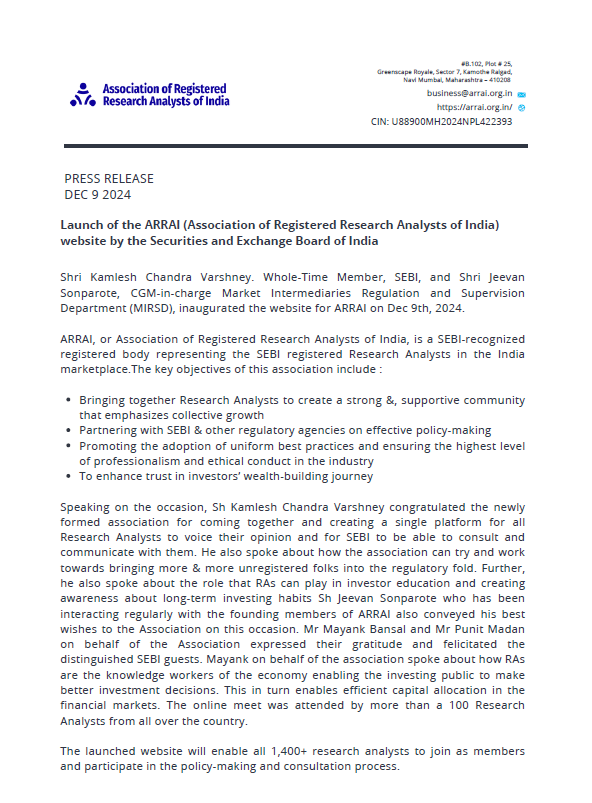
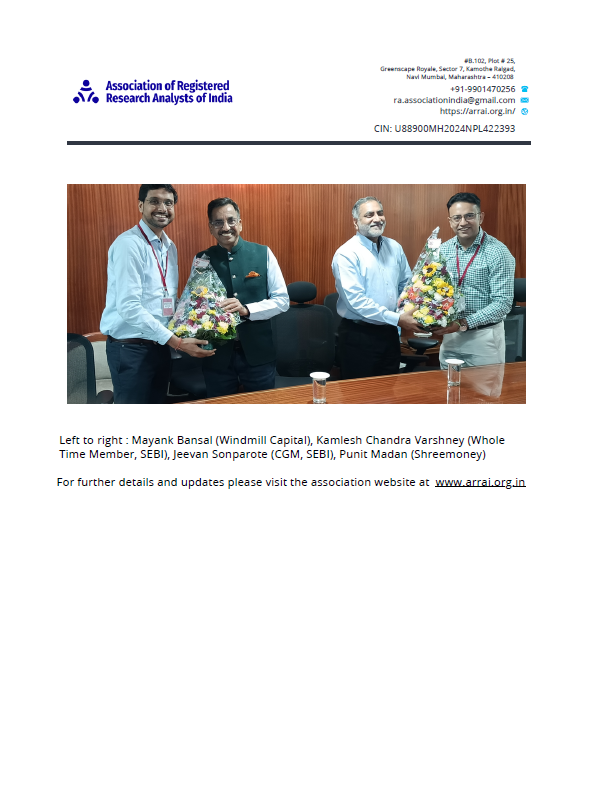
ARRAI working group met with the SEBI Chairperson Sh. Tuhin Kanta Pandey and his team of senior officials on Wednesday.
ARRAI is thankful to the regulator for this opportunity to place the views of our RA community
ARRAI is thankful to @SEBI_India Chief Mr Pandey to consider and agreeing with the ARRAI representation for advance fee collection limits.
We continue to believe that SEBI will remain open to jointly work on issues of the Research Analysts community
https://t.co/IXxUJP70ZE
We have launched a powerful & detailed Mutual Fund portfolio analysis tool on @TickertapeIN. Sharing some of the key features:
1. Diversification Score: 🌐
Learn and understand how diversified your MF portfolio is. You can also discover and see top mutual funds held by the other tickertape users
Heartbreaking news from EY Pune - a young CA succumbed to the work pressure and nobody from EY even attended her funeral - this is so appalling and nasty!!!
500 Cr AUM, 1L Investors, 3 Months
A heartfelt thanks to all the investors for the trust you have placed in us. Your support towards our goal of making investment products accessible to every Indian fuels our determination!
#EraOfPassive
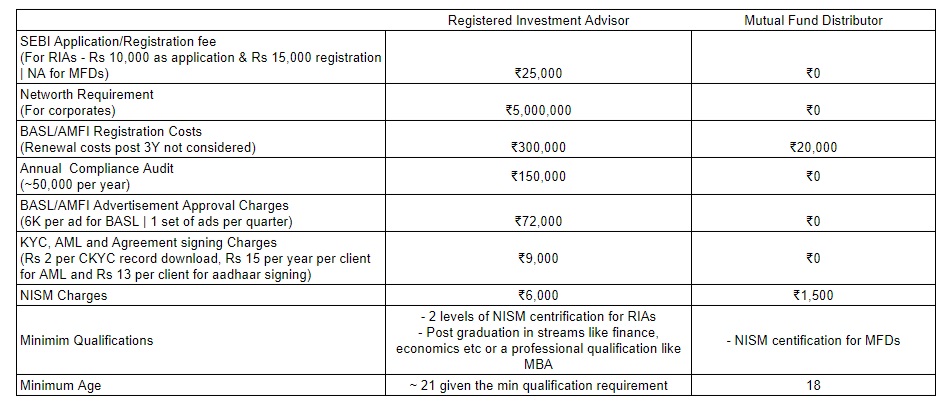
India has close to 1,22,000 mutual funds distributors (MFDs) but only ~1400 registered investment advisors (active RIAs might be close to just 800). While part of this can be attributed to vintage/legacy, there is also an economic reason behind these extremes.
First let’s understand few basic points before we make any comparison
- Both RIAs and MFDs can provide advice on Mutual Funds. This comparison is only valid if services by RIA/MFD are provided on mutual funds. In addition to Mutual Funds, RIAs can provide advice on other securities as well.
- Regulations require RIAs to register under a non-individual corporate category, if they have more than 150 clients. For all the calculations below, charges for a corporate IA registration and 150 clients are considered
- Some registrations are required to be renewed in 3 years. Thus, a 3 years timeframe is considered for the comparison
As clearly shown in the attached table, the minimum capital required by a corporate RIA to run the business in a compliant manner for a 3Y period is upwards of Rs 57,00,000 vs just Rs 20,000-25,000 for MFDs. A bulk of the capital required by RIAs is to meet the networth criteria, but even if we ignore the minimum networth requirement the difference between the capital required to run the two businesses is ~ 30 times.
Additionally, qualification, experience and other compliance requirements are way more cumbersome for RIAs vs MFDs. If we go into the details of the compliance requirements of RIAs vs MFDs, it would require one more thread 🙂 I wanted to compare only the cost aspect of setting up the businesses. Also, I have not included the additional manpower cost that an RIA might require to comply with all the requirements vs a MFD.
India deserves more RIAs to build a transparent and strong investing culture. In my view, the regulatory burden on the RIAs needs to be drastically reduced to attract more experts and professionals in the regulatory ambit vs pushing them out. At smallcase we have been working with a significant portion of the active RIA community over the last 5 years and have been helping them reduce some of their operational burden through technology but a lot more can and needs to be done.
PS: I believe that MFDs play an important and critical role in the ecosystem. The comparison is just to explain how different the regulatory requirements are for an RIA who is providing advisory services on MFs vs MFDs.
Last January, I noticed something peculiar in my 2yo’s bedroom that - after a year of obsessive reporting - led me to a profound cosmic revelation about what’s even possible in our universe. A 🧵.
The era of passive begins!
We at Zerodha Fund House are on a journey to create simple & transparent mutuals funds for everyone. Taking our first step, we recently launched our first set of funds: 2 index funds that track the Nifty LargeMidcap 250 Index
If RA/RIAs leaving the platform is a non issue, I don't understand why your story bases all the conjecture on this. Anyway, with the numbers I shared publicly that point is addressed.
Beyond that also, your article is full of misunderstandings, misrepresentations and wrong facts. Let me address them all one by one
- In the last step of how smallcase works, you have mentioned that investors can automatically mirror the portfolios. This is wrong, nothing on the smallcase platform happens automatically. Investors have to login with their broker credentials and place the orders manually and they are allowed to customize/change the orders as per their liking. At smallcase we believe in clear segregation of advice/research and execution.
- On managers who left smallcase, you have mentioned Abakkus. They have not left the platform and continue to serve the existing clients (you have not mentioned this fact)
- You have quoted another RIA (Sampada). He was offboarded from the platform for not following regular compliances and not providing necessary declarations. Also, he had no clients on smallcase platform. This has also been conveniently left out.
- In your infographic, you have mentioned that SEBI said that selling model portfolios is not part of the responsibility of research analyst. Would request you to point to the specific regulation which says this. Please don't quote settlement orders, as they are always contextual. Also, SEBI has already issued an informal guidance which says portfolio recos are covered under RA regulations. I'm happy to direct you to the exact clause of the regulations [clause 2(1)(w) of RA regulations] which can clarify your doubt to establish the fact that any recommendation (single/portfolio) that can form basis of investment is considered as research and covered under RA regulations. Today there is no confusion among RAs on these rules, please don't create any.
- Your point with respect to how RIAs operate on smallcase platform is also wrong. Every RIA does a suitability assessment/risk profiling test for the investor, basis investors objectives, experience etc to determine whether the portfolio is suitable for him/her, sign an advisory agreement and then onboard the client. This point is also missing in your article.
- Coming to your point of SEBI saying past performance can not be shown on the website. Again, please direct me to the SEBI regulation which considers everything shown on website as advertisement. Websites of RA/RIA are not advertisement. If we extend the logic to outside RA/RIA world, every article published on mint will be considered as advertisement :)
Would request you to go through this tweet thread to understand the matter of showcasing performance on RA/RIA websites better - https://t.co/S7ZJWUl7Vv
- On your point with respect to why performance of model portfolios and actual returns can differ, its highlighted as an issue. Please understand that these are advisory/research products where investors are in the driving seat, unlike PMS/AIF/MFs. Such products ensure that investors have full control on whether they want to follow the recommendations or not.
Also, saying that smallcase didn't provide you the data doesn't give you any right to push wrong information through convenient arguments which suit your story. With the clarifications provided, will wait for you to make the necessary changes to the article
Also, DM is open if you want to understand anything better.
Why do i get a feeling most articles are written these days with an intent to grab eye balls more than delivering factual information
With few months of experience business journos write stories on securities laws that have been well established as well as undermining decades of experience of practicing professionals who practice under strict regulations and compliance.
Not done i say.
Have to dis-agree with the Mint piece on Smallcase. First the big picture as discussed in the piece co-authored by me in the Financial Express https://t.co/fAovj69q7X
#Zerodha Mutual Fund has launched its inaugural new fund offers (#NFOs) — the Zerodha #ELSS Tax Saver Nifty LargeMidcap 250 Index Fund and the Zerodha Nifty LargeMidcap 250 Index Fund.
@anshul91_m with details. | @zerodha
https://t.co/i3B3oCVvHe