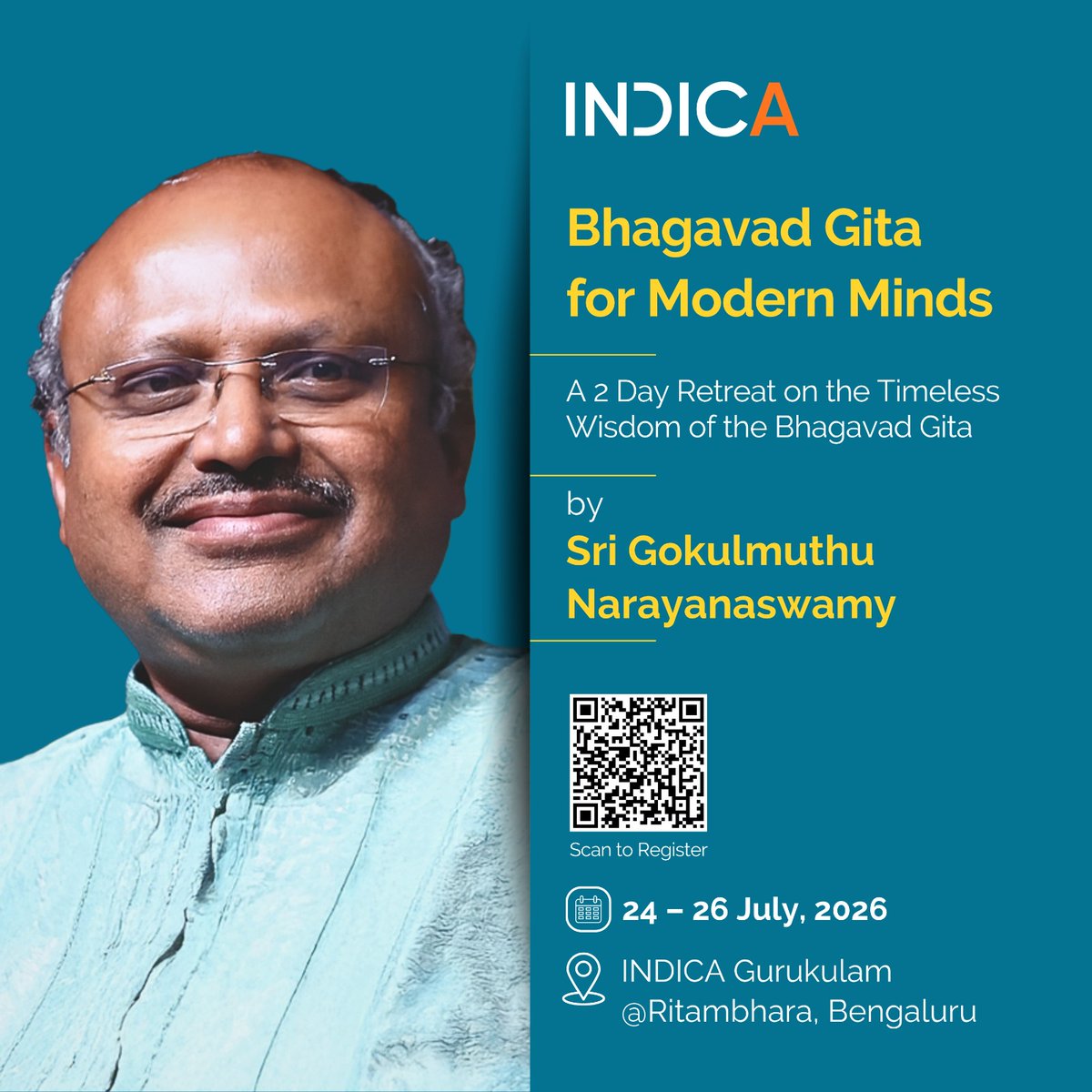
Bhagavad Gita for Modern Minds
A 2 Day Retreat on the Timeless Wisdom of the Bhagavad Gita
By Sri Gokulmuthu Narayanaswamy
Date: 24–26 July 2026
Venue: INDICA Gurukulam @Ritambhara, Bengaluru
The Ramakrishna Order sees the Bhagavad Gita not as philosophy alone, but as a way of living. Sri Ramakrishna’s call - “First God, then the world”—and Swami Vivekananda’s “Arise, awake, and stop not till the goal is reached” embody the Gita in action: rooted inwardly, engaged outwardly.
Join Sri Gokulmuthu Narayanaswamy - devotee of Sri Ramakrishna, founder of the Vivekananda Study Circle at IIT Madras, mentor to student communities at IISc and Ramakrishna Math, and a long-time teacher of Vedanta, Bhagavad Gita, and Vivekananda’s thought.
Drawing from his experience teaching the Gita across more than fifteen student batches and from his book Essence of the Bhagavad Gita for Modern Minds, this retreat offers a reflective and practical immersion into the Gita for contemporary life.
Register now: https://t.co/5KHbrSJPa1
@YogaIndica @advaitaacademy
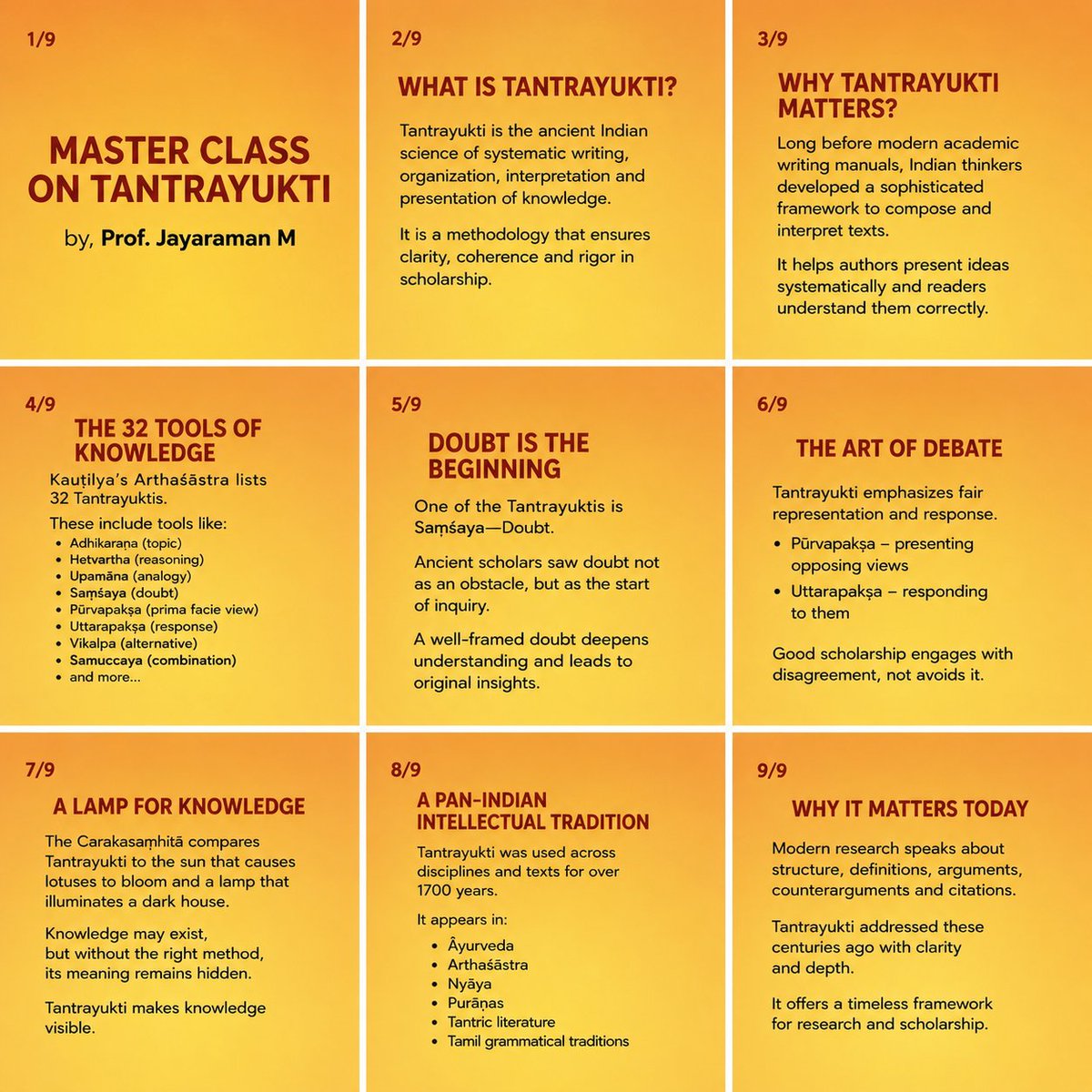
The Master Class on Tantrayukti will be held in New Delhi between June 13 and 14 by Professor Jayaraman M, by INDICA in collaboration with @CentralSanskrit University.
Tantrayukti is, at its core, a strikingly elegant way of thinking about how knowledge comes into form. What makes it intellectually beautiful is not only its technical sophistication, but the way it refuses to separate clarity from creativity, or structure from insight. It treats writing not as the passive recording of ideas, but as a disciplined craft in which thought is continuously shaped, refined, and made intelligible through carefully designed intellectual “devices.”
Prof Jayaraman has written a book on Tantrayukti published by INDICA. In a article on the same published in Samvadasamgrahah brought out by the IKS division of the Ministry of Education, he writes at the heart of it lies a simple but profound intuition: ideas do not arrive fully formed. They need architecture.
The pairing of Tantra and Yukti already carries this sensibility. Tantra is expansion - the unfolding of a field of knowledge in its fullness. Yukti is the intelligent act of holding that expansion together without letting it collapse into confusion. One gives breadth, the other gives coherence. Together, they create a balance between openness and rigor that feels remarkably modern in its sensibility.
What is intellectually remarkable is how systematically this was developed across traditions for over a millennium and a half. Whether in the philosophical debates of Sanskrit texts, the precision of Ayurvedic treatises, the grammatical discipline of Tamil literature, or the analytical structures of Buddhist scholastic writing, Tantrayukti functions as a shared cognitive grammar. It is less a “theory” in the abstract sense and more a lived intellectual practice - something that shapes how thought is generated, organised, and communicated.
The Carakasaṃhitā captures this beautifully through metaphor when it compares Tantrayukti to a lamp in a dark room or sunlight opening a field of flowers. The image is not ornamental. It is epistemological. These devices do not add meaning from outside; they allow what is already present but unarticulated to become visible.
What is particularly sophisticated is the way Tantrayukti does not privilege one mode of reasoning. It includes doubt (saṃśaya) as a generative tool, not a flaw; it builds space for objection and response (pūrvapakṣa and uttarapakṣa) as part of the structure of thought itself; it allows for omission, implication, analogy, and invention as legitimate linguistic strategies. Knowledge here is not linear exposition but layered articulation.
Even uncertainty is methodised. Doubt is not the opposite of knowledge—it is its starting point.
Seen this way, Kauṭilya’s enumeration of 32 yuktis is less a rigid taxonomy and more a map of intellectual dexterity. Content generation, structural design, and linguistic refinement are not separate stages of writing; they are interwoven movements within thinking itself. A text is not assembled after thought; it is thought taking shape through structured articulation.
What makes the system quietly extraordinary is its psychological depth. It recognises that clarity is not natural - it is constructed. It requires restraint, selection, sequencing, and a sensitivity to how meaning unfolds in time. It also recognises that excessive rigidity can suffocate insight, and so builds in flexibility through exceptions, alternatives, and interpretive openings.
In that sense, Tantrayukti is not just a methodology of writing. It is a philosophy of cognition.
There is something deeply contemporary in this. In an age overwhelmed by fragmented information, rapid interpretation, and unstructured assertion, Tantrayukti offers a reminder that intelligence is not merely about having ideas, but about knowing how to hold them together without distortion. It is about giving thought a form that allows it to be shared without losing its depth.
Ultimately, its beauty lies in its restraint. It does not try to dominate thought with a single system. Instead, it offers a set of subtle instruments that help thought become itself—clearer, more articulate, and more alive in its expression.
Wishing all the participants a very fruitful session of enquiry and growth.
Can Advaita Vedanta help reshape global thought?
In this thought-provoking lecture, Professor Sthaneshwar Timalsina ji argues that Advaita Vedanta should not remain confined to monasteries, Sanskrit texts, or private spiritual practice. Instead, he proposes that the rigorous philosophical framework developed by Adi Shankaracharya has the potential to contribute meaningfully to contemporary discussions in philosophy, psychology, cognitive science, consciousness studies, and even social theory.
Drawing from decades of study in traditional gurukulas, monasteries, and academia, he highlights how Shankara's thought developed sophisticated systems of epistemology and ontology that can engage modern debates about consciousness, selfhood, imagination, creativity, virtual reality, and the nature of truth.
A central theme of the talk is the need to move beyond intellectual colonization by actively participating in global philosophical conversations rather than merely preserving inherited knowledge. He argues that Indian philosophical traditions offer powerful alternatives to dominant modern frameworks built on excessive individualism, materialism, and dualistic thinking.
Watch the full video here: https://t.co/U58wJ5nMlz and do subscribe to our Youtube channel.
Why Going Far is the Only Way Home
What if the greatest obstacle to a meaningful life is the belief that we are running out of time?
Filmmaker and seeker Akanksha Damini Joshi, author of the newly published Aalolika, and Co-Founder of the Center for Embodied Knowledge, offers a powerful alternative to the modern obsession with urgency. Drawing from a story in the Vishnu Purana, she reflects on how Lord Vishnu journeys across the world with Garuda, only to return and realize that sometimes one must travel very far to come truly near. The seeker’s path, too, often circles through the world before arriving at the self.
Central to her reflections is what she calls the “Yoga Plan” - the Dharmic understanding that life unfolds across vast stretches of time, not within the confines of a single lifetime. This perspective replaces anxiety with steadiness, encouraging wholehearted effort without attachment to immediate results. Yet this freedom requires Viveka, or discernment, lest patience slip into complacency.
Joshi’s insights emerge not only from scripture but from lived experience. She recalls entering meditative states while dancing in a crowded Delhi discotheque, discovering that meditation is not merely a technique but an inward flowering that can arise anywhere. She also argues that ecological healing begins within. Forests are destroyed outside only after the forests within have been neglected; rivers are dammed outside only after the inner river of bliss has run dry.
Equally profound is her reflection on death. Raised in an army family, she learned early that awareness of mortality does not diminish life - it intensifies it. In the Dharmic tradition, Yama, the Lord of Death, is also a teacher who reveals what truly matters.
For Joshi, India’s wisdom traditions remain alive, not merely in texts or institutions, but in ordinary people whose lives embody timeless insights. The ultimate invitation is to see life as Leela - a divine play - where even struggle becomes part of a larger unfolding story.
Sometimes, the longest journey is simply the journey back to ourselves.
Follow INDICA for more such Quests. Full interview: https://t.co/88KHBqFzq0
@nkgrock@daminijosh
INDICA's Master Class on Tantrayukti commenced with the chanting of the Śrī Veda Vyāsa Stutiḥ by Prof M Jayaraman, the Acharya of the sessions.
Who is Vyāsa?
For Prof. Vishwa Adluri, the answer cannot be found within the familiar categories of modern scholarship. The attempt to identify Vyāsa as merely the historical author of the Mahābhārata already presupposes a framework foreign to the text itself. The Indian tradition does not present Vyāsa simply as an individual writer but as a civilizational intellect, the figure through whom the Vedic vision is gathered, organized, transmitted, and made available to human understanding.
As Adluri notes, "Vyāsa is not just an author but the very breath of Brahman - the ongoing revelation of Dharma." This is a theological claim. Vyāsa belongs to what Adluri describes as Brahmavāda, a textual and intellectual tradition whose authority does not depend upon historical verification but upon its capacity to reveal metaphysical truth. Within this framework, revelation is an ongoing process through which Dharma continues to be disclosed.
Seen in this light, the Mahābhārata is an inquiry into the Veda, a sustained reflection on the meaning of revelation itself. The war, the moral dilemmas, the debates, and the teachings are not merely narrative devices but instruments through which Vedic knowledge is examined, interpreted, and brought into the sphere of human experience.
For Adluri, Vyāsa stands at the centre of this entire enterprise. Vyāsa is the principle that links revelation, textuality, interpretation, and lineage. The tradition of Vyāsa extends beyond the ancient world and continues through teachers who preserve and transmit this vision in every generation. The Mahābhārata therefore remains a living text because Vyāsa remains a living presence within the tradition.
If we approach the Mahābhārata solely as history or mythology, we may fail to see what it understands itself to be: a Mimāṁsā of the Veda and a vehicle of Brahmavāda. In our fixation on the "when" and the "where," we risk overlooking the deeper questions of the "what" and the "why"—the very questions the tradition, through Vyāsa seeks to illuminate.
https://t.co/VVAINS74A4
4th Swami Dayananda Saraswati Memorial Lecture
There are some people who speak about Sri Shankara Bhagvadpada as historians do. And then there are those rare few for whom Acharya is not history at all - but a living presence, a chaitanya still moving through Bharat, shaping its memory, geography, and destiny.
Listening to Manish Pandeyji of Ekatma Dham at INDICA’s 7th Global Oneness Festival Valedictory Session was to encounter that second kind of bhakti.
When he speaks of Shankara, it is with the intimacy of someone who believes Acharya is still quietly orchestrating events from behind the visible world. The 108 ft Statue of Oneness was not ultimately the work of architects, engineers, sculptors, or committees. It was Shankara’s own sankalpa taking rūpam.
The artists themselves, he says, felt this. Shankaracharya himself had become the kalpaka, the yojaka, the niyojaka — the conceiver, organiser, and unseen guide of the entire process. There was no separate mādhyam because Acharya himself was the mādhyam. The vichāra and the mātrā were him alone.
And perhaps that is why Manishji never speaks of the pratima as an object. He speaks of it almost as a darshana.
The murti does not show Shankara seated in meditative stillness. It shows him in prayāṇa mudrā — carrying the ādeśa of his guru from Omkareshwar to Kashi and beyond. This is sannyāsa in motion.
What empires could not permanently unify through power, Acharya unified through tīrtha, yātra, paramparā, and sacred memory. The Char Dham, the four Amnāya Peethas, the very imagination of Bharat as one sacred geography.
He invokes Nani Palkhivala, whose reverence for Shankara carried unusual significance because it emerged from a mind known for intellectual rigour and neutrality. Palkhivala called Shankaracharya the supreme “Universal Man”.
Manishji repeats this insight almost with vismaya. How could one human life contain so much? For Manishji, Ekatma Dham is an offering born from this wonder.
That is why he resists calling it a museum. What they are building instead is a living anubhava kshetra where the Rishi Paramparā can once again be felt.
The Narmada is not scenery; she is part of Acharya’s inner yātra. Shankara came from Kalady seeking Narmada. The Annapurna complex is not merely a food court; it is a celebration of Bharat’s anna samskriti.
Even the technological ambition — the immersive storytelling spaces, the IMAX theatre, the film on Acharya — emerges from the same desire: to make him experientially alive for future generations.
And it is perhaps in the three great sankalpas taken at the Prayag Kumbh Mela that one sees most the depth of people's devotion.
The first sankalpa was to celebrate Acharya Jayanti as the International Day of Oneness.The second was the resolve for a Decade of Oneness. And the third was perhaps the most moving: a Digvijaya Yātra retracing Acharya’s sacred journey across Bharat, beginning from Kalady on January 16 and culminating at Kedarnath on his Jayanti.
What a fitting finale
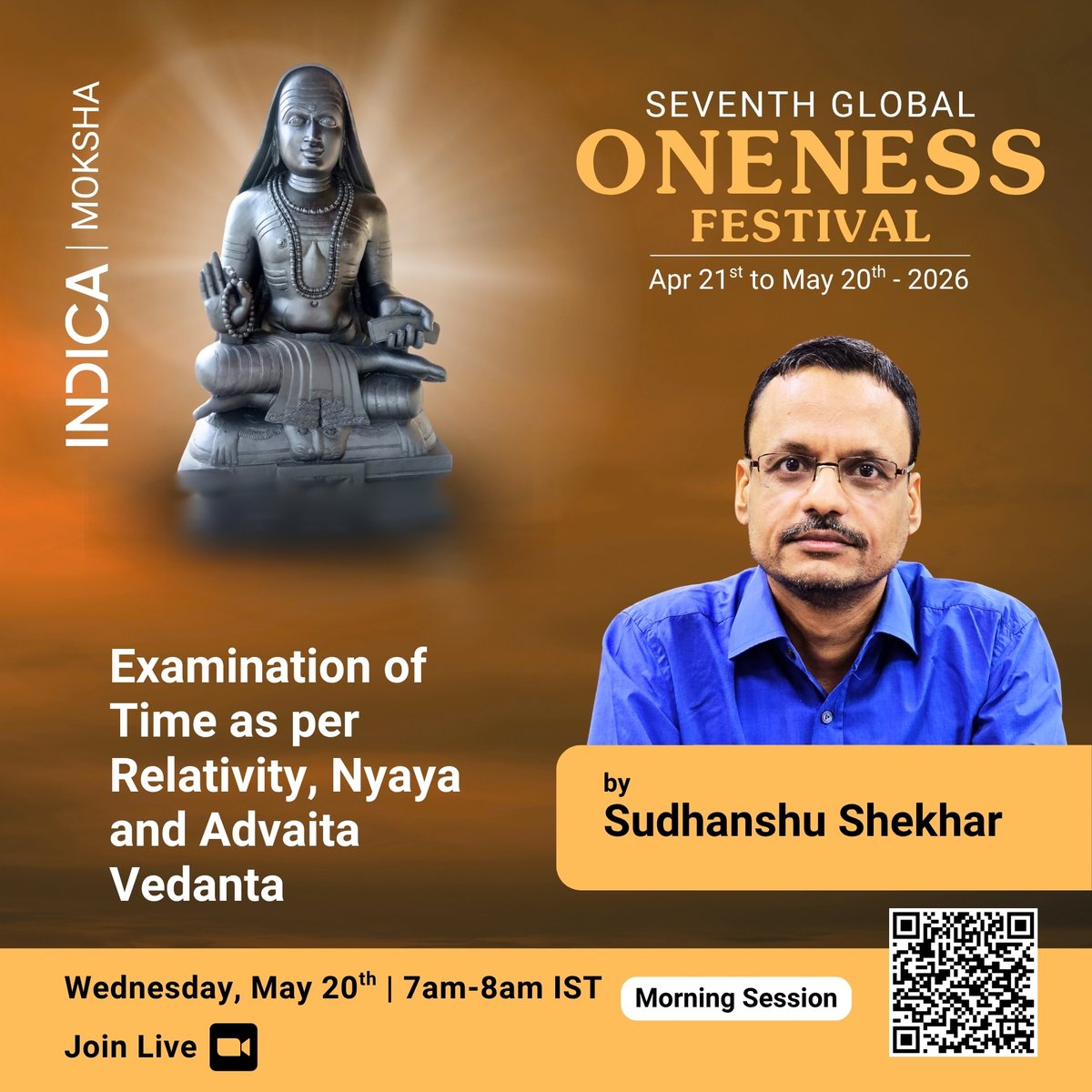
INDICA's 7th Global Oneness Festival, organised by INDICA Mosha, May 20, 7 AM to 8 PM IST. Examination of Time as per Relativity, Nyaya and Advaita Vedanta by Sudhanshu Shekhar
To register click here: https://t.co/TmthfEkgRd
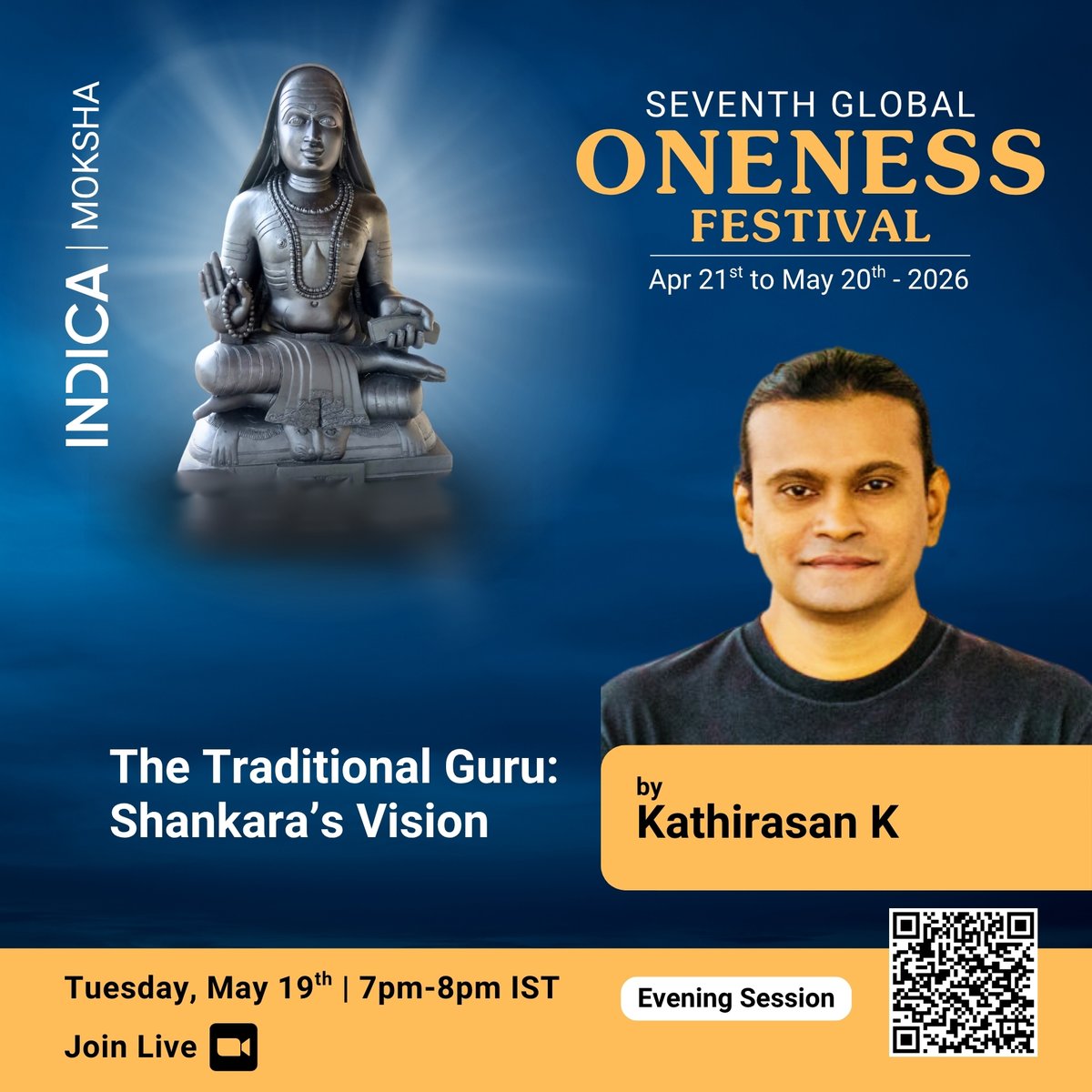
INDICA's 7th Global Oneness Festival, organised by INDICA Mosha, May 19th, 7 pm to 8 pm IST. The Traditional Guru: Shankara’s Vision by Shri Kathirasan K
To register click here: https://t.co/TmthfEkgRd
INDICA 7th Global Oneness Festival, organised by INDICA Moksha, May 19, 7 am to 8 am. Reflections on Dakshinamoorthy Stotram by Vid. Goda Anantha Somayaji
Register here: https://t.co/TmthfEkgRd
INDICA 7th Global Oneness Festival, organised by INDICA Moksha, May 18, 7 pm to 8 pm. Transcending Fear: A Vedantic Perspective by L Ramaswamy
Register here: https://t.co/TmthfEkgRd
INDICA 7th Global Oneness Festival, May 18, 7 am to 8 am IST, Shankaracharya’s enunciation on Sankhya Yoga in Bhagavad Gita by Dr. Chandrashekhar Tekal
Register here: https://t.co/TmthfEkgRd
INDICA 7th Global Oneness Festival, May 17, 7 pm to 8 pm IST, Vakhyartha Sadas on शांकरवाग्वैभवम् Sadas Adhyaksha: Vidwan Dr. Shrihari Shivaram Dhaygude, Assistant Professor, Dept. Of Advaita Vedanta, National Sanskrit University, Tirupati.
Participating Vidwans:
1. Dr. Srinivas Jammalamadaka (Moderator)
2. Dr. L. Sowjanya Kumar
3. Vid. Varadarajan Dravid
4. Vid. V Krishna Sharma
5. Vidwan Kuvalaya Datta
Do not miss this special session.
Register here: https://t.co/3dUzFtgI4s
INDICA's 7th Global Oneness Festival organised by INDICA Moksha, May 16th, 7 AM - 8 AM IST, Sunday Special Series: Vada & Vidya – Pivotal Dialogues of Adi Shankaracharya by Vid. Shankararama Sharma
Register Here: https://t.co/TmthfEkgRd
INDICA's 7th Global Oneness Festival organised by INDICA Moksha, May 16th, 7 PM - 8 PM IST, Poetic Imagery of the Gangashtaka Stotram and Its Sculptural Representations by Smt Rekha Rao
Register Here: https://t.co/TmthfEkgRd
INDICA's 7th GLOBAL ONENESS FESTIVAL
Valedictory Session: Acharya Shankar Sanskrit Ekta Nyas, Govt of MP, May 20 7pm - 8 pm IST
In many ways, the journey of the INDICA Global Oneness Festival finds a natural culmination in the vision embodied by Ekatma Dham - a space where Advaita is not merely preserved as philosophy, but reimagined as a living civilizational force.
The festival’s years of careful curation bringing together Acharyas, scholars, artists, scientists, seekers, and institutions across the world - point toward precisely such a future: one where India’s deepest spiritual insights once again become the basis for education, culture, research, ethics, ecology, aesthetics, and collective life.
What makes Ekatma Dham especially significant is that it attempts to move beyond the idea of a memorial or pilgrimage center. Instead, it envisions an integrated ecosystem rooted in the principle of Oneness - where contemplation and scholarship coexist with artistic expression, scientific inquiry, traditional learning, and community life.
In that sense, it resonates deeply with the spirit of the Global Oneness Festival itself, which has consistently sought to present Advaita not as an abstract metaphysical doctrine confined to monasteries or academic discourse, but as a transformative framework capable of addressing the fragmentation of the modern world.
The dialogue between ancient wisdom and contemporary disciplines - something the festival has nurtured through conversations on consciousness studies, neuroscience, cosmology, yoga, Sanskrit, ecology, governance, and aesthetics - finds architectural and institutional expression at Ekatma Dham.
For us, Ekatma Dham stands not simply as the endpoint of a festival journey, but as a powerful symbol of what thoughtful cultural curation can ultimately aspire toward - the revival of sacred spaces where knowledge is lived, transmitted, practiced, and embodied across generat
If Advaita Vedānta teaches non-duality, then what place does devotion have in it?
In this talk organised by @advaitaacademy as part of GOF26, I explore the profound relationship between knowledge and devotion as expounded by Sankara in his Gita Bhasya.
https://t.co/P7IHqftVtk
INDICA's 7th Global Oneness Festival organised by INDICA Moksha
Valedictory Session- May 20th, 7 am - 8 pm IST
Presentation by Acharya Shankar Sanskrit, Ekta Nyas, Govt of MP on Ekatma Dham A Global Center of Oneness
INDICA's 7th Global Oneness Festival organised by INDICA Moksha, May 16, 7 AM, Saturday Special Series: Gleanings from Vivekachudamani by Shri Aravinda Rao
Register Here: https://t.co/TmthfEkgRd
INDICA's 7th Global Oneness Festival, curated by INDICA Moksha May 14, 7 PM IST, Sant Dnyaneshwar’s Amrutanubhava in the light of Kevala Advaita by Manuj Kanti Mazumdar
Register here: https://t.co/TmthfEkgRd