CHILD TRAFFICKING SUSPECT ARRAIGNED AS DETECTIVES RESCUE 22 GIRLS IN MOMBASA
A 27-year-old suspect linked to an alleged child trafficking and sexual exploitation ring has been arraigned before the Shanzu Law Courts following an intelligence-led operation by detectives in Mombasa County.
The suspect, Almasi Rama Amos, was arrested by detectives from the Anti-Human Trafficking and Child Protection Unit (AHTCPU) alongside officers from the Regional Criminal Investigations Office (RCIO), Mombasa, after weeks of investigations into disturbing reports of child abuse targeting vulnerable young girls.
Detectives trailed the suspect to his hideout in Nguu Tatu Estate within Concordia area of Kisauni Sub-County, where they found him in the company of three female juveniles.
Preliminary investigations have uncovered a disturbing scheme in which the suspect allegedly operates so-called “rescue centres” across Mombasa and Kilifi counties under the pretence of nurturing and mentoring young girls.
Behind the facade, however, the centres were being used as grounds for sexual exploitation and abuse of minors.
Further, the suspect led officers to a facility in Ribe, Rabai Sub-County, where detectives rescued nineteen (19) more female juveniles, bringing the total number of rescued victims to twenty-two (22).
Appearing before the Shanzu Law Courts today, the suspect faced a litany of charges, including defilement, child trafficking for purposes of sexual exploitation, promotion of child trafficking, and child abuse, among other serious offences.
He pleaded not guilty to the charges and was denied bond. The case is scheduled for mention on June 8, 2026.
The Directorate of Criminal Investigations remains committed to protecting children from exploitation, abuse, and trafficking, and individuals involved in such heinous crimes will be relentlessly pursued and brought to justice.
#FichuaKwaDCI. Call 0800 722 203 (Toll-free) or WhatsApp at 0709 570 000 to report anonymously. Usiogope!
Another Death Inside A Police Station!
24 years old Brian Njung’e, a student at Kiambu National Polytechnic, was arrested yesterday Thursday 21st May morning in Kirigiti area of Kiambu town and booked at Kiambu Police Station.
Brian called his mother from the police station around 9am and they spoke, where Brian informed the mother of his arrest.
The family, including the mother, rushed to the police station to follow up. They got there just before noon and requested to see Brian but were asked to wait.
They were kept waiting until around 2pm when they were called in and informed that Brian had allegedly committed suicide in the cells.
Police claim Brian was alone in the cells as other cellmates had been taken to court. The family is crying foul and wants justice arguing that the police story doesn’t add up.
@yule_mzeiya@AnuarSaddat No one is going to rent with landlords In the near future... affordable housing is the way..I personally waiting for one to be complete in Nakuru and join.
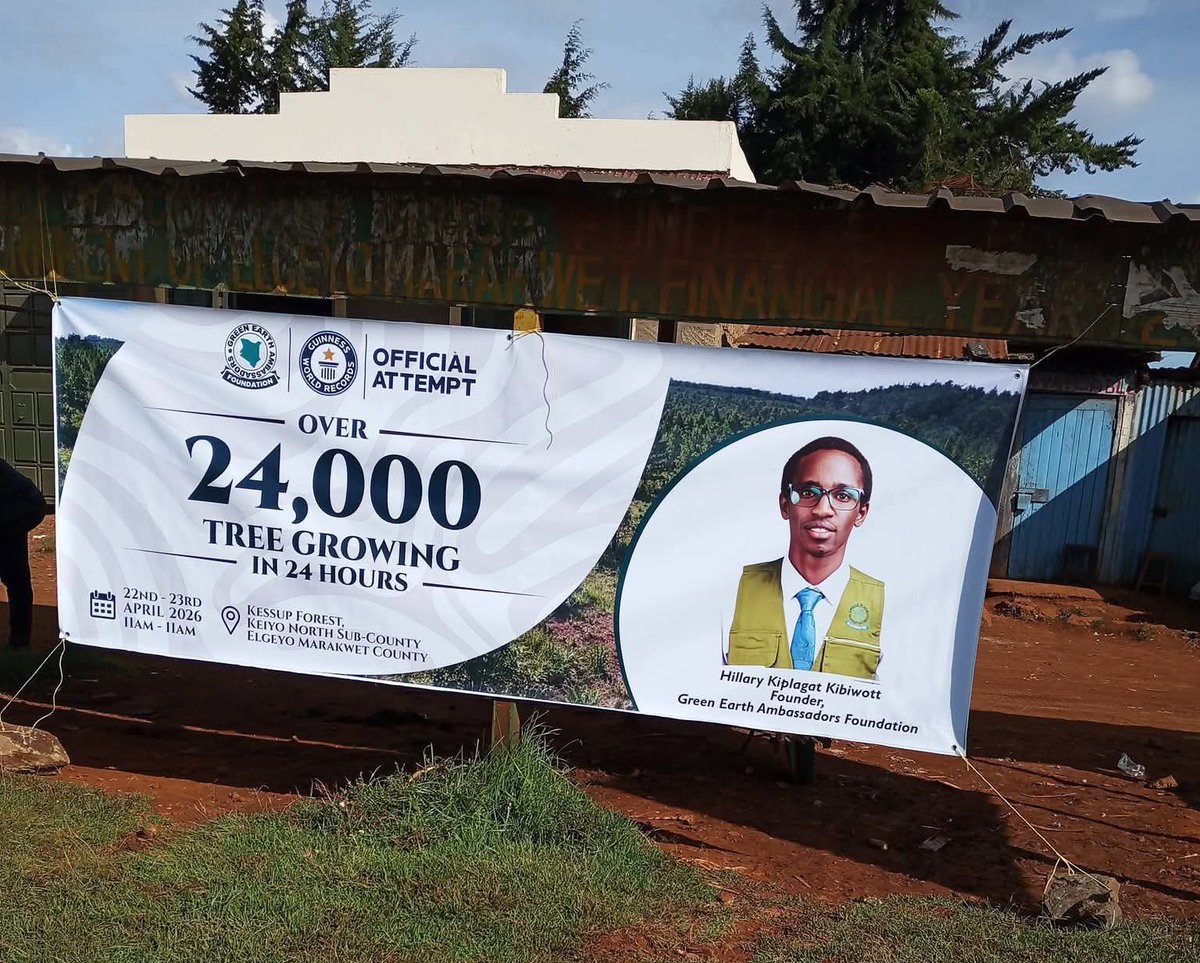
Hillary Kiplagat Kibiwott is attempting a Guinness World Record by planting 24,000 trees in 24 hours at Kessup Forest, Elgeyo Marakwet, this Wednesday.
Kenya’s rush into a 2,000MW nuclear plant in Siaya is a historic mistake in the making – economically, environmentally, and strategically.
First, context. Kenya already gets about 85–90% of its electricity from clean sources: geothermal, hydro, wind and increasingly solar. We are a global poster child for clean power without nuclear. Our main challenge isn’t a lack of clean options. We aren’t planning and using what we have well enough. So why gamble billions on the most complex, riskiest option on the menu?
A single 2,000MW nuclear plant is one of the largest, most expensive projects in our history. These plants are notorious for cost overruns and delays in far richer, more technically advanced countries. If it runs late (very likely) or goes over budget (almost guaranteed), someone has to pay. That “someone” is Kenyan taxpayers and electricity consumers. We risk locking ourselves into decades of high tariffs or more public debt to service a mega‑project we didn’t actually need.
Meanwhile, the opportunity cost is massive. For the same money, Kenya could add thousands of megawatts of geothermal, wind and solar across multiple counties, plus storage and transmission to stabilise the grid. Geothermal alone, in the Rift Valley, can provide 24/7 baseload power without importing fuel – and we’ve already shown we know how to do it. Wind in Turkana, solar in the north and east, small hydro, battery storage: these are proven, modular, quicker to build, and spread economic benefits more widely than one giant plant in Siaya.
Then there’s the risk profile. Nuclear accidents are rare, but when they go wrong, they go very wrong and last for generations. Putting a first‑ever nuclear plant on Lake Victoria, which supports millions of people across several countries, is a huge regional gamble. Even “minor” incidents or perceived risk can devastate fisheries, tourism, and local livelihoods. Radioactive waste is a 100‑year question in a political system that struggles to manage five‑year projects without scandal. Do we really trust our current institutions to run a flawless nuclear safety culture for the next century?
Governance is the elephant in the room. Nuclear is the kind of project that attracts opaque deals, expensive foreign contractors, complex technology transfer promises, and huge procurement contracts. In a country where big infrastructure routinely raises questions about corruption and value for money, adding nuclear’s complexity is like pouring petrol on a smouldering fire. Once we sign, we are locked in – to a vendor, to a technology, to a repayment schedule – regardless of how our economy or technology options evolve.
Strategically, it also makes little sense. The world is moving towards flexible, distributed, renewables‑heavy systems supported by storage and smart grids. Nuclear is the opposite: big, centralised, inflexible units that must run almost all the time to be economical. On a grid like Kenya’s, where demand is still growing and industrialisation is uneven, dropping 2,000MW of inflexible baseload can actually complicate balancing, especially when we add more variable wind and solar. We risk building a system that is technically elegant on paper but financially and operationally brittle in reality.
Kenya’s climate and geography give us an embarrassment of renewable riches: untapped geothermal reservoirs, some of the best wind regimes on the continent, abundant solar irradiation, and room for regional power trade. Instead of doubling down on what works and scaling it smartly, we are flirting with the most capital‑intensive, politically risky, institution‑demanding technology available. It’s like bypassing a field full of ripe maize to plant a single, exotic crop we’ve never grown before, which only matures if the weather is perfect for 20 years.
If our goal is cheap, reliable, climate‑friendly power that supports jobs and industry, the answer is to go deeper on what we’re already good at:
– Aggressively expand geothermal as firm baseload.
– Add more wind and solar, especially near demand centres.
– Invest in storage, transmission, and regional interconnectors.
– Fix governance, planning, and utility finances so that Kenyans actually feel the benefit on their bills.
Nuclear might have a place someday in a much larger, richer, more industrialised Kenya with rock‑solid institutions. But right now, when we are already at 85%+ clean power and sitting on huge untapped renewable potential, a 2,000MW nuclear plant is not visionary at all. It’s a high‑risk distraction. Our focus should be on making Kenya the first truly renewables‑powered industrial economy in Africa, not a test case for big nuclear on Lake Victoria.
In Murang’a, there is a program called the Murang’a Youth Service. Yesterday there was a recruitment exercise across the whole of Murang’a. This program takes 30 youths per ward, and so far they have taken more than 8,000 youths. The youths are selected through balloting, if you pick “yes,” you get a chance. No educational qualifications are required.
If you are selected, you work in cleaning the towns in Murang’a for two months and you are paid Ksh 400 per day. You receive Ksh 300, while Ksh 100 is sent to your parent.
After finishing the cleaning work, you are taken to a polytechnic to study a course of your choice such as plumbing, hair and beauty, etc., for three months, and the program pays for your NITA exam.
After completing the exams, there is a graduation, and you are given Ksh 15,000 to start a business. If you start your business in Murang’a, you do not pay a business license fee for one year.
Murang'a is making other Kenyans feel like they were born in Mogadishu. Now that is empowerment, silent, focused and impacful, not what we are currently seeing in other areas. Other leaders are milking the country dry while telling their mumu voters that all development is taken to Murima bcoz of entitlement.🤡
Naivasha man embarks on a tree-hugging challenge to raise awareness on discrimination of area residents in military and police recruitment over discoloured teeth
@0_sankara@Gideon_Kitheka@Asmali77 Why are y’all so fixated on Kenya? Why can’t y’all be satisfied with your own country? Why push yourselves onto people who clearly don’t want to associate with you? I mean you’ll never see a Kenyan man begging and salivating for your country.