Directed by Dr. Shelby Putt, the Biological Anthropology Lab @ Illinois State U investigates human biology & behavior from an evolutionary perspective.
Ape knapping behaviors fall outside the range of experienced human knappers, meaning there's no single universal way to make even simple stone tools. This suggests that the stone knapping actions of early hominins was likely affected by their anatomy, cognition, and motivations.
Learn how Redbird undergrads are gaining new skills, career trajectories in a research experience funded through the @IllinoisStateU Office of Student Research and by the Provost's Office. @ISUBioAnth https://t.co/qiGsM3vz2W
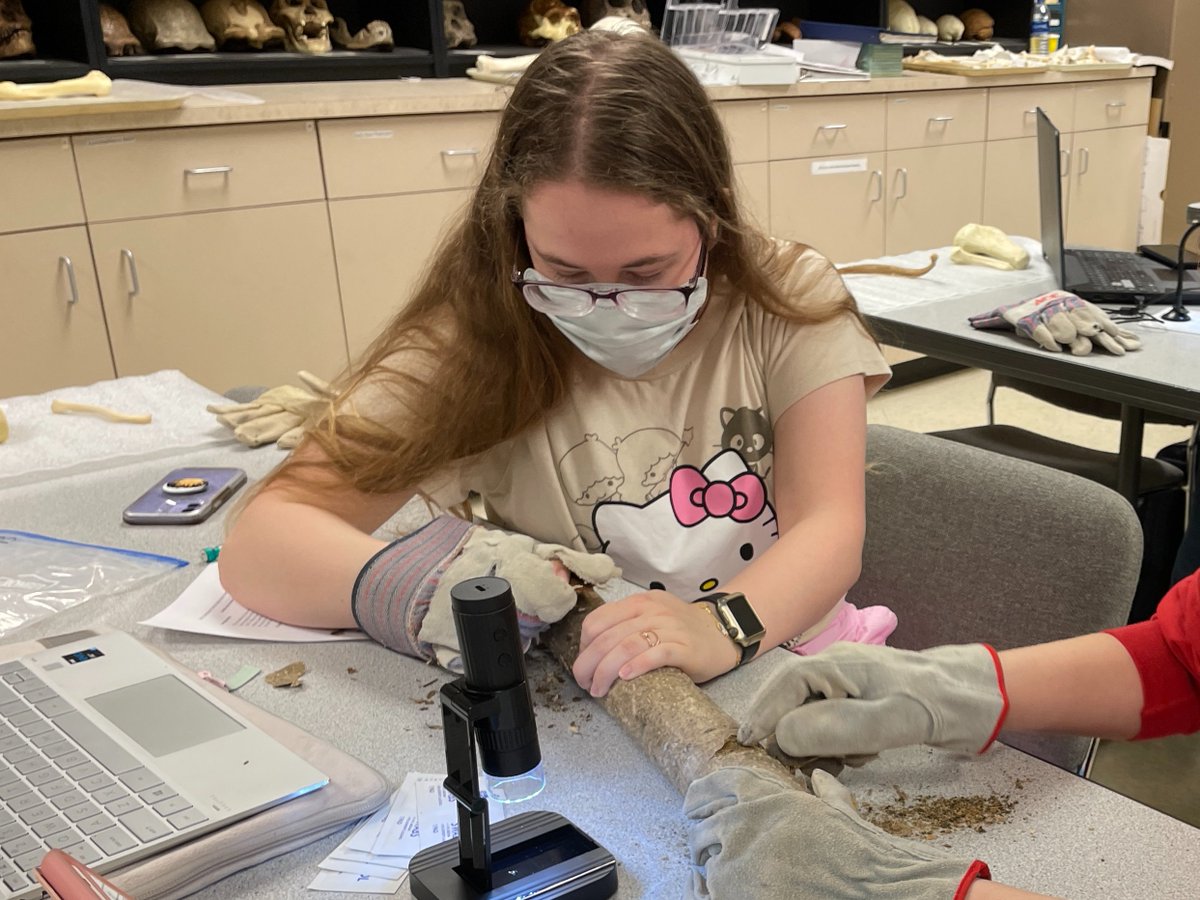
Meet our summer interns! Valerie Jackson is a junior Anthropology major fascinated by primate behavior. She is looking forward to learning how to construct an ethogram and navigate new coding software to investigate ape behaviors, which she hopes to develop into a senior thesis.
Meet our summer interns! Lucah Kloster is a junior Anthropology major who hopes to "gain experience with large project planning, further insight into the origins of early hominin stone technology, and make preparations to run an experiment on asocial flintknapping in the fall."
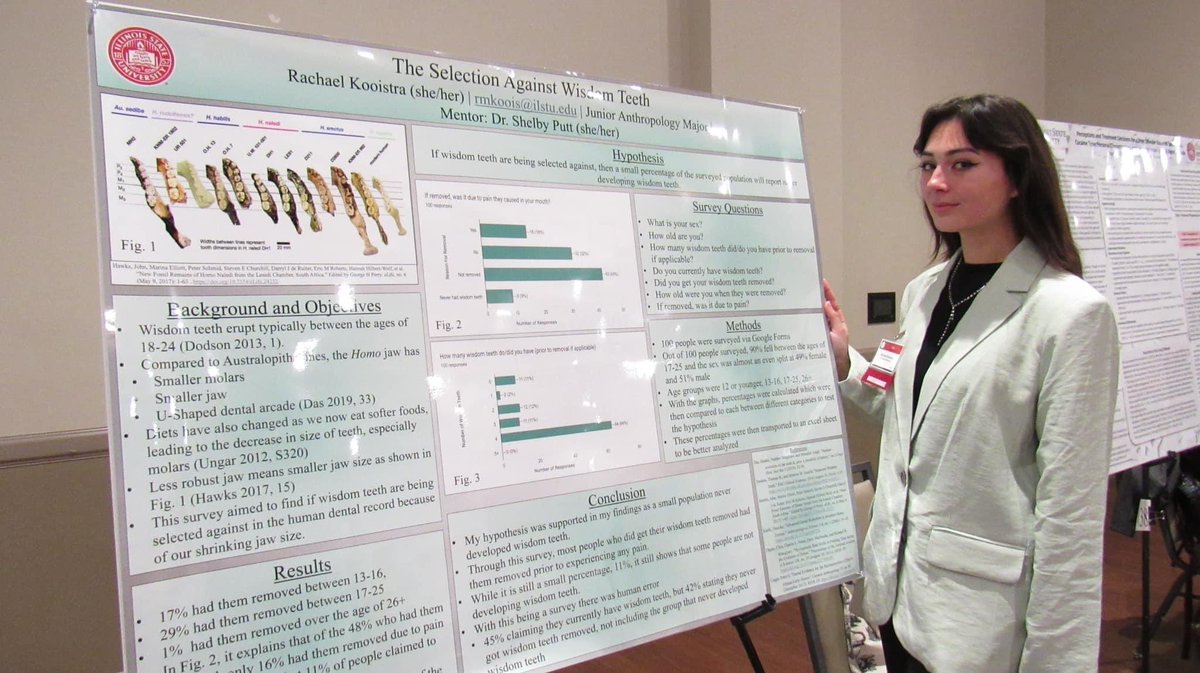
Rachael Kooistra represented the Anthropology Program at the ISU Research Symposium with her poster, “The Selection against Wisdom Teeth.” Rachael‘s research into wisdom teeth began in Dr. Putt’s ANT 265 class as an unessay project.
#RedbirdProud#RedbirdScholar
Dr. Putt’s approach to teaching biological anthropology and archaeology involves a student-centered classroom that emphasizes the power of play and project-based learning.
https://t.co/un6aWnxdmv via @IllinoisStateU
Katelyn critically analyzed the methods that forensic anthropologists use to identify a deceased person's ancestry from their bones. She was especially concerned about the application of traditional methods when identifying people of mixed ancestry.
Heidi compared the ear anatomy of Neandertals and modern humans. She created exaggerated wire art replicas of the semicircular canal and cochlea to show the differences between these two species. She concluded that Neandertals were more prone to ear infections.
Heather and Ashley were inspired by a study done by the Primate Research Institute at Kyoto University in which a captive chimpanzee was superior at a memory game compared to human players. So, they put their classmates to the test!
Kate wanted to know how eye color variation in #BloNo has changed since the 1930s and how it compares to global variation. So, she created eyeball pie charts. The eye on the left represents global frequencies, and the eye on the right represents eye color frequencies locally.
What do eyeball earrings, wire cochlea, and a memory game all have in common? They're all #unessay projects in Explorations in Biological Anthropology! Click on the pictures to learn more about this batch of students' semester projects.
#anthropology